How To Graciously Accept Our Annual Gift
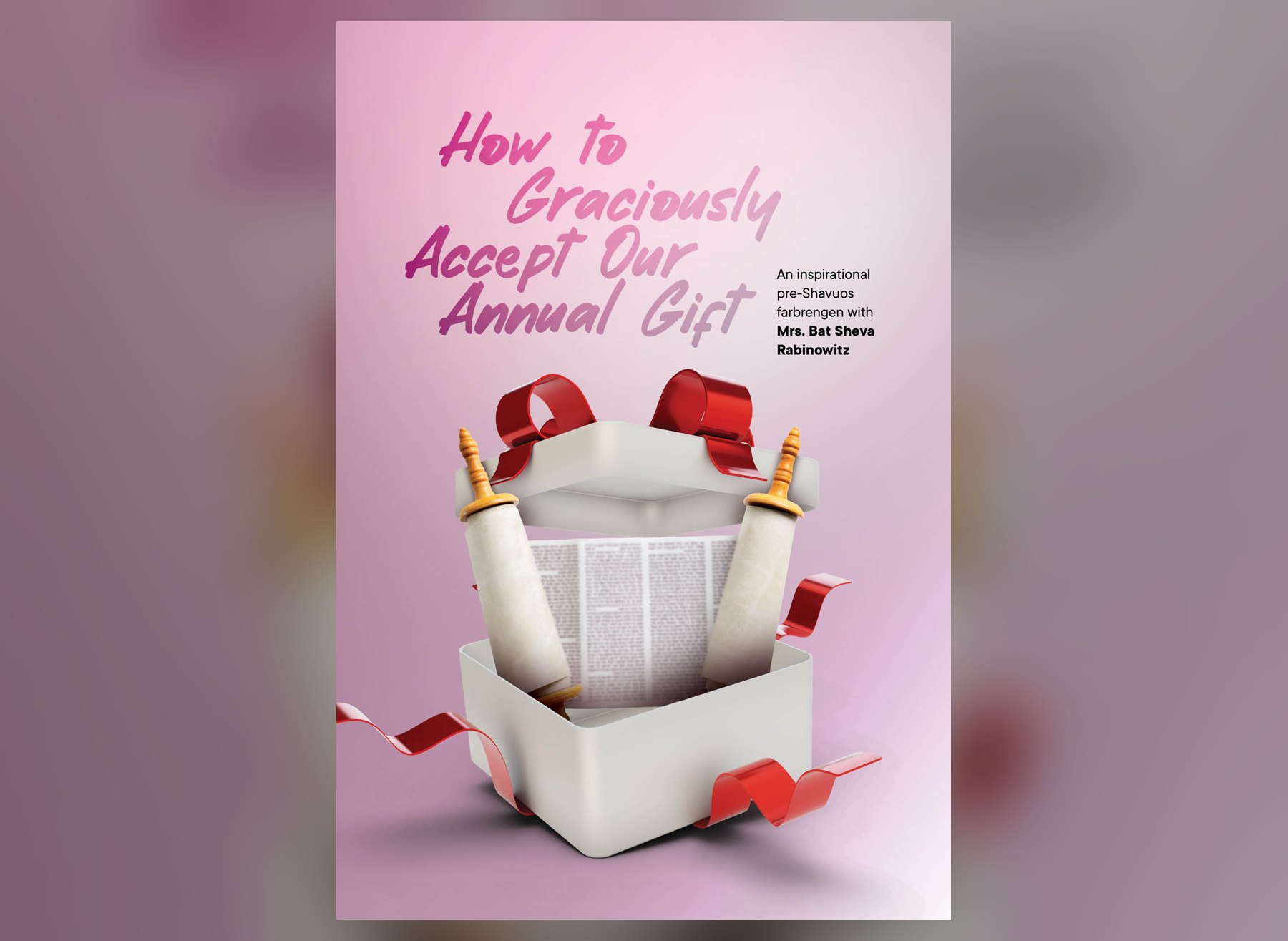
An inspirational pre-Shavuos farbrengen with Mrs. Bat Sheva Rabinowitz
But I’m busy with my pots, so how do we inspire ourselves and prepare?
A farbrengen which will show you that “the Torah is not in the heavens,” and how to receive it with joy and pnimiyus. It’s possible!
As a woman, a large part of preparing for Yom Tov involves physical things like cooking, organizing the house, making sure everyone has what to wear, etc. and there are the physical things that you deal with on the holiday itself. Although there is a spiritual atmosphere which a husband and sons provide, boruch Hashem, whether being up at night learning Torah, mivtzaim, etc. as Chabad women we shouldn’t suffice with that. It is very worthwhile to do some learning of halachos and sichos, as much as possible. It uplifts us and affects the rest of the household.
We can make a hachlata that from now on, for example, we are going to strengthen the shiurim of Chitas which the Rebbe spoke about in connection with Mattan Torah and the yahrtzeits of Dovid HaMelech and the Baal Shem Tov. Right after the morning brachos, my father says some pesukim from Chumash, some pesukim from Tehillim, and a few lines of Tanya (these are selected verses and not intended to replace the Chitas which is learned later). This is the “reishis arisoseichem.” In our daily activities, the gashmiyus pulls us down and we need to constantly pull toward the spiritual!
With everything we’re busy with, it’s worth being particular about Chitas, Sefer HaMitzvos and shiurei Torah. I once heard from R’ Amram Muell, “The Torah doesn’t take time; it provides a blessing in time!” And not just in that, but in everything. One of the reasons that the Torah was given in a desert is because just as in the desert, the Jewish people had no material concerns: they had the mon, water, and clothes, thanks to Moshe, Miriam and Aharon, so too with Torah. Hashem wants to teach us that when a person devotes himself to Torah, Hashem will take care of all his physical needs.
You can see that “whoever accepts the yoke of Torah, has the yoke of the government and of derech eretz removed from him.” Additionally, the Rebbe says to beautify mitzvos as a preparation for the Geula and this involves combining the material and the spiritual and not getting bogged down in the material, whether it’s tznius, kashrus, any mitzva we do. We see women who are imbued with holiness. Their worldly ambitions are small because they are focused on the primary goal.
Keep Forging Those Connections!
We have the ability to combine the material and the spiritual from the one who gave us the Torah, Moshe Rabeinu, and in our generation, the Rebbe, who himself combined the material and the spiritual in the most perfect way; he was a man of G-d.
At the start of the Alter Rebbe’s leadership, he had a group of devoted Chassidim. One of them was Shlomo the lekach macher, a baker. He said that on one of the sheloshes yimei ha’hagbala the Alter Rebbe spoke about emuna in a tzaddik and emotionally said, “Before Mattan Torah, Hashem said to Moshe, ‘And in you too, they will believe forever.’ All Israel agreed with the fact that they had a leader but they had to know that this was Moshe Rabeinu. Now too, we need to know it’s the Mezritcher Maggid.” And in our generation, we need to strengthen hiskashrus to the Rebbe.
Growing up, I absorbed a great hiskashrus to the Rebbe, thanks to my parents. My father, Rabbi Hertzl, would fly to the Rebbe every year for Shavuos. Besides the fact that it’s the best Yom Tov to go since there aren’t many halachic questions, he went with the feeling of receiving the Torah from the Moshe Rabeinu of the generation.
With my mother z’l, I saw the combining of elyonim and tachtonim. Whenever she cooked in the kitchen, I heard her playing a tape of the Rebbe’s sichos, and she did all his horaos with simcha and bitachon. This genuine, inner hiskashrus accompanies me and my children and provides strength both at home and on shlichus.
We need to let people know who the Nasi HaDor is, that he is a one and only and incomparable to any other tzaddik. As the Rebbe says in a maamar that the distance in standing between Rashbi and the other Tannaim was like the difference between a created being and the Creator! When connecting with the Rebbe, one can receive the Torah with joy and pnimiyus just like you receive a gift, with open arms, desire and joy.
With Simcha and Pnimiyus!
Learning the teachings of the Rebbe connects us with the Torah in a way of understanding and comprehension that gets inside of us and turns Mattan Torah into something exciting and current that pertains to our lives today as opposed to yet another station on the timeline of history.
Chassidim asked the Mittler Rebbe what they should ask of Hashem the night of Shavuos and the answer was, “I would want the ‘column of fire’ of Torah.” The Torah was given with thunder and lightening and today too, it needs to be received with a commotion, with chayus! It’s not just like that, that we say the “shehechiyanu” blessing when we light the Yom Tov candles. As we do so, the giving and receiving of the Torah is renewed. Thinking about how we preceded the men in receiving the Torah engenders joy together with responsibility and a sense of mission. In order to receive the Torah in such a way, we need to work, to exert ourselves, even though we are not so used to that these days.
The Rebbe Rashab once said a maamar which took from erev Shauvos deep into the night. When he finished, one of the Chassidim said, “This time, we have ‘temimos’ in the fullest sense.” He meant that usually, we delay davening Maariv on the night of Shavuos and are particular about it happening after the stars come out so that there are seven complete weeks. This time, the davening was especially late.
The Rebbe said, “Temimos which comes as a matter of course and not through avoda is not temimos. When we toil over something, it becomes engraved inside us in a deep way and becomes part of us.”
Teach the Little Kinderlach!
We should instill this awareness in our children; they are guarantors for us and, if not for us, who will educate them and care for them. Let us include them in preparing the food for Yom Tov and tell them about Mattan Torah as we do. Let’s sing songs from preschool with them… True, the rebbis will tell them, as well as the moros and preschool teachers, but there is no substitute for a mother’s story, especially while working together. Tell them a story about the Baal Shem Tov on the Yom Tov which is his yahrtzeit. This is also a good opportunity to emphasize the subject of kashrus with the children and to teach them the halachos about meat and milk on the Yom Tov when we eat both.
We instill in children the joy of Torah and its value all year by being a role model and making a fuss about anything having to do with Torah and kedusha. Everything has to revolve around learning Torah and Chassidus and thus we merit to instill the value that the Torah is the most important thing in life.
This is often seen in the little things like a special treat when learning with Abba and celebrating a siyum of a child’s mesechta in a big way. The grandparents can be called too, so they hear the siyum which is the greatest nachas they can have, which makes it also kibud horim.
Mattan Torah for Other Jews
The Jewish people accepted the Torah by saying, “naaseh v’nishma,” with bittul. I’ll share with you a personal moment of bittul and kabbolas ol. As women, we have many of these moments.
We are shluchim for sixteen years in the Neve Oranim neighborhood in Tzfas and this year, my husband wanted us to make five seudos Moshiach, aside from the seuda for women and hosting a family. I didn’t know how I would manage this when I had to get my own home ready for Yom Tov while calling women to come to the women’s seuda and preparing what was needed for other seudos Moshiach, but we already said, “naaseh.” I got to work and saw how Hashem helped! Women called and offered their help and other things that weighed on us were suddenly resolved.
Afterward came the “nishma,” when I realized that these seudos had an ongoing impact and that people really needed this chizuk. They themselves asked us for more and more shiurei Torah. Someone said to my husband, “How great it is for you; you way is so clear!” and “Thanks to your keeping Torah and mitzvos, your lives are happy ones.” The same is so for writing to the Rebbe through the Igros Kodesh. The fact that we have whom to turn to for any problem or questions arouses envy! In short, the truth is revealed before the Geula and we just need to provide the goods, and what’s on the agenda now is publicizing the Aseres HaDibros in a way that will speak to the animal soul too. Speaking of Chitas, we have an obligation and privilege to promote the daily shiurim and to tell people that it’s also a segula for protection.
Torah Protects and Saves!
I give a shiur for women. In one shiur, I spoke about the topic and one of the ladies decided to put a Chitas and Tehillim in her car. Her husband asked her to take it out but she insisted and he gave in, the power of a woman. One day, there was someplace she had to be and her husband and son drove her there. She got out at the hall and they went on their way.
A few minutes later, her husband called to emotionally tell her that a car slammed into them and they were miraculously saved. “In the zechus of the sefarim!” That’s another reason why the Torah was given in a desert. A desert is a dangerous place and the Torah protects and saves from every danger!
Bringing Bikkurim!
The story is told of Chassidim of the Alter Rebbe who went to him for Shavuos in a long convoy at the head of which was a decorated ox, just like when bikkurim were bought to the Beis HaMikdash.
When the Alter Rebbe saw this from his window, he fell prostrate on the floor and mumbled, “What do they want of me?” His wife, Rebbetzin Shterna, said, “They want you to tell them what you heard from your master, the Maggid.” The Rebbe said, “Is that so? I will tell them more and more!”
We can arouse in the Rebbe the desire to be mashpia upon us plentiful bounty and mainly, the Geula that we, as women, are particularly connected to as it is our role to make a beautiful dirah, to serve Hashem with taanug, like in the Geula! Take note that the Megilla associated with Shavuos is called Megillas Rus for a woman, the grandmother of Melech HaMoshiach! With Hashem’s help, we will merit to stand before him with our “bikkurim” and say, “See the saplings that we have grown” and hear a “new Torah” from him!
Beis Moshiach #1412 • pp. 44-47
© 2026 Beis Moshiach Magazine. All rights reserved.
This article originally appeared in Beis Moshiach #1412. You are welcome to share it with friends and family by email or in print, provided that you do not change, add to or omit any part of it, you credit the author and Beis Moshiach, and you include a link to archive.bmoshiach.org (written out in full in printed copies).
To republish this article in a newspaper, magazine, book or website, please request permission in advance at [email protected].