The Mysterious Jew From Paris
The year was 5738 (1978). R’ Eliezer Kayin, an Amshinover Chassid from Yerushalayim, was flying from Eretz Yisrael to New York and on the way was stopping for a couple of days in Paris, France.
R’ Eliezer was young and newly married, but he was already a very important man with many connections to the Israeli government, and he was the type of person who got invited to all sorts of important events.
The flight went smoothly, and R’ Eliezer got off the plane, together with his friend R’ Chanoch who had been on the same flight.
Both men settled into their hotel rooms, but when they couldn’t fall asleep they decided to go for a late-night walk together.
* * *
The streets of Paris were filled with bright lights, tourists heading back to their hotels, and workers on their way home after a long, hard day.
As they walked, the roads grew darker and narrower. Eventually, they were passing a small coffee shop when they noticed a group of people huddled together, listening to someone speak.
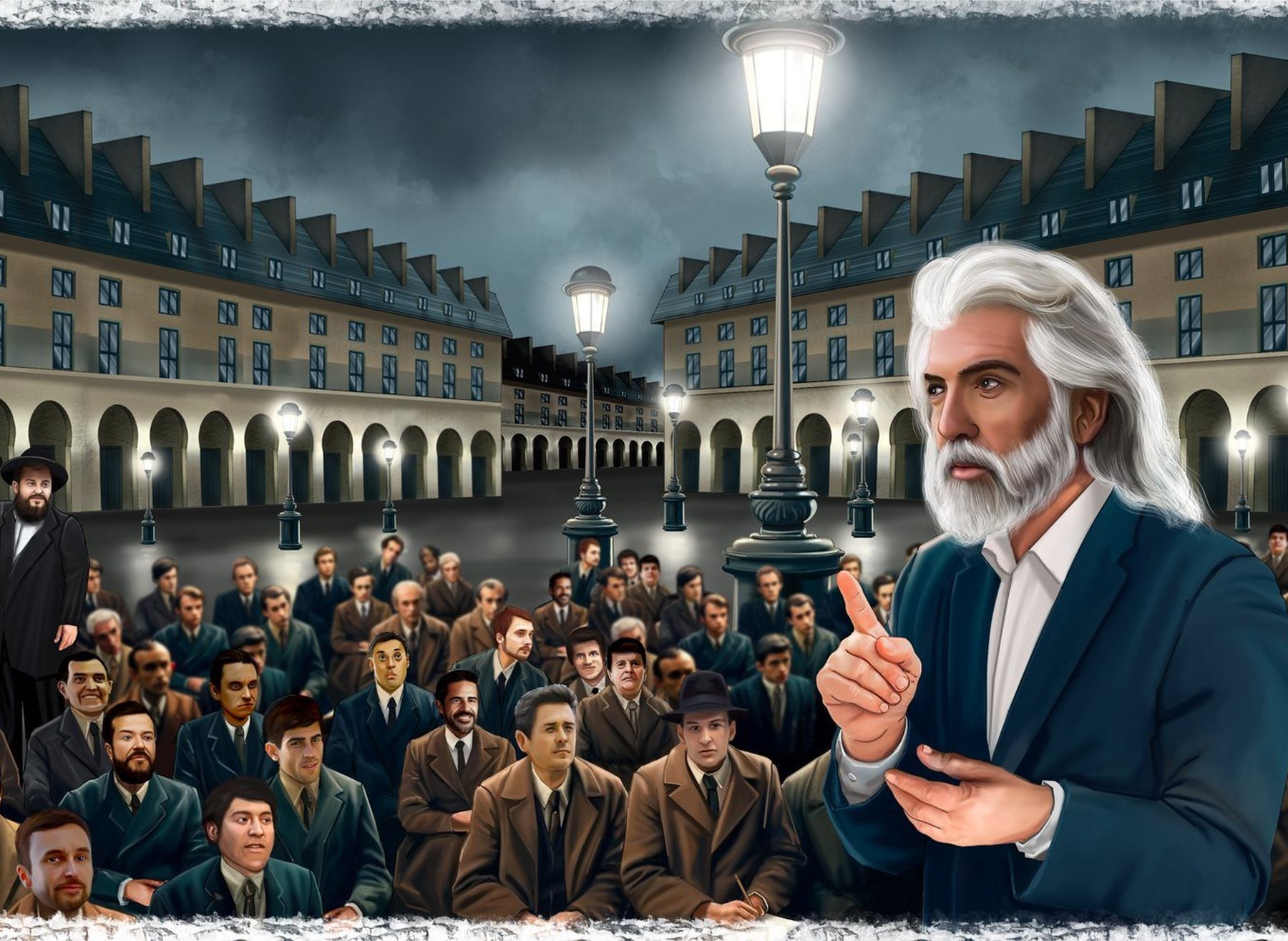
R’ Eliezer and R’ Chanoch slowly approached the group to find out what was going on, so late at night. In the middle of the crowd sat an old man with long, shiny, gray hair that flowed over his shoulders. He was a handsome, well-dressed fellow, with a bright personality, and he sounded excited about whatever he was going on about.
Some were taking notes, and others were recording what he was saying. R’ Eliezer’s French wasn’t strong enough to figure out what the lesson was about, but this man was clearly an expert giving a class on something important.
After watching for some time, the two yidden turned and made their way back to their hotel rooms.
“That was odd,” said R’ Chanoch. “I wonder if anyone could tell us more about that man.”
“There was definitely something special about that man,” agreed R’ Eliezer. “It’s a shame you’re leaving Paris already tomorrow.”
The next day, R’ Chanoch caught his flight to Australia as planned, but later that night, R’ Eliezer decided to explore some more, and hit the streets again for another midnight walk.
He was met by the exact same sight: that now-familiar crowd of young people, surrounding this wise, old, handsome man. He was speaking with just as much energy as the night before.
R’ Eliezer just watched, but then, for just a quick moment, their eyes met. The old man caught sight of the Chassid, and they were staring each other right in the face.
“Fin vanet kimt a yid?” asked the man in perfect Polish Yiddish – “Where is a Yid like you from?”
R’ Eliezer was completely shocked. I thought he was a goy! he thought to himself. Shaking off his surprise, he answered, “I’m from Eretz Yisrael. I have a stopover here, but I’m leaving for New York tomorrow, im yirtzeh Hashem.”
The mysterious man asked, “If it’s your last night, would you like to visit my house? I think you’d find it interesting.” The man had finished his lesson, and people were making their way out of the coffee shop’s courtyard. R’ Eliezer felt funny about accepting a random professor’s home invitation. But he was also so, so curious! Here was a French-speaking scholar, with long, silver hair, who also spoke excellent Yiddish! He’d never met anyone like him before! He had to find out more.
“Okay, lead the way.” R’ Eliezer finally answered, and the two men got into a black car parked at the side of the road. On the ride to their destination, the two men entered a very fancy, expensive part of town.
Homes became larger and more beautiful, gardens more colorful, and sweet flowery smells filled the midnight air.
“I used to teach Greek philosophy full-time at the Sorbonne university here in Paris,” the man explained in his perfect Yiddish.
“Now I only speak 6 hours a week, and I write in my spare time.” The men got to know each other along the way, until finally, the car stopped in front of a beautiful house.
The two men got out of the car and stepped into the entrance hallway. R’ Eliezer was amazed by the tall ceilings, expensive art work, and fancy furniture. “This is the non-Jewish room,” the man said.
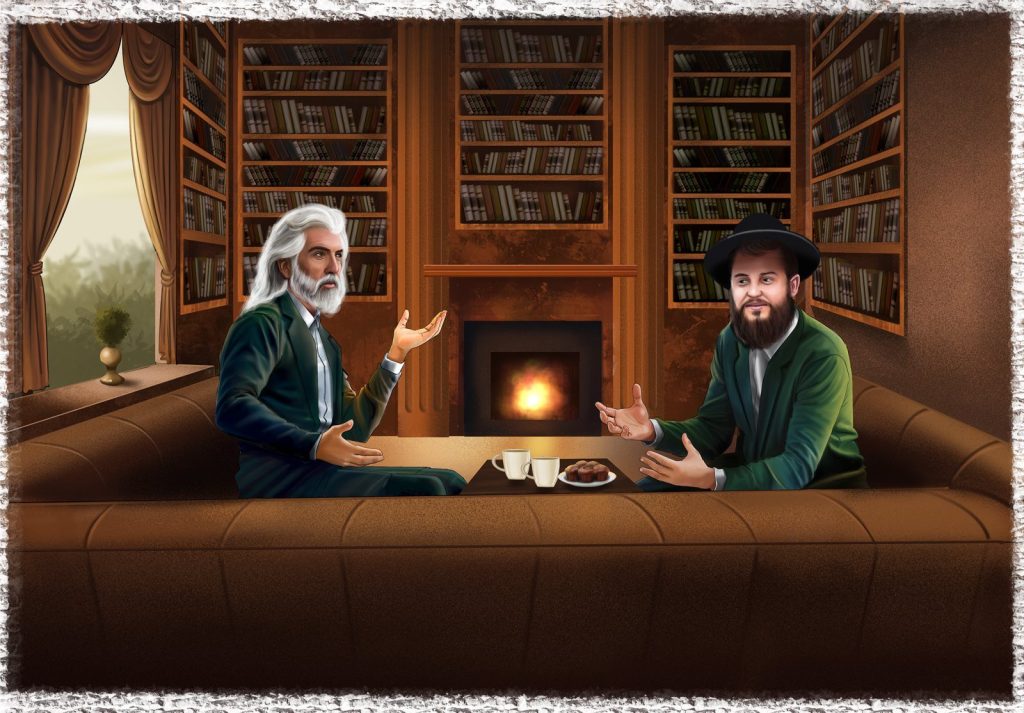
They continued into another room, full of bookshelves. Thousands of famous and even rare sefarim covered the shelves. A Shulchan Aruch HaRav by the Baal HaTanya lay open on the coffee table. R’ Eliezer stood there in complete awe.
“This is the Yiddishe room,” the man explained. R’ Eliezer noticed all sorts of sifrei Chassidus, from Chabad Rebbeim and others as well, including Noam Elimelech from the famous R’ Elimelech of Lizhensk. He looked around some more, only to realize that there were no mezuzos on any of the doors. It was strange… this man could speak like a Yid and learn like a Yid – but was he a Yid? If he was, R’ Eliezer would expect a man this dedicated to his learning to hang mezuzos on his doors. The library was just so impressive! He simply couldn’t wrap his mind around it.
Eventually, R’ Eliezer was invited to sit down on the couch and the two men continued talking.
“Does my new friend have a name?” asked R’ Eliezer as politely as possible. But the man simply held up a hand, showing that he didn’t want to answer.
He did, however, continue to speak. “I came from Poland. I lived through WWII and Hitler, yimach shemo v’zichro. I was just a bachur at the time, but my parents had given me a tremendous chinuch. To them, my Torah learning meant everything, and I loved to learn more than anything else. But when the war began, things changed so much, so quickly…”
The man went on to tell R’ Eliezer how terrible it was living during those times, along with how he survived and escaped Europe after the war.
“I’m in a fight with Hashem,” the man said, looking at the wall, still in thought. “I believe in Him, but I’m fighting with Him. That’s why I don’t keep mitzvos. I know everything I’m supposed to do, but I don’t even fast on Yom Kippur,” he murmured, sadly.
The two men sat in silence for a few minutes, and then the man turned back to R’ Eliezer. “If I asked you to do something for me, would you take my hand and swear that you’ll do it?”
R’ Eliezer looked the old man in the eyes. He could tell that this was extremely important to him, and he wanted to help this Yid who’d lived through so much.
“Yes, I will,” he answered.
“Okay,” the man began. “What I’m about to share with you is information that I’ve never told anyone, not since the war. You must promise not to tell anyone anything about me. Promise?”
R’ Eliezer promised.
The man went on to share his name with R’ Eliezer, and about his family. R’ Eliezer felt shivers up and down his whole body when he heard who this man was. He was the son of a super famous Rebbe from Europe, with living relatives all over Yerushalayim and Bnei Brak!
“But none of them know I survived the war,” the man explained. “And besides, I’ve strayed so far. I don’t live like any of them anymore. The one thing I’ve held onto is my deep love for learning Torah, thanks to my holy parents, of course.”
“Now listen,” he continued. “You’re the only person I’ve shared this with. And I’ve done this so you can help me with this one thing. I need you to stay in Paris a few more days, so I can prepare something for you to deliver to the Lubavitcher Rebbe, in Brooklyn, NY.”
R’ Eliezer was caught off guard. He himself had grown up a Satmar chossid, and later chose to follow the Amshinover Rebbe. Though he had nothing against the Rebbe – in fact, he respected him very, very much – R’ Eliezer felt uncertain. There are so many Rebbes, Gedolim, Tzaddikim, he thought to himself. “Why davka only Lubavitch?” he asked the man.
The man shook his head and said, “The third Chabad Rebbe, the Tzemach Tzedek, once sent a great chassid, R’ Yitzchak Aizik of Homel, to the famous R’ Yisroel of Ruzhin for a special mission to help the Jewish community. It was erev Shabbos, and R’ Aizik saw the Heiliger Ruzhiner smoking a pipe. R’ Aizik thought to himself, ‘My Rebbe, the Tzemach Tzedek, is busy with learning and davening on erev Shabbos. Why is the Ruzhiner smoking a pipe right now?’
“That moment, as if the Ruzhiner read his mind, he called R’ Aizik over to the window, and asked him, ‘What do you see outside the window?’ R’ Aizik could only see the sky, so that’s what he answered. ‘But now the shomayim of the week is leaving, and making way for the shomayim of Shabbos. Look well.’ R’ Aizik couldn’t see any of that, but he understood that some things just aren’t exactly as they seem. The Ruzhiner was simply a holy Tzaddik, and his ways couldn’t be understood by regular people – not even by big Chassidim from long ago.”
The old man looked R’ Eliezer in the eyes. “Tell me – do you know anyone that can see the shomayim of Shabbos? The only person I can think of who can is the Lubavitcher Rebbe.”
R’ Eliezer didn’t press anymore, but he did delay his flight another three days so the man could prepare some important papers for R’ Eliezer to deliver to the Rebbe. They met each night leading up to R’ Eliezer’s flight, where the man shared more about his interesting life. It turned out that the man had never married, and had lived alone his whole life. The more R’ Eliezer got to know him, the more he wanted to help him.
* * *
Before R’ Eliezer’s flight to America, he stopped by his new friend to pick up the package for the Rebbe.
The man handed R’ Eliezer a big, fat, sealed envelope, and gave him two very important instructions.
“Firstly,” he said, “do not open the envelope, no matter what!” R’ Eliezer agreed seriously, showing that he understood how important this was. “And secondly,” the man went on, “only give the envelope directly to the Rebbe. Do not give it to one of the Rebbe’s secretaries, or to anyone else to give to the Rebbe. You alone must give this to the Rebbe. If you can’t get it to the Rebbe, do not leave it with anyone.” The two men shook hands, making the promise official, and then R’ Eliezer boarded the plane to New York.
* * *
The next day, R’ Eliezer arrived in 770, looking for a private meeting with the Rebbe. He found one of the Rebbe’s secretaries, Rabbi Groner, and asked if he’d be able to give the letter to the Rebbe.
“Impossible,” Rabbi Groner answered. “I can give it to the Rebbe for you though. Don’t worry, I don’t open any mail.”
“No, no, no, I have to do it!” R’ Eliezer argued. He tried to convince Rabbi Groner to let him in to see the Rebbe, but nothing worked.
This is such an important shlichus, R’ Eliezer thought to himself. How can I just give up? He looked at the large envelope in his hands. This is from the son of a holy Rebbe. This is clearly a special thing! I must continue!
* * *
R’ Eliezer traveled from his family in Williamsburg, Brooklyn to 770 in Crown Heights many times to convince Rabbi Groner to let him see the Rebbe, but with no success.
He understood where Rabbi Groner was coming from. This was after the Rebbe had gone through a serious heart attack, and he needed to protect the Rebbe’s health. But if only Rabbi Groner understood how important this is! thought R’ Eliezer. But I can’t share anything with him. I promised I wouldn’t!
At that point, R’ Eliezer felt there was nothing else he could do. The only thing he could do was send the envelope back to Paris. He felt terrible that he couldn’t complete the shlichus properly.
* * *
But then one day, although he’d had no plans to do so, Hashem guided R’ Eliezer back to 770 for one more try. He knew he couldn’t go through Rabbi Groner, or any other secretary for that matter. He would simply need a miracle.
It was the fast of Shiva Asar B’Tammuz, which had been pushed off due to Shabbos. R’ Eliezer knew that the Rebbe would be davening with the Chassidim that day because of the fast.
R’ Groner spotted R’ Eliezer, and, remembering other times they’d run into one another, warned him with a cold stare, as if to say, “Don’t you dare go anywhere near the Rebbe!”
And it worked. R’ Eliezer stepped back, figuring he wouldn’t be able to get close to the Rebbe, and again became afraid his plan would never work – until…
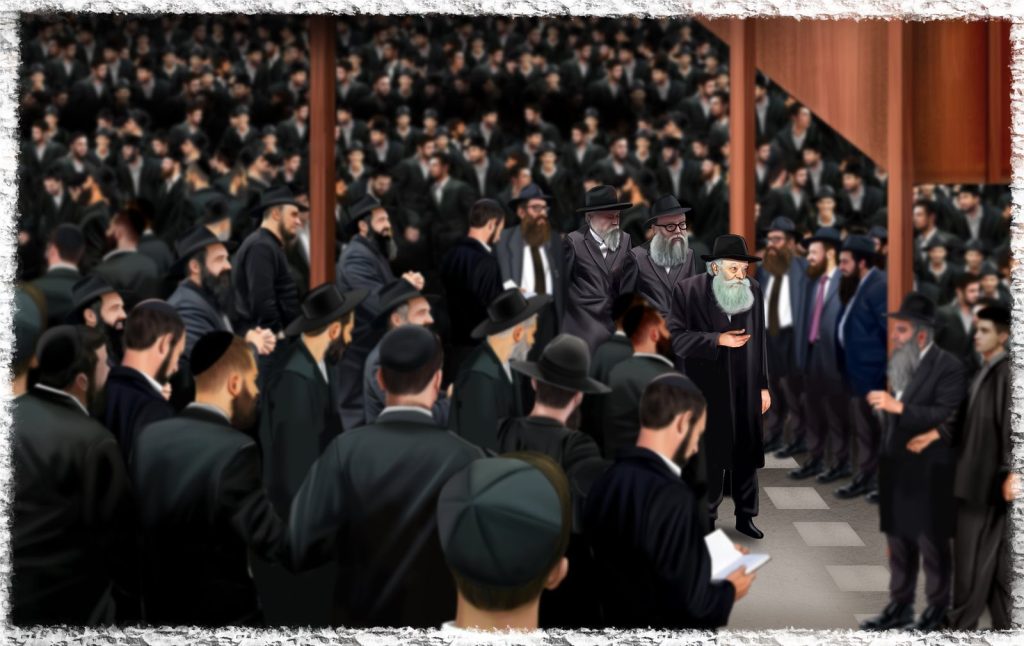
Mincha had just come to an end, and the Chassidim began clearing a path. The Rebbe suddenly started walking down the path towards R’ Eliezer. R’ Eliezer thought the Rebbe would walk right past him, but to his surprise, the Rebbe stopped in front of him and looked him right in the eyes!
R’ Eliezer stumbled backwards a step. He couldn’t believe what was happening. Is the Rebbe looking at someone behind me? Finally, the Rebbe put out a hand and said, “Nu?”
R’ Eliezer knew exactly what to do. Still in shock, he placed the envelope into the holy hands of the Rebbe, who responded with a friendly, “Ah dank,” or “thank you,” in Yiddish.
The Rebbe continued on his way, and R’ Eliezer was left standing in the crowd, unable to move. “Ma norah hamakom hazeh – look how amazing this place is!” he whispered. He couldn’t get over the Rebbe’s ruach ha’kodesh, and how naturally the Rebbe had just allowed this miracle to happen!
Right after leaving 770, R’ Eliezer called the man from Paris, who was very happy to hear that the job had been properly fulfilled. He wanted to know how the Rebbe received his envelope, and he was very pleased to hear the full story.
* * *
The two men kept in touch, speaking over the phone from time to time. At one point, R’ Eliezer asked him if he got an answer from the Rebbe, to which he replied, “Altz is b’seder – everything is fine.” R’ Eliezer even found out that he’d spoken with the Rebbe over the phone a few times regarding his envelope, but not through the Rebbe’s secretaries. He spoke straight to the Rebbe himself, which was totally unheard of! The Rebbe understood how important it was that this one Yid, all the way in Paris, got to keep his secret.
* * *
R’ Eliezer returned home to Eretz Yisrael a short while later. Time passed, and R’ Eliezer’s life went on. Whenever he and R’ Chanoch met, they’d always discuss the same thing.
“Yes,” R’ Eliezer told R’ Chanoch one day while sitting together in a Bais Medrash. “The Rebbe stopped right next to me on his own, and I never even said a word! This Yid is obviously a very special man.”
“Oy, if only I’d stayed those extra days with you, my friend, I’d have the zechus to be a part of your adventure,” cried R’ Chanoch. “My father-in-law, Rabbi Kitov, would have loved to meet him as well! He loves a good Chassidishe mayseh, and I’m sure this man had many to tell! But which Chassidus did he belong to? Where did he come from?” he asked.
“I’m sorry, but I can’t tell you. I promised with a tekias kaf! We shook hands on it. Even the Rebbe went out of his way to keep this man’s secret.”
* * *
A year later, R’ Eliezer returned to 770 to be by the Rebbe for Tishrei. Even though, in the beginning, he wasn’t sure what his friend from Paris found so special about the Rebbe, he now saw for himself just how great the Rebbe’s ruach ha’kodesh was. The Rebbe was powerful, and he could see things no one else could.
It was erev Yom Kippur, and on this day, there is a minhag to ask someone for a piece of lekach, honey cake, so that during the year, we shouldn’t need to ask for anything else! Hashem should give us more than we need b’shefa, without having to ask for it!
Chabad Chassidim would regularly ask the Rebbe for lekach, so thousands of Chassidim gathered outside the Rebbe’s room in 770 to await their turn. R’ Eliezer was in line with everyone else. When he finally reached the Rebbe, their eyes met, and he moved on after taking his lekach and hearing the Rebbe wish him a good year, but just then, R’ Eliezer felt someone grab his shirt and pull him back.
“The Rebbe wants to give you another piece of lekach!” Rabbi Groner told him. R’ Eliezer got a second piece of lekach, along with a second bracha. R’ Eliezer knew immediately. This must be for my Yid in Paris! he thought.
He wanted to call him right away, but Yom Tov was on its way, so he waited until chol hamoed Sukkos. But when he tried, his old friend wouldn’t pick up the phone!
Finally, after the last days of Yom Tov, R’ Eliezer found the Sorbonne’s number, where the man taught. A quiet voice was on the other line.
“Bonjour, comment puis-je vous aider? How can I help you?” the clerk asked in French.
“Yes, hello,” replied R’ Eliezer. “I’m trying to get in touch with one of your professors. Could I speak with him?”
“Sir, we have 13 campuses. It would be very difficult for me to find the contact information for a single professor. There are so many. Perhaps you could give me a name?”
R’ Eliezer shared the name, and to his delight, the clerk could help him get some information after all.
“But sir,” asked the woman, “can I ask why you must speak with the professor?”
“He’s a good friend, and I must speak with him immediately!” R’ Eliezer insisted.
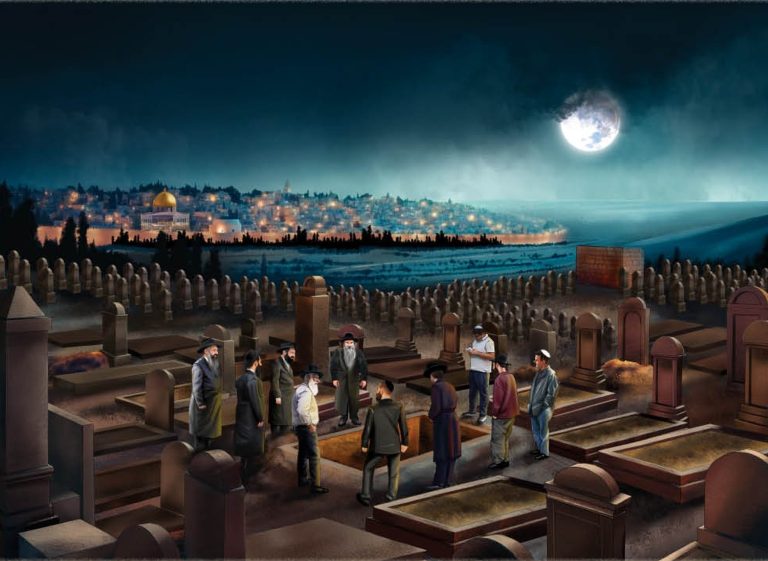
But the news that came next was heartbreaking and unexpected. R’ Eliezer’s friend from Paris had passed away from a heart attack on Simchas Torah. But even worse, he’d been buried in a non-Jewish cemetery!
That night, R’ Eliezer couldn’t sleep at all. How could the son of a Rebbe be buried in such a disrespectful way? He deserves the highest kavod! But what can I do?
For many nights, R’ Eliezer lay awake with these same thoughts. He wanted to share the story with his family. Carrying this secret alone was too much for him. But he’d promised not to tell anyone!
Eventually, R’ Eliezer asked advice from the Amshinover Rebbe.
“And now, this man – the son of a Rebbe – is buried in a non-Jewish cemetery!” R’ Eliezer finished, wiping a tear from the corner of his eye.
The Amshinover Rebbe looked very shaken by what he’d just heard. “It’s good that you didn’t share this with your family. Don’t even tell me. You have to keep this man’s secret.
“As for the grave, the Lubavitcher Rebbe already gave his blessing. You don’t have to worry about it,” he said seriously.
“But what if the Rebbe doesn’t know about it?” asked R’ Eliezer, still concerned.
“You don’t have to worry about it,” repeated the Amshinover Rebbe.
* * *
After leaving the meeting, R’ Eliezer felt like a new man. Not only was he happy to know that he’d done the right thing, but the news about the Lubavitcher Rebbe protecting his friend’s neshama was simply miraculous.
* * *
That summer, around a half a year later, R’ Eliezer was taking a trip to Europe, decided to stop at his friend’s kever in France to say tehillim. He called the Sorbonne university to see if they could help him find out where he was buried.
“Oh, yes, yes,” said the clerk on the other line. “Several months ago, he was transferred to the Jewish cemetery.”
R’ Eliezer was shocked. He couldn’t believe it! Who’d told them to move him? But in his heart, he knew the Rebbe was the one behind it all.
Every year, R’ Eliezer honored his friend’s yahrzeit by lighting a yahrtzeit candle, saying kaddish, and mentioning him in yizkor. R’ Eliezer passed away in 5784 (2024).
May his memory be a blessing.
Beis Moshiach #1413 • pp. 51-57
© 2026 Beis Moshiach Magazine. All rights reserved.
This article originally appeared in Beis Moshiach #1413. You are welcome to share it with friends and family by email or in print, provided that you do not change, add to or omit any part of it, you credit the author and Beis Moshiach, and you include a link to archive.bmoshiach.org (written out in full in printed copies).
To republish this article in a newspaper, magazine, book or website, please request permission in advance at [email protected].