Let’s Go: Build The Beis HaMikdash!
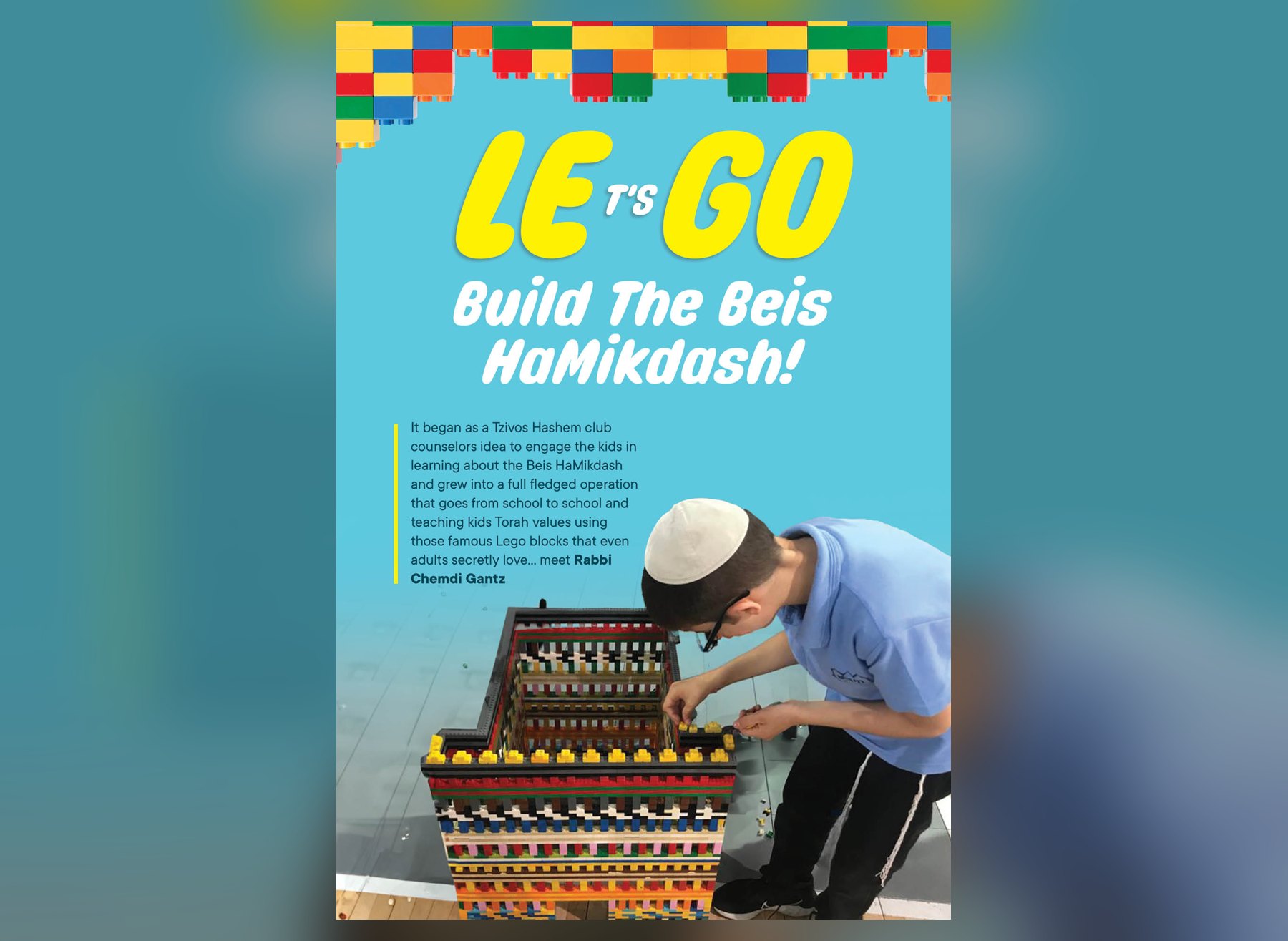
It began as a Tzivos Hashem club counselors idea to engage the kids in learning about the Beis HaMikdash and grew into a full fledged operation that goes from school to school and teaching kids Torah values using those famous Lego blocks that even adults secretly love… meet Rabbi Chemdi Gantz
Seven years before World War II, in a Danish carpentry, somewhere in northern Europe, a village carpenter invented the toy which in the last century became a hit.
It is simple but wonderful. You can learn from it how to follow instructions and create impressive and accurate things. You can also play with it without rules or instructions, and create tens of thousands of variations of small and large buildings.
Lego.
You can create almost anything with it. From houses for plastic people the size of a finger, to a real size Mercedes car that will be immortalized in the Guinness Book of Records… and it is also possible to create a structure with holy content, and build the Beis HaMikdash with it. Avraham Fried sang about how the Mikdash was built with tears. Maybe he is right too… Although the Mikdash will come down ready from the sky, we can also build one for ourselves, out of Lego.
We asked Rabbi Chemdi Gantz, who managed to make workshops on the Mikdash a hit, to tell us how it all started. How Lego went from being a hobby to a shlichus, and how we can get children for whom the words “the Beis HaMikdash” means nothing, to remember what the purpose of each chamber in the Mikdash is, and to live the experience of building it anew.
From Tzivos Hashem Activities To Successful Workshops
In Chemdi’s own words:
At a very young age, I started playing with Lego. I remember myself building from the age of six, but I probably started even younger. My mother would buy me Lego, encourage me to play with it, and admire my building skills in front of guests, admiration aimed mainly at my eavesdropping ears from the other room.
When my parents would fly to the Rebbe, the gift that I got from them when they came back was, of course, a new Lego set. I don’t know if I really showed special talents in assembly at a young age, but the encouragement I received from all sides pushed me to do more. I am very grateful to my mother, who made sure that I developed this hobby which eventually became a profession and shlichus.
I internalized inyanei Mikdash very strongly in the Talmud Torah Chabad in Rechovot where I studied as a child, in its first class. Towards the end of the year, in the months of Tammuz-Av, we were taught a lot about the Mikdash which was done in a very experiential way.
After I got married, I ran Tzivos Hashem programming in the settlements Rechalim, Tapuach, Yakir and Nofim, with the late Rabbi Rubin. This was a weekly activity that the children really liked. We would also organize a Lag B’Omer parade for them, baking matza for Pesach, and more; programming around the cycle of the Jewish year. For the Nine Days, I brought the big Lego kit I had at home, I added more Lego to it from my mother and mother-in-law, and together with the children we built the Mikdash. It was the first time that I conducted an activity with children using Lego.
The following winter, I bought the largest Lego package I found on the market, and in cooperation with Chabad of Rechovot, with the help of about a hundred children from the city who came to the activity, we set up a Lego menorah three to four meters high within an hour and a half. Lego projects on this scale were a new thing for me. It was a big challenge, but the end product was very impressive.
That’s how I started. I slowly realized the power of working with children using Lego, and started running workshops about the Beis HaMikdash or in honor of Chanuka – creating a public menorah.
A year or two after I started working in the Lego field, I focused a lot on the subject of the Mikdash. I lived in Yehuda-Shomron at the time, and I did a program in every single settlement or outpost. Today I operate all over the country, among all the demographics. After years in this field, with siyata d’shmaya, I was able to reach the scope I am operating in now.
Inculcating A Deep Message Through Play
I begin each workshop with the question “Why is it important to learn about the Mikdash?”
The children always give answers like “It’s the holiest place,” “It’s Torah study,” but the real answer I teach them is twofold: First, in the Geula, which will come with Hashem’s help today, we will have a Mikdash again, and we will have to know how it is built and what you do there. To learn about the Mikdash is to prepare for the Geula as the Rebbe wants. The second answer is Hashem’s answer to the prophet Yechezkel that is given in the Midrash: Even if we don’t have a Mikdash today, learning about it is considered like rebuilding it.
After this introduction, I begin with an explanation of the Mikdash, using a model. I don’t just come to play Lego, but mainly to convey messages with it. After that we build the Mikdash together, a model two meters wide, more than a meter high. Twenty thousand Lego pieces! And for more than an hour the children sit busy assembling it. At the end, there is a quiz about what we learned in the workshop. In some of the places where I visit, the children know nothing about the Mikdash, and after the activity they know how to answer where the wood chamber and the oil chamber are, what is the height of the Nikanor Gate and more. I always enjoy this knowledge they’ve gained, acquired in an hour of play.
These workshops are a “dira ba’tachtonim,” literally. Lego, the simplest and most mundane game in the world, becomes an illustration that connects pure souls in such a tangible way to the Beis HaMikdash, to the Geula and to Elokus. In general, children feel very attached to the Mikdash. There are adults who may sometimes shy away from the subject. The subject of korbanos may sometimes be perceived by them as something mystical, especially when talking about the fact that we are waiting for the third Mikdash. But children do not have these barriers. They connect to it automatically.
There was a teacher who warned me before the workshop that her class was very problematic. It was difficult to get them to concentrate, they were extremely energetic and it was difficult to get them to sit quietly. I really couldn’t get them to listen, but the Lego did it without any problems. They sat and built enthusiastically. The teacher was shocked.
One of them insisted that he didn’t like Lego, and didn’t want to participate. I asked him to try and help us for just five minutes, no more. Finally he gave in and came over to join the building project. At the end of the workshop, this child was not willing to leave the Lego. He begged us to leave him for a few more minutes of play.
The workshops for creating a public Chanuka menorah that I give have also become a hit – this year all my Chanukah evenings were taken. I traveled, mainly to Chabad houses all over Eretz Yisrael, from the Golan Heights to Eilat. In this workshop, the children arrive about an hour before the lighting and together they build a 2-3 meter high menorah, and then light Chanukah candles in it at the main public lighting. In these sessions, the sense of unity is very much felt. In contrast to a personal Lego creation where everyone takes home what they created, after such activities, the children leave with a sense of satisfaction that comes from everyone’s joint creation.
At some point, I started doing workshops on the Mishkan too. I would begin these workshops with the question – what was the first Lego in the world? What was the first object built so that they could take it apart and put it back together? The answer is – the Mishkan. The Mishkan was definitely not Lego in the sense of the toy, but it was built using the exact same method – a rigid structure, not a tent, that could be dismantled and reassembled.
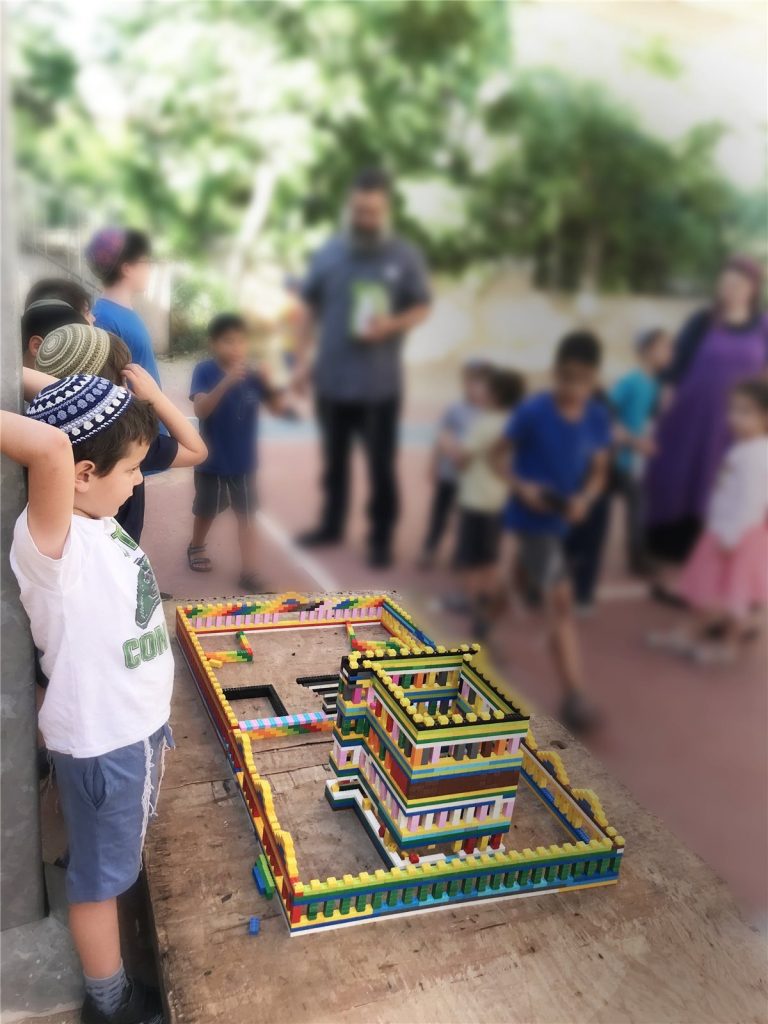
The sockets and the middle bolt are an example of this. These are methods used in Lego even today, which means that we are building the Mishkan with the same technique in which they built it then.
These workshops are given in the third grade, where they learn about the Mishkan in class.
In one of the classes, where the children were captivated by the activity, the teacher was really sorry that we only came at the end of the year. They learned about the Mishkan for a good few months, and the children weren’t that connected to the lesson. These are complicated parshiyos which are difficult for children to absorb, and a physical illustration can make the subject very fascinating and real for them.
The Rebbe emphasizes the study of the Mishkan, because the Mishkan is the work of Moshe’s hands, and the works of Moshe’s hands, as we know, are eternal.
I want to say thank you to my wife for allowing the Lego hobby to enter our home. Not every woman would agree to her husband filling the house with buckets full of colorful Lego bricks and half-finished models, and not everyone would look favorably on the fact that her husband sits and plays with Lego in the middle of the night… My wife, and my mother, who I mentioned earlier, have a very big part in this, and its success.
Beis Moshiach #1421 • pp. 44-47
© 2026 Beis Moshiach Magazine. All rights reserved.
This article originally appeared in Beis Moshiach #1421. You are welcome to share it with friends and family by email or in print, provided that you do not change, add to or omit any part of it, you credit the author and Beis Moshiach, and you include a link to archive.bmoshiach.org (written out in full in printed copies).
To republish this article in a newspaper, magazine, book or website, please request permission in advance at [email protected].