A Good Eye
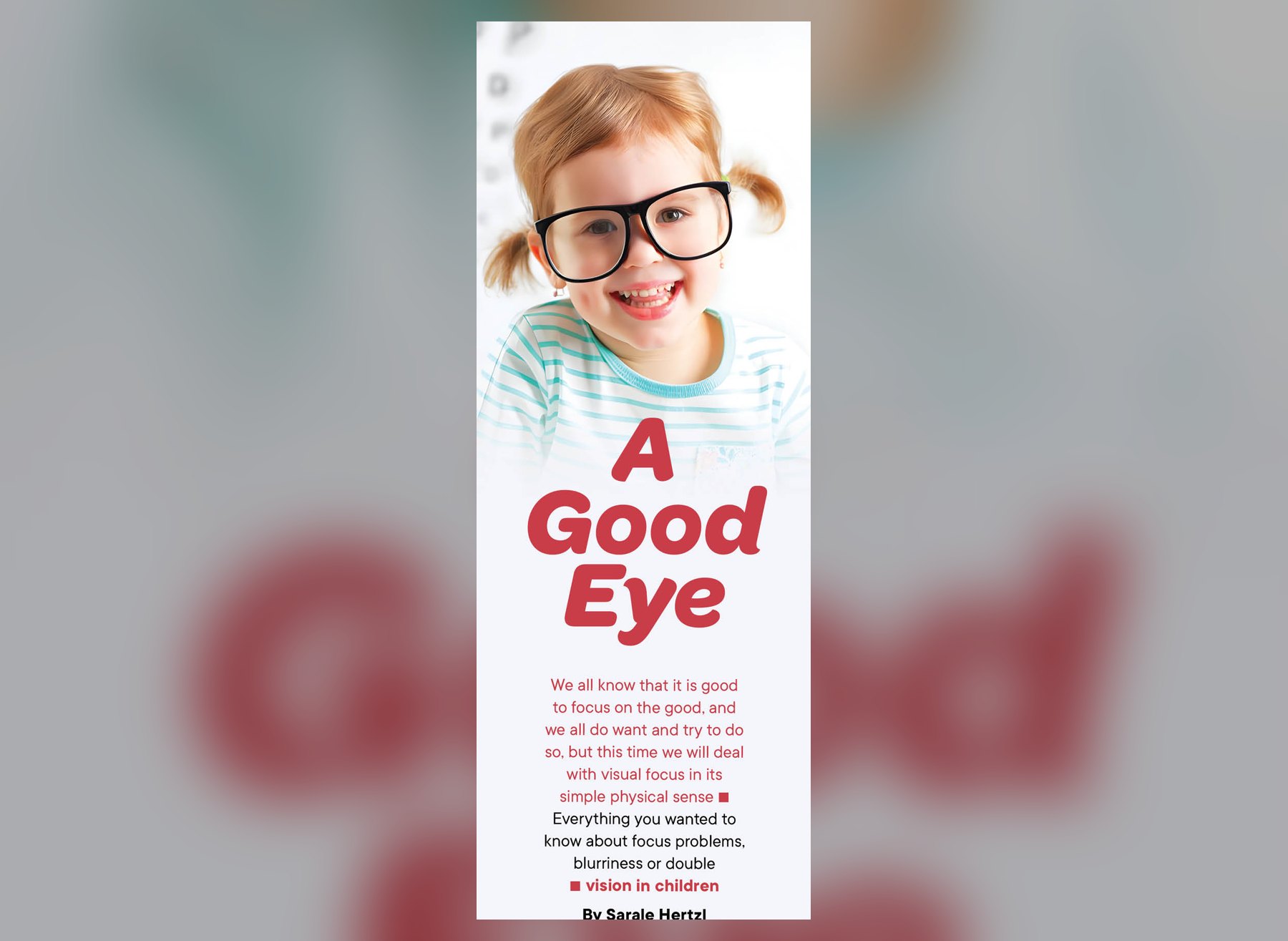
Everything you wanted to know about focus problems, blurriness or double vision in children
We all know that it is good to focus on the good, and we all do want and try to do so, but this time we will deal with visual focus in its simple physical sense
Visual focus problem: what, who and when.
Visual focus problem is a collective name for several functional problems of the eyes, related to their cooperation in looking in different directions, distance or reading.
It may appear at any age, however, it mainly affects children in the lower grades, with a prevalence of 5 to 10% among children, especially at a time when there is a growing need for extended reading and reading comprehension. Even more mature students may suffer from these problems during exam periods, due to the considerable visual effort they are required to make during this period.
When and to whom is it recommended to contact?
As in any other field, in the field of vision too, it is recommended to find problems, if any, and treat them as early as possible. Therefore, during the years of childhood, the recommendation is to perform an eye test at an ophthalmologist and using drops to dilate the pupils, at the ages of one and three, when from the age of three it is possible to test visual acuity using a board with drawings familiar to the child.
An ophthalmological examination is very important even if there are no complaints from the child. Especially when it comes to preschool age, when the child is not able to talk and tell about an existing problem or is not aware of it because he does not know another situation. It is recommended to perform such a test every one to two years.
Of course, apart from that, it is important to pay attention to the child’s behaviors or complaints that should turn on a red light for us. For example:
Lack of interest in reading and avoiding it.
Inability to persist in reading and writing for more than a few minutes.
Excessive rubbing of the eyes.
Eye pain and headache.
Double vision.
Blurring.
Tears.
Fatigue.
Reading difficulties.
Dry eyes.
Excessive blinking.
Closing one eye many times during the day. Tilting the head in a certain direction when trying to read or look into the distance.
Getting too close to the book or screen. Difficulty converging the eyes inwards while reading or looking at close objects. Squinting of one of the eyes towards the page while writing (there is also a “hidden” squint, which manifests itself only in times of fatigue).

Difficulty copying from the board to the notebook and slow copying.
Spelling errors.
Sometimes the difficulty may be expressed indirectly in the form of learning difficulties, lack of concentration, general discomfort, disruption of studies and more.
What do we do?
Sometimes, when more than a normal eye examination is required, it is possible and necessary to contact an expert in examining eye movements, focusing ability and strabismus, double vision and lazy eye, who deals with functional vision, and can recommend simple vision exercises, most of which can be performed at home. It is important to maintain persistence in performing exercises, and to follow the expert’s instructions regarding them. Many visual focus problems are easily solved, and the condition of the treated child in terms of reading and studies may improve quickly.
There are cases in which the correction of the focus problem will require the provision of prisms in the glasses. These cases will be diagnosed during the examination.
Beis Moshiach #1426 • pp. 46-47
© 2026 Beis Moshiach Magazine. All rights reserved.
This article originally appeared in Beis Moshiach #1426. You are welcome to share it with friends and family by email or in print, provided that you do not change, add to or omit any part of it, you credit the author and Beis Moshiach, and you include a link to archive.bmoshiach.org (written out in full in printed copies).
To republish this article in a newspaper, magazine, book or website, please request permission in advance at [email protected].