The Kiddush Hashem of the Holocaust Kedoshim
A unique correspondence of the Rebbe discussing a passage from the Mitteler Rebbe’s Chassidus, presented for his birthday, Yom Hilula and Chag HeGeula on 9-10 Kislev
To understand the following correspondence, we will first present the words of the Mitteler Rebbe in Sha’ar HaTeshuva (Chapter 5) freely translated and adapted:
The Arizal explicitly said that specifically in his time (he was nistalek in 5333 [1573]), the shmados (religious persecutions) that had occurred throughout approximately 500 years (from the persecutions of [4]956 in Rashi’s time [=a series of heinous pogroms conducted against Jewish communities in France and Germany in the course of what is known as “the First Crusade”] until the expulsion from Portugal in [5]252) have ceased.
All those who sanctified Hashem’s name – thousands and tens of thousands in every generation, as detailed in the book “Shevet Yehuda” regarding the specific persecutions in each year during those 500 years in France – were from souls that lived during the First Beis HaMikdash period, who were great people with elevated souls who served Hashem in all but for the grave sin of avoda zara to which they were attached with a great lust, to the point that in the days of Achav, there were merely seven thousand individuals who didn’t kneel to the Ba’al deity.
These generations had no elevation or tikkun (correction) until the time of the philosophers in Rashi’s and the Rambam’s era until the Arizal, because “they were increasing the nourishment of avoda zara’s crowns of klipah”. Therefore, the tikkun was through mesiras nefesh for Kiddush Hashem with simple emuna, which stands contrary to human intellectual reasoning.
However, in the Arizal’s time, when the true Kabbalistic wisdom was revealed to him, the persecutions were cancelled and would “no longer occur”.
Someone wrote to the Rebbe, attempting to address the apparent contradiction between this teaching of Arizal and the reality of countless shmados Jewish history abounds with even after the Arizal’s time, culminating, of course, with the terrible events of the Holocaust in our generation, a question the Rebbe raised several times:
“I heard that the Rebbe asked multiple times about the statement in Sha’ar HaTeshuva that from the time of the Arizal, persecutions have ceased and would no longer occur, despite the Amalekim of our generation [=the Nazis yimach shemam]. I do not understand the difficulty, for in Sha’ar HaTeshuva the discussion is about religious persecution where Jews sacrificed their lives not to convert. In the last generation, however, there were no such persecutions, as the Nazis yimach shemam sought to annihilate even meshumadim [=converted Jews] assimilated for many generations, as long as their ancestors were from the seed of Israel. May Hashem save us in every generation, just as He did for our forefathers in those days and in this time.”
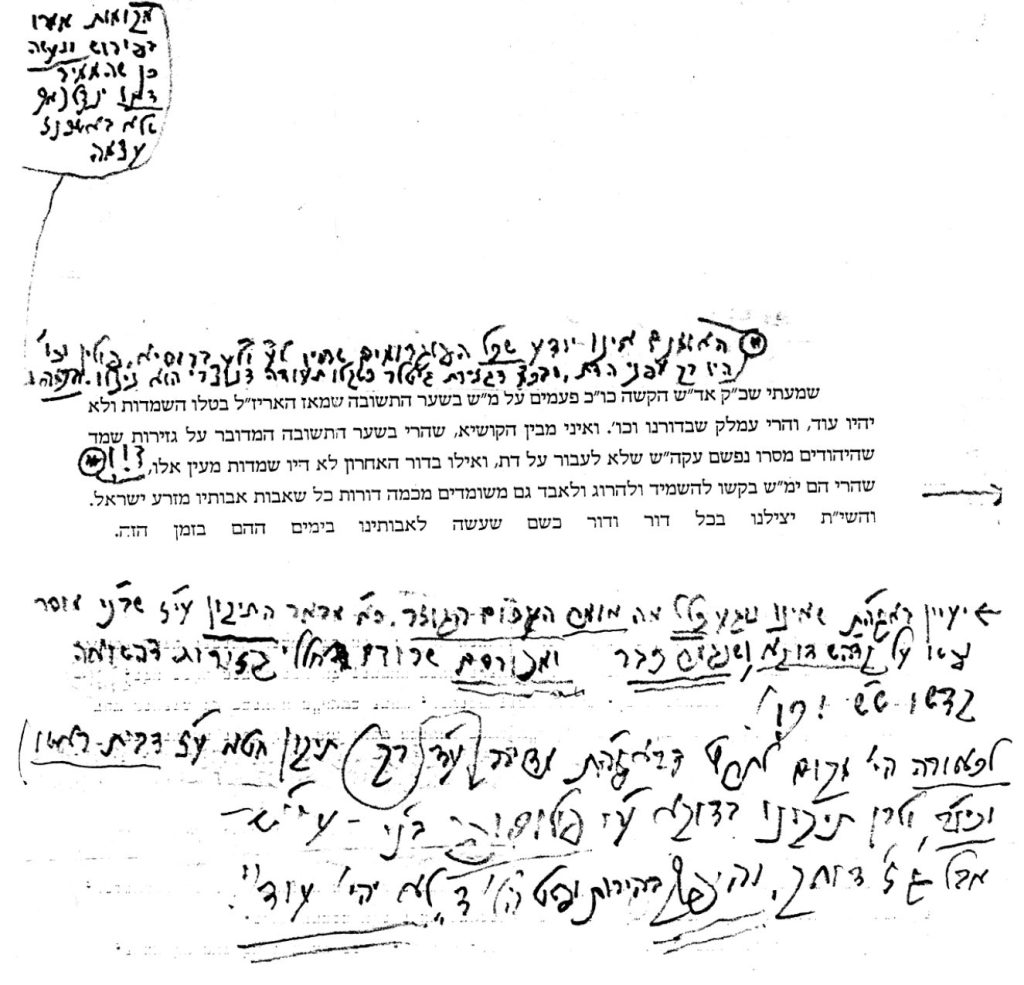
The Rebbe responded with a “?!!” after circling the words “the last generation there were no such persecutions” and commented:
האומנם אינו יודע שכל הפוגרומים שהיו ל”ע ול”ע [=לא עתה ולא עלינו]ברוסיא, פולין וכו’ היו רק מפני הדת, ובכ”מ [=ובכמה מקומות] דגזירת גיטלר כשק[ב]לו תעודה דנוצרי הוא ניצלו. ובכמה מקומות אמרו בפירוש ונעשה כן שהממיר דתו ינצל (אף שלא באשכנז עצמה)
Is it truly unknown to you that all the pogroms that occurred, ל”ע ול”ע [=an acronym usually meaning לא עלינו ולא עתה, not now and not upon us] in Russia, Poland, etc. were only because of religion? And that in many places under Gitler’s* [Hitler’s] persecutions, when one received a Christian certificate they were saved. And in many places they, the authorities, explicitly declared this and this actually happened that one who converts his religion will be saved (though not in Germany itself)?
יעיין באגה”ת שאינו נוגע כלל מה אומר העכו”ם הגוזר, כ”א [=כי אם] מבאר התיקון עי”ז שבנ”י מוסר נפשו על קדה”ש דוקא, ושנגמר כבר ומפורסם שרובם דחללי גזירות דהשואה קדשו ש”ש [=שם שמים] וכו’.
Examine the Igeres* [Sha’ar] HaTeshuva that we are discussing, which is not at all concerned with what the persecuting non-Jewish says, but rather explains the tikkun (= spiritual rectification) that was achieved through a Jewish person’s mesiras nefesh (self-sacrifice) for Kiddush Hashem specifically, and it has been established, and famously so, that most of the Holocaust victims sanctified Hashem’s name, etc. with their death.
לכאורה הי’ מקום לתרץ דבאגה”ת מדבר רק ע”ד [=על דבר] תיקון חטא ע”ז [=עבודה זרה] דבית ראשון וכיו”ב, ולכן תיקונו בדוקא ע”י פילוסופי בנ”י – עיי”ש** –
Ostensibly, there would be room to explain that in the Igeret [Sha’ar] HaTeshuva he speaks only about the rectification of the sin of avoda zara of the First Beis HaMikdash and the like, i.e., avoda zara by people of great spiritual stature, and therefore its rectification was specifically through the philosophers among Bnei Yisrael (see there), whereas later shmados which targeted other types of Jews came to atone for other sins.
אבל ג”ז [=גם זה] דוחק, והיפך בהירות ופשט הל’ ד”לא יהי’ עוד”.
But this explanation too is “forced,” and contrary to the clear and plain meaning of the language of the Mitteler Rebbe “they will no longer occur”.
* In parts of Russia, they interchange the “h” with a “g” sound, and therefore pronounce the name of Hitler ym”sh as above.
** This is as it appears in the original handwritten text, and apparently referring to the Sha’arei Teshuvah of the Mitteler Rebbe’s to which the questioner refers
*** In the Sicha of Shabbos Parshas Vayechi 5751 the Rebbe indeed uses this distinction and proves from the Mitteler Rebbe’s words in Sha’ar HaTeshuva that the Holocaust is a matter unto itself beyond comprehension, which is not in the category of punishment and rectification for sins (see also Likuttei Sichos, volume 21, page 397 and onward). However, based on this response before us, this does not yet explain the difficulty that the very essence of the Holocaust (regardless of its meaning) contradicts the statement that “there will no longer be” persecutions with no conditions whatsoever.
Beis Moshiach #1437 • pp. 6-9
© 2026 Beis Moshiach Magazine. All rights reserved.
This article originally appeared in Beis Moshiach #1437. You are welcome to share it with friends and family by email or in print, provided that you do not change, add to or omit any part of it, you credit the author and Beis Moshiach, and you include a link to archive.bmoshiach.org (written out in full in printed copies).
To republish this article in a newspaper, magazine, book or website, please request permission in advance at [email protected].