Is, Was, and Wasn’t: Retroactivity in Judaism
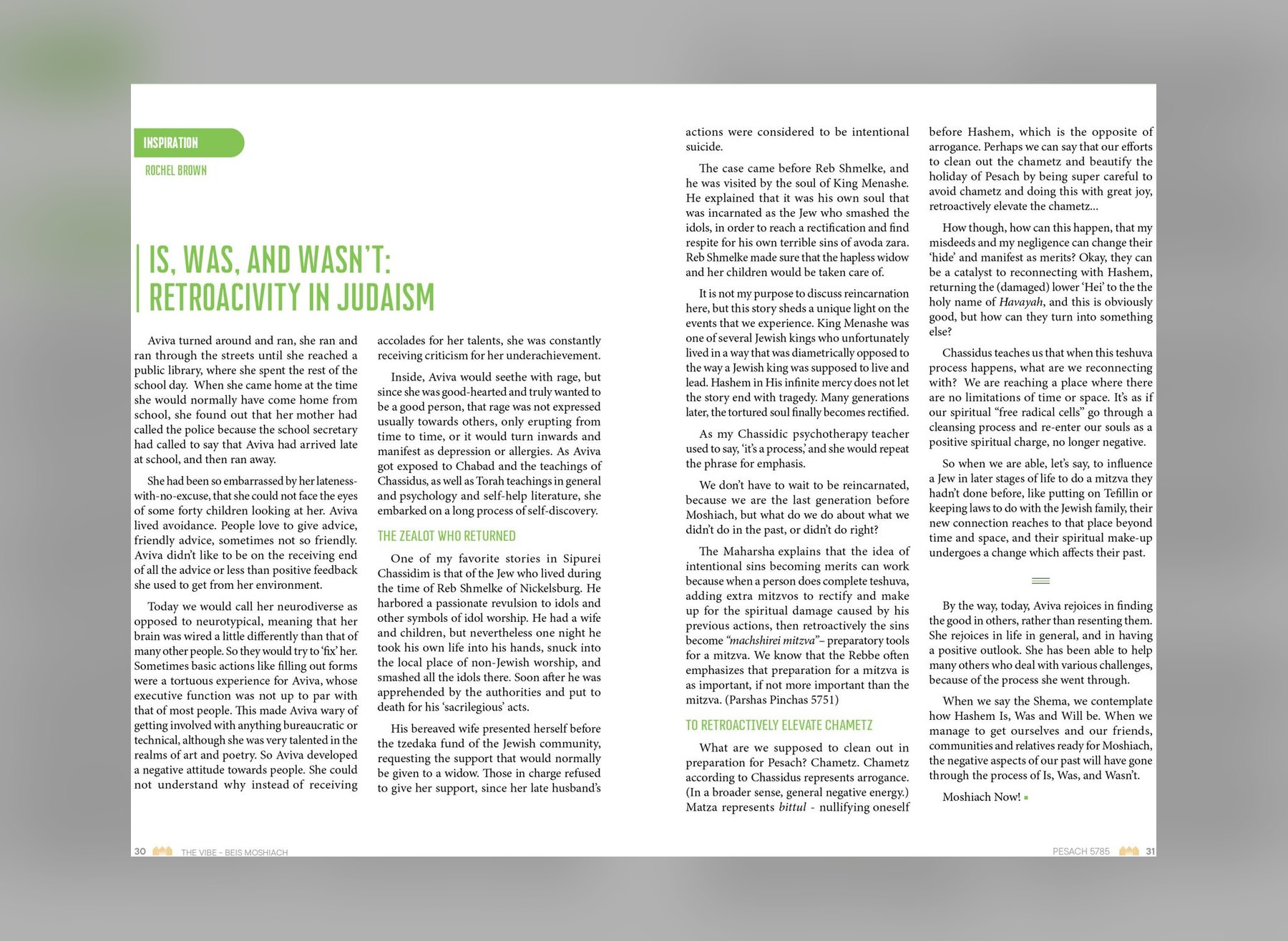
Aviva turned around and ran, she ran and ran through the streets until she reached a public library, where she spent the rest of the school day. When she came home at the time she would normally have come home from school, she found out that her mother had called the police because the school secretary had called to say that Aviva had arrived late at school, and then ran away.
She had been so embarrassed by her lateness-with-no-excuse, that she could not face the eyes of some forty children looking at her. Aviva lived avoidance. People love to give advice, friendly advice, sometimes not so friendly. Aviva didn’t like to be on the receiving end of all the advice or less than positive feedback she used to get from her environment.
Today we would call her neurodiverse as opposed to neurotypical, meaning that her brain was wired a little differently than that of many other people. So they would try to ‘fix’ her. Sometimes basic actions like filling out forms were a tortuous experience for Aviva, whose executive function was not up to par with that of most people. This made Aviva wary of getting involved with anything bureaucratic or technical, although she was very talented in the realms of art and poetry. So Aviva developed a negative attitude towards people. She could not understand why instead of receiving accolades for her talents, she was constantly receiving criticism for her underachievement.
Inside, Aviva would seethe with rage, but since she was good-hearted and truly wanted to be a good person, that rage was not expressed usually towards others, only erupting from time to time, or it would turn inwards and manifest as depression or allergies. As Aviva got exposed to Chabad and the teachings of Chassidus, as well as Torah teachings in general and psychology and self-help literature, she embarked on a long process of self-discovery.
The Zealot Who Returned
One of my favorite stories in Sipurei Chassidim is that of the Jew who lived during the time of Reb Shmelke of Nickelsburg. He harbored a passionate revulsion to idols and other symbols of idol worship. He had a wife and children, but nevertheless one night he took his own life into his hands, snuck into the local place of non-Jewish worship, and smashed all the idols there. Soon after he was apprehended by the authorities and put to death for his ‘sacrilegious’ acts.
His bereaved wife presented herself before the tzedaka fund of the Jewish community, requesting the support that would normally be given to a widow. Those in charge refused to give her support, since her late husband’s actions were considered to be intentional suicide.
The case came before Reb Shmelke, and he was visited by the soul of King Menashe. He explained that it was his own soul that was incarnated as the Jew who smashed the idols, in order to reach a rectification and find respite for his own terrible sins of avoda zara. Reb Shmelke made sure that the hapless widow and her children would be taken care of.
It is not my purpose to discuss reincarnation here, but this story sheds a unique light on the events that we experience. King Menashe was one of several Jewish kings who unfortunately lived in a way that was diametrically opposed to the way a Jewish king was supposed to live and lead. Hashem in His infinite mercy does not let the story end with tragedy. Many generations later, the tortured soul finally becomes rectified.
As my Chassidic psychotherapy teacher used to say, ‘it’s a process,’ and she would repeat the phrase for emphasis.
We don’t have to wait to be reincarnated, because we are the last generation before Moshiach, but what do we do about what we didn’t do in the past, or didn’t do right?
The Maharsha explains that the idea of intentional sins becoming merits can work because when a person does complete teshuva, adding extra mitzvos to rectify and make up for the spiritual damage caused by his previous actions, then retroactively the sins become “machshirei mitzva”– preparatory tools for a mitzva. We know that the Rebbe often emphasizes that preparation for a mitzva is as important, if not more important than the mitzva. (Parshas Pinchas 5751)
To Retroactively Elevate Chametz
What are we supposed to clean out in preparation for Pesach? Chametz. Chametz according to Chassidus represents arrogance. (In a broader sense, general negative energy.) Matza represents bittul – nullifying oneself before Hashem, which is the opposite of arrogance. Perhaps we can say that our efforts to clean out the chametz and beautify the holiday of Pesach by being super careful to avoid chametz and doing this with great joy, retroactively elevate the chametz…
How though, how can this happen, that my misdeeds and my negligence can change their ‘hide’ and manifest as merits? Okay, they can be a catalyst to reconnecting with Hashem, returning the (damaged) lower ‘Hei’ to the the holy name of Havayah, and this is obviously good, but how can they turn into something else?
Chassidus teaches us that when this teshuva process happens, what are we reconnecting with? We are reaching a place where there are no limitations of time or space. It’s as if our spiritual “free radical cells” go through a cleansing process and re-enter our souls as a positive spiritual charge, no longer negative.
So when we are able, let’s say, to influence a Jew in later stages of life to do a mitzva they hadn’t done before, like putting on Tefillin or keeping laws to do with the Jewish family, their new connection reaches to that place beyond time and space, and their spiritual make-up undergoes a change which affects their past.
* * *
By the way, today, Aviva rejoices in finding the good in others, rather than resenting them. She rejoices in life in general, and in having a positive outlook. She has been able to help many others who deal with various challenges, because of the process she went through.
When we say the Shema, we contemplate how Hashem Is, Was and Will be. When we manage to get ourselves and our friends, communities and relatives ready for Moshiach, the negative aspects of our past will have gone through the process of Is, Was, and Wasn’t.
Moshiach Now!
The Chassidishe Vibe #1455 • pp. 30-31
© 2026 Beis Moshiach Magazine. All rights reserved.
This article originally appeared in Beis Moshiach #1455. You are welcome to share it with friends and family by email or in print, provided that you do not change, add to or omit any part of it, you credit the author and Beis Moshiach, and you include a link to archive.bmoshiach.org (written out in full in printed copies).
To republish this article in a newspaper, magazine, book or website, please request permission in advance at [email protected].