4 Generations in Milan
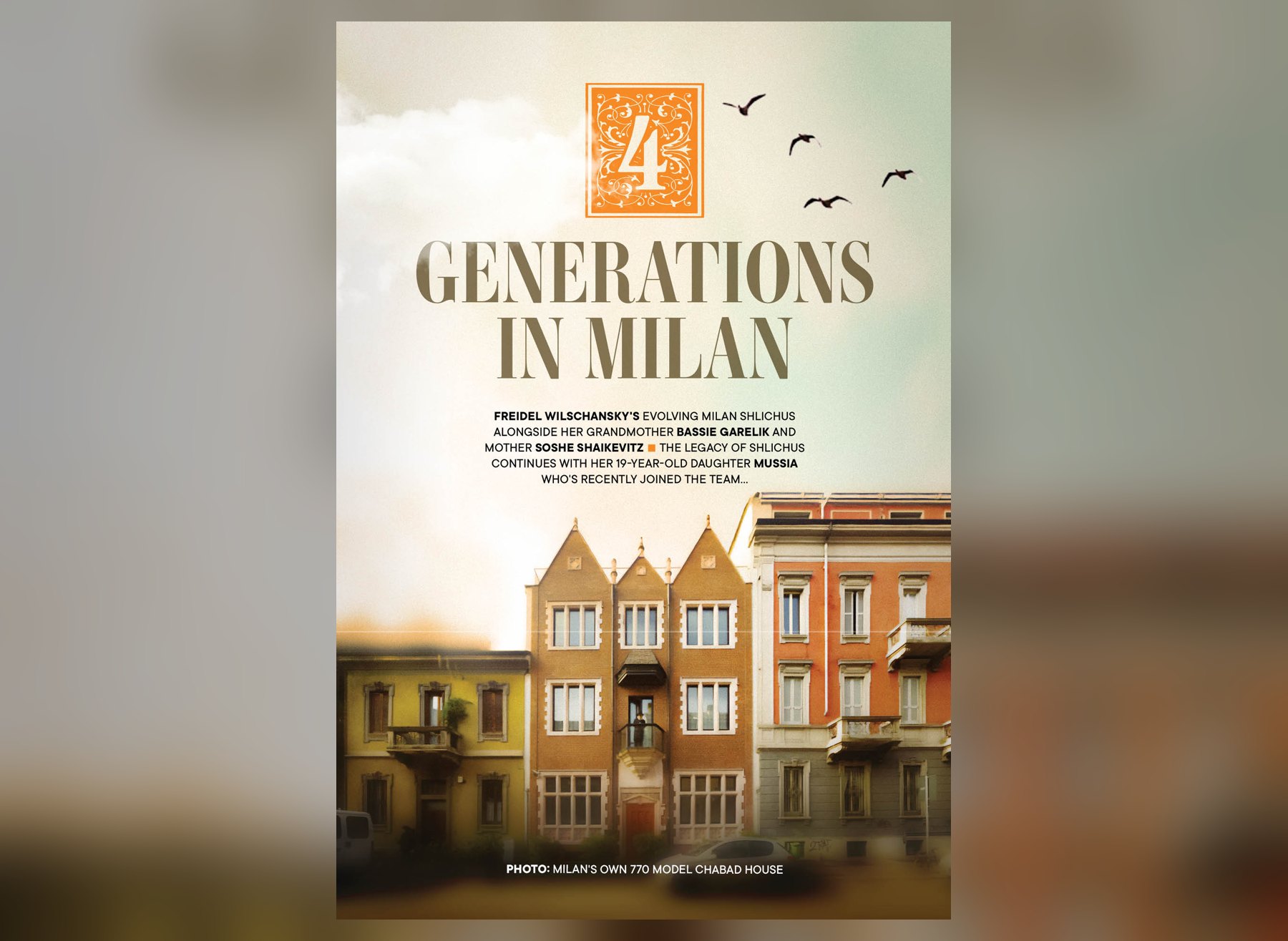
Freidel Wilschansky’s evolving Milan shlichus alongside her grandmother Bassie Garelik and mother Soshe Shaikevitz * The legacy of shlichus continues with her 19-year-old daughter Mussia who’s recently joined the team…
Freidel is the third generation in the Milan shlichus, daughter of Mrs. Soshe Shaikevitz, the shlucha in Milan. Her grandparents, Rabbi Gershon Mendel a’h and Rebbetzin Bassie Garelik, arrived in Milan in 1959 and were among the first shluchim sent by the Rebbe. During that period, only a few couples were sent outside the United States on the Rebbe’s shlichus.
After their marriage, the Shaikevitz couple lived in Crown Heights for a year and a half, and then submitted several shlichus proposals they had received to the Rebbe. The Rebbe chose Milan from the list of places, and they’ve been there since, the second generation of shluchim.
“I was sure my shlichus would be somewhere completely different,” says Freidel, the granddaughter. “We wrote to the Rebbe and received an explicit answer about Milan. We thought we would only be here for the first year and then move on to another place, but when we wrote to the Rebbe again at the end of the first year, we received clear instructions to stay. In the end, we do what the Rebbe wants.”
Mussia, Freidel’s 19-year-old daughter, was born into the shlichus. She studied in Milan schools until sixth grade, and in seventh grade went to study in a high school in Eretz Yisrael. She then studied for one year in seminary, and now she’s in Milan, helping her parents.
Third And Fourth Generation On Shlichus
What does a day on shlichus look like?
“My specific shlichus is in the seminary,” Freidel explains. Together with her husband, Rabbi Sender Wilschansky, she runs a seminary for Chabad girls from around the world who want to study limudei kodesh for a full year, while experiencing social and Chassidishe activities. “Every morning I go to the seminary and return when the children come back from school. In the evening, I go back to the seminary to teach evening classes. Additionally, there are regular classes such as Tanya classes at the Chabad House for young women from the community – classes open to the general public, farbrengens, and events related to special dates. On Shabbos, we have meals for the seminary girls, and on Friday night we have large Shabbos meals with tourists, guests, and people from the local community.”
“I am a madricha in the seminary,” says her daughter Mussia. “So I am actually the fourth generation of shlichus here: my great-grandmother – Mrs. Garelik, my grandmother – Mrs. Shaikevitz, my mother, and me. We all work together, day by day. It’s quite moving, to be honest. As a madricha, I’m responsible for the social atmosphere in the seminary, staying with the boarding school girls. Twice a week, I study one-on-one with girls from the community. I also help my parents organize Chabad House events, which is something I really love doing.”
What is special about life as shluchim in Milan?
“It’s the most special shlichus!” says Freidel. “Once when my grandmother went in for a yechidus, the Rebbe told her that when Moshiach comes, he will arrive first in either Melbourne or Milan. These are the first two places where the Rebbe sent shluchim… My grandmother left the yechidus deeply moved and quickly called my grandfather. She asked him in amazement, how could it be that the Rebbe said to her ‘either Melbourne or Milan’ and not ‘Milan or Melbourne’… It was then decided to build a house in Milan for the Rebbe – a building replicating 770.
“I think this knowledge, that the Rebbe will come to us in Milan, is very special and also obligating. I don’t know exactly how it will happen, maybe on the way to Yerushalayim? The Rebbe will show us. That’s what he told my grandmother and that’s how it will be. Milan is definitely ready for the coming of Moshiach, and from here we will all travel on clouds to Yerushalayim.”
Mussia refers to the community that exists in Milan and has been established for many years. “In the beginning, there was nothing here. When my great-grandfather and great-grandmother arrived in Milan, they had to start everything from scratch – meet people, build institutions, build a community. I was born into a reality where there was already a community, and many people regularly participate in Chabad House activities. Today, Milan has three schools: elementary, high school, and seminary. There are even kosher restaurants and shops here. Although you won’t find all the products like in Israel, there is no shortage, thank G-d. On the rare occasions when there’s no milk – we buy soy milk. Tourists who come here almost never come to us to eat during the week, since there are many kosher food options in the area. They come to the Chabad House mainly for Shabbos meals.”
Shlichus From Childhood
Let’s go back to the beginning, tell us about your childhood on shlichus.
“I have very pleasant memories of shlichus, but we were less aware of it. For us, this was life, we simply didn’t know anything else. Now the concept of shlichus has entered the international consciousness so that everyone knows and respects it. The Kinus HaShluchim and the Kinus HaShluchos have become very public events saluting the shluchim. We didn’t have that special feeling of ‘wow, we’re on shlichus,’ we knew we were here on the Rebbe’s shlichus to spread Yiddishkeit and Chassidus, it was the most natural and obvious thing.”
Freidel gives us a taste of the shlichus ‘from the past’: “Everything was an experience. During Purim, we helped my father organize Purim meals, he was responsible for organizing them from A to Z. During the Yomim Noraim, there were tefillos in the Chabad style; we would come to daven at the Chabad House and it was so special – the niggunim, the atmosphere…
“I saw in my parents an example of dedication to the children at home while conducting ongoing activities with the community. My mother was devoted to our chinuch without compromises. My father was dedicated to every aspect of the shlichus, the Lag B’Omer parade and organizing events for the whole family, a summer camp for children who don’t study in Chabad during the year and lack ‘Yiddishkeit,’ farbrengens at home on every Chassidishe date.”
“My first memory of shlichus,” Mussia recalls, “is of many guests. We would host many Jews on Shabbos who didn’t yet observe Torah and mitzvos.
“My parents made shlichus a positive thing for us. Doing mivtzaim? It’s fun. Giving classes? A pleasure. The activities, events, connection with community members – everything that happens on shlichus – is part of our lives. There was never a separation between family life and shlichus. I remember my parents involving us in every event that was about to take place, consulting with us, listening to our opinions.
“More than a year ago, when I was studying in Israel, my mother sent me pictures of floor tiles to choose for the Chabad House so I could give my opinion… Even when we’re not in the area – we continue to be involved in the shlichus.”
Let’s move on to the time when you decided to go on shlichus. What made you actually go?
“As I said at the beginning,” Freidel shares, “I didn’t want to be a shlucha in Milan. For me, it was about going on shlichus anywhere on the globe except Milan and Israel, and I even told this to my husband before finalizing the shidduch. He said: ‘Wherever the Rebbe wants.’ We lived in Milan for a year and then wrote to the Rebbe through the Igros Kodesh about a specific place of shlichus we wanted to go to. The Rebbe wrote to stay three or four years in Milan.
“Later we wrote again, and always received an answer related to Milan or to the field in which we are engaged in shlichus, the seminary. In fact, we didn’t set out for Milan one day, but landed directly into it from the wedding, without knowing that this would be the shlichus the Rebbe set for us. We made plans, thought we would be here for a very limited time, but Hashem arranges the plans in the best way for us.”
At what stage did you take on roles, initiate on your own?
“For us, shlichus begins at age zero,” Mussia smiles. “At a very young age, everyone already has a role. For example, three hundred people come for the Seder and a lot of help is needed; each of the children knows how they are helping out. We have always been part of the organizers, expressing our opinions on various topics. My parents always listen to our opinions. Of course, not everything goes according to what we said, but it’s important to them that we’re involved in the details of the shlichus. Even when our help isn’t required, we try to lend a hand.”
How do the example from your parents and the habits from a young age help in your shlichus today?
“I grew up with the perception that shlichus is not a chiddush but a given; many things came to me naturally,” Freidel answers. “This is how I grew up, so of course this is how I will raise my children. I copy what I saw and experienced as a child, and pass it on.”
The education for shlichus in the family passes from generation to generation, as Mussia explains: “Through the conduct of my parents in many situations, they taught me to act with mesirus nefesh and dedication. Today, when I have some challenge, I remember a similar issue my parents had, and it helps me to act in the right way. A recent example: one of the community girls wanted to learn with me one-on-one and I didn’t know where to fit the study into the crowded schedule. Later she updated me that she couldn’t make it and I was quite happy. In the end, she called and said she could, and really wanted to study with me. The truth is I didn’t want to, the days are busy, but I understood that now I need to give up my comfort and commit. This is part of life on shlichus. I don’t see it as a daily difficulty, I’m used to committing and giving of myself for someone else, a habit I received as a gift from my parents.”
Each Period Brings Some Challenge
Tell us about difficulties and challenges in shlichus.
Freidel and her daughter say unanimously that it’s difficult to answer this question, because they hardly see any significant difficulties, boruch Hashem. There are challenges here and there, but they don’t draw too much attention.
After thinking a bit, Freidel answers: “I don’t want to use the word ‘loneliness’ because a Jew is never lonely, but there is definitely a lack of company like in a regular Chabad community in Eretz Yisrael. We need to make the community, to create an environment. I wouldn’t call it a challenge necessarily, because we’ve gotten used to this reality.
“The truth is, life in general is full of challenges, each period brings some challenge, but in the end, Hashem arranges things. We have miracles left and right, one could write an encyclopedia about it.”
Mussia also brings her perspective: “When I was a little girl, I studied in a co-ed class and it was difficult for me. In addition, I saw my parents very busy with shlichus and not just spending time around their children like other parents. Sometimes I wondered ‘why does it have to be this way?’ but more from a place of curiosity, to understand why we are different. It didn’t really bother me. I don’t feel that we lacked something in childhood. We had fun and knew that our parents were busy with the Rebbe’s shlichus and we were privileged to be part of it, even if it meant that our parents are not just ‘ours.’
“Another issue that was challenging, before the current house we lived in a small house, where we continued to live even when we were already nine children. Why didn’t we move? It turns out that for every possibility that came up, the Rebbe responded negatively. Only when we were able to live very close to the seminary did we receive an answer about the importance of living near those we are trying to influence… Living on shlichus brings many challenges, but they are not too burdensome. There is always the feeling that we are different from everyone, but in a positive sense, special and good. Actually, the hardest thing was getting up early for school every morning.”
The More You Give On Shlichus, Shlichus Gives Back Many Times More
“Shlichus” – what does this word mean to you?
“To do the Rebbe’s will,” says Freidel. “To go where the Rebbe says, whether it’s Kfar Chabad, Yerushalayim, or Crown Heights, or whether it’s Thailand, India, or Milan. No matter where you are, it’s definitely the place where you need to be – and there to act according to the Rebbe’s will.”
“Dedication,” Mussia answers in one word, and adds that this word raises a positive connotation for her, of something good. “I remember a game we once played in the seminary and I had to say things against shlichus (another girl had to say things in favor of shlichus), and I simply couldn’t say… I think that as much as you give in shlichus, the shlichus gives back many times more, especially spiritually,” Mussia answers.
“For instance, we talk about tznius in the seminary and I myself need to be tzanua. When the talk is on hiskashrus to the Rebbe, I need to connect myself to the Rebbe. We always need to be better than our demands of others. People in the community have certain expectations of us. We are Chabadniks so we are different, we are more strict than them.
“We can apply the same to the material side of things; we have tools and powers from Hashem and we have the privilege to use them in a positive direction. My mother, for example, is very talented in design. In my opinion, she could work as an interior designer, turn the talent into a career. But no, she uses this talent for the shlichus, to design the new building of the Chabad House, to prepare interesting presentations for classes, and so on.
“In shlichus, we harness all the existing powers within us and feel that we never separate from ruchniyus. Even arranging and packing food for a traveler is ruchni because this way they will have kosher food.”
Has shlichus changed you?
“I don’t know myself ‘not on shlichus’ to tell you if I would be different,” Freidel says with a smile. “But I am one hundred percent sure that when you are on shlichus – you gain everything. Because shlichus is not just giving classes or organizing events, shlichus is not just answering questions or being a listening ear. Shlichus includes everything and it’s a great privilege. In addition, as a bonus, in all respects you grow, learn, and improve. A person who is on shlichus uses all the hidden and revealed powers they have. No one goes on shlichus to discover their potential, but afterwards they really succeed in touching all the potential that exists within, even in things unknown to us.
“Of course, it’s important to emphasize that the purpose of shlichus is not to fulfill ourselves; it’s very important to emphasize this. This is a very secondary thing, the externals of externals. Shlichus brings some change, a positive change that is definitely real, but it is a very secondary and side benefit.”
Mussia’s answer is similar to her mother’s: “If I wasn’t on shlichus – I wouldn’t be me. Even my physical character is influenced by the shlichus, it’s a life reality that changes you from within.”
For The Benefit Of The Shluchim
The Rebbe promises that going on shlichus is for the benefit of the shluchim. How is this being fulfilled for you?
“First of all,” Mussia replies, “daughters of shluchim are much more mature. The toughening in shlichus brings them depth, understanding, and the ability to manage in all kinds of situations. I acquired my entire personality from the shlichus.
“In addition, we live day-to-day with the belief that everything belongs to the Rebbe, not to you. The Rebbe wants the best on shlichus – so it will happen, even if it doesn’t always seem like it will. I don’t remember talking at home about financial expenses. My parents believe that the mosdos belong to the Rebbe and the Rebbe will help. Looking back, even in less easy times, we didn’t feel it at home, we didn’t feel worry in the air. In the end, everything always worked out with wonderful hashgacha pratis.
“Once I said to my father, ‘It’s scary to get married and go on shlichus without knowing how we will finance the activities,’ and my father answered me: ‘Whoever takes care of my money – will also take care of your money, b’ezras Hashem.’ Real confidence that Hashem will arrange everything, and it really happens. Provided that the goal is one hundred percent for the Rebbe.
“My father helps his fellow shluchim a lot in financial matters. He also uses his bank account for purposes not directly related to our activities, but those of others. Interestingly, the bank never raised questions. There was only one time when he tried to assist in an operation that was not related to shlichus – and the bank raised problems…”
Do you see your daughter continuing on the path you have set for her to be an active shlucha herself?
“There is nothing more beautiful than seeing the continuity of the shlichus, with Mussia and with all the children. Our children are always shluchim, from the moment they are born. Even when they study outside the home, in yeshivas and schools in Israel. Shlichus is something that does not expire… it accompanies them everywhere and no one can take it away from them. The title ‘shlucha’ is not limited in time or place, they always live in this consciousness, wherever they are.”
Shofar At The Pedestrian Crossing
When I ask to hear stories about a Jewish spark that was ignited, Mussia and her mother remember the following story:
“The story occurred a few years ago on Rosh Hashana,” Mussia begins. “We were walking with my parents to have the Rosh Hashana meal with the seminary students. We walked a certain way and in the middle we passed through a place where we don’t usually pass, without any special reason. We saw a woman walking towards us and my father asked her if she would like to hear the shofar. Upon hearing the question, she began to cry, right in the middle of the pedestrian crossing. After she calmed down a bit, she told us that her husband has Parkinson’s disease, and because of that they don’t leave the house, so she doesn’t go to shul and doesn’t hear the shofar. My father blew the shofar for her and she was very moved.”
Freidel completes her part in the story: “Following the encounter, the woman began to keep in touch with us. Unfortunately, her husband passed away not long after. In his final hours we read Tehillim and ‘Shema Yisrael’ with his children. I don’t know what caused us to walk along that unfamiliar path, other than hashgacha pratis, following which we enabled two Jewish neshamos to do the mitzva of the day of Rosh Hashana, and connected another Jew to the Chabad House.”
“Another story,” Freidel recalls, “happened during a Shabbos meal we prepared for the seminary girls. We needed a non-Jew to do work that from a halachic perspective was permissible for us to ask in that situation. My husband went out to the street to call one of the passersby. Only after a very long wait did a young man pass by and my husband called him and explained the situation. As they were coming in, the young man said he knows some Jews, and his maternal grandmother is Jewish. This young man was Jewish!
“Of course, we didn’t let him do the work we needed… It’s amazing to see the hashgacha pratis. That young man is from another city and came for some errands, he didn’t need to come to the seminary street but passed by here on the way… That’s how we discovered a Jewish soul. We connected him with the shliach in his city and another spark came closer to the light.”
Mussia adds a small story from her childhood showing how much the G-dly soul always exists, it just needs to be revealed.
“The story is related to the tefillin and Shabbos candles campaigns. Since forever, my father has taken us along on mivtzaim. There was a time when a Jew who immigrated from Egypt would make it difficult for my father every week: ‘Why do we need to put on tefillin?’ He declared that he is a Jew in his heart and does not believe in actions in practice. Nevertheless, when my father helped him put on tefillin and he continued with his arguments, he always cried, every week without exception. We see here how beneath all the kelipos, the spark always exists, and even reveals itself.”
“A story that relates more to me,” adds Mussia, “was when I was in sixth grade, I had a friend from school who came to me once a week to do homework together. She came from a home that doesn’t observe mitzvos for now and was very excited about the Chitas she saw at our place. I bought her a Chitas for her Bas Mitzva with her name engraved on it and she was very happy. To this day she keeps it with her.”
How is Milan preparing for the Geula?
“Milan is ready for the Geula,” says Freidel with absolute confidence, “Milan is an acrostic of the words ‘Mi LaHashem Eleinu’ (Who is for G-d, to us). This is the place, our entire purpose here is to bring the Yemos HaMoshiach. In the seminary, the emphasis on Moshiach is very strong. At the Chabad House, it’s a given that Moshiach is coming and his identity is clear to everyone.
“Even the community members, composed of Jews who are mekuravim but not yet Chabadniks, are exposed to the topic and aware that ‘Hinei, hinei, Moshiach ba.’ They know that we are here to bring about his hisgalus.”
“The whole purpose of shlichus is to bring the Rebbe here,” adds Mussia. “People ask us how long we are here, and we tell them it’s temporary, just until the Geula comes. At the moment of hisgalus, we all ascend to Eretz Yisrael.”
In conclusion, what will you do at the moment of the hisgalus? What will happen at that moment?
“Suddenly everything will be understood,” says Mussia. “The girls in the seminary, the community in Milan, everyone will understand that Geula is a real thing, and not just talk. It’s clear to us that the Geula is coming, but all the people we’ve influenced will understand and see that this is the truth, everything will be clear. At the moment of hisgalus, I will realize how many things I could have done and didn’t manage to do. I will be very happy about everything I’ve accomplished, but I won’t be satisfied because more could have been done.”
“Whatever the Rebbe tells us to do or what he wants us to do – that’s exactly what we’ll do,” Freidel concludes the interview. “We are ready and waiting for that moment.”
How It Aall Began
Before going on shlichus, R’ Gershon Mendel Garelik received a Tanya from the Rebbe while in yechidus. The Rebbe said to him that surely he would find a Jew on the plane to whom to give the sefer.
As the Gareliks were on the plane, they looked for Jews but didn’t see any. They didn’t know what to do and were frustrated over not being able to do as the Rebbe requested. They had just gone on shlichus and from the very start were stymied.
Suddenly a man approached them who didn’t look religious but then they noticed he wore a yarmulka.
“I see that you are from Chabad,” he said. “By any chance do you have a Tanya?”
This was the Gareliks’ “bruchim ha’baim” to shlichus.
You Were Chosen For The Job
In the first years of Mrs. Bassie Garelik’s shlichus, she would give a parsha shiur for girls once a week. They once asked her to give a shiur in the afternoon for girls and a shiur for women in the evening. She prepared two different sichos of the Rebbe so it wouldn’t be repetitious for the girls who would also attend the women’s class.
In the middle of giving the shiur for women, she forgot the sicha. She tried to remember it and other sichos, and could not. The women told her, “Continue,” but she had nothing to say. She said, “Let’s sing a niggun” and the shiur somehow ended.
She went home feeling terrible. How could they ask me to speak and I had nothing to say?
She wrote to the Rebbe that she taught in Beis Yaakov and there were very talented girls and what a pity it was that they weren’t shluchos of the Rebbe because they would do such a good job.
The Rebbe answered in response to this letter and also to a previous letter she had written in which she wrote she felt she came down to the world in order to knock on doors and get ‘no’s’ and if this is what she had to do, this is what she would do.
The Rebbe’s answer was: I am sure you are not doubting the decision of the one who sent you.
Those aren’t the Rebbe’s exact words but the message was clear: the Rebbe sent you and this is just the right shlichus for you.
Beis Moshiach #1456 • pp. 42-49
© 2026 Beis Moshiach Magazine. All rights reserved.
This article originally appeared in Beis Moshiach #1456. You are welcome to share it with friends and family by email or in print, provided that you do not change, add to or omit any part of it, you credit the author and Beis Moshiach, and you include a link to archive.bmoshiach.org (written out in full in printed copies).
To republish this article in a newspaper, magazine, book or website, please request permission in advance at [email protected].