When Shopping Fills More Than Your Cart
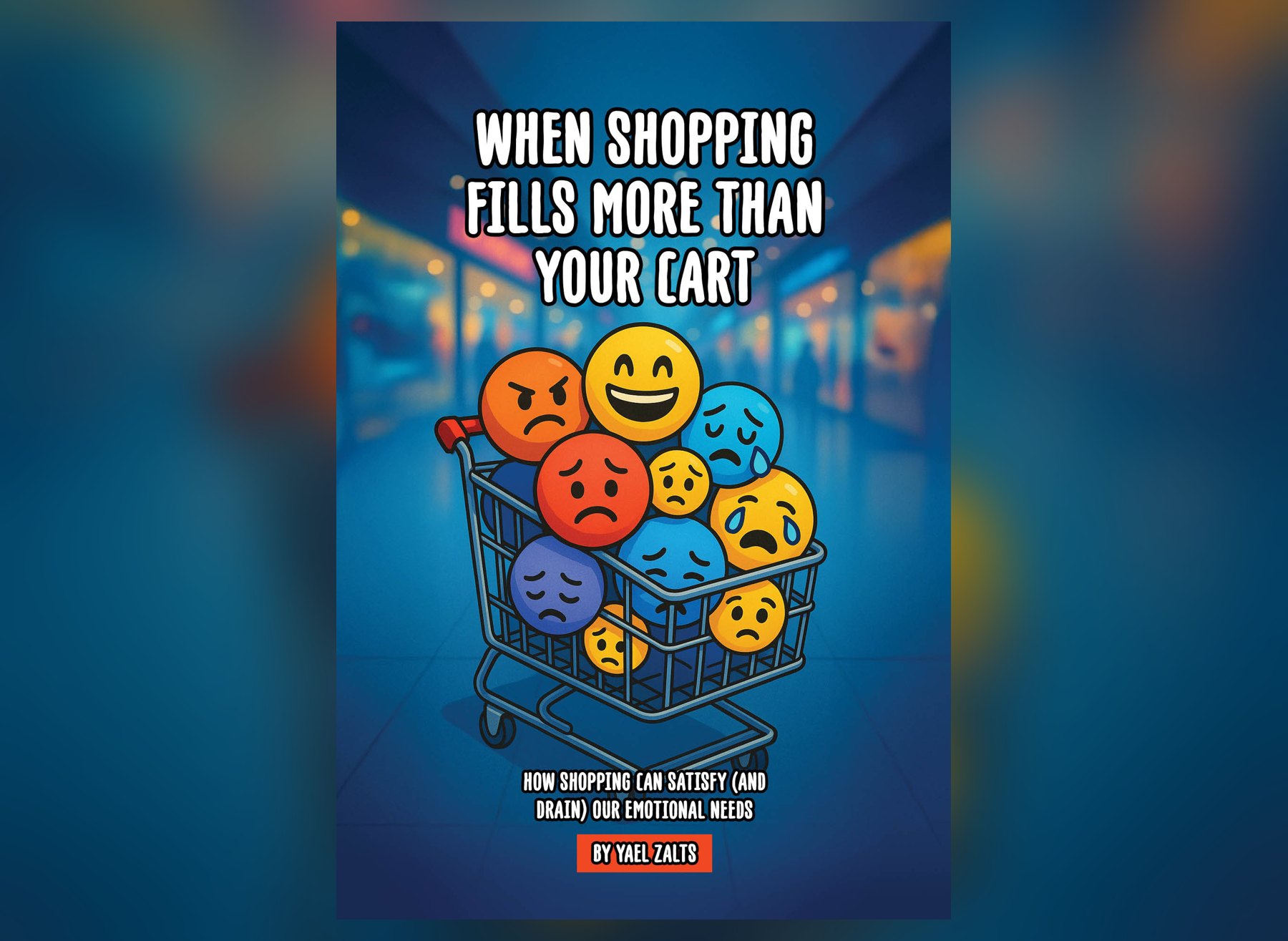
“Who wants to go shopping?”
In many homes, the answer is already known in advance. In almost every family, there is that person who takes on the role of ‘foreign minister’ and eagerly takes charge of the family’s shopping. Every request, regardless of the weather, will be answered with joy, and every problem—of any type—will be solved in their way by another purchase.
“What’s the problem? Let’s buy a new iron.”
“Why argue? Buy one for her too.”
“Don’t cry, we’ll buy you a new one to replace the broken one.”
“Are you bored? Let’s go buy an interesting craft.”
“I’m inviting a friend to study for a test, so I’m buying something for us to snack on.”
“It’s time for dinner. What should we eat? I’m going to buy something.”
Unnecessary Shopping
The refrigerator is packed to the brim, the toy drawers and clothing compartments are full, and colorful cans of canned and dry food are piling up on the pantry shelves, yet there’s always a desire to buy something else, something new, something not in the house. And sometimes the feeling arises that this behavior isn’t right, and we don’t need to buy so much.
We try to make a list in order to buy less, thinking: ‘If we put an organized list on the refrigerator, write down when an item runs out, go shopping once a week on a fixed day, decide in advance what to cook every day and what we need for Shabbos, and most importantly, set a firm and predefined budget—then, shopping will be under control.’
Really? Does budgeting and planning the shopping prevent unnecessary and emotional purchases? Marketers and salespeople prove that the reality is not like that. Today, no product is sold because of its features, qualities, and quality. Products are presented as those that will affect consumers’ lives in a special, magical, and desirable way. The product is not what it is; it is what it gives to the user. The examples call out to us from every advertisement and flyer: If you buy a certain product—you are a great mother; when you buy me, you will be successful and accomplished; when your kitchen is equipped with our devices, you’ll receive compliments.
The advertisement isn’t about the product but about the buyers, and it addresses their values, emotional preferences, and self-image.
The Shopping Experience: Fulfilling Emotional Needs
Why do advertisers appeal to emotions and values? Because shopping is meant to satisfy emotional needs.
The organized list deals with the benefits of the shopping process and the products we buy. In fact, the shopping process is better known as “the shopping experience,” an experience that product designers and shopping mall architects work hard to create. What do we feel when we shop? What do we want to feel, and why do we go on a shopping spree? What are the emotions that drive us to unplanned purchases?
Shopping Brings Joy

“For two Shabbosos, we didn’t have an appropriate cover for the challos because the previous one got worn out and completely unraveled, and here I found a new, creative cover, in the right color, with a special embroidery—much more beautiful than the one we had before, the one we got as a wedding gift. There’s no joy like resolving a doubt—until now, I didn’t know where I would find a new cover, and now that I’ve found such a good one, I’m really happy.”
“My mood was low, the house was messy, and the kids were cranky. I decided to go out with them. Where? I took my wallet, and we went. We went into a few stores, bought some toys to keep them busy, candies to calm them down on the way, something for the house, and something for myself—that I wanted for a while—and we came back home tired but satisfied. I put them to bed and tidied up everything, putting on the counter what I bought for the kitchen—amazing.”
Shopping As a Surprise Adventure
“We went out to buy a pair of pants for the nine-year-old, and came back with three dresses for the girls and a sun hat for the baby. I bought shirts for Shabbos and cheap slippers for the little one. Good thing they had bags—how else would I carry all these things? You always need good bags. Did we buy pants? Of course. Two pairs. After all, that’s why we went out…”
You never know what you’ll find in the stores:
Did you know there’s a device that dispenses bags? Did you know that stickers are made today that don’t come off in the heat? That you can buy cork lids for bottles and colorful fabric covers for plastic containers that lost their original lids? And that there are powders you can make instant cakes with? That corn flakes can come in mango-coconut-watermelon flavor? Have you ever seen honey and milk shampoo?
If all these things are made, then people must be buying them. They try the taste, test the experience, and come back to purchase more surprising products.
Shopping As Renewal and Change
“A low, stylish cabinet for the phone changes the entire look of the entryway and the atmosphere. Since we bought it, I’ve noticed that the kids are making more of an effort to keep the area tidy. The cabinet helped me refresh the organizational habits of the people in the house, and b’ezras Hashem, it will last until the next purchase.”
The ‘Shehechiyanu’ bracha recited on a new garment highlights even more the renewal experience that comes with shopping. We thank Hashem for the ability to buy a new garment, wishing each other a year of renewal, enjoying the garments, and hoping to buy new ones again and again. Renewal is one of the most enjoyable parts of the shopping process for any product.
Shopping: Opportunity for Us to Prove Ourselves
The various purchase options and many sales give us a wide range to apply our judgment and make informed shopping decisions. Much has been said about savvy consumers who are hard to confuse, as opposed to those who are tempted by any discount without verifying that the purchase is worthwhile.
We believe we are smart people, and the shopping process gives us a chance to prove this to ourselves and others. We knew not to buy X and realized it was better to purchase Y instead; we were clever and smart enough to take advantage of double discounts, and instead of buying the recommended product we bought another one, which was actually cheaper and more worthwhile.
We eagerly share our wisdom with our friends, whom we care about, and explain to them the logic behind our purchases. In our daily routine, we operate automatically—getting up at the designated time, preparing the usual cereal, going to the usual workplace, and following the rules there. Shopping gives us a chance to express our hidden talents. Moreover, discount deals present a real challenge for beginner and advanced accountants. Calculating how many free minutes, how much per 100 grams, and how much we’ll pay in the end for prime plus three-point-four—when we crack the discount calculation method, we feel even smarter than the marketers themselves.
Shopping Helps Us Form Our Identity
“When I buy the shampoo that my mother bathed me with, and I bathed my children with when they were born, and I give it to my daughter-in-law—on the happy occasion of the birth of our grandchild—I know I’m doing the right thing. This shampoo has the real scent of babies—just as a well-cared-for baby should be.” What is a good mother? The definition is so elusive, complex, and subjective. Buying shampoo can instantly buy you that title.
“Girls who wear a shirt with that logo, they are the ones who know what’s going on today, and they are reckoned with, because they know. If I wear what they wear, it means I am one of them, with all that implies.” Try asking a teenager what exactly that implies, and she will fervently explain to you that it means everything. What exactly? It’s a feeling. Clearly, anyone who has a particular bag, wallet, and skirt is a very specific person. The desire to belong to a group makes us buy products that associate us with that group.
Shopping Makes Us Unique
Without contradicting the fact that shopping helps us feel we belong, shopping also helps us be special. Only we have a certain product; we bought the standard, but we upgraded and improved it. You can buy this product in several variations, and we chose one of those because it reflects our personal taste.
Every time we choose, we feel special, not like the rest of the herd, providing ourselves with a unique experience of using a product made just for us. A custom order of furniture, clothing, or a flavor combination at an ice cream stand gives us this in exchange for payment—not always high.
Shopping Expresses Love
A kalla receives gold when she gets engaged, because gold says more clearly than words: “You, our dear kalla, are more precious to us than gold and pearls. See how much money we spent to make you happy!” The message of the gift is—if I spent money on you, it means you are precious to me.
When it comes to a new daughter-in-law in the family—who isn’t well known yet—the message holds. But when it comes to children whom we value for their character, personality, and what they mean to us—using the price of the gift as the basis for evaluating the importance of the relationship is wrong and misleading.
Still, parents and children often signal that shopping for someone should prove how much we love them. Parents sometimes say, “I buy you exactly the candy you love because I love you,” or, “I wasn’t home, but I didn’t forget you, and I brought you gifts.”
Children may even conclude, “You don’t buy me what I ask for—because you don’t love me.” Buying desirable products for those we love is meant to express our feelings toward them, and the more, the better.
Meeting Emotional Needs
If shopping meets such complex and numerous emotional needs, it’s no wonder we buy so much… Missing out on a good purchase is accompanied by a feeling of bitter loss. Why? Because emotional needs must be satisfied. We need to feel joy, we need change and renewal. Deep in our hearts, we need to feel loved, that we belong, that we are important, and that we have the option to choose and express our uniqueness. There is no avoiding the fulfillment of these needs.
However, it is clear and obvious that fulfilling emotional needs through shopping is temporary, fleeting, and requires money for the next purchase to again satisfy the emotional need that only intensifies. When we get used to change and renewal, to joy and attention that come with shopping—we become dependent on money, managing an unbalanced budget to balance our emotions.
Shopping and the Family Budget
At the beginning, I wrote that some believe it’s not right to buy so much, and that shopping is not the solution. Why? Because of the budget. But a discussion about the family budget is not a discussion about money. A family that wants to live on a balanced budget cannot merely compare income to expenses. Emotional needs will take their toll, and there will always be exceptions and necessary purchases requested by the children, demanded by the daughter, and that cannot be refused.
We parents, will find ourselves in a dilemma and a sense of guilt for not providing the children with what they need, thus justifying more purchases that lead us into the red at the bank and disturb our peace of mind.
To manage a family budget, one must understand the emotional needs of everyone in the house and provide abundant love, attention, and joy. In our home, these values are not bought in stores, nor purchased at season’s end. We fulfill our spiritual and emotional needs and express our sense of belonging in real and appropriate ways.
We love our children through listening, empathy, hugs, and time spent with them—not by compensating with expensive toys. We create joy and renewal through Torah study, learning halacha, engaging stories, and understanding the depths of the soul—not through purchasing a new bag.
We, the parents and educators, express our free will and uniqueness when we stand by our principles and do not compromise in the realms of education, worldview, and halacha.
The above points have been raised for reflection and awareness. Each person will find the right way to discuss the budget with their family, recognizing everyone’s values, emotions, and feelings. A deep and understanding conversation will give everyone a sense that we are not trying to “save at their expense” and not disregarding their needs. On the contrary, through understanding the deepest needs, we will manage a proper budget, and instead of a fleeting answer, we will provide a true and eternal solution.
Beis Moshiach #1457 • pp. 42-45, 50
© 2026 Beis Moshiach Magazine. All rights reserved.
This article originally appeared in Beis Moshiach #1457. You are welcome to share it with friends and family by email or in print, provided that you do not change, add to or omit any part of it, you credit the author and Beis Moshiach, and you include a link to archive.bmoshiach.org (written out in full in printed copies).
To republish this article in a newspaper, magazine, book or website, please request permission in advance at [email protected].