Soul Surgery
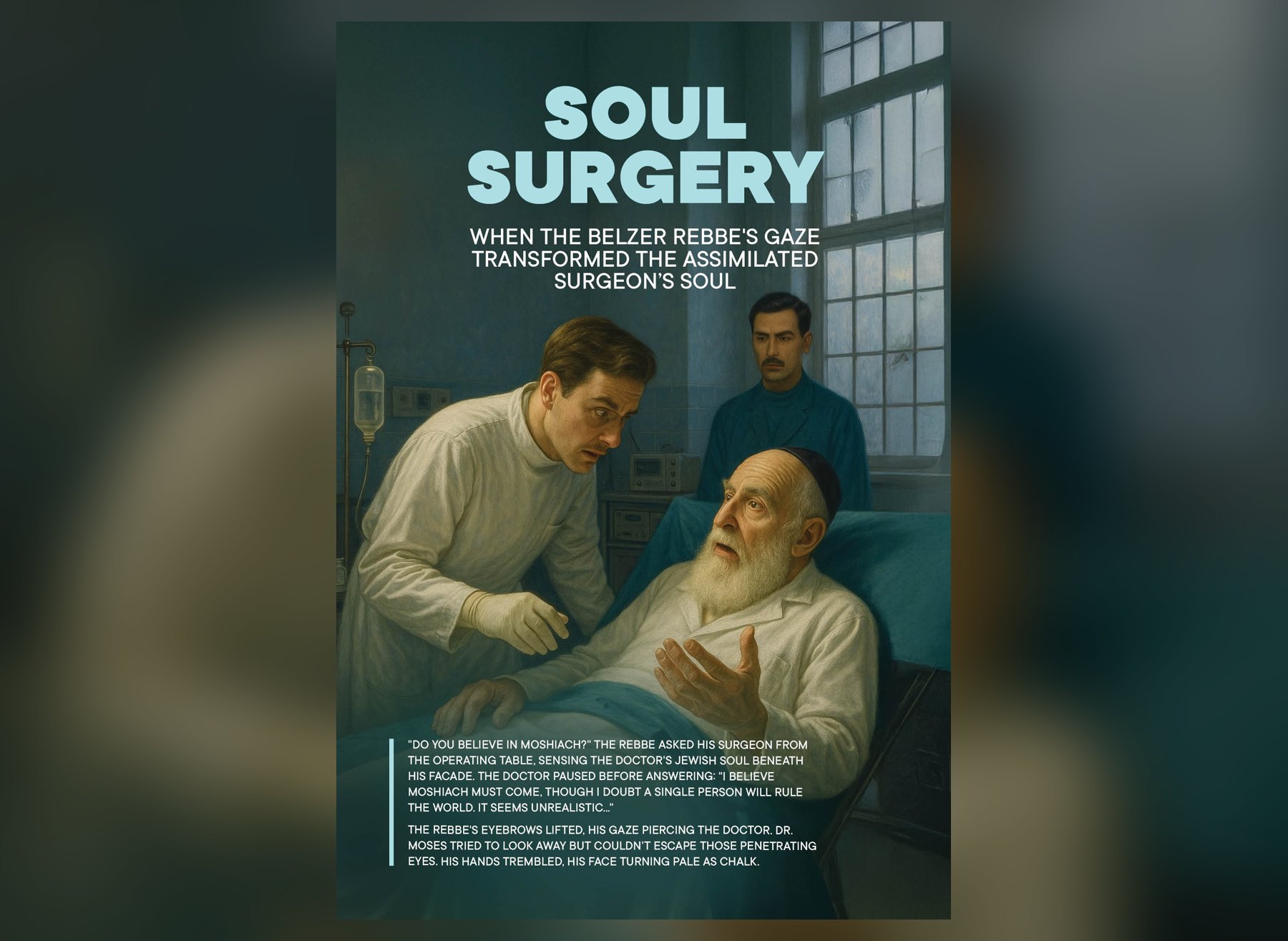
“Do you believe in Moshiach?” the Rebbe asked his surgeon from the operating table, sensing the doctor’s Jewish soul beneath his facade. The doctor paused before answering: “I believe Moshiach must come, though I doubt a single person will rule the world. It seems unrealistic…” The Rebbe’s eyebrows lifted, his gaze piercing the doctor. Dr. Moses tried to look away but couldn’t escape those penetrating eyes. His hands trembled, his face turning pale as chalk…
I
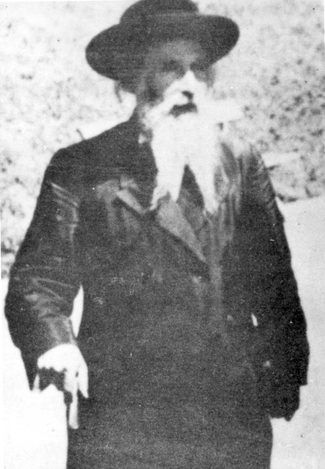
Rabbi Yehoshua Rokeach zecher tzaddik v’kadosh l’vracha, the second Rebbe of the Belz Chassidic dynasty, was among the greatest of giants. His wisdom, Torah scholarship, and sanctity were renowned by all.
Yet, more than any other trait, the Rebbe was known for his ruach ha’kodesh. Many times, he would relate things that would occur in the future. At the time of their utterance, his words were generally too obscure for his followers to comprehend. Only after events had unfolded and were clearly fulfilled would the Chassidim come to understand the depth of his words.
One of Rabbi Yehoshua’s devoted followers was the Belzer Chassid and Torah scholar, Rabbi Shaul Brach, who served as the Av Beis Din in the community of Magendorf (and later in the cities of Karoly and Kashau). Reb Shaul was great in his Torah knowledge and piety, leading a life of extreme asceticism; nevertheless, he was like a compassionate father to his community – caring deeply for their needs and, when necessary, fighting their battles.
It was during one of Reb Shaul’s first journeys to his Rebbe, Rabbi Yehoshua of Belz, seeking to bask in his spiritual aura. Reb Shaul’s heart pounded with excitement as he saw the first houses of the town of Belz in the distance. When he merited entering the Rebbe’s room, a frightful awe seized him.
The tzaddik looked into his face with soft, kind eyes, took the kvittel from his hand, read it, and said gently: “I know you well. Nothing is hidden from me.”
Suddenly, the Rebbe’s expression became serious. He pulled out a blank sheet of paper from a drawer, spread it on the table, and began to sketch the layout of the town of Magendorf, where Reb Shaul served as Rav. Then he marked Reb Shaul’s house, filled in many details, and drew the rooms of the house with precision – each room to its exact dimensions, including all the household items…
Reb Shaul stood in stunned silence.
The Rebbe then put the paper back in the drawer, looked at his Chassid and said: “You see, Rav of Magendorf, I know you well. Even your home – nothing is hidden from me!” Reb Shaul nodded silently in awe.
Before Reb Shaul left the room, the Rebbe blessed him to grow stronger and achieve greater heights in Torah study, and strengthen his yeshiva with many outstanding talmidim. Reb Shaul quietly responded, “Amen!” and left the room in amazement, barely able to whisper a single word: “Rebbe…”
II
At the start of the year 5654 (1893), illnesses began to plague the frail body of Rabbi Yehoshua Rokeach. His suffering became unbearable. His sacred avoda was disturbed. None of his Chassidim knew the details of his condition, but everyone knew he was in pain.
Yom Kippur arrived. A vast crowd of Chassidim gathered in the shul, dressed in white kittels, wrapped in talleisim. As the sun reached the tops of the trees, the Rebbe ascended the grand platform. Before beginning the Neila prayer, he delivered a tearful drasha based on the statement of Chazal: “Repent one day before your death.”
The massive crowd was silent. A heavy hush filled the shul. This was the first hint of his impending departure that year.
Even after Yom Kippur, he deviated from his usual practice. Normally, at the start of the new year, he would bless his children, grandchildren, and family members. That year, he said instead: “I wish to bless the entire holy congregation – the residents of the city and the many Chassidim who came here for the Yomim Tovim.”
Some time later, his condition worsened. Renowned specialists were summoned. “He must undergo surgery urgently,” they ruled. “Such an operation cannot be performed in Belz. He must be transferred quickly to a hospital in Vienna.”
Despite his agony, the tzaddik traveled to Vienna. Further tests confirmed the necessity of surgery – the sooner, the better. Rabbi Yehoshua fully understood his grave condition. He nodded in agreement but first sat at a table and, with awe, wrote his final will. He then immersed in a mikva, emotionally recited vidui, and ascended the operating table.
III
Among the operating surgeons was one named Moses – or by his full Jewish name, Moshe Yitzchok. He was a clever and resourceful Jew who had grown up in a small Jewish town called Leiden. His father raised him in Torah and good deeds, but young Moshe Yitzchok longed for the outside world. He found the small-town Jewish life too constraining. Upon reaching adulthood, he informed his parents he would be leaving for Vienna: “I want to see the world, enjoy life, and pursue higher education at the university. I have decided to study medicine and become a doctor,” he said decisively.
All his father’s attempts to dissuade him were in vain. That very week, Moshe Yitzchok left Leiden, traveled to Vienna, changed his name to Moses, and abandoned his Jewish heritage.
He enrolled in high school. His exceptional talents propelled him forward, and within months he graduated with distinction. Soon, he was admitted to the prestigious University of Vienna as a medical student.
Years passed. Moses became a world-renowned surgeon, bearing no trace of his origins. His clean-shaven face, styled hair, and mustache gave him a completely non-Jewish appearance… Now he stood before the operating table of the tzaddik, Rabbi Yehoshua Rokeach of Belz, waiting for the anesthesiologist to begin.
Suddenly, Rabbi Yehoshua turned his face toward Moses, looked him in the eyes, and asked in Hebrew: “You are a Jew, Moses. I wish to ask – do you believe in the Creator and Ruler of the world?”
The doctor was stunned, taken aback by the unexpected question. After a moment’s hesitation, he answered briefly: “Yes, Rebbe, I believe in the Creator of the world.”
The doctors continued preparing in silence. The smell of medicine was strong in the room. The surgery was about to begin. Yet something still troubled the Rebbe.
“And in Moshiach Tzidkeinu, who is to come and redeem us from exile at any moment – do you believe in him?”
The respected doctor was surprised by the second question. Still, he gave it a moment of thought and replied carefully: “I believe that Moshiach must come. I do not know when, and I am unsure if it will be as you say. But,” the doctor raised his voice, “I do not believe that a single person will rule the world. Such a thing is not realistic…”
Moses clearly struggled to express such views before the Rebbe, but he persisted.
The tension in the room rose. The Rebbe’s thick eyebrows slowly lifted, and his eyes fixed upon the doctor. Moses shifted uncomfortably, trying to avert his eyes, but the Rebbe’s gaze was piercing and inescapable.
His hands began to tremble. His face turned pale as chalk.
The other doctors watched in astonishment, not understanding the exchange. Moses took a deep breath, trying to regain composure, but his spirit was shaken. Then the Rebbe quietly asked: “Now do you believe that a man can strike fear into others with a single look?”
Moses nodded silently.
“So it will be with the coming of Moshiach,” the Rebbe continued. “Terror will fall upon all who see him, and none will be able to resist. All will abandon their corrupt ways, and Moshiach Tzidkeinu will rule over the entire world.” The Rebbe raised his voice: “Everyone will repent of their perverse ways, and Moshiach Tzidkeinu will reign over all of humanity.”
Moses, now pale, nodded again: “Yes, Rebbe,” he whispered.
Hours passed. The surgery was successful. The tzaddik of Belz began recovering, while Tehillim were recited in every Shul and Beis Medrash across Galicia, piercing the heavens.
IV
At the hospital in Vienna, only a few were permitted to visit the Rebbe. Among them was Reb Shaul Brach.
As soon as he heard about the surgery, he rushed to Vienna and arrived just before Shabbos, Parshas Bo. He was allowed, with the Rebbe’s permission, to visit him.
Tears came to his eyes as he approached the Rebbe, who sat like a king, hiding his immense pain. When his devoted Chassid drew near, the Rebbe greeted him with a smile.
Reb Shaul handed the Rebbe a kvittel and stepped back in reverence. The Rebbe’s face suddenly turned serious. Deep lines formed on his forehead. His eyes stared at a distant point through the window: the spires and palaces of Vienna.
Suddenly, he snapped out of his reverie and, ignoring the note in his hand, began speaking softly:
“Listen, Rav of Magendorf. A Jew must remain strong and steadfast in his faith in G-d, even when facing hardship. Even in pain and suffering, even when in critical condition – like being taken to Vienna, placed in this hospital, in this room, and on this very bed – he must not despair. He must strive to recover. Because even after all these tribulations, he can rise from his bed, be fully healed without any trace of illness.”
“Not only that,” the Rebbe continued, “but he can rise from the lowest depths to the highest heights. He can eventually serve as the Rav of a great city, with a vast Jewish congregation, and even more than that – he can serve as the Rav of a major city, famous for its vibrant Jewish life.”
Reb Shaul Brach stood confused and frightened. ‘What was the Rebbe hinting at? Was the Rebbe referring to himself? Was he planning to become the Rav of a great city?’ he wondered.
He left the room bewildered and deeply unsettled.
Two weeks later, the tzaddik returned his soul to heaven. On the train back from Vienna to Belz, a minyan of Chassidim accompanied him – including the great doctor Moses, the very same Moshe Yitzchok, now a G-d-fearing Chassid…
V
Many years passed. The son of Rabbi Yehoshua, Rabbi Yissachar Dov Rokeach, ascended the throne of the Belz Chassidic dynasty, leading his community with strength and dignity. Reb Shaul Brach formed an unbreakable bond with him and became his devoted disciple.
That day was a gray, overcast one. Reb Shaul was in his large yeshiva, preparing for his regular shiur. While he was studying the sugya before him, a long, harsh cough suddenly overtook him. His face turned pale, and within seconds, he turned blue. His pupils reddened and bulged with strain – and a moment later, he collapsed.
His students rushed to him in alarm and laid him down on a bed in an adjacent room. One of them quickly brought cloths soaked in vinegar and placed them on his forehead. After a long few moments, Reb Shaul awoke, opened his eyes, and tried to raise his head slightly – but immediately collapsed again under the weight of great exhaustion.
Doctors examined him carefully and concluded that Reb Shaul was in serious, even critical condition. All the signs pointed to that – though they could not determine the exact source of the illness. “You must take your father immediately to Vienna,” they told his family. “There are expert doctors there who may be able to diagnose the illness.”
The family was shocked. They had not imagined that their father’s condition was so dire. Without delay, they summoned a wagon driver to take them to catch the next train to Vienna, which was due to depart soon.
Reb Shaul’s head was heavy. A deep weariness spread through his entire body, and dark circles danced before his eyes. His thoughts became muddled; everything before him grew dim. He tried to glance around one more time – when suddenly, he saw a Chassid sitting beside him. At first, he didn’t understand how this man had entered the closed train car. The Chassid’s kind eyes looked softly into his, and after a long silence, he gently stroked Reb Shaul’s forehead and whispered: “Do you remember, Shaul, what the Rebbe told you before his passing, when he lay sick and suffering in the hospital in Vienna? – Even in times of trouble, a Jew must place his hope in G-d and pray for salvation.” A moment later, the man disappeared.
Reb Shaul shuddered where he lay – and suddenly fell into a deep faint. The accompanying doctor immediately leaned over him, working to steady his breathing.
The doctor worked on the suffering patient for a long time. Finally, he turned to the family and announced: “Your father’s life has been saved. The illness nearly overtook him – a great miracle just occurred for him,” he murmured in awe.
Upon arriving at the hospital, Reb Shaul underwent thorough examination. “Yes, we know this illness,” the doctors said. “It’s a rare condition – but it can be treated. What the patient needs more than anything is rest and peace of mind. Recovery will require great strength.”
The family breathed a sigh of relief – a great weight lifted from their hearts.
A short time later, Reb Shaul opened his eyes, turned his head weakly, and looked around for a long time. The place looked familiar – but he couldn’t recall why. “But I’ve never been hospitalized here before,” he whispered to himself.
Then a strange fatigue overtook him again and he nearly drifted to sleep – when suddenly a flash of memory struck him: “This is the very room where the Rebbe lay before his passing,” he realized. “Not only that – but I’m lying now in the very bed where the Rebbe lay…”
Suddenly, the vision from that encounter reappeared vividly before his eyes. He clearly saw himself standing before the suffering Rebbe, who told him: “A Jew must not despair, even if he is in a terrible, dire state. Even if he has contracted a painful and serious illness – he must not lose hope.” The words echoed in his ears. The Rebbe’s voice continued to resonate as if from a mystical world. He also remembered the Rebbe’s guidance: “He must try and make the effort to recover. For even after all this suffering, he can rise from his bed and be fully healed – with no trace of the illness remaining…”
Several weeks later, Reb Shaul Brach left the hospital healthy and strong. He emotionally told his family all that had transpired during those past weeks. After a period of recovery, he resumed leading his community and giving his regular shiurim in the yeshiva.
VI
A few more years passed, and one day, messengers arrived in his town from the leadership of the city of Karoly, where thousands of Jews regularly filled dozens of magnificent shuls.
“The Rav of our city passed away some time ago,” they said, “and we would be honored if you would come and serve as his successor – the chief rabbi of Karoly.” The city’s leaders had already signed the appointment letter.
Reb Shaul agreed to their request. He packed his belongings and parted, with great sorrow, from the Jews of his town and from the diligent talmidim of the yeshiva.
It seemed to him that in Karoly, he would be able to lead his community in peace of mind. But less than a year had passed since his arrival, when additional messengers came – this time from the community of Kashau (Košice) – a great Jewish center in Hungary, even larger than Karoly, home to tens of thousands of yerei shomayim.
Rabbi Shaul’s heart was troubled. A full year hadn’t even passed since he became Rav of Karoly – and now he was being asked to leave his congregation again for a different city?
He was deeply torn. After struggling with himself and uncertain what to decide, he sent a letter to his Rebbe, Rabbi Yissachar Dov Rokeach, the third Rebbe of Belz, describing in detail his doubts and inner conflict.
Not many days later, the messenger returned from Belz with a reply from the Rebbe. The letter was brief: “Let the Rav of Karoly recall what my father, of blessed memory, told him in the hospital before his passing.”
Reb Shaul grabbed his head in both hands, and the letter slipped from his fingers. A cry of awe escaped his lips: “How could I have forgotten the Rebbe’s other words to me?”
He began to replay in his mind those special moments – when he stood before the Rebbe who was lying in the hospital during his final days:
“…And not only that – but from this deep pit, he will rise and ascend to the greatest heights. And afterward, he will be appointed as the Rav of a great city, with a vast Jewish congregation. And more than that: he will serve as Rav of a major city, renowned throughout the world for its vibrant Jewish life.”
All the Rebbe’s words had come true – with astonishing clarity.
“How far-reaching was the prophetic vision of the Rebbe,” he murmured.
He then summoned the messengers from the city of Kashau – who held the letter of rabbinic appointment in their hands.
Beis Moshiach #1460 • pp. 22-27
© 2026 Beis Moshiach Magazine. All rights reserved.
This article originally appeared in Beis Moshiach #1460. You are welcome to share it with friends and family by email or in print, provided that you do not change, add to or omit any part of it, you credit the author and Beis Moshiach, and you include a link to archive.bmoshiach.org (written out in full in printed copies).
To republish this article in a newspaper, magazine, book or website, please request permission in advance at [email protected].