The Overall Tzaddik With Polished Buttons
Rabbi Beroka of Chozaah used to frequent the marketplace of Lefet, and Eliyahu HaNavi would often appear to him there. One day, Rabbi Beroka asked Eliyahu: “Is there anyone in this marketplace who is destined for the World to Come?”
“No,” Eliyahu replied.
In the meantime, two men entered the market. Eliyahu said to Rabbi Beroka: “These two are destined for the World to Come.” Rabbi Beroka approached them and asked: “What is your occupation?”
They answered: “We are cheerful people [jesters], and we cheer up those who are sad.”
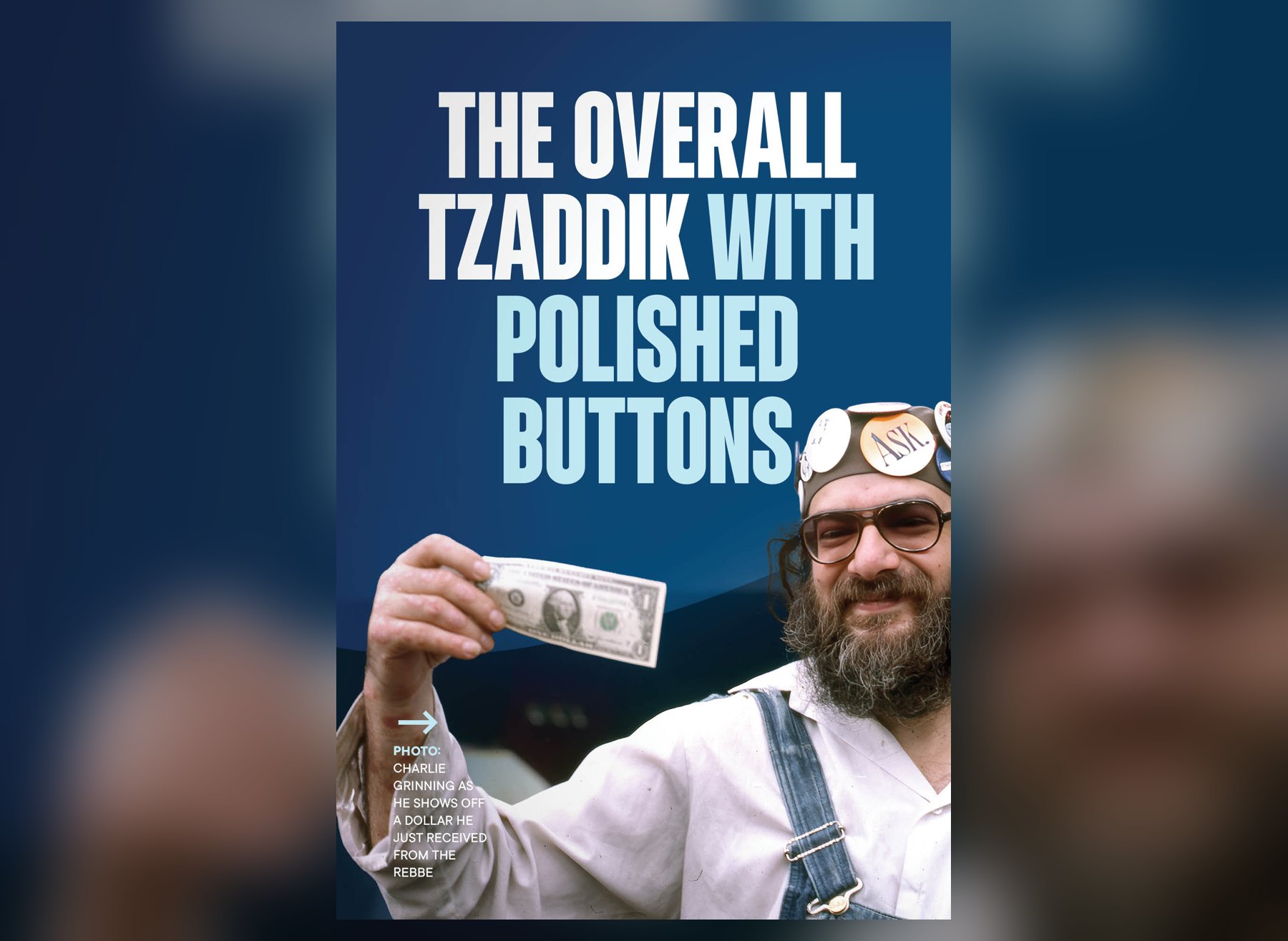
This story, found in Gemara Taanis, perhaps reflects the life and character of Tzadik HaLevi Nassofer, known to all Lubavitchers as “Charlie Buttons” – a colorful and unique personality in the Crown Heights neighborhood. He dedicated his life to bringing joy to Jews and putting smiles on the faces of many, including the Rebbe himself.
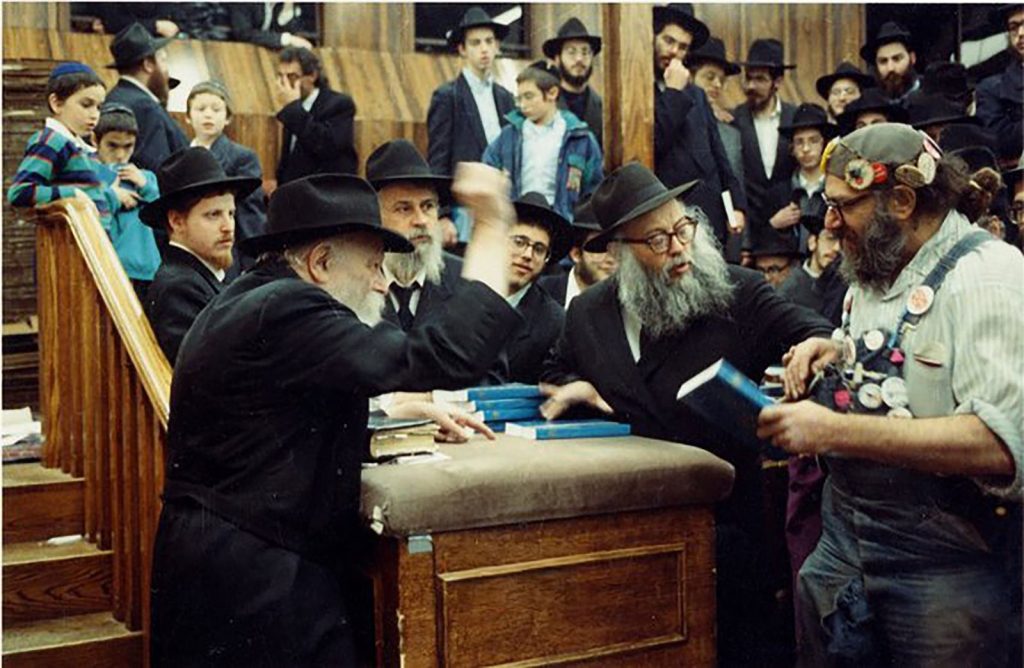
He passed away last week at the age of 81. Charlie was a unique and colorful figure who roamed Beis Chayeinu – 770 – and the broader Crown Heights community for decades. He became well-known for his unconventional outfit – denim overalls and a white shirt, adorned with countless colorful button pins bearing Jewish symbols and messages. Hence, the nickname “Charlie Buttons.”
Community members recount that he would always greet everyone with kind words and a heartfelt “Boruch Hashem,” spreading joy wherever he went.
Charlie’s Life
Tzadik HaLevi Nassofer was born on the 18th of Tammuz, 5704 (1944), to his father Yisroel Eliezer (Izzy) HaLevi Nassofer, the son of Russian immigrants. Charlie was born in Nebraska, where his father served in the military. Later, the family moved back to New York.
His father opened and managed a sewing machine business but passed away at a young age when Charlie was only ten. He left behind Charlie and his two younger sisters. Their widowed mother raised the three children alone, working as a secretary and bookkeeper at the local Jewish center.
Charlie grew up in a neighborhood where Jewish families were a minority, yet Jewish awareness was present. They participated in local Jewish classes. He was a good and bright child, well-liked and academically inclined, studying technology in both high school and college.
His distinctive first name – Tzadik – stood out from childhood. Few knew his real name, as he eventually became widely known as “Charlie Buttons.
As a young adult, Charlie lived in Manhattan, where he first encountered Chabad shluchim who distributed Shabbos candles as part of the Neshek campaign. He once said how a Chabad woman came to distribute Shabbos candlesticks at a weekly singles group that met in various Manhattan shuls. Inspired by the idea, Charlie wanted more to share with others and was directed to Rabbi Kastel in Crown Heights. He took the subway there, where Rabbi Kastel asked him to put on tefillin and join events – and that’s how he came to Crown Heights.
From then on, he became a frequent visitor and eventually a permanent fixture in the neighborhood and at 770.
Charlie never married but devoted his life to bringing joy to Jews, embracing the Chabad community as his extended family.
A well-known anecdote recounts how, one day a year, after the annual Gemilus Chesed dinner, Charlie showed up dressed in the uniform of the Chesed organization, for an entire day – a show of gratitude and support, instead of his usual denim overalls.
Colorful Personality
Over the years, Charlie became a well-known figure in Crown Heights – easily recognizable by his thick beard, baseball cap, perpetual denim overalls, and especially his dozens of button pins with Jewish and Chassidic messages, such as the Rebbe’s ten mitzva campaigns, Tzivos Hashem, and Camp Gan Israel. He wore them proudly, spreading smiles and good vibes.
Charlie dedicated most of his time to community celebrations – for decades he appeared at nearly every bris, wedding, or bar mitzva in Crown Heights. He never needed an official invitation; he always knew where to go and was always welcomed warmly.
He would greet the celebrants with a heartfelt “Mazal Tov,” would say a l’chaim with them, and sometimes deliver a brief speech in English in his unique style. Topics he was passionate about included the coming of Moshiach and shleimus ha’aretz. When he spoke about these, his voice would boom with excitement, and he often raised his hand to form an ‘L’ shape – for Lubavitcher Rebbe.
He would then take out dozens of colorful balloons to give to the children, brightening the celebration even more.
“How did you come to make people happy at weddings?” Tammy Holtzman once asked him.
“I knew Rabbi Dworkin z”l, the rabbi of Crown Heights. He told me it’s a big mitzva to bring joy to grooms and brides. Since then, I’ve been attending weddings every night, bringing balloons to increase the happiness.”
“Charlie was an inseparable part of our childhood in Crown Heights,” wrote one community member. “He taught us about real simcha and simplicity. We learned from him that we don’t need a lot to bring joy to others; it’s enough to have a balloon, a smile and a big heart.”
Charlie also had a fixed “route” on Friday nights: he would go to every shalom zachar gathering in the neighborhood, drink a shot of mashke, say “l’chaim” to honor the new baby, and bless the parents.
“I’m happy when others are happy,” he said. “I’m not especially happy myself. I was fired from my job a number of times and it was frustrating. I attended numerous weddings but I myself am still not married. I told the Rebbe I hoped for improvements in my life. He told me: ‘It’s never too late.’ I still hope to have a job and a family. Meanwhile, even though my situation isn’t joyful, I love bringing joy to others.
“At first, I only attended weddings, mitzvas simchas chassan v’kalla. Then I thought, it’s a shame I don’t attend the vort too; I bring joy to the chassan and kalla there. From there it went to brissin, shalom zachars, melava malkas, etc. When asked how he found out about all these events, he replied: “I have angels. Some are regular, some not so much.”
Charlie added, “It’s exhausting to attend so many events each night. Some people are kind and offer me a ride. Others pass me by in their cars, heading to the same event – and they just don’t care,” he said with disappointment.
Despite his unusual appearance, the Rebbe always encouraged and uplifted Charlie. He gave him a sense of belonging, love, and acceptance, which kept Charlie returning again and again.
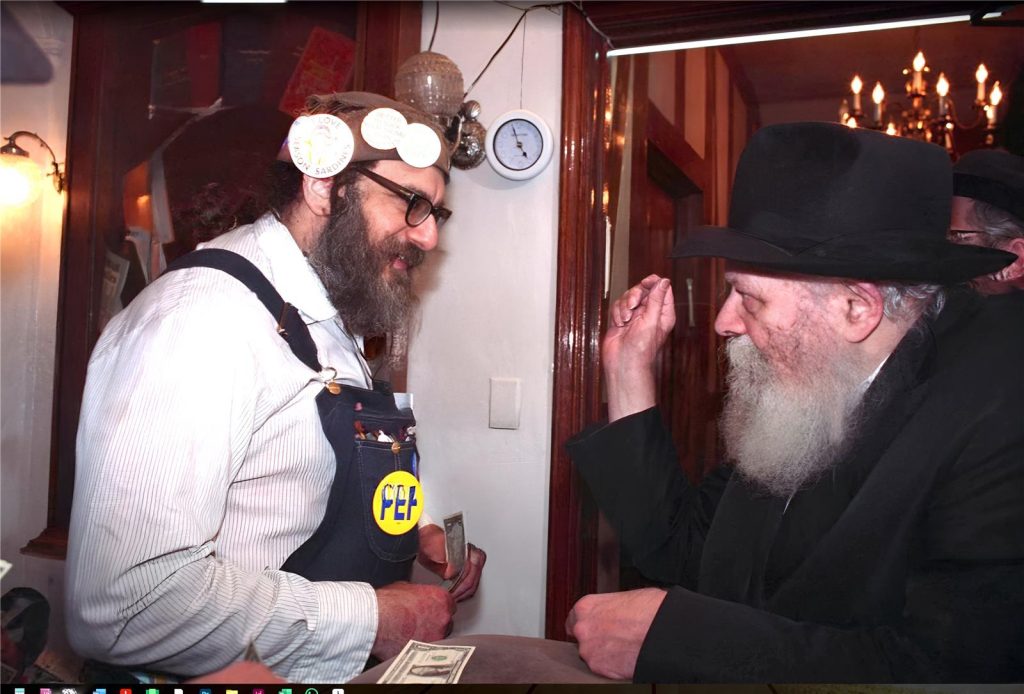
Often, the Rebbe would look toward Charlie and smile. This was especially apparent at the end of farbrengens, during the distribution of ‘kos shel bracha,’ or on Sundays during the ‘dollar distributions.’ Charlie would approach the Rebbe, receive a dollar or a blessing, and then raise his hand in the familiar ‘L’ sign, shouting, “Long live the Lubavitcher Rebbe!”
Charlie once shared how he lost his yarmulke while swimming at Long Island beach. “I wrote to the Rebbe,” he said.
“And what happened?”
“The Rebbe sent me a new yarmulke,” he answered.
In his early years in Crown Heights, when he took the train on Fridays, Charlie would often see the Rebbe walking from his home to 770.
“I would tell him things,” Charlie said. “I told him about myself and what I do. And the Rebbe would respond.”
“What did he say?”
Charlie fell silent.
“That was the essence of his life,” said one acquaintance. “The Rebbe’s personal attention gave him the drive to keep spreading joy and good deeds, knowing the Rebbe was proud of him.
“At every farbrengen, just after everyone answered ‘Amen’ to the Rebbe’s blessing, Charlie would shout his own loud, rolling ‘Aaaaamen!’ that echoed through the hall, making even the Rebbe smile.”
A Children’s Book About Charlie
Charlie Buttons’ colorful character extended far beyond the boundaries of Crown Heights – and often made headlines and coverage in Chabad and even general media.
One of the memorable stories is his surprising participation in California’s grand Lag B’Omer parade in 5771 (2011). That year, the Rebbe’s shluchim in Los Angeles organized an impressive unity parade on Pico Boulevard, with thousands of children participating from throughout the region.
Suddenly it was announced over loudspeakers about the parade’s “guest of honor” – a special Grand Marshal who had come from New York: Charlie Buttons! Hundreds of children cheered as Charlie appeared at the parade entrance, sitting confidently atop an open American car and waving his hands in all directions.
“Thousands of smiling faces welcomed Charlie,” news sites reported, “and he, in response, quickly blew colorful balloons and distributed them to the enthusiastic children.” For many of the young participants, this was the first time they had the privilege of meeting the “famous Charlie” about whom they had heard stories. Overnight, Charlie became the darling of California’s children, just as he was beloved by New York’s children.
In 5776 (2016), an illustrated children’s book was published titled “Charlie Buttons and Yossi’s Baby Brother’s Sholom Zochor” – a book telling the adventures of Charlie at a wedding, bris mila, and sholom zachar from the perspective of a boy named Yossi. The book was written by Yaffa Leba Gottlieb, who said she was greatly influenced by Charlie’s character. Part of the book’s proceeds went directly to “Charlie’s Balloon Fund” – a special fund that helped finance the balloons Charlie distributed to children at celebrations.
Brochures about Moshiach would prominently stick out of the front pocket of his overalls. When he was on the train, he would do “mivtzaim.” Before he got off the train he would announce: “Here is the home of the Messiah.”
People on the train would ask him questions, and he in turn would ask back if they know who the Messiah is.
“Well, do they know?”
“Not all of them.”
“So what do you do then?”
“I tell them!…”
In His Later Years
In 2020, when his health deteriorated, Charlie moved to live in a Satmar nursing home in Williamsburg. Even there, in the new place, he didn’t abandon his way of life. Groups of tmimim and community members from Crown Heights organized special visits to him during holidays, brought him mishloach manos on Purim and the dalet minim on Sukkot.
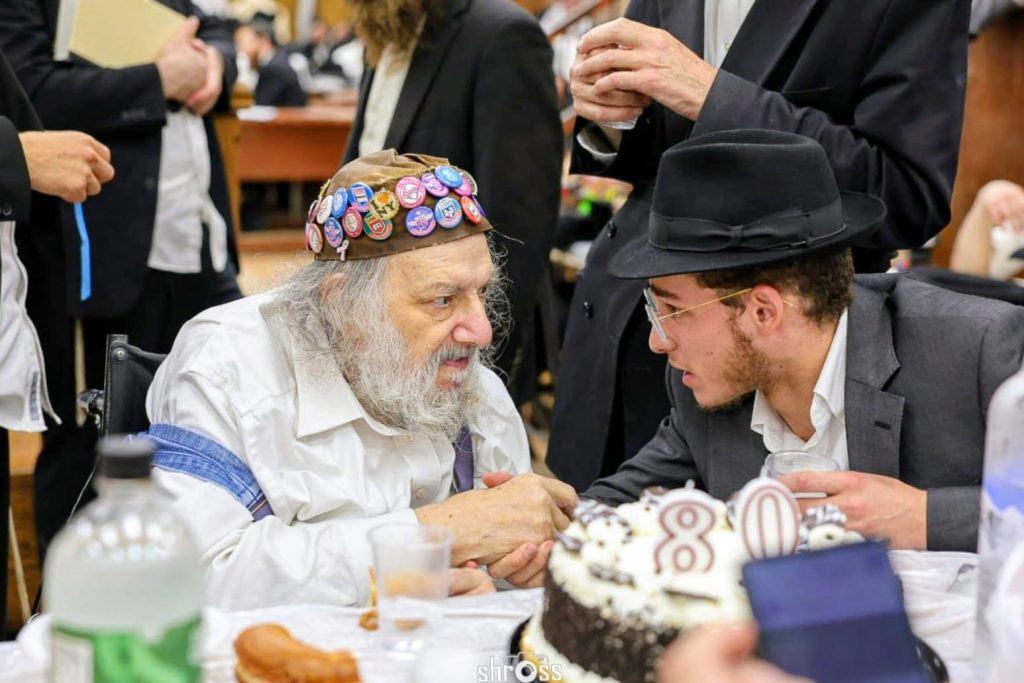
The last time he appeared at 770 was last year, when he turned 80. The farbrengen was organized for him by tmimim, young married men, and senior citizens, during which the crowd said ‘l’chaim’ in his honor and wished him heartfelt blessings. At the end of the evening, Charlie was presented with a touching surprise gift: a large, framed picture of himself receiving a dollar for tzedaka from the Rebbe – with the Rebbe looking at him and smiling broadly toward him. Charlie looked at the picture and tears choked him up. He hugged the picture warmly – and thanked all those present from his heart. This was apparently his last great joy in this world.
Charlie’s funeral took place on Friday, 11th of Iyar. Despite the short notice and timing – erev Shabbos – hundreds from the community – many of whom remember him from a very young age – gathered in the courtyard of 770 to escort Charlie on his final journey. The funeral departed from ‘Beis Chayeinu,’ the place that had been home to him for over a jubilee of years.
He was buried in the Mount Hebron cemetery in Queens, and community members ensured there would be a minyan to escort him with final honor.
* * *
“Charlie reminded us that everyone can be a shliach and contribute their unique part to the world. With Charlie this was expressed in spreading joy and smiles; telling everyone about the coming of Moshiach; and bringing a smile to the Rebbe’s face,” says one of the Crown Heights community members who knew him as a child, forty years ago. “Charlie expressed the tmimus and true joy of a Chassid. He reminded us, amid all the seriousness of life, that the Aibishter also loves simple joy.”
One of his acquaintances who participated in the funeral adds: “He was a person who knew how to bring joy to every Jew. There are people who teach Torah through their analytical ability, there are those who through their personality show what Ahavas Yisrael is. Charlie taught us that one can be a jester in the positive sense – to bring joy and a goodhearted feelings to everyone.”
“Yechi Charlie!”
Recently, I wrote an editorial about activism (Issue #1456) – contrasting positive models with less positive ones. I intended to return to this subject and elaborate further and I still do. But in the meantime, the Chabad community lost one of its most beloved figures: a person who was neither a mashpia, shliach, rabbi, nor even an average, run-of-the-mill Chassid. Yet no one doubted Charlie’s love and dedication to the Rebbe and his shlichus.
I believe Charlie represents the kind of activism we must emulate. No, I don’t mean you should start wearing buttons on your hat and overalls on your shoulders. I don’t mean you should necessarily repeat the same speech that Charlie delivered hundreds, if not thousands, of times at every Siyum HaRambam, shalom zachar, l’chaim, wedding, and subway car (he attended every one…) — a speech which I remember to this day because we memorized it as children in camp.
But I think we should all embrace the spirit of who Charlie was.
Charlie wasn’t a regular person – but that’s exactly the point. The message from Charlie is that a Jew, a Chassid, has to be obvious, just like Charlie was. No one had any doubt about what Charlie represented. It has to be clear to anyone who meets us exactly what we represent. If we believe in something, it should not be a secret. And if it’s right to believe in it, then it’s right to talk about it and to teach about it proudly just like Charlie Buttons.
At the same time, we must not cause antagonism. We must come with a smile and with charm, so that even if people don’t agree with you the first time, they’re still happy to see you again. Charlie was different from everyone else, yet he was loved by all. I’m sure not everyone at every shalom zachar or wedding he visited connected with some of his signature phrases like “Kever Never! Rebbe Forever!” But everyone connected to Charlie himself. Everyone loved him. And if someone thinks fondly of such a person, he can also ‘swallow’ and eventually digest things he thought he cannot.
This is the type of activism that brings Moshiach – being unmistakably who you are while remaining genuinely lovable.
And remember this: “The Lubavitcher Rebbe is the Messiah of this generation, the Lubavitcher Rebbe is the Messiah of all generations. Let the word of the Messiah spread forth to all the nations: Israel is one land, one Torah, one people, and shall not be divided by the President of the United States and politicians in Israel as is being done; piece, by piece, by piece. There shall be no peace until Israel is one, for it says in the Torah: “From river to river, from sea to sea, from the river of Egypt to the river of Euphrates. Then the Messiah shall be revealed!”
— Levi Y. Liberow
Beis Moshiach #1463 • pp. 18-24
© 2026 Beis Moshiach Magazine. All rights reserved.
This article originally appeared in Beis Moshiach #1463. You are welcome to share it with friends and family by email or in print, provided that you do not change, add to or omit any part of it, you credit the author and Beis Moshiach, and you include a link to archive.bmoshiach.org (written out in full in printed copies).
To republish this article in a newspaper, magazine, book or website, please request permission in advance at [email protected].