Rescue From Morocco With a Dollar of the Rebbe

A story like Aviva’s (a pseudonym) – who was rescued from an Arab town in Morocco and arrived in Eretz Yisrael in recent months – is rare, even among the cases Yad L’Achim handles. It is a story of deep longing, spiritual yearning, and Jewish identity. Beyond the heroic rescue by the Yad L’Achim team, the story includes a dollar from the Rebbe, negel vasser, and a loving family reaching out to embrace a sister who had drifted away…
A story like A.’s – who was rescued from Morocco and arrived in Eretz Yisrael in recent months – is rare, even among the cases Yad L’Achim handles. It is a story of deep longing, spiritual yearning, and Jewish identity. Beyond the heroic rescue by the Yad L’Achim team, the story includes a dollar from the Rebbe, negel vasser, and a loving family reaching out to embrace a sister who had drifted away. It is a story that can inspire any woman to appreciate where she is, to pray for all Jewish women still in physical or spiritual exile to return home soon, and above all, for the collective soul of the Jewish people – Knesses Yisrael – which has long yearned to return to its Father in Heaven.
Rabbi Yechiel Revach, the Rebbe’s shliach in Agadir, Morocco, relates:
My wife and I have had the merit, boruch Hashem, to serve as the Rebbe’s shluchim in Agadir, Morocco, for over a year now. During this time, we’ve met many Jews from Agadir and surrounding cities. Eventually, we learned about a Jewish woman living in a nearby city called Inezgane. Her life story is extremely complex.
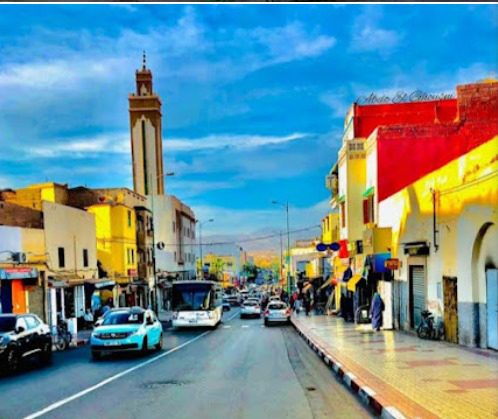
It’s important to understand that although Inezgane is very close to Agadir – just a few minutes’ drive – it’s worlds apart. While Agadir is modern, developed, and home to tourists and expats, Inezgane is large, underdeveloped, and considered an extremist Muslim city. Living there is, in many ways, like living in Gaza.
A. was born in Eretz Yisrael into the Pinto family, a well-known rabbinical family from Morocco. As a child, her family moved to France, and she attended Jewish schools. Her home was traditional, strictly observing kashrus, Shabbos, and chagim, with great reverence for rabbanim and gedolei Yisrael. Her father even brought her to receive a dollar from the Rebbe when she was a baby, and he clung to the Rebbe’s bracha for her during the difficult years that followed.
Despite the clear Jewish values at home, as a somewhat modern teenager, A. met a Muslim man in France – a Moroccan immigrant – and despite her family’s firm opposition, she married him. They had two children.
Following this tragic turn, her family moved to Israel, and over the years, contact with her was almost completely lost. She deeply missed them, but remained in France.
Eventually, her husband’s residency in France became problematic, and he had to return to Morocco. A. and the children joined him and moved into his family’s home in Inezgane, where extended families still live together. She and her children were given one room in the large family house and lived in dire conditions – both economically (in absolute poverty) and religiously. How is is possible to live in a Muslim city, with a Muslim family, who don’t view the Jew favorably?
A. said that her husband accepted her insistence on separating dishes, lighting Shabbos candles, and not eating chometz on Passover, but his family opposed these practices. She feared showing any signs of Jewish observance in front of them.
When we tried to visit her at home, we couldn’t enter unless her husband was there. She went to call her brother-in-law, trembling with fear. She said she was scared to walk the streets and hardly left the house. She and her children lived in constant lockdown.
A strong urge awakened in her: her children must know where they came from – that they are Jews. Her Hebrew wasn’t great, since she left Israel as a child, but she tried to speak Hebrew to them, use their Jewish names, and tell them everything she knew. As her oldest son’s bar mitzva approached, she was deeply worried: How would he celebrate it? Would he take on the mitzvos?
The Muslim schools they attended treated them poorly and constantly reminded them of their Jewish identity. One day, the teacher asked the class to draw a flag, and the younger child innocently drew an Israeli flag. A. panicked, afraid of the consequences.
Although the situation for Jews in Morocco is good and there is great respect for anything to do with Judaism, and there is even a royal decree to have protection for every Jewish mosad, still, a lone Jewish woman with two small children in a dangerous and overcrowded city like Inezgane is anything but safe.
As she grew stronger in her Jewish observance, she became more careful about kashrus. This meant they became almost vegetarian, as kosher meat was unavailable and unaffordable.
We would frequently invite her and the kids to the Chabad House, sending a taxi to bring them. During these visits, we taught them basic Jewish laws and practices – washing hands in the morning, Modeh Ani, Pesukim, and more.
One day, A. called us, excited: her son refused to get out of bed because they forgot to put a cup for handwashing beside it – he didn’t want to touch the floor with “impure” hands.
After each visit, we gave her bags of kosher meat and chicken. A., such a delicate woman, was uncomfortable receiving charity, but it was the only way to provide her children with kosher food.
At that point, it became clear: we had to help her separate from her husband and move to Israel.
Two major obstacles stood in her way. The first was psychological: this non-Jewish man was the father of her children, she had lived with him for years, and he treated her and the children kindly. Separating from him was emotionally hard.
The second was financial. She barely had money for food and clothes – how could she afford passports, documents, and plane tickets?
Then came the miracle: her non-Jewish husband agreed to everything. He supported her plan to go to Israel for a better future for the kids. She had reached such low state, with so much to contend with, spiritually and materially, that she began to realize that from this point on, she needed to just head upwards. She began thinking of visiting Eretz Yisrael and inviting her husband to follow her and convert.
In chapter 119 of Tehillim, it says, “I considered my ways and turned my feet toward Your testimonies.” The Baal Shem Tov explains that sometimes you need to be clever with the yetzer hara so it will enable us to do mitzvos. Someone who finds it hard to get up early to serve Hashem, promises himself a cup of coffee. After the coffee he will also learn and daven, of course.
So, we discussed the idea that he might join her later and perhaps even convert, because it was extremely hard, psychologically, to separate her from him. When we spoke only of a temporary visit and the option of his joining her, this broke the psychological barrier and she was ready to seriously think of going to Eretz Yisrael. We knew that once she arrived in Israel, saw her extended family, and resumed a life of Torah and mitzvos, she’d realize that her true place was there and there was nowhere to return to.
We contacted Yad L’Achim. We knew only they could help. Boruch Hashem, they gave us the green light – financially, legally, and logistically. Tamar, a social worker from Yad L’Achim, contacted A., and things began to move quickly. Nothing stood in her way – not the flight suspensions due to the Gaza war, not bureaucratic hurdles, not even her layover in France. Everything was arranged perfectly.
When A. and her children arrived in Israel, her family was waiting at the airport and welcomed them with open arms despite the 15-year disconnect.
Seeing those photos here in Morocco brought tears of joy to our eyes – it felt like a rebirth.
“I Have the Blessing of the Tzaddik!”
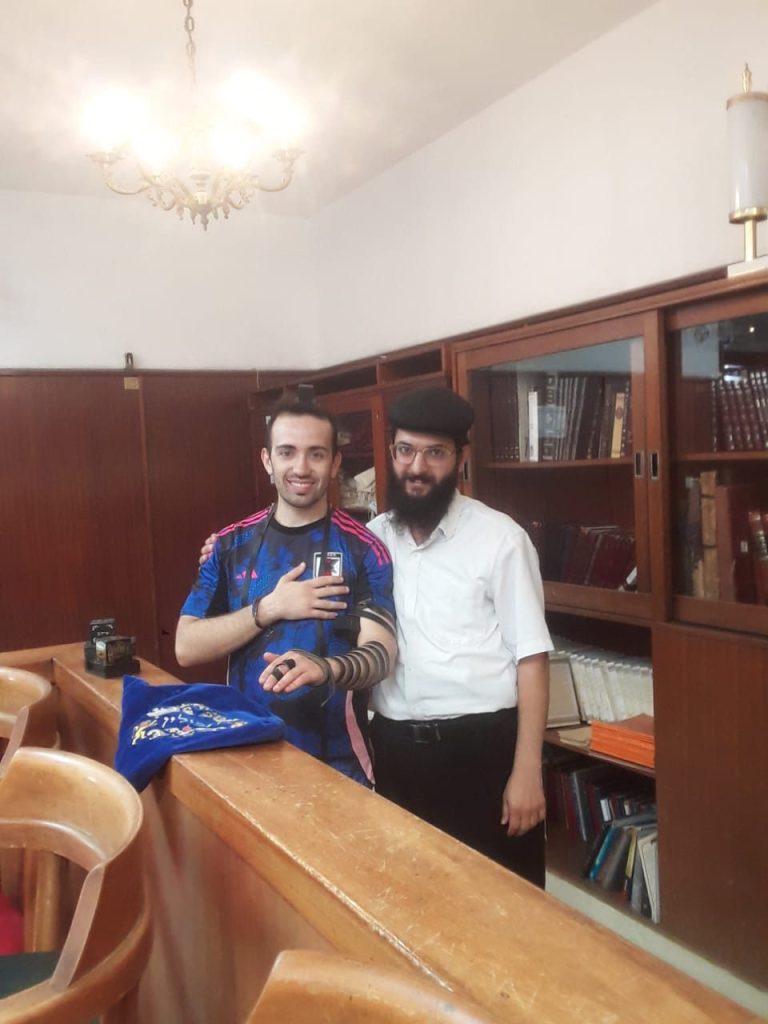
Tamar Carmi, social worker from Yad L’Achim:
My connection with A. began when the Chabad shliach in Agadir contacted Yad L’Achim. He spoke of a mother with two children, living in a remote area, coming to the Chabad House for Chanuka candle lighting and preparing her son for his bar mitzva.
Our contact became almost daily. A. would call or send voice messages filled with tears and gratitude. She had a burning desire to move to Israel with her children, but the task seemed impossible – flying, dealing with documents, and settling in a new country with nothing.
Though her family in Israel was ready to welcome her after years of estrangement, with the grandmother never having met her grandchildren, the economic and bureaucratic challenges seemed unsolvable to her.
She told me, without knowing I was a Chabad Chassida, how she had been held as a baby by her father when they went to receive a dollar from the Rebbe. She still keeps the photo. Even in Morocco, she often said, “I have the blessing of the tzaddik,” and she felt it protected her and her children. When I said, “The Rebbe is sending you good shluchim,” she knew exactly what I meant.
Encouraged by Rabbi Revach, I got to know a gentle, soft-spoken woman. She confided in me her worries about the chinuch of her children, how she had no way of raising them as Jews in such a remote Muslim area, and how she wanted to bring them to Eretz Yisrael to provide them with an open Jewish education and to reconnect with her family
Her Hebrew wasn’t bad, and her life had been hard from every angle, in a poor, distant place and big parnassa difficulties. But the one thing that was important to her, which she repeated in every conversation was giving her children a Jewish education. It was moving! With many girls, we see how the physical and psychological difficulties make them want to leave this kind of life and return to Jewish life, but with A. the only motivator was chinuch. The only thing she thought about was the spiritual fate of her children.
On Simchas Torah, war broke out, and their situation worsened. The children faced more antisemitism at school. A. felt an even stronger pull to Israel. Technically, things were complicated. Flights to Israel were canceled but she, as a French citizen, could travel to France.
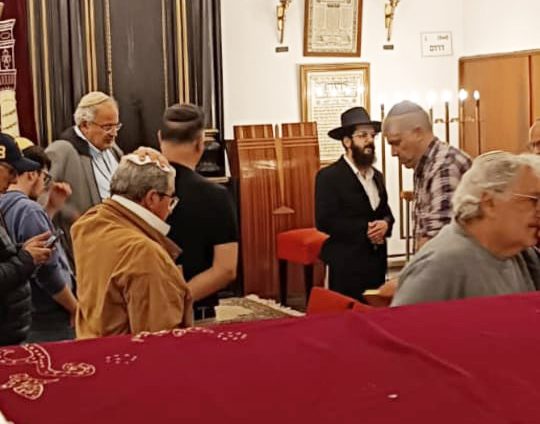
We got her tickets to France, hoping she could fly to Israel from there. She ended up stuck in Paris for three weeks. During that time, the greatness of the Chabad community in Paris became clear. Initially meant to host her briefly, they met her and her children – who arrived with only plastic bags, no luggage – and immediately adopted them and took care of all their needs. They gave her temporary housing, bought her suitcases, filled them with clothes and essentials, hosted them for Shabbos, and provided meals and everything else. She felt the Rebbe guiding her throughout her life – from infancy to this point.
She and her children arrived in Israel late at night. We had already contacted her family and notified them of her imminent arrival. Her entire extended family came to welcome her warmly after 15 years apart.
During her first days in Eretz Yisrael, she stayed with her mother, whom she met again after so many years. Afterwards, we arranged an apartment for her, and she also found a nice job that allows her to leave the house and support herself and her children.
It’s important to note that she receives intensive support from a social worker on behalf of Yad L’Achim. A mentor was appointed for the children to help them, at their own pace, become familiar with Jewish values and integrate into society. Additionally, Yad L’Achim provides generous assistance with rent, enabling them to live independently and adapt to life in Israel.
For A., above all – are the children, for whom she cared so deeply. They are now here, in Eretz Yisrael, getting to know their extended family, and b’ezras Hashem, will very soon be integrated into a proper Jewish education, just as she always dreamed.
Beis Moshiach #1466 • pp. 46-49, 50
© 2026 Beis Moshiach Magazine. All rights reserved.
This article originally appeared in Beis Moshiach #1466. You are welcome to share it with friends and family by email or in print, provided that you do not change, add to or omit any part of it, you credit the author and Beis Moshiach, and you include a link to archive.bmoshiach.org (written out in full in printed copies).
To republish this article in a newspaper, magazine, book or website, please request permission in advance at [email protected].