Dancing Among the Vines
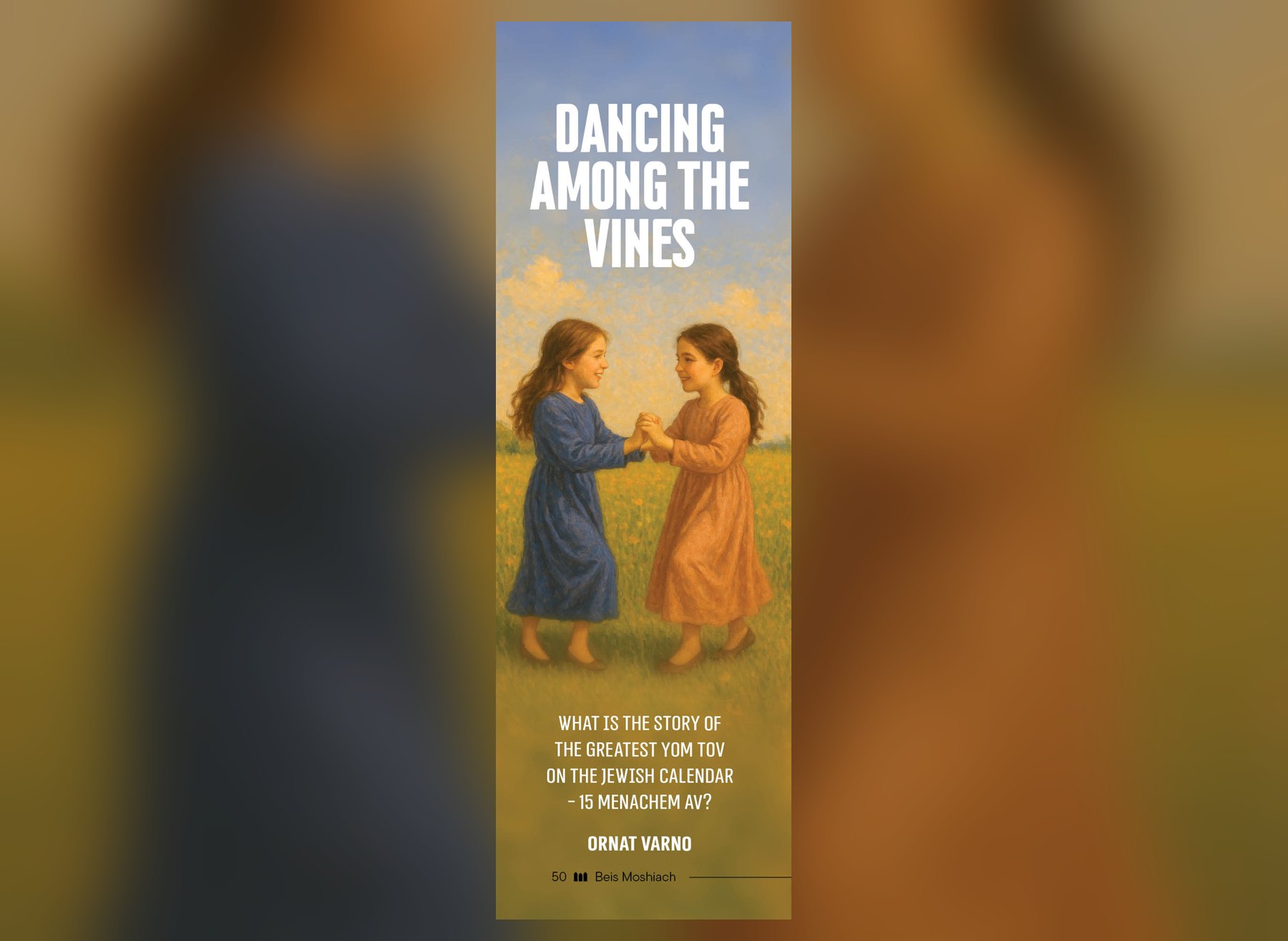
What is the story of the greatest Yom Tov on the Jewish calendar – 15 Menachem Av?
The Three Weeks are a time when Hashem and the Jewish People as a whole are becoming distant from one another. The climax comes on Tisha B’Av, the day when the house that served as their meeting place was destroyed. In a surprising way, specifically on this day, there appear the buds of a renewed sense of closeness between G-d and the People of Israel, arousing a feeling of hope for the building of a new Beis HaMikdash. At the conclusion of Megillas Eicha, which we read on Tisha B’Av, we request: “Restore us to You, Hashem, that we may be restored! Renew our days as of old.” This is a request for a renewal of the days, i.e., a request for a renewal of the Jewish circle of time.
Re-Building
In practical terms, you can say that on Tisha B’Av, one chapter has been completed in the spiritual avoda on the circle of time for the concluding year, and we begin the avoda of preparing for the new year, in which there lies the opportunity for teshuva and revitalization in connection with the building of a new home. Thus, a few days after the Destruction of the Beis HaMikdash, on the fifteenth of Av, we can already see the surprising and uplifting renewal of the connection between the Creator and the Jewish People, to the point that it is stated regarding this day: “There were no days as joyous for Israel as the fifteenth of Av and Yom Kippur.”
The connection between Hashem and Am Yisrael is compared to a connection between a man and a woman. In fact, the renewal of the connection between G-d and the Jewish People expresses itself in our world as well by renewing the connection between half-souls and establishing Jewish homes according to the Torah. We learn from our Sages, of blessed memory, that the fifteenth of Av is “the day on which tribes were permitted to enter one another’s [tribe]” and “the day on which the tribe of Binyomin was permitted to enter the congregation”, after a period of time when the tribes were not allowed to marry into another tribe and the tribe of Binyomin was forbidden to be part of the congregation of Israel. In other words, this is a day of matchmaking designed to lead to marriage, a connection between man and woman until “they shall become as one flesh.”
How is the shidduch made?
On this day, the daughters of Israel were dressed in white garments, and they would “go out and dance in the vineyards” and say: “Young man, lift up your eyes and see what you choose for yourself. Do not set your eyes on beauty, rather set your eyes on the family. ‘Charm is deceptive, and beauty is naught, a G-d-fearing woman is the one to be praised.’”
With Timbrels And Dances
The Rebbe explains that the “dance in the vineyards” was actually a dance in a circle, and he compares the dance of the daughters of Israel to the dance of the tzaddikim: “In the future, the Holy One, Blessed be He, will arrange a circle-dance of the righteous.” At the dance of the tzaddikim in Gan Eden, those dancing are together in one circle, close to one another, whereas Hashem sits among them – in the middle of the circle. The matter alludes to the love and closeness between the dancers and the closeness between them and G-d.
We have already encountered the dancing women of Israel previously, after the parting of the Red Sea: “And all the women went out after her with timbrels and dances.” It’s interesting that in the two depictions, the dancers were described in the act of “going out”. From where did they go out and where were they going? At the Exodus from Egypt, it is clear that they were going out from slavery to freedom – but how does this relate to the fifteenth of Av?
The Rebbe explains that the fifteenth of Av is uniquely connected to the future Redemption, since it comes after the great descent of Tisha B’Av, a descent for the purpose of an ascent, until the greatest ascent of all – “so that the “Lion” [G-d] will come during the [month whose] sign is the lion and [re]build Ariel.” Thus, on the fifteenth of Av, there is an illumination similar to the future Redemption, and even on this day, there is a going out from a state of exile to a state of redemption.
In addition, the women express the desire of their soul and its prayer for the building of the Beis HaMikdash with dance, i.e., specifically with the help of the body. This fact alludes to the Redemption because in the World to Come, we will know the great quality of the body over the soul: “Ultimately, the focus of the Divine intent is the body. In the present, the ultimate superiority of the body is latent, but in the World to Come, it will be so manifest that the soul will be nourished by the body.”
In another allusion to the Redemption, we see that the women make their voices heard and say: “Young man, lift up your eyes…” The Alter Rebbe explains that the voice of the kallah, the voice of the women, is currently not heard. The woman is on the level of the mekabel, while the man is on the level of the mashpia. However, at the time of Redemption, the roles will be reversed, and the woman will reveal herself as the level of her husband’s crown – “A virtuous woman is the crown of her husband”, she makes her voice heard and grants her abundance of blessings to her husband.
The Moment To Connect
In conclusion, on the 15th of Av, there shines a kind of revelation of the Future to Come. This is a day when the moon shines in its fullness at the height of its splendor and beauty, along with the Jewish People, the woman, and the physical body. This is a special moment in the Jewish circle of time, which enables us women to connect to the root of our inner feminine essence, revealing the light of the crown hidden within us and bestowing a new light upon ourselves and the world.
Beis Moshiach #1471 • pp. 50-51
© 2026 Beis Moshiach Magazine. All rights reserved.
This article originally appeared in Beis Moshiach #1471. You are welcome to share it with friends and family by email or in print, provided that you do not change, add to or omit any part of it, you credit the author and Beis Moshiach, and you include a link to archive.bmoshiach.org (written out in full in printed copies).
To republish this article in a newspaper, magazine, book or website, please request permission in advance at [email protected].