A Helping Hand
From the TzaddikStory.org collection
Reb Leibel Kushmar from Berzhin, Poland was a very special Yid. Not only did he have exceptional yiras shamayim, but he was also a big gvir, a wealthy man with tons of money. But unlike other rich people, he didn’t keep it all to himself. He decided to be a baal tzedaka, which meant he gave lots of tzedaka to anyone who asked.
R’ Leibel had recently bought a beautiful new home, and he wanted to make a proper chanukas ha’bayis. Since R’ Leibel was such an ehrilicher Yid, he wasn’t busy worrying about how many desserts there would be, or what types of meats should be served. He was most concerned about the ruchnius. That was why he invited the great tzaddik and Rebbe, Reb Abba Shmuel of Zychlin, who was known to be a great baal mofes – a miracle worker.
* * *
“Did you hear…?” Reb Nochum asked Reb Zanvil in the marketplace.
“I can’t hear you, speak up!” The town was busy and bustling, as Shabbos quickly approached.
Reb Nochum raised his voice. “I said, did you hear who’s coming to town?!” Reb Zanvil raised his eyebrows, unsure of the answer, and Reb Nochum yelled, “The Zychliner Rebbe, Reb Abba Shmuel! I’ve heard he can do anything!”
Reb Zanvil couldn’t contain his excitement. “I… I’ll ask him for a bracha for my cow! She’s my only source of parnassa, and she just hasn’t been giving milk like she used to! And maybe, Reb Leibel the gvir will offer me some tzedaka. You know how hard it has been lately…”
“Yes!” Reb Nochum agreed. “And my Yenta is just about the right age to get married! I’ll ask him for a bracha in finding the perfect chosson – a lamdan and a yerei shamayim from a rich family!”
News spread around the shtetl of Berzhin as fast as lightning, and in no time, Yidden from all over the area knew Reb Abba Shmuel of Zychlin would be at the gvir R’ Leibel Kushmar’s chanukas ha’bayis, the opening of his new home… and everyone planned to be there.
* * *
But in Tomashev, not far from Berzhin, lived a man named Reb Herschel. Long ago, Reb Herschel used to have a good life. He worked hard, made a nice parnassa, and supported his family honorably. But 12 years earlier, the poor man became completely paralyzed. He couldn’t move his body at all. He couldn’t work. He couldn’t bring home any food. He couldn’t do a thing for his family. But he was able to speak, and one day, that was just what he did…
* * *
“OY!!!!!” cried Herschel from his room, waking up his children. They quickly came running.
“Tatty! What’s wrong?!” cried the youngest.
He gathered all his strength to share what was on his mind. “Children, listen to me. As you know, Reb Leibel has planned an amazing chanukas ha’bayis, and I need to get a bracha from the Zychliner Rebbe. It’s the only way I’ll be able to marry off all of you!”
His children just stared at him, not knowing what to say, until the eldest finally spoke up. “But Tatty, it’s impossible… Thousands of people will be there. There’s no way you’ll be able to push through those crowds to speak to the Rebbe.”
Reb Herschel started to cry a loud, hopeless wail from deep inside his chest. His children stood there, heartbroken.
“Tatty, please, we know you want to help us, but you can’t move. You’re paralyzed. There’s nothing we can do.”
“Please!” Reb Herschel cried. “Hire a wagon driver! Do anything! I must be there! I must get a bracha. Somehow…”
His children felt like there was no convincing him out of it. So, they rented a wagon, and prepared their father for his journey.
* * *
Reb Herschel’s children lifted their father onto the wagon, and hopped on behind him. The journey wasn’t long, and there were so many Yidden traveling in the same direction. They were in good company.
Along the way, they met a kind-looking young man, who was interested in their story. After explaining their father’s situation, he made a suggestion.
“You are right in thinking it’ll be impossible for your father to cut through the crowds and get a bracha from the Rebbe, but I have an idea for you.
“Every day at the same time, the Rebbe takes a walk in Reb Leibel’s garden alone, without any of his Chassidim. If you meet him there, maybe you’ll have a better chance.”
* * *
And so, that was exactly what they did.
They traveled to Reb Leibel’s garden, right outside his beautiful new house, and stopped the wagon.
“Pick me up,” Reb Herschel ordered his children. “Put me right in front of the garden gate. This way, the Rebbe will have no chance of missing me.”
“But Tatty – this isn’t our home-”
“You must!” Reb Herschel ordered. “It’s the only way.”
Feeling rather uncomfortable, the children listened to their father, placing Reb Herschel exactly where he had asked… and he waited there, like a lump of bones on the floor, unable to move a muscle.
* * *
After some time, the Zychliner Rebbe stepped out of the house, alongside the baal tzedaka, Reb Leibel.
When Reb Leibel spotted Reb Herschel, a paralyzed man, laying on the floor, he froze for a moment, feeling overwhelmed and embarrassed that the Rebbe had to see this. What’s going on here…? He thought to himself.
But Reb Leibel was a good person, and he didn’t become angry at Reb Herschel, or yell at him, like other people may have. He understood that this man needed help.
“Here, Reb Yid. Take this money, and please be on your way. I don’t want anything taking away from the simcha of the day. Let the Rebbe be,” Reb Leibel gently asked.
With those words, Reb Herschel began to cry the same loud, wailing cry he’d cried next to his children, and he simply wouldn’t be moved.
“REBBE!” he yelled. “Please have mercy on me…! I’ve been paralyzed for 12 years already! I barely have enough bread to feed my family… Please… Please, have mercy on me!”
The Zychliner Rebbe moved closer to Reb Herschel. “Tell me – what is your name and your mother’s name?”
Reb Heschel answered.
“You know,” the Rebbe continued, “all the stories in the Torah are holy, and they are for all of us, for all time, even now.
“There’s a story in Gemara Brachos about a chochom who became very unwell. A tzaddik came to do the mitzva of bikur cholim, and took the sick man’s hand. After this, the chochom was completely healed,” explained the Rebbe.
“This is a lesson for us,” said the Rebbe. “That when there is no other way, there is a segula… Take the sick person’s hand, and chayus – life, and hashpaah – bracha, will pour into him.”
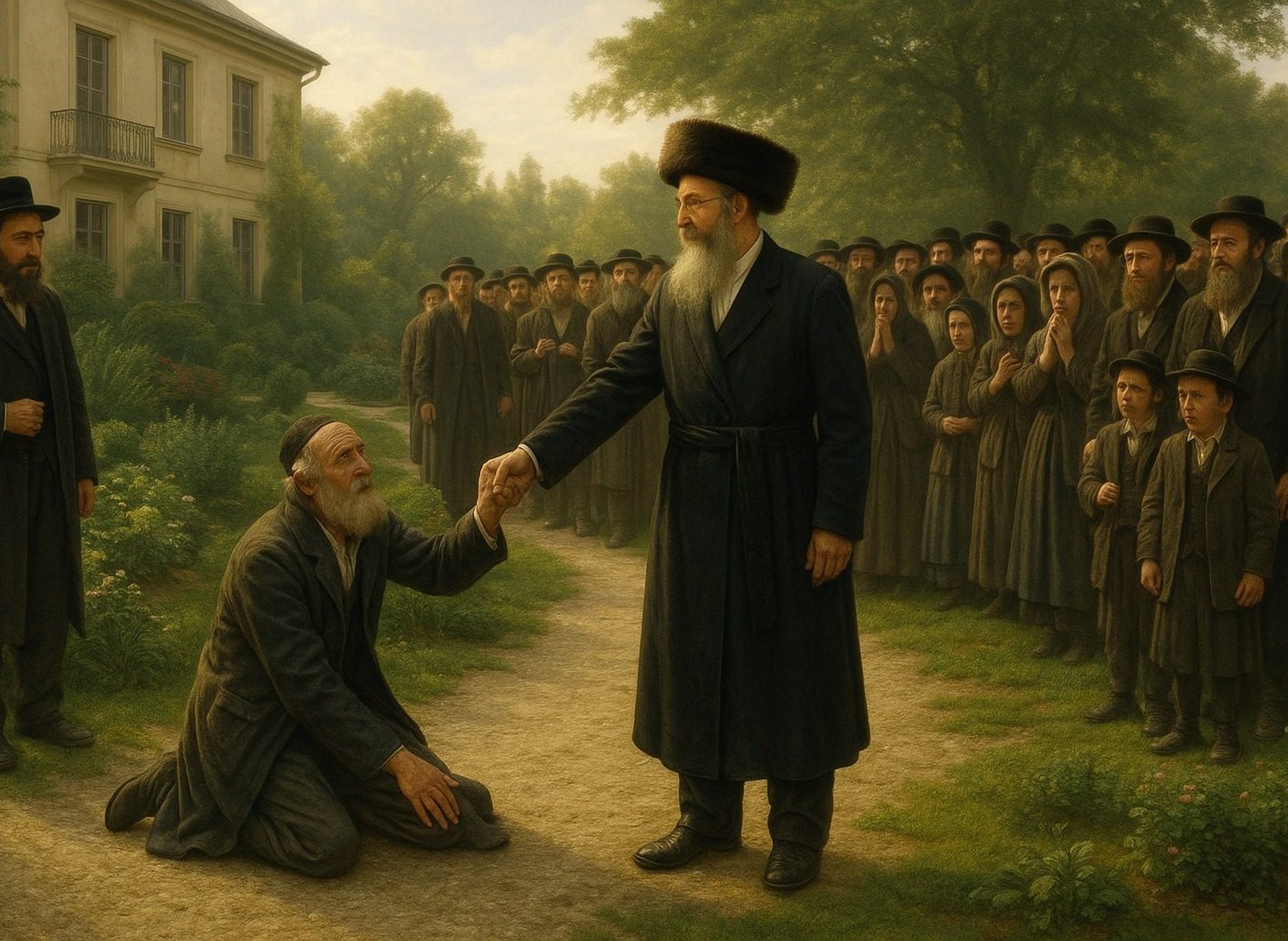
With that, the Zychliner Rebbe took the poor man’s hand.
“Stand up, Herschel!” the Rebbe commanded. “Come with me into the garden.”
Suddenly, in front of all the visitors who had gathered around to watch, Herschel rose up, just like a regular man, and began walking into the garden with the Rebbe, as if nothing was ever wrong with him.
“Listen,” the Tzaddik said quickly, “you must leave right now to avoid ayin hara.”
Herschel followed the Rebbe’s instructions, but once the Zychliner Rebbe noticed the crowds of people who had just seen what had happened, and realized the unwanted attention they would give him, he, too, decided to get into his wagon, and ride all the way back home to Zychlin.
After this story, Reb Herschel lived many healthy years as a Chassid of the Rebbe, visiting him in the town of Zychlin very often.
Boy Am I Sleepy
Reb Lazer, a deeply connected Chassid of the Zychliner Rebbe, ran a local mill for a poritz. Although we don’t see many today, mills were big machines in tall towers with spinning stones that ground wheat into flour. Reb Lazer was responsible for making sure that the mill was running and working. In other words, he was the mill’s manager. He worked hard, six days a week, providing a good parnassa for his family, while paying his children’s rebbeim, and then rested on Shabbos. He was a good Jew who cared very much about Yiddishkeit and his Rebbe, Reb Abba Shmuel of Zychlin.
One day, Reb Lazer took a trip to his Rebbe. He had a problem.
“Whenever Shabbos comes in,” began the chossid, “I get so tired. Come kiddush time, I can barely keep my eyes open.”
The Rebbe listened carefully while Reb Lazer continued. “I know it’s normal to feel tired after a long week of work, but this feels different. This… tiredness is so strong – unlike anything I’ve ever felt before. I just instantly fall asleep – It takes away from my oneg Shabbos. I can’t focus on my children, spend time with them, or tell them a story. I don’t like it at all! There must be a reason for this!”
The Rebbe stroked his beard, and thought for a moment.
“You have embarrassed Shabbos. Therefore, Shabbos has embarrassed you. That’s why you fall asleep. You must apologize to Shabbos.” And with those words, Reb Lazer left the yechidus room, beet red from embarrassment, and completely confused.
“Whatever did I do to ‘embarrass’ Shabbos? I keep Shabbos every week. I can’t think of anything I may have done to chas v’shalom embarrass her”, he thought. He felt very bothered that he didn’t know what the Rebbe meant. He knew he had to get to the bottom of this.
* * *
When the frustrated Chassid returned home, he gathered his children together for a meeting.
“My precious kinderlach, please tell me – can you think of a time I may have done something to embarrass the Shabbos?” he asked.
His children looked just as confused as he had, but his eldest boy, we’ll call him Yankel, had something to share. “Tatty, I’ve kept a secret to myself, and I’ve never told you before, because I felt it wouldn’t be respectful. But if you give me permission, I will tell you.”
His father practically jumped out of his seat! “Yes, My Yankele! Please, tell me. It’s for my own good. I must hear!”
Yankel bowed his head, shy and embarrassed to speak. He didn’t want to make his father uncomfortable.
“Go on, Yankel!” encouraged his father.
“Alright. One late Shabbos night, I was still awake, and I watched you wake up in the middle of what seemed to be a very deep sleep. You were thirsty, but you must have been so tired that you didn’t realize it was Shabbos…”
“Nuu! Yankel, go on! Please!”
“You lit a match, took a cup of water, put out the flame, and went back to sleep.” Yankel took a deep breath and looked up at his father again.
“Aaaahhhh,” Reb Lazer said to himself. “So I did embarrass the Shabbos! I did a little sleep walking to break Shabbos, and now it seems Shabbos wants me to stay asleep – I must go back to Zychlin and tell this to my Rebbe! I need a tikkun! It was a mistake!”
* * *
“WHAT?!” cried the Zychliner Rebbe in his study. “You forgot it was Shabbos? But how can a Yid forget that it’s Shabbos?! It says b’feirush in the Torah, ’Zachor es yom ha’Shabbos l’kadsho!’ You must care enough to remember Shabbos the way you should! Even if you’re sleep walking, you should be thinking about Shabbos!”
The Rebbe looked deep into the Chassid’s eyes. “You must go through a nisayon for the Shabbos – a test – and if you pass this test, Shabbos will forgive you, and you will no longer feel so tired on Shabbos.”
* * *
Life went on as usual. That was, until one day, when he was visited by the poritz, the owner of the mill Reb Lazer managed.
“Lazer, my trusted worker!” said the poritz, while giving the chossid a nice hard pat on the back. “I plan to buy new machines for the mill. They’ll be very expensive, so I’ll need the mill to run longer throughout the week to make more money to cover the cost. I’ll need you to run the mill seven days a week now.”
Reb Lazer froze.
“But don’t worry,” continued the poritz. “I don’t expect you to work on your Sabbath. I’ve heard that Jews are allowed to hire non Jews to work for them on that day, so they can work instead of you.”
Reb Lazer had true yiras shamayim, and this “trick” did not make him feel comfortable. “Honored Sir, it may be that some people do that, but I won’t. As long as I’m the one running the mill, it will not be used on Shabbos. Not by me, and not by anyone else.”
This made the poritz quite angry. “How dare you speak to me this way!” he said, coming right up close to Reb Lazer’s face. “Then I’ll hire a different Jew to run my mill altogether – or, better yet, I’ll find a non-Jew instead! Who needs you Jews, anyway…”
The poritz hoped his words would change the chossid’s mind, but it did just the opposite.
“I’m sorry sir, but Jews have gone through horrible things to keep Shabbos, and I will never break the holy Shabbos just to bring home some money. Forcing anyone else to disrespect Shabbos feels just as wrong. They’ll ask me questions, and I’ll end up doing work on Shabbos… I’m sorry. It just won’t work out.”
“You… are… FIRED!!!” yelled the poritz at the top of his lungs. “Go find yourself another job, or maybe become a beggar! You’re done working for me! How ungrateful of you not to accommodate me, while I’m giving you such a great job – do you know who I am?!”
The Chassid packed his things and left the mill, with no job, and no way to bring money home for his family. But he wasn’t upset. He would do anything for the Shabbos.
* * *

It was a beautiful spring day, not long after the big trouble at the mill. Reb Lazer looked out his window and saw the poritz’s servant coming up to his door. Why would he be here? he thought to himself.
“The poritz would like you to come to the mill as quickly as possible,” explained the servant. “If you would please come with me now, I will bring you in his carriage.”
Reb Lazer hopped inside, curious to know what the poritz wanted after he’d been so angry with him. Could he have more mean things to say? Reb Lazer wasn’t afraid. He knew Shabbos came first.
* * *
“Ahhh, my good friend.” The poritz invited the chossid to sit down. “I must tell you… No. I must apologize to you. You see, as soon as you left, I hired a new manager and bought the new machines, just like I said I would, but things kept going wrong. First, one machine broke, then another, then another – I brought in the best mechanics in the area to fix them, but nothing was working! They told me themselves, ‘This is all very strange. These things shouldn’t be happening!’ That’s when I realized that G-d was punishing me for how I treated you.
“I fired you and left you with no way to make a living! I apologize. I hope you will forgive me and come back to work for me at the mill. You can close everything down on your Sabbath. It’s completely fine with me. Just, please… let’s pretend nothing ever happened. I can’t afford to mess with you…”
The Chassid was amazed. He knew he had passed his nisayon.
That Shabbos, he felt as wonderful as ever. He wasn’t tired anymore! He could enjoy kiddush with his family, and speak with his children about the parsha, just like he used to.
Not only did Reb Lazer keep Shabbos, but Shabbos kept Reb Lazer – all thanks to the Zychliner Rebbe.
Beis Moshiach #1472 • pp. 55-59
© 2026 Beis Moshiach Magazine. All rights reserved.
This article originally appeared in Beis Moshiach #1472. You are welcome to share it with friends and family by email or in print, provided that you do not change, add to or omit any part of it, you credit the author and Beis Moshiach, and you include a link to archive.bmoshiach.org (written out in full in printed copies).
To republish this article in a newspaper, magazine, book or website, please request permission in advance at [email protected].