When Joy Becomes a Struggle
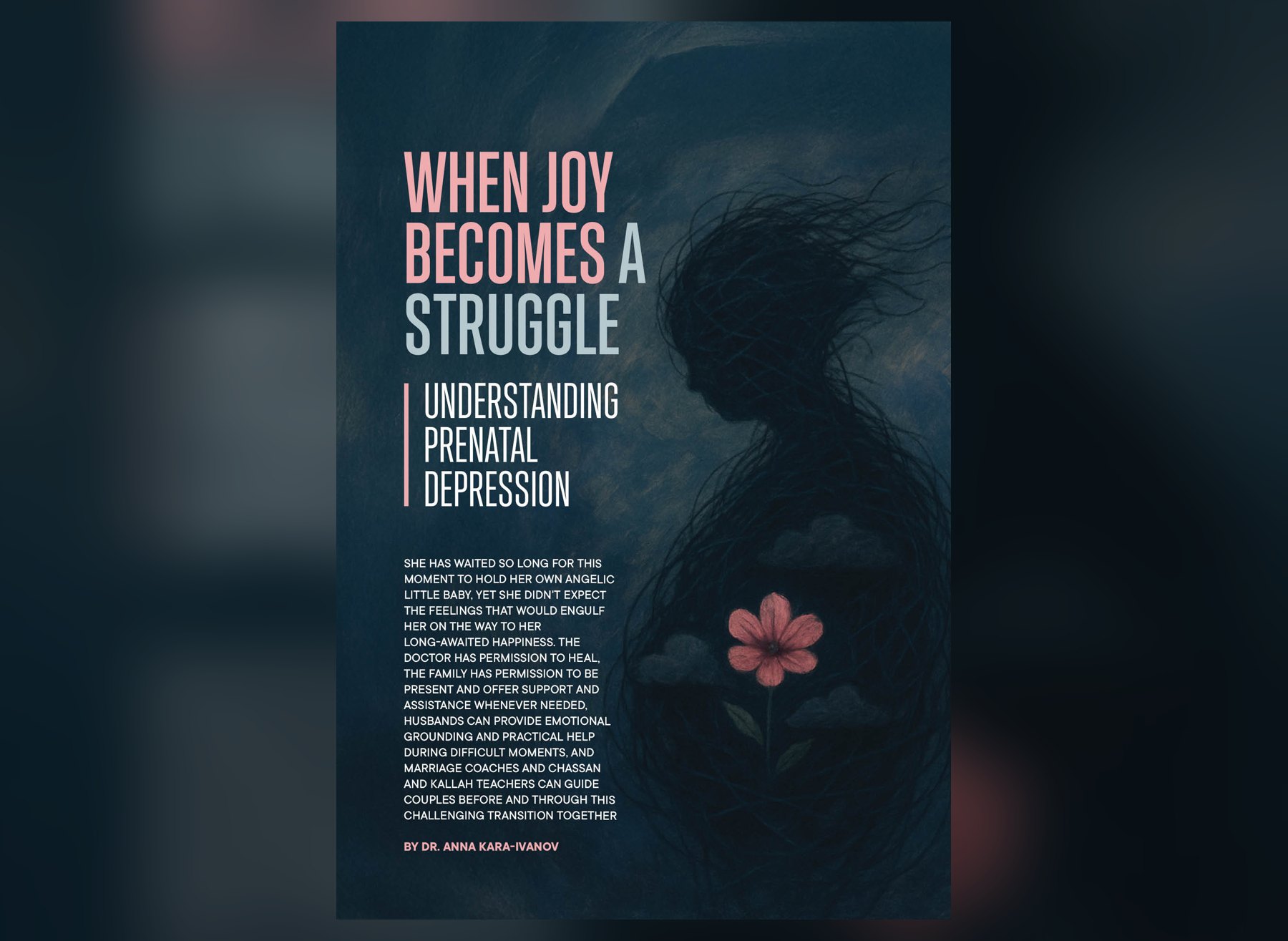
She has waited so long for this moment to hold her own angelic little baby, yet she didn’t expect the feelings that would engulf her on the way to her long-awaited happiness. The doctor has permission to heal, the family has permission to be present and offer support and assistance whenever needed, husbands can provide emotional grounding and practical help during difficult moments, and marriage coaches and chassan and kallah teachers can guide couples before and through this challenging transition together.
A blushing kalla standing with excitement under the chuppa, sometimes nervous, yet always filled with hope for a positive future of rosy dreams. After some time has passed, each woman develops her own story, and soon feels that there’s another big mazel tov on the way, producing considerable excitement in her immediate circle of family and friends.
However, sometimes beyond all the excitement, she finds herself completely unprepared for another possible dimension to this new experience. Quite often, a woman can find herself in a new and unfamiliar body, changing uncontrollably and creating what feels like an endless illness. No one prepared her, and she feels that she can’t share what she’s going through with anyone or turn to someone for help because until the fifth month, in accordance with the Rebbe’s well-known instructions, we don’t publicize a pregnancy, except to immediate family. “Blessing is found only in something hidden from the eye,” etc.
However, this is a grave mistake. As with any intensive physical experience, the problem sometimes doesn’t stay within the body’s limits – instead, it penetrates more deeply, even into the soul.
If this is happening or has already happened to you—just know that you’re not alone.
Many women experience significant emotional changes after birth – this is a well-known fact. However, what gets discussed less is how these phenomena often appear already during pregnancy. This is why what was previously defined as postpartum depression is now classified as “perinatal depression,” a concept that connects the pregnancy period with the postpartum period in a holistic way. This is quite a natural and correct association, since every woman knows that pregnancy, birth, and the newborn child are permanently bound together.
I purposely emphasize the subject of pregnancy-related depression (or prenatal, as it is usually called) because this topic gets discussed far less than postpartum depression, which is so widespread and common in the childbirth experience. Thus, the overall perception is that depression after birth seems more legitimate. In contrast, a woman experiencing actual depression or despondency during pregnancy can sometimes get reactions like “These are joyful sorrows,” “Pregnancy is not an illness,” “Such blessings,” and so on.
We can understand why these reactions come. A young woman waiting for a shidduch can’t comprehend what you’re complaining about. Another waiting for children might think that your complaints are signs of ingratitude and so on.
However, the weak, depressed expectant mother is suffering daily, and if that’s not enough, she constantly receives the message that it’s wrong for her to suffer because she’s supposed to be happy.
What is she to do?
When the Joy Turns Into Agony
Statistically speaking, among the leading causes of anxiety and depression we find events that by all accounts are meant to be joyous—weddings, pregnancies, births, job promotions. Sometimes, a powerful change, even if we’re really waiting for it and want it badly, is a shock that our psyche doesn’t always know how to handle, how to digest and integrate into the system where we feel most comfortable.
The problem is that as a society, we don’t always manage to handle this complexity – a very joyous event being experienced by someone who relates to it as something very difficult, even traumatic. We aren’t very good at accepting the fact that success by its very nature can also be an upsetting and distressing experience. Society and complexity rarely get along; that’s the way it is.
Since we aren’t able to handle this complicated situation, we prefer not to give too much attention to such phenomena, labeling people who face such challenges as “spoiled,” continuing to believe that if you harbor negative feelings, it means you’re not grateful enough to Hashem for the tremendous gift you received.
The problem is that such incidents don’t disappear simply because we’re unfamiliar with them… On the contrary, they grow exponentially until they become impossible to ignore.
We don’t want an expectant mother in a dejected emotional state to deteriorate to the point of actual perinatal depression, receiving a diagnostic name for her “problem,” along with recognition and treatment. We want to help her several stages beforehand (according to the well-known parable about the donkey with its burden: when it’s merely leaning off its back, it’s enough for one person to straighten it and help restore it to its proper place, but if the burden falls off completely, not even five people can manage to lift it).
Identifying the Problem
So, how do we identify when a woman, whether before or after birth, is experiencing emotional hardship? How do we distinguish between normal difficulties and those requiring a call for help?
First of all, becoming a mother is a real challenge. Even if we’ve been waiting and anticipating this for a long time, it’s important to remember that no woman is similar to another in how she goes through pregnancy, and not every pregnancy for one woman has to be like all the others. Therefore, our past experiences don’t predict what we may face in the future.
Mood swings are quite normal in pregnancy and after birth, and they result from our body’s hormonal system, which among other things influences our moods and various cravings and desires. Similarly, an expectant mother or a woman after birth will often be more vulnerable and sensitive than usual, taking things more to heart. Sometimes, leading up to the birth or immediately after, a woman tends to withdraw more into herself and her inner world, and this too is completely normal behavior. Pregnancy is also often accompanied by understandable changes in appetite and sleep patterns – vital measures in assessing depression at various levels.
Nevertheless, when an expectant mother or woman after birth has literally stopped eating, her sleep patterns have changed considerably, and/or her energy levels have significantly decreased – this should raise serious concern or at least prompt us to check what’s happening with her.
Above all, the most important measure of a woman’s emotional state is what she’s experiencing within herself.
If you feel depressed or that you’re facing problems more than usual, on a level that makes it difficult for you to get out of bed in the morning or enjoy things that you enjoyed in the past, and especially if you feel that you’re going through something quite serious – that your ability to think about the good you’ve had in your life so far and the good you can expect in the future, including a new baby, is rapidly disappearing – please don’t handle this on your own. You deserve support and help and reach out to get it.
As said previously, the sooner we get involved, dealing with the problem becomes much easier, preventing unnecessary deterioration of your emotional state. A woman with prenatal depression that goes untreated may continue in this state even after birth, possibly harming her attachment to her newborn child and her ability to recover fully.
In this connection, it’s important to mention the condition known as hyperemesis gravidarum (HG), which is quickly gaining recognition as part of the general understanding that even something joyous can be an extremely difficult experience.
Hyperemesis gravidarum is an illness characterized by excessive vomiting, which severely impairs a woman’s ability to function daily. If left untreated, this condition can cause dehydration, significant weight loss, and other unpleasant symptoms. Why am I mentioning all this here? Because many women who have suffered or suffer from hyperemesis report that their bodies and overall well-being sustained considerable damage, to the point of occasional breakdown leading to a very poor emotional state. Depression is a very common side effect – virtually an integral part of this condition. As stated above, there’s nothing surprising here – someone in poor physical health most of each day will have a very hard time feeling good emotionally.
A few more words in conclusion on the issue of preparation: Any event, even the most difficult, is much more tolerable when it’s expected to some extent. You have to understand that this woman in the early stages of pregnancy, handling the feeling of shock, spends half of her energy dealing with guilt over how she would dare to feel this way after all the good Hashem has showered upon her, instead of dealing with the problem itself. Preparation and normalization transform virtually every emotional phenomenon into something more bearable.
Practical Steps
Speak Up! Just talk when things are going badly for you. You have no reason to feel ashamed, even if the reason for your difficulty seems ridiculous and unjustified. Your experiences are valid and legitimate, even if another person wouldn’t necessarily experience them under the same circumstances. Don’t stay alone and don’t try to be a hero when you might suffer harm somewhere along the road. The Rebbe MH’M teaches us to seek help at significant crossroads in our lives—a mashpiah, family members, friends, professionals. Without a doubt, pregnancy is a significant crossroads and you should use the human resources that are at your disposal.
Listen to the women around you. Be on the lookout for possible trouble, even if you think there’s no good reason for it. Don’t dismiss difficulties simply because they don’t align with your expectations (“A newlywed woman expecting a child should be happy”) or your values (“Children are a blessing and a joy”).
Anyone involved in preparations for major life events – kalla teachers, childbirth counselors, doulas, makeup artists, and mainly friends, mothers, and sisters – lay the groundwork. You don’t put ideas in people’s heads; you provide an empathetic voice, a compassionate foundation upon which you can build a support system for the person listening to you. Then, she can identify what she’s going through, accept it without getting overwhelmed, and seek help when needed.
This also applies to chassan teachers and all those who work with expectant couples. Prepare them and teach them about all possible scenarios. They can be a main support system for expectant and postpartum mothers – the first line of defense for identifying problems and seeking help.
As always, I emphasize: if you need to turn to someone for help, make sure you get assistance from people with professional training capable of dealing with matters of a serious and intensive nature.
May we all have easy and happy births with the True and Complete Redemption, speedily in our days!
Beis Moshiach #1476 • pp. 38-41
© 2026 Beis Moshiach Magazine. All rights reserved.
This article originally appeared in Beis Moshiach #1476. You are welcome to share it with friends and family by email or in print, provided that you do not change, add to or omit any part of it, you credit the author and Beis Moshiach, and you include a link to archive.bmoshiach.org (written out in full in printed copies).
To republish this article in a newspaper, magazine, book or website, please request permission in advance at [email protected].