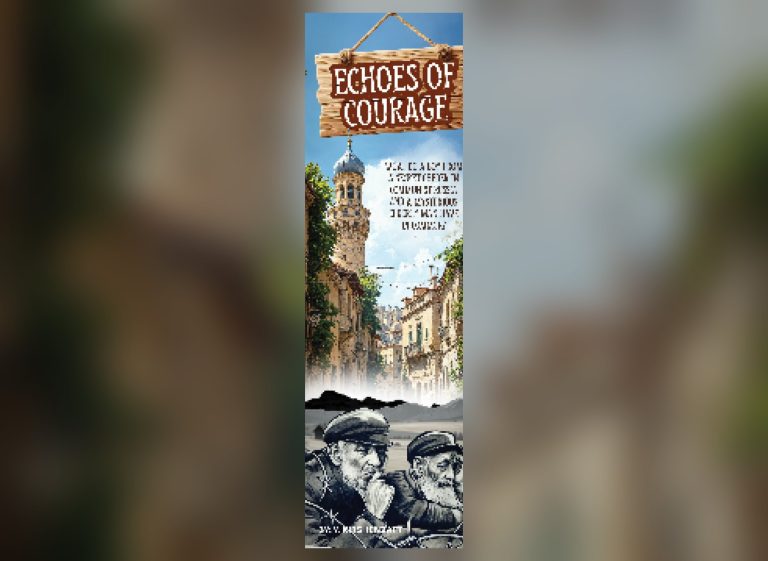
Echoes of Courage – Chapter 40: Fateful Decision

Previously: Russia: Avremel’s wife pursues the man who handed her the mysterious package. The goy explained that he owed a debt of gratitude to her father. He warns her to leave the country soon.
Eretz Yisrael: The neighbor insists he is Ukrainian. After leaving him, the boys realize they didn’t question him about the cubes. Moishy remains suspicious of the neighbor.
Russia 5715
Avremel’s wife, who was holding the package of passports, began examining them. She suddenly turned pale. There were only five passports! There were five children plus her; she needed a sixth passport. The goy noticed her dismay and said, “Yes, I know. I wasn’t able to obtain an additional passport.” He sounded apologetic.
The woman felt the ground moving beneath her feet. Her feet shook and if she hadn’t grabbed on to a nearby closet, she would have fallen.
The goy left the house without another word and she remained with her thoughts. How can I leave Russia without one of my children? It’s impossible to leave one of the children here, without a father or mother.
The more she thought it over, the more she realized how stuck she was. She knew that every additional day she remained in Russia posed immediate danger. She knew that the communist police wouldn’t hesitate to take her children and place them in a Soviet orphanage for “reeducation,” which would pose both physical and spiritual danger.
She was well aware that the situation she was in was dangerous. How could she decide? What should she do?
She spent another day or two mulling it over, agonizing about what to do.
“I have no choice,” she whispered to herself. “If we stay, we will all be in danger. I must find a suitable place where I can leave the little one, someplace where he will be in good hands and protected until the day he can leave the Soviet Union.”
She wasn’t sure this decision was correct but the more she thought about it, she realized that this was about the welfare of them all versus the good of the individual and she had no choice.
She looked at the baby sleeping in the carriage; he had just recently joined the family.
* * *
A figure wrapped in something dark knocked at the door of the little house. The door opened and there stood a distinguished looking Chassid, his gaze both piercing and soft at the same time.
“R’ Sholem” she said. “I need your help.”
Sholem immediately recognized the person standing there as none other than the wife of Avremel who was in prison.
“Come in,” he said, opening the door widely.
It was only when she was inside and sitting down that she relaxed somewhat. Pessia, Sholem’s wife, joined the conversation.
She told Sholem and his wife everything that had been going on with her family and about the rare opportunity she had.
“There are only five passports and we are six. The visas that we received from OVIR only last ten days and so, I have no choice,” she said with a sob, “but to leave someone here.”
Sholem was pained at her plight.
“Then you want us to keep one of the children,” he said, immediately grasping her point.
Avremel’s wife stammered a bit. She wasn’t able to utter those words. She just nodded and spread her hands out in a gesture of helplessness.
“I have no other option,” she said, looking down. “It would be my ten-days-old baby. I decided he must stay here and if you can care for him, I would be calm knowing that he is in good hands in a warm, Chassidishe home.”
“Why the baby?” asked Sholem, breaking the deep silence that followed her pronouncement. The mother looked again at her baby and her eyes filled with tears.
“First, he is very weak and just had his bris mila. We have a difficult journey ahead of us and he might not make it, chas v’shalom. Second, he still doesn’t know the family and he won’t suffer from being disconnected from the rest of the family.”
Sholem looked sadly at the baby, lying in the cumbersome carriage.
“Third, he has a special bracha from his grandfather, my father alav ha’shalom, who was blessed in a dream by his father and told us to name the baby ‘Yosef Yitzchok’ for the Rebbe. He promised that this would give the baby the strength to withstand the trials he would face.”
She was unable to overcome her emotions and she burst into tears. Sholem handed her a handkerchief and she wiped her eyes.
“I plead with you,” she said in a choked voice, “raise my son to mesirus nefesh. He should know who his father is and why he is in prison. He should follow in his ways in a life of Torah and mitzvos.”
“Don’t speak that way,” he shushed her gently. “With Hashem’s help, he will yet meet his father just as my children met me after I was arrested. I will continue trying to gain your husband’s release so that he can continue his holy work in this darkness and now, also so that he will be able to raise his son until the day they can leave Russia.”
With such a promise, she kissed her baby again and again, caressed his head and at a certain point, she knew she had to hold back her emotions and part from him. She gave him a final hug and left the house, walking quickly.
Yerushalayim 5785
Mendy and Zalmy looked in surprise at Moishy’s retreating back.
“I don’t believe what he just said,” said Mendy, making fists without realizing it. “Boris explained very well what’s happening here and I think he’s perfectly okay even if he doesn’t have Rav Landau’s hechsher on him.”
Zalmy gave a half-smile.
“I agree with you. We need to convince Moishy so he doesn’t do something foolish.”
From that day on, the children’s attitude toward the neighbor changed, as did his attitude toward them. They began saying “Hello” and “Good Morning” when they met on the stairs. The children also began acquainting him with Yiddishkeit. On Fridays, they would put tefillin on with him.
Until the time came, the time Moishy knew would come. It was an ordinary day. The sun was shining when Zalmy left the house for school. He passed the big shul and on the bench near the shul he saw a familiar person. At first, he wasn’t sure because he was sitting with his back to him but as he got closer he became sure. The man was holding a cup of coffee and he had his other hand close to his mouth and was whispering into his … watch. Yes. It was the neighbor.
Zalmy went closer to say hi but heard a sentence that made his tremble.
“They bought my nonsense,” he guffawed.
Zalmy, who was behind him, decided to quietly move closer and listen in. He couldn’t believe what he heard.
“So, you’re saying the children are sure you’re Ukrainian?” said an unclear voice from the watch. But it was enough to understand. The Russian laughed and whispered a few more words in Russian into his watch.
Zalmy immediately ran to Moishy’s house.
“Good morning, early bird,” said Moishy with an eye half open. “What brings you here to my house, especially at this early hour?”
Zalmy told him what he saw and heard. There was no sign of any reaction on Moishy’s face.
“I knew that’s what would happen in the end. Now, we have a double problem. We will need to act wisely.”
* * *
At the same time, a few streets away, on the third floor of the senior home. An unknown figure was walking with a square object hidden in his clothes.
To be continued
Beis Moshiach #1488 • pp. 60-62
© 2026 Beis Moshiach Magazine. All rights reserved.
This article originally appeared in Beis Moshiach #1488. You are welcome to share it with friends and family by email or in print, provided that you do not change, add to or omit any part of it, you credit the author and Beis Moshiach, and you include a link to archive.bmoshiach.org (written out in full in printed copies).
To republish this article in a newspaper, magazine, book or website, please request permission in advance at [email protected].