The Secret Language of Teenage Rebellion
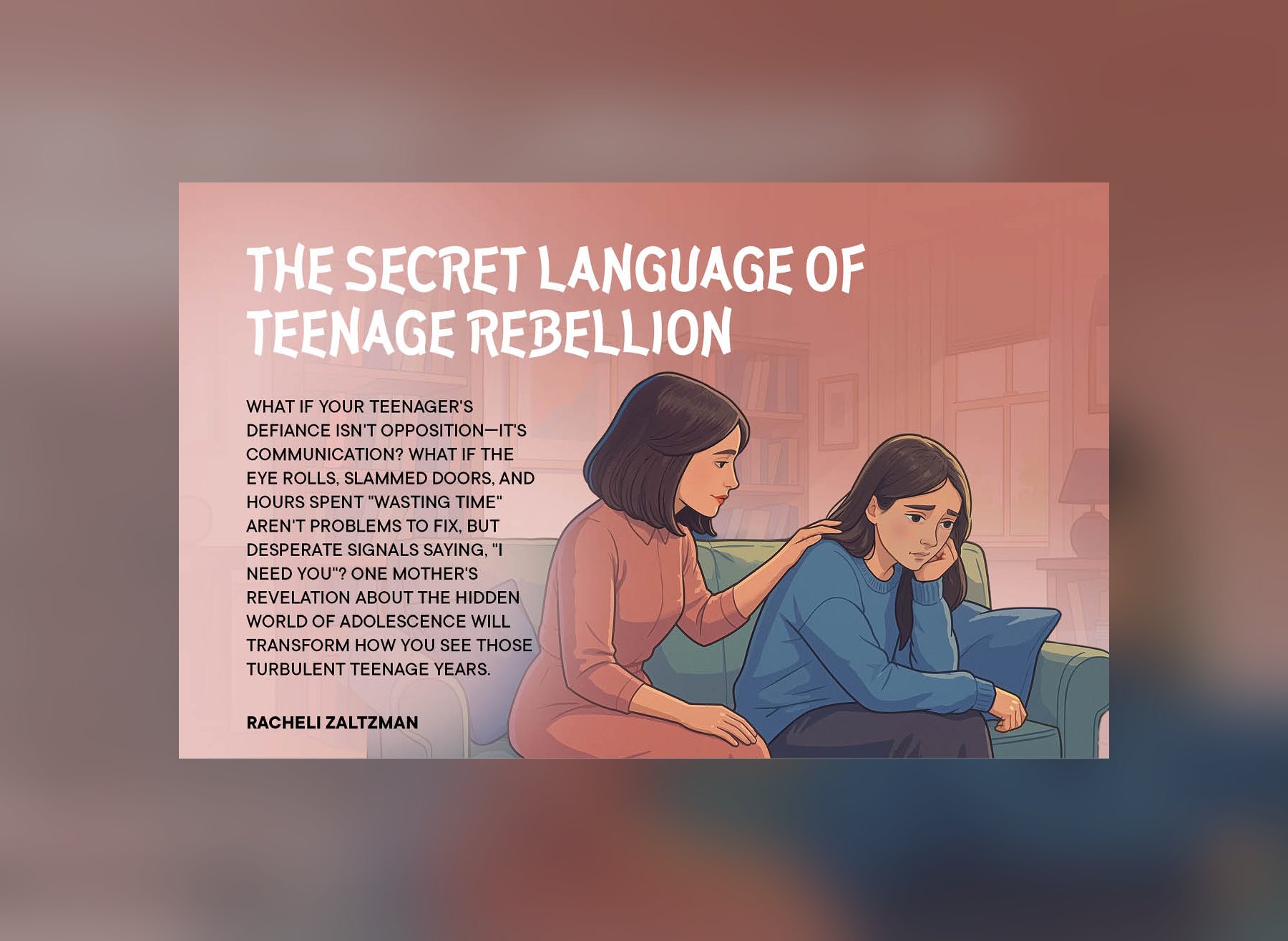
What if your teenager’s defiance isn’t opposition – it’s communication? What if the eye rolls, slammed doors, and hours spent “wasting time” aren’t problems to fix, but desperate signals saying, “I need you”? One mother’s revelation about the hidden world of adolescence will transform how you see those turbulent teenage years.
She gazed at the sweet teenager sitting on the grass, cradling her head in her hands and stifling choked sobs. She wanted so badly to run to her and hug her, to comfort her. But she forcibly restrained herself. She doesn’t know her; she probably wouldn’t agree to share with her.
She stood and watched her trembling shoulders. She tried to think of what it was she was going through – maybe she lost something valuable? Maybe she’s struggling with her conscience over something she’ll laugh about in the future? Or maybe she fought with a close friend? She couldn’t know. And perhaps her own teenager is also dealing with some crisis right now, and she doesn’t know about it?
Going Back to the Child in Us
At first, she thought she knew everything. And then life taught her humility. After searching for a long time for the path, broken and hurting, she found it. She set aside judgment.
Every time the teenage boy or girl “does things to spite her,” erupts, or cries over nonsense – she goes back in time, to the little girl within her:
The one who rages when “she feels like it.”
The one who doesn’t notice those around her and tramples on others without paying attention.
The one who holds tight – tight to her dreams, and then shatters them against the waves in a moment of crisis.
The one who spends entire days with friends and doesn’t know how to move the broom even an inch.
And then suddenly the storm within her subsides, because that’s exactly who she is. She understands the conclusion immediately – she needs me there beside her. Hugging, caressing, loving.
Suddenly she understands that her daughter is both:
Both a curious and alert girl, and also in bed for over 12 hours. Both bold and appeasing her friends. Both studying for tests and wasting time for hours upon hours.
A Glimpse Into the World of a Teenager
Recently I heard two interesting podcasts about teenagers. The first by Itai Shaulian, who talks about how in the normal developmental process of a teenager… wasting time is also included, it’s part of their life. When they experience the feeling of wasting time and emptiness, the meaning they’re searching for grows. From this experience the question arises: For what was I created? What is my purpose here in the world?
And the second is by Yael Zaltz, who describes how 90 percent of a child and teenager’s life experiences are necessarily connected, and only 10 percent of the experiences are by choice. They didn’t choose where to be born and to which parents and with whom to share a room. They didn’t choose the friends in their class, didn’t choose which school to study in, and they also have no control over the curriculum.
Certain subjects taught in school they don’t like at all, the recess breaks are too short for their taste, they don’t prepare the family shopping list themselves and they also have no ability to decide what to eat for dinner. And most importantly, they didn’t choose the hidden candy cabinet from which Mom pulls out treat after treat when no one’s looking.
For us adults, the situation is reversed: 90 percent of our lives we chose, and 10 percent we didn’t. We chose a job, we chose a spouse, we chose where to live, we chose on what to spend money and we chose where to go this week.
So what is expected of a child and teenager? That they perform all the tasks assigned to them with a satisfied smile? It’s enough if they perform with joy the tasks they connect to. In the future, when they go out into life and choose for themselves all the things described above, they will be more connected to what they do.
Mommy, Where Did You Go?
Both the small child and the teenager call to us desperately. The first will demand it with tears, and the latter will hint to us through defiance and unpleasant manipulations. The first will get what they want here and now; without delay they’ll receive a hug. As far as the latter – we’ll always wonder what we should do. But the latter needs us very, very much, even if they’re being defiant.
Look into eyes that speak of pain, look at expressions that speak the language of the heart.
Don’t pay attention to the tough outward behavior, to the hurtful statements. She simply needs you, he simply needs you. You, as you are, natural. And yes, also the hug.
But you left – you went to prepare, cook, fold, organize, arrange. You also went further away – you went to help neighbors, you went to exhausting work. You went far, you forgot them a little – they didn’t come closer. But maybe they will. It depends only on you.
Here are two wise things I heard regarding our relationship with children and teenagers:
The first – it’s worthwhile for each child to have their own hidden corner at home. There you can occasionally leave a small note with lots of love or a small pampering treat.
The second – it’s important for parents to have quality time with each child separately once a week, even for a few minutes. You can take them out a few minutes earlier from school, play with them in the nearby park, or go for a walk. This will contribute to the relationship with each child, and for the teenager the relationship with the parent is especially important, even if they don’t admit it.
One Goal, Two Ways
And another important point worth remembering: in parenting there is great importance to the words we choose to use.
When a small child asks for another cookie, and you only allowed them one, and they insist they didn’t get one, there are two ways to answer them:
One: “Why are you lying?” and the other: “You mean you want more?”
Afterward you’ll decide if you allow them another one, but the discourse is critical.
In the first way – the child internalizes that they’re a liar. If you say the word “liar” a few more times or if someone else from the household or friends says it to them – that’s the label that will be attached to them. In the second way – you didn’t ignore the fact that they already got a cookie, and yet you expressed their desire to get more. And this is also true regarding our teenagers.
With a teenager it can look like this:
One way: “A short skirt? Why do you always buy immodest clothes?”
And the other way, honestly: “Your new skirt bothers me a lot. Maybe we’ll exchange it?”
In the first way you attached labels to her – a girl who’s only interested in acquiring immodest clothes. In the second way you offered her a practical solution and laid out your pain before her.
And it doesn’t come easily. We won’t always succeed in doing only what’s right. To create changes, in all areas of life, requires a moment of pause, thinking inward, into my innermost self, a review of the passing day, the actions done in it, the statements I didn’t pay attention to.
To work from awareness, you can create a chart: in the first column write the sentence that was said or the deed that was done, and in the second column – the proper substitute. Try next time to stick to the substitute. Not easy, but worthwhile.
And if you look at the teenager with a deeper gaze, you’ll understand that this phase is not easy for her. Teenagers go through many physical, mental, and social changes. Instead of looking at her with a disappointed look, think about her challenges and difficulties, arouse compassion in your heart toward her and embrace her to you, close – very close.
Give your teenagers space, shower them with love.
You yourself will gain from it.
Beis Moshiach #1489 • pp. 48-50
© 2026 Beis Moshiach Magazine. All rights reserved.
This article originally appeared in Beis Moshiach #1489. You are welcome to share it with friends and family by email or in print, provided that you do not change, add to or omit any part of it, you credit the author and Beis Moshiach, and you include a link to archive.bmoshiach.org (written out in full in printed copies).
To republish this article in a newspaper, magazine, book or website, please request permission in advance at [email protected].