Children & Trees Grow Together in Vienna
Previously: Rabbi Yaakov and Eidla Biderman are sent by the Rebbe to be shluchim in Vienna; The Rebbe said that they are accomplishing “big and great things”. But Reb Yaakov doesn’t see that yet
Rabbi Yaakov and Eidla kept writing letters to the Rebbe, telling him about all the small things they were trying to build. They wrote about the programs for the Yomim Tovim, and about the Jewish-learning booklets they’d translated into German so people could understand. Every project felt tiny, but they wanted to share it all with the Rebbe.
One day, a letter came back.
“May you have success with your preschool…”
A preschool? They didn’t have one.
They looked at each other in surprise. But a few days later, the doorbell rang. A group of Russian Jewish parents stood there, almost desperate.
“We need a Jewish preschool for our children,” they pleaded. “Please – can you open one?”
Now it made sense.
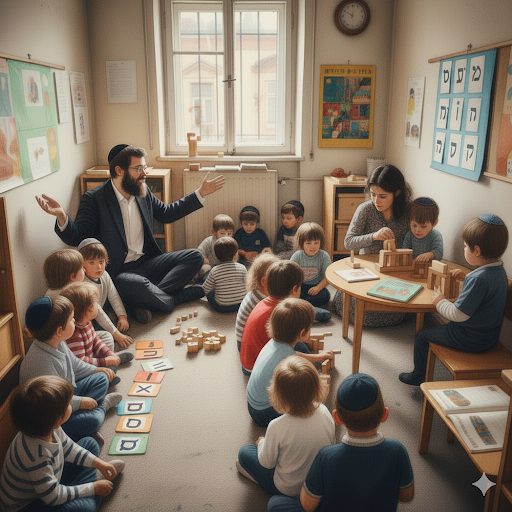
So, in a tiny little room, with hardly any space and just a few toys, they opened a preschool. It didn’t look like much, but it was full of warmth and Jewish songs and little voices learning Alef-Beis.
And so it went. Again and again, they saw the same thing happening. The Rebbe didn’t only guide them – he knew just what would happen, right before it did. They began to understand something very deep:
We are just the Rebbe’s hands and feet in Vienna. The Rebbe is the head, he’s running the show.
Not long after, hundreds of Jewish families left the former Soviet countries in Asia – places like Bukhara and Georgia – and passed through Vienna on their way to new lives. Some only stayed for a short time. Many stayed for good.
Most of these families had nothing Jewish for their children. No Hebrew School. No shul. No programs. Some had once known Jewish life and wanted to rebuild it. Others came from places where they had never learned anything at all, and were experiencing it all for the very first time.
Their children needed a home. Their parents needed support. Their neshamos needed light.
And somehow, in Vienna, in their small and simple way, Rabbi Yaakov and Eidla were ready for them – because the Rebbe had prepared them first.
* * *
Just a few years later, something special happened.
The Lelover Rebbe sent several of his sons to the Lubavitcher Rebbe for a yechidus – a private meeting of neshamos. They entered the Rebbe’s office, spoke with him quietly, and received warm brachos. Then, before they left, the Rebbe said:
“Tell your father that his grandson in Vienna, HaRav Yaakov Biderman, is doing unbelievable things. Gedolos v’niflaos. He is a huge success in Vienna.”
When Rabbi Yaakov heard these words, he almost froze.
Huge success?! He didn’t feel like one. Not at all.
He looked around Vienna and saw… a few pairs of tefillin he’d put on with people. A tiny after-school program. A preschool, squeezed into a tiny room. A few families who’d begun learning or davening again.
Was that really “gedolos v’niflaos” – great and wondrous things?
Reb Duvid, Yaakov’s father, told the story to the Lelover Rebbe. “But Yankev says there are no unbelievable successes,” he explained.
The Lelover Rebbe lowered his head. He sat quietly for a moment. Then he lifted his face and spoke slowly, as if choosing each word with care.
“Duvid… when a tzaddik says something, he sees the past, the present, and the future, all in one vision. If the Lubavitcher Rebbe says gedolos v’niflaos, then it will be.”
The Rebbe wasn’t only seeing what existed now. He was seeing everything that would one day grow from those first tiny seeds.
* * *
One of the first Yidden Rabbi Yaakov met in Vienna was Mr. Leon Zelman. Mr. Zelman worked for the government, as the head of the Jewish Welcome Service. His job was to welcome back Jews who had run away from Austria during Nazi times.
Rabbi Biderman later said, “Once in a while, I would stop by and put tefillin on with Mr. Zelman. He always asked what I was doing, and I told him about the children we were helping.”
In 5746 (1986), something happened that shocked the world. The secretary-general of the United Nations, Kurt Waldheim, finished his job, and wanted to run for president of Austria. But many people knew his past: he’d been a Nazi officer during the Holocaust, serving in Greece, where Jews were tortured and killed.
At first Waldheim lied and said, “I never killed anyone.” Then, he changed his story and said, “People were killed, but I didn’t do it. I was just following orders.”
The World Jewish Congress proved what he had done, and countries all over the world refused to allow him to visit. But Austria felt insulted. Many Austrians said, “Who are these American Jews to tell us what to do? We didn’t cause the Holocaust!” And because so many countries stood against Waldheim, even more Austrians voted for him. A terrible Nazi became president.
Around that time, a wealthy American businessman named Ronald Lauder arrived in Vienna as the new U.S. Ambassador. He was the son of Estée Lauder, a famous businesswoman. He didn’t grow up celebrating any Yomim Tovim – not even Chanuka – but he cared deeply about the Jewish people. When he heard Waldheim was now the leader of Austria, he worried. “What will happen to the Jews here?” he asked.
One day, he met Mr. Zelman and asked, “Do you know anyone in Vienna who cares about Jewish life? Anyone who’s trying to help the community?”
Mr. Zelman scratched his chin. “Well… there’s a young Chabad rabbi. Biderman.”
“Give me his number,” Lauder said.
Soon Rabbi Biderman received a call. Someone important wanted to meet him. He put on his best suit and took a taxi to 16 Boltzmanngasse, the giant American Embassy – a building that looked like a palace with fifty-six windows.
Inside, they sat on brown leather couches.
“Nice to meet you, Ambassador Lauder,” Rabbi Biderman said. “What can I do for you?”
“Oh, Rabbi,” Lauder said warmly, “wonderful to meet you. What do you do for the Jewish people, and how can I help you do more?”
Rabbi Biderman told him about the small after-school program, the tiny preschool filled with sixty children, and the need for a larger shul for Bukharian and Russian Jews.
“Come see our preschool,” the Rabbi invited.
Lauder came the next day. He planned to stay for fifteen minutes. Instead, he stayed over an hour. The tiny, crowded apartment was bursting with children, teachers, songs, and energy.
“I’ll help you get a bigger place,” he said. “Come to my office next week, and we’ll make a deal.”
When they met again the next week, Lauder leaned forward excitedly. “Rabbi, I want to build you a huge building – with my name on it, in big letters. Beautiful! Modern! Elegant!”
Rabbi Biderman smiled and thought of all the children who needed a real school.
“But it has to be in an elegant neighborhood,” Lauder added. “Not the crowded districts.”
Rabbi Biderman froze. The Jews they served lived in the second district – nothing fancy about those streets.
“Can we build near where the Jewish people actually live…?” he asked.
“No,” Lauder insisted. “Nothing can be small or simple if my name is on it. It must be fancy.”
Rabbi Biderman understood that, if he wanted the school, he needed a perfect compromise.
He met with the top architect in Vienna. The architect introduced him to the official in charge of city land. Surrounded by giant blueprints and models, the man whispered, “I’ll tell you a secret. There’s a beautiful park in the second district. Next to it is a piece of land. People think it’s part of the park – but actually, it’s available. It used to be a hospital for children with lung diseases. It’s empty now. You can have it. Build your school there.”
It was perfect – close to the Jewish neighborhoods, beautiful enough for Lauder. The mayor approved it. Everything seemed ready.
Then, the newspapers exploded.
“No way! Chabad will destroy the park!”
“They will cut down trees!”
“They will ruin our precious nature!”
People on the street glared at Rabbi Biderman. Some treated him like a criminal. Every office he went to said the same thing: “We don’t mind giving you the permit… but the other fifteen offices won’t approve it.”
He needed sixteen licenses. He had none.
Even the official Jewish community said, “Stop this! You’re making all the Jews look bad!”
The architect already drew the plans. The project would cost ten million dollars. But the dream seemed impossible.
Rabbi Biderman felt crushed. “Why is building a school for children turning into a war?” he wondered.
He told Lauder, “Let’s do it somewhere else.”
“No,” Lauder said firmly. “I will only help you if it’s in that park.”
Nothing worked. Everything fell apart.
* * *
Then Rabbi Biderman realized something. “I didn’t write to the Rebbe all month…!”
So, he wrote a long, detailed letter, explaining everything: the protests, the newspapers, the trees, the mayor, the permits – everything.
Very soon after, Leon Zelman called. “Someone wants to speak to you.”
“Who?” asked Rabbi Biderman.
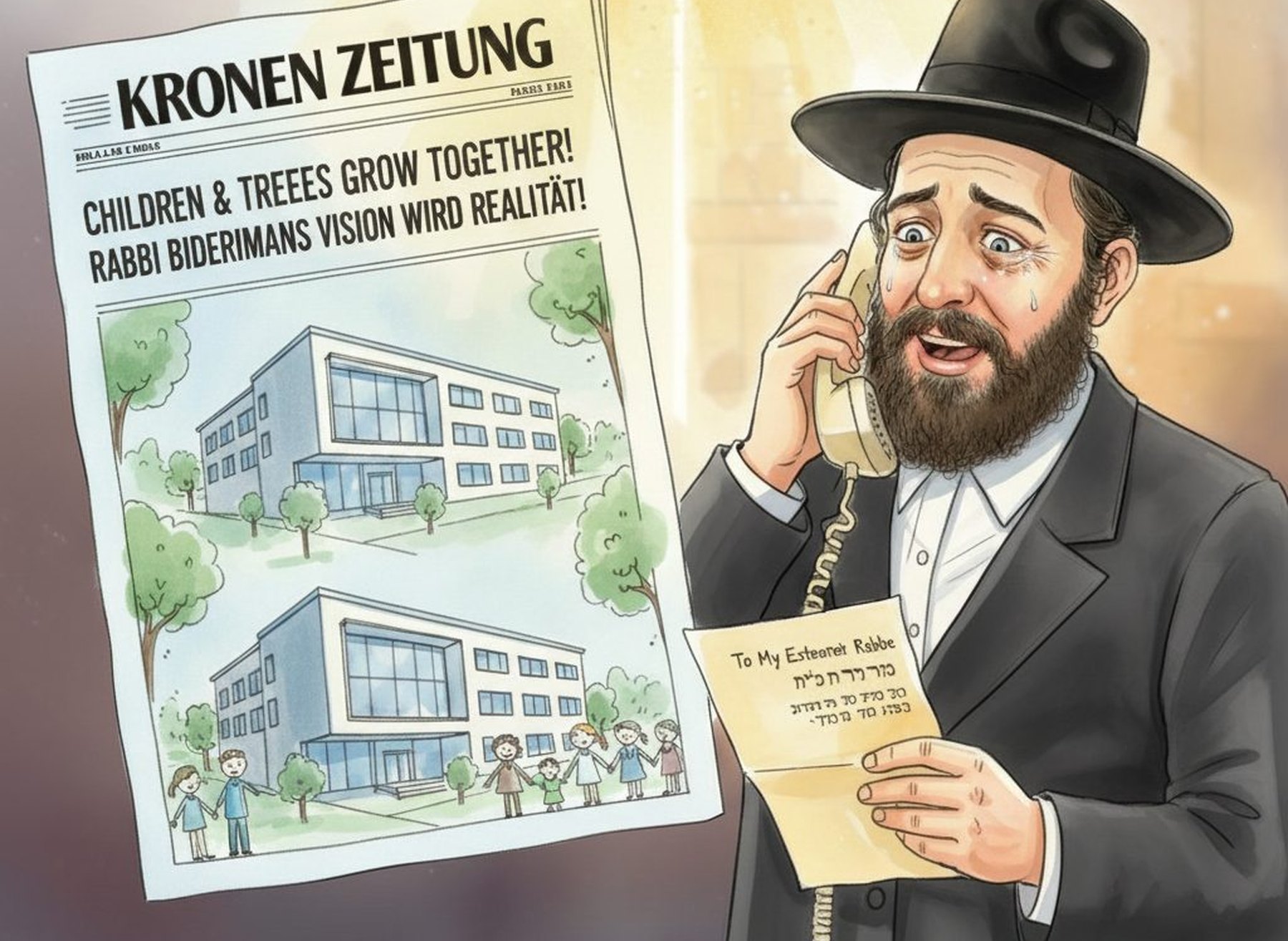
“He owns and publishes the Kronen Zeitung – the tabloid read by three million people a week. Whatever he writes becomes the opinion of the whole country. He’s the most influential man in Austria.”
And this man wanted to speak to Rabbi Biderman.
When they spoke on the phone, the man sounded old and tired.
“Rabbi,” he said softly, “I have a problem. I’m getting older. I’m not Jewish, but I am a believer. And I am afraid. Years ago, one of my writers published things against the Jewish people, and I didn’t stop him. People read it and believed it. I feel terrible about it. I feel responsible. What will happen when I go to heaven…?”
He wasn’t saying he’d been part of the Nazis. But he felt deep sadness that, during the long time he’d spent running a powerful newspaper, he hadn’t always stood up for what was right. He felt he’d allowed hurtful things to be printed about Jews, and he wanted to fix it before it was too late.
Rabbi Biderman thought for a moment. “Why don’t you write something good about the Jewish people? Maybe about Israel?”
The next day, the newspaper published a huge article defending Israel.
Two or three weeks later, he called again. “Rabbi, this is not enough. I want to do something big. Something that will change the city.”
Then Rabbi Biderman remembered the school. He told him everything.
“Say no more,” the man said. “I know exactly what to do.”
The next day the newspaper headline screamed: WHO IS AGAINST THE CHILDREN?
It supported the Jewish school.
The next day: CHILDREN AND TREES GROW TOGETHER!
Explaining why the school belonged near the park.
The next day: NEW SCHOOL OPENING RIGHT HERE!
With a map and drawings of the building.
Millions of people read it. Everything changed.
Suddenly the mayor called. “Hey buddy, Rabbiner Biderman! What happened with our project? Why aren’t we doing it?”
TV and radio hosts announced, “What a beautiful plan! When is construction starting?”
Before they wrote to the Rebbe, everyone was against them. After they wrote to the Rebbe, everyone supported them. There was no other logical explanation.
It was a open bracha.
They held a groundbreaking with many important guests, even the prime minister of Israel. Construction began. The school became a stunning building, with wide staircases, tall windows, and warm wooden halls.
They had to pay half a million dollars to replace trees that had been removed. Who paid?
The non-Jewish owner of the Kronen Zeitung.
* * *
Today, there are four huge buildings in that area. The city council voted to name the street after the Rebbe – and every political party agreed.
What Rabbi Biderman learned was simple:
The Rebbe is running the show.
All we have to do is try not to get in the way.
The school still stands there today.
Beis Moshiach #1490B • pp. 54-58
© 2026 Beis Moshiach Magazine. All rights reserved.
This article originally appeared in Beis Moshiach #1490B. You are welcome to share it with friends and family by email or in print, provided that you do not change, add to or omit any part of it, you credit the author and Beis Moshiach, and you include a link to archive.bmoshiach.org (written out in full in printed copies).
To republish this article in a newspaper, magazine, book or website, please request permission in advance at [email protected].