The Power of the 75th Anniversary
On Monday afternoon, the 19th of Tammuz 5728 (1968), an unexpected farbrengen took place at 770. What began as a scheduled yechidus for three shluchim – Rabbi Yitzchok Groner, Rabbi Shlomo Cunin, and Rabbi Moshe Feller – transformed into an historic gathering when the Rebbe suddenly announced a farbrengen. The Rebbe entered carrying a Siddur and the fifth volume of the Alter Rebbe’s Shulchan Aruch (unbound), and immediately announced that the completion of printing this volume alone warranted a farbrengen. He recited ha’gafen and drank some wine and began to speak. The Rebbe opened by noting that this very day marked seventy-five years since the conclusion of his father-in-law’s bar mitzva celebration. The Rebbe Rayatz’s bar mitzva had been celebrated with seven days of feasting, culminating on the 19th of Tammuz (since one day of the week-long celebration was a fast day). This milestone anniversary carried profound spiritual significance that the Rebbe proceeded to explain.
The Mystical Meaning of Seventy-Five
The number seventy-five isn’t merely chronological – it represents a complete spiritual process. As Torah Or explains regarding Avrohom’s age when he departed Charan, seventy-five combines two essential elements.
Seventy represents the seven emotions (middos) in their fullness. Each of the seven emotions contains ten facets, creating seventy total aspects. This represents the external dimension of the emotions in their complete state.
Five represents the five supernal kindnesses (hei chassadim) that expand and elevate everything they touch. Through these five kindnesses, the inner dimension of the emotions is drawn down and revealed.
Together, seventy-five creates the conditions for the ultimate transformation: drawing down intellect (mochin) into emotions (middos). This descent isn’t simple, because intellect and emotions are fundamentally different – even opposite – essences. For sublime wisdom to flow into and animate the emotions requires both external completeness (seventy) and internal depth (five).
Only when Avraham reached this state of seventy-five years could he “depart from Charan” – moving from the constricted passage between intellect and emotion into full revelation. The narrow throat separating head from heart opens completely, allowing even the highest levels of Chochma to flow into the middos.
Tefillin: Drawing Down the Highest Lights
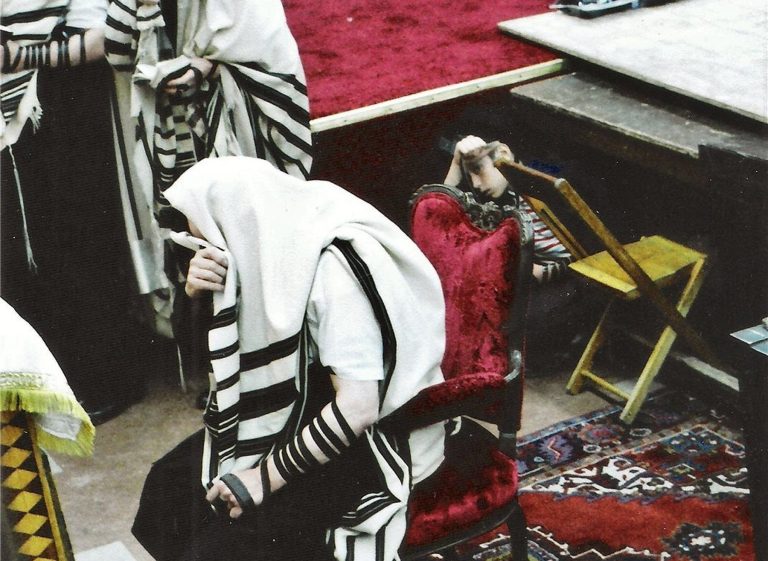
This concept directly connects to tefillin [as explained in the hemshech connected to this special occasion], whose essence is drawing intellect into emotions. The teaching “The Holy One, blessed be He, puts on tefillin” describes precisely this process – the emotions (represented by Zeir Anpin) receiving the highest intellect (mochin of Arich Anpin).
The Power of the 75th Anniversary
When seventy-five years pass from a monumental spiritual event, special strength flows from Above. Through the merit of the Rebbeim – especially the Rebbe Raytz, whose bar mitzva celebration reached its climax on this day – we can now accomplish what seemed beyond reach.
This milestone empowers us to draw downwards influences from the highest spiritual heights (למעלה מעלה עד אין קץ) into the lowest physical depths (למטה מטה עד אין תכלית), making for Hashem a dwelling place in the lower worlds through actual deeds performed with joy and gladness of heart.
Through marking this seventy-fifth anniversary, we hasten the fulfillment of the prophecy “And all the peoples of the earth shall see that Hashem’s Name is called upon you,” bringing the true and complete redemption through Moshiach Tzidkeinu, very soon.
The farbrengen lasted one hour and ten minutes, concluding with the singing of “Nyet Nyet Nikavo.” Afterward, the three shluchim entered for yechidus, where the Rebbe expressed that the farbrengen had taken place in their merit, and gave them crucial guidance for their shlichus.
(Freely adapted from Hisvaaduyos 5728 and a diary written by R’ Moshe Slonim a”h)
Beis Moshiach #1492B • pp. 4-5
© 2026 Beis Moshiach Magazine. All rights reserved.
This article originally appeared in Beis Moshiach #1492B. You are welcome to share it with friends and family by email or in print, provided that you do not change, add to or omit any part of it, you credit the author and Beis Moshiach, and you include a link to archive.bmoshiach.org (written out in full in printed copies).
To republish this article in a newspaper, magazine, book or website, please request permission in advance at [email protected].