A Child Builds a Doll, a Doll Builds a Child
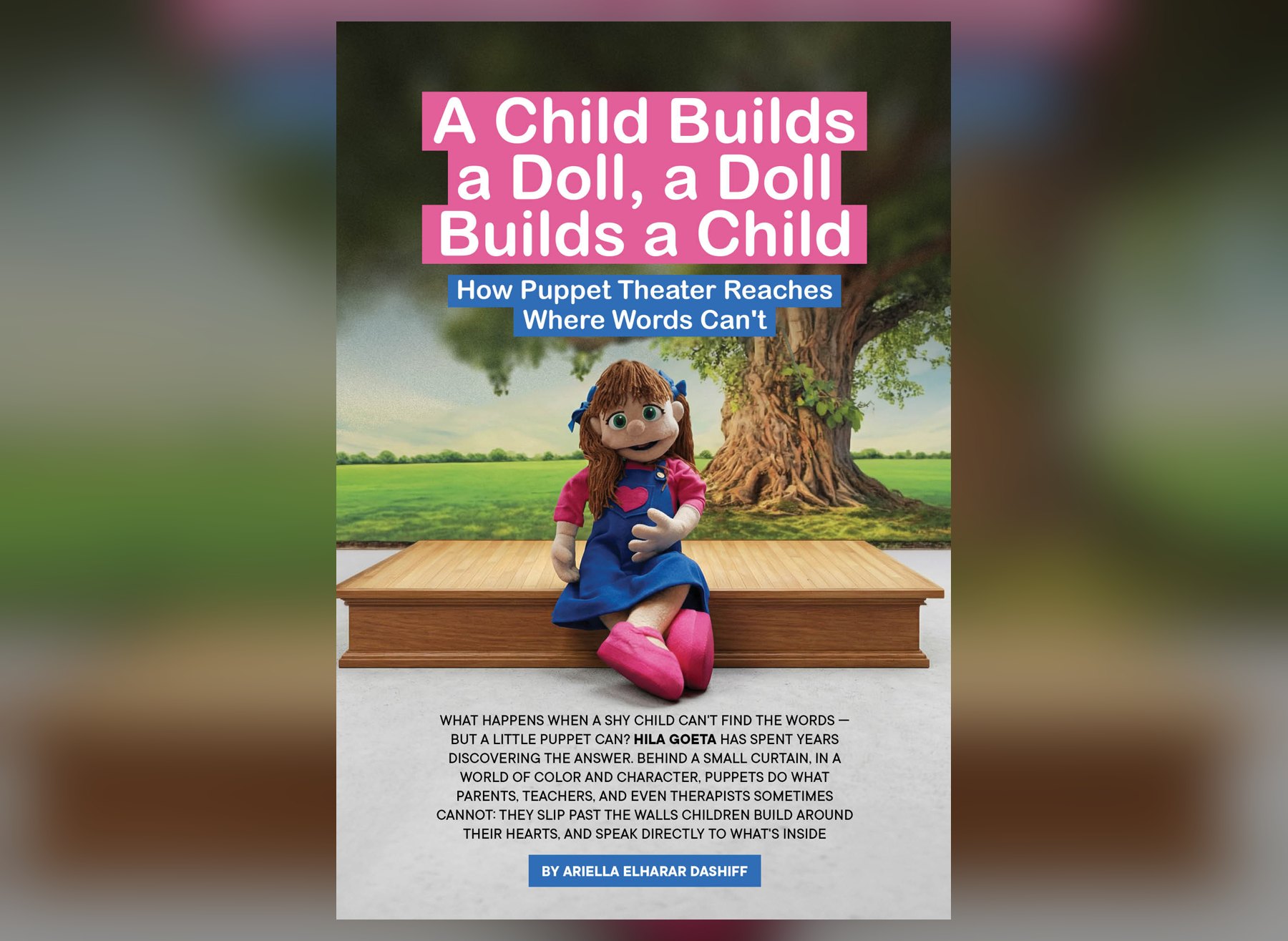
How Puppet Theater Reaches Where Words Can’t
What happens when a shy child can’t find the words – but a little puppet can? Hila Goeta has spent years discovering the answer. Behind a small curtain, in a world of color and character, puppets do what parents, teachers, and even therapists sometimes cannot: they slip past the walls children build around their hearts, and speak directly to what’s inside
Once upon a time there was a tree who was sad at heart. He didn’t like his long, needle-like leaves – he would have preferred leaves made of, say, gold. Hila Goeta, a puppet theater operator, granted the sad pine tree his heart’s desire. But then something happened that made the pine tree rejoice in the old, good leaves that Hashem had given him.
Once upon a time there was a boy who didn’t like his hair, which was brown and curly. He didn’t like the color of his eyes either – he would have preferred blue. And in general, he knew that in kindergarten, at circle time, there’s always one child who knows all the answers to the teacher’s questions – and that child wasn’t him. It is the heart of this boy, and of so many other children like him, that Hila Goeta tries to enrich and heal through her puppets.
This wonderful treasure – the Goeta family’s theater, “Tehila shel Buba” (A Doll’s Glory and a play on Hila’s name) – had been hiding in the apartment below mine, and I had never given it a second thought. Over the past year and a half, in the wake of the war, I was exposed to the use of puppet theater in the field of education, and I came to learn that playing with theater puppets helps young children cope with emotional and psychological difficulties.
The question that interested me most was whether Hila uses the puppets as a therapeutic tool – and the answer was “no.” But even that “no” isn’t entirely clear-cut.
But let’s start from the beginning.
A Little History
“From a very young age I loved puppet theater,” Hila recalls. “After performances I would go backstage, ask questions, observe with curiosity, and watch how the operators breathed life into the puppets. At home I would perform for neighbors and family. When my mother saw my passion and talent, she built me (with her own hands!) a large puppet theater. I would buy all kinds of puppets, and on Shabbos, on Yomim Tovim, and on various occasions, I would put on shows for cousins, family, and neighbors.
“When I grew up, I studied education at Beis Rivkah, received my degree, and worked as a kindergarten teacher for several years. “Eventually, my love for puppetry led me to seek formal training in the field, but all the available programs were non-religious, which wasn’t quite right for me. Over time I discovered that in Bnei Brak there was a performing arts school that offered a puppetry course. I enrolled and traveled there once a week for classes. I felt a need to deepen my knowledge further. For me, the puppets weren’t just a teaching aid – they were an end in themselves: educational theater.
My final project was a performance I put on at my daughter’s kindergarten, when she was four. The teacher was thrilled, and I jokingly told her that maybe I’d run a club there the following year. She took my words a little more seriously than I had intended. To my great surprise, one of the mothers ‘informed’ me that the teacher had told the parents I would be running a club at the kindergarten the next year… I was a little nervous, but I saw it as a sign from Heaven. In the end I mustered up the courage to commit – and I jumped in with a creative friend who helped me at the time.
“Things developed and expanded over the years. We ran workshops and puppet activities, we produced larger shows – and then came the COVID pandemic. Activities came to a halt for a while, but my husband and I thought it over and decided to stop the clubs and instead focus on producing large-scale performances and workshops. We learned a bit about marketing, and that’s really what we’re doing now, baruch Hashem.”
A Puppet on the Way to the Heart
Our ears are sensitive, and our hearing – selective. We don’t like to hear criticism, instructions, or mussar. But if the adorable puppet Zisi tells us how wonderful and fun it is to brush our teeth – success is almost guaranteed. According to research on the subject, the puppet bypasses emotional barriers and goes straight to the heart – and this holds true, of course, for Jewish content as well. “We work with all kinds of sectors,” says Hila, who sees the transmission of Jewish and educational content as a mission. “Yes, there are even non-religious schools that want to instill Jewish values in children – love of fellow Jews, gratitude to Hashem, the meaning of the holidays, and more. We go there too, and of course the activities are tailored to the audience.
“Once I put on a performance for a non-religious audience, and I thought about asking the children who created the world. I hesitated a little, but I said to myself: ‘What’s the worst that could happen?’ I asked – and all the children answered in unison: ‘Hashem created the world.’
Naturally, in such cases I need to remember who invited me and to present the content in a way that will be well received. But generally speaking, people’s resistance isn’t nearly as strong as one might expect. As a rule, I say upfront that the content is based on Torah values. Of course, people who don’t define themselves as religious also attend performances and workshops at Chabad Houses and similar venues – but people enjoy the shows and connect with them.”
In most homes, a mother and father are out the door by seven in the morning on the school-and-work circuit and won’t see each other again until six in the evening. And even then, the demands of daily routine claim most of their time together. How do you give a mother or father quality time with their children? Puppet-making workshops have the power to connect – not just during the workshop itself. “In our parent-child workshops we tell the parents: ‘Now turn off your phones and connect with your child for a little while.’ Parents and children build a puppet together – for example, a ‘sock puppet of emotions.’ The puppet goes home and becomes a sweet memento for both parents and children. It serves as a reminder of the quality time they shared, and encourages them to keep creating quality time, listening, and connection at home.” (For ideas, see sidebar.)
Why Do Children Connect with Puppets?
“There’s magic and fun in puppets. If, for example, we want to teach about the mitzva of returning a lost object, you can come and lecture – like a lesson – or convey the content in a far more experiential and engaging way: through a performance. The child connects to the content partly because he sees himself in the puppet’s place; he identifies with it. The puppet does all kinds of things – good or not so good – and the child feels a sense of identification with those actions. He recognizes which character he resembles, and the reflection the puppet offers helps him learn about himself and work through his experiences.
“Messages can pass through much more easily, because the children experience everything in a tangible, concrete way. More than that – they actually live the reality of the performance. When something like magic happens on stage, the children are overjoyed. You see a powerful identification with what’s happening on stage, and through that, children connect to values in an experiential, meaningful way – not a superficial one.”
Puppets in the Service of Geula
Who would have believed that four-year-olds would learn Tanya or engage with concepts of Geula? With puppets, anything is possible. On Hila’s stage, two kings appear – one red and angry, the other white and welcoming. “This performance illustrates the struggle of the two souls for the heart of a small child who is struggling to return a lost object. We work very hard to ensure that the children are not passive during the performance, but rather go through the process alongside the puppets. The puppets ask the children questions and the children respond; they share their feelings with the children and consult them. In the performance about the two kings, the children are full partners in the hesitation and the emotions of the child on stage. They encourage him to overcome the evil king, to return the lost object – and they even help him ask for forgiveness.”
And what about Geula?
“The desire to awaken children’s hearts to live with and yearn for Geula gave birth to the performance ‘Keys to Redemption.’ The performance is about a child who desperately wanted to know what the world would be like at the time of Geula. In a dream at night he sets out on a journey to discover the Geula, and he encounters his grandfather, who had miraculously recovered from illness. He asks his grandfather through what merit the children merited the coming of Geula, and his grandfather answers that he cannot tell him directly – but if he finds the keys, he will know.
“And so he sets off on a journey to discover the keys to Geula. Along the way the children are exposed to that wondrous era: candies growing on trees, giant fruits that talk, and an ascent on clouds to the Beis HaMikdash – with joy and excitement. In the dream, the child finds keys inscribed with words that he doesn’t know how to piece together. When he wakes up, he tells his father about the dream and the keys, and his father helps him assemble the words into the phrase ‘Just one more small deed’ and explains its meaning.
“I love this performance especially! And incidentally, it helps parents connect too. Once a mother came over to me afterward and said: ‘I didn’t know that’s what it will be like at the time of Geula – now my davening is going to be different.’”
A Child Builds a Doll, a Doll Builds a Child
Tips for Parents on Encouraging Emotional Expression
Option One: The parent puts the puppet on their hand, and the puppet tells the child how it experienced an unpleasant situation similar to the child’s own. Then the parent, speaking as the parent, turns to the child and asks: “What do you think? How can we help it? Let’s help together – do you have any ideas?” – all as if it has nothing to do with the child himself. The child offers ideas, the parent responds and suggests his own, and the puppet “reacts” as well. It shares how it feels about the proposed solutions, raises doubts and concerns, or expresses joy and a range of other emotions. In this way, the child helps the puppet – and in doing so, indirectly helps himself.
Option Two: Let the child put the puppet on his own hand and give it a voice. The child begins sharing his own feelings through the puppet. It’s worthwhile to encourage this, and to try to bring the child to offer the puppet advice about situations where he himself needs help. The puppet worn on the child’s hand is both the child and not the child – which sometimes allows the child to express things he would never dare say otherwise. It isn’t he who is saying these things – it’s the puppet – and so it becomes much easier.
Option Two holds an additional advantage: the child is the one who decides what the puppet will say and how it will respond when told something uncomfortable. Moreover, the child is the one who decides not to subject himself to painful self-criticism – which makes it easier for him to open up and share.
There are cases where a puppet is used to help a child move toward a better place. We experienced a funny example when we ran a program at a certain school – parents reported that their children went to shower because the puppet said they should… It motivated them to bathe, and with greater enthusiasm than usual.
You can suggest to a child that he choose a puppet he loves and identifies with, or create one with him. In the WhatsApp group we’ve opened, we share both easy-to-make puppet crafts and tips for how to use them.
Beis Moshiach #1501 • pp. 42-45
© 2026 Beis Moshiach Magazine. All rights reserved.
This article originally appeared in Beis Moshiach #1501. You are welcome to share it with friends and family by email or in print, provided that you do not change, add to or omit any part of it, you credit the author and Beis Moshiach, and you include a link to archive.bmoshiach.org (written out in full in printed copies).
To republish this article in a newspaper, magazine, book or website, please request permission in advance at [email protected].