I Want to Be a Tamim
Previously in this story: A boy from Teaneck studying at NYU by the name of Immanuel Storfer, meets a young Chabad rabbi on a Manhattan street corner. He takes his first steps in Yiddishkeit, walks to 770 on Pesach night – and at the Ohel, the Rebbe answers his question about where to go next with a single word: “Mayanot.”
Last time, I left you with a cliffhanger.
I was standing outside the Ohel after having just written a letter asking the Rebbe what to do with my life. I had two choices in front of me: a non-Chabad yeshiva that had already accepted me, or a place called Mayanot, a Chabad yeshiva in Yerushalayim for baalei teshuva.
I stepped outside, unsure how I’d get my answer.
And then I heard it.
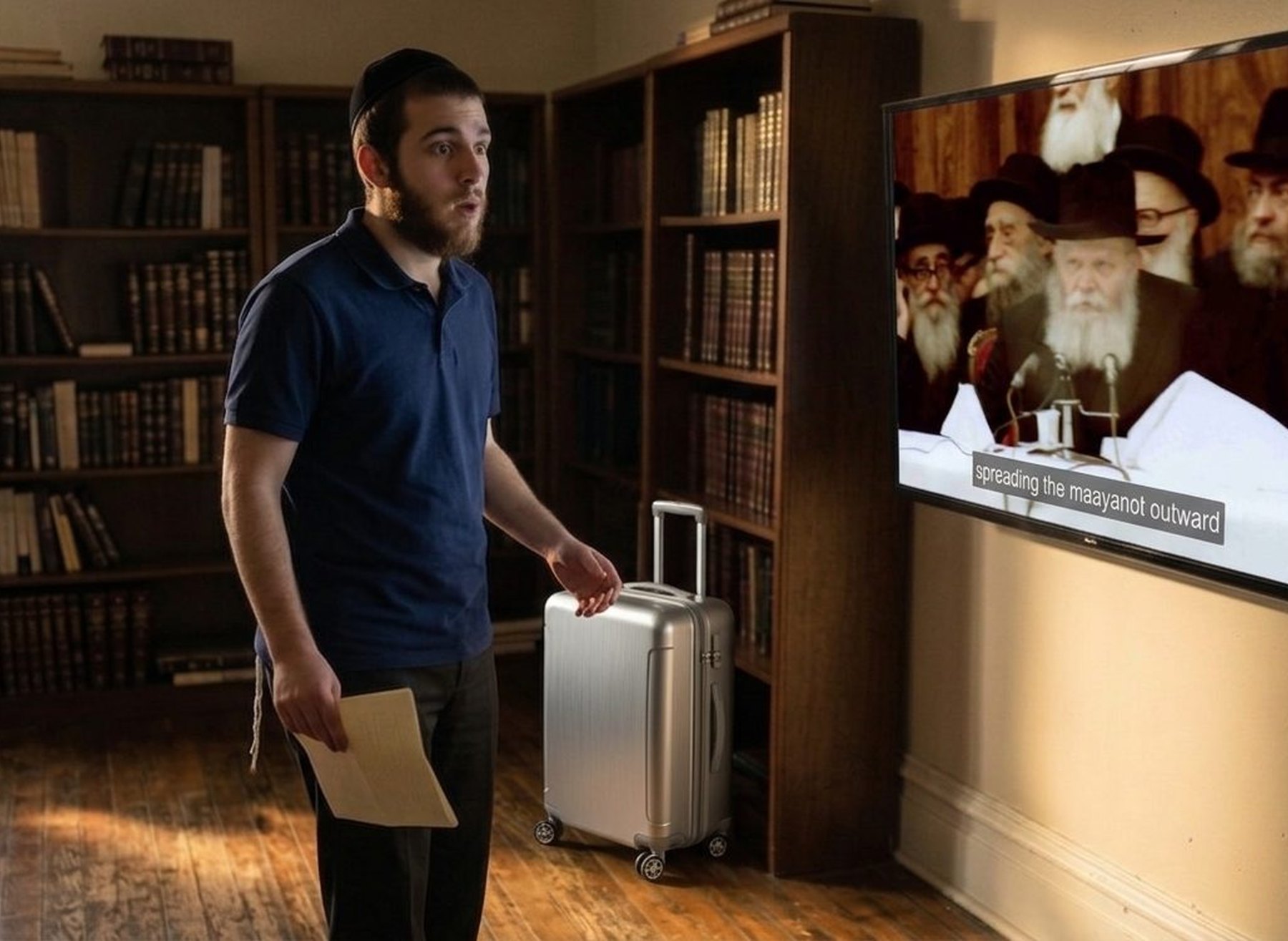
On a screen nearby, a video of the Rebbe was playing. The very first word out of the Rebbe’s mouth was – “Mayanot.”
I froze.
The Rebbe kept going, talking about the wellsprings of Torah spreading outward – repeating the word again and again. And standing there in the parking lot of the Ohel with my heart pounding, I knew.
The Rebbe had answered me.
I went to try the other yeshiva first, since that’s where I had already registered. But something didn’t feel right. The learning was fine, the people were kind – but it wasn’t what I was looking for. I couldn’t stop thinking about what the Rebbe had said.
And so it was. I was going to Mayanot.
* * *
Yerushalayim is a different world.
The streets, the stones, the sounds – all of it hits you at once. And somewhere in that ancient city, I found Mayanot: a place full of young Jews from everywhere, all trying to figure out the same things I was.
We learned Chumash. We learned Tanya. We had long Shabbos meals that stretched into the night with singing and stories. For the first time in my life, I was surrounded by people who were asking the same questions I was – and slowly, together, we were finding answers.
But what made Mayanot truly special wasn’t just the learning. It was the Chassidus.
The Rebbe hadn’t just said the word “Mayanot” by accident. He was speaking about the wellsprings – mayanos – of Torah spreading outward into the world. And at Mayanot, that was exactly what we were learning: the inner dimension of Torah, the Chassidus of Chabad, the teachings of the Rebbe. The very waters the Rebbe had been talking about.
Every class in Tanya, every farbrengen, every late-night conversation about Chassidus – I understood now that this was what the Rebbe had been pointing me toward. Not just a yeshiva. A wellspring.
But I always knew Mayanot wasn’t the end of the road. It was a beginning.
And the longer I was there, the more I felt something pulling me further. I wanted more. I wanted the real thing – the full yeshiva experience. Gemara. Halacha. A chavrusa. Chassidus. The whole world of learning that I hadn’t even touched yet.
I wanted to be a “Tamim.”
That’s a Chabad word. A Tamim is a student of Tomchei Tmimim – the Chabad yeshiva network that the Rebbe Rashab established over a hundred years ago. In Lubavitch, it carries real weight. To be a Tamim means you’re fully in. You’re not just curious about Yiddishkeit – you’re committed to it, you’re living it, you’re building your whole life around it.
I wanted that.
So I walked into Tomchei Tmimim in Crown Heights, the central Chabad yeshiva right there in 770, and asked to enroll.
* * *
The rabbi who greeted me, Rabbi Schwei, was polite. He listened. He nodded. And then he said, very carefully:
“The yeshiva isn’t really designed for… someone in your situation.”
I blinked. “What do you mean?”
“The bachurim here have been learning since they were children. They know Gemara. They know Rashi. They know Yiddish. You’re coming in at – well – a different starting point.”
He wasn’t being mean. He was being honest. But I heard what he wasn’t saying: You don’t belong here.
I took a breath.
“I learned,” I said, “that the Rebbe Rashab davened for ten years to open this yeshiva. And I learned something else too.”
Rabbi Schwei looked at me and waited.
“Tomchei Tmimim isn’t just a school,” I continued. “It’s a place the Rebbe Rashab built with mesirus nefesh. And Chabad sefarim explain that he didn’t just open the doors and hope the right people would come.
“They explain that he saw the future of the yeshiva,” I said, “and he chose the neshamos who belong here.”
Not random. Not like, “Whoever shows up.” Chosen – on purpose.
“Meaning,” I said slowly, “that the Rebbe Rashab knew there would be thousands of bachurim over the years – in different countries, in different generations – and he still built this yeshiva for specific neshamos.”
“So when you ask me, ‘Why are you here?’” I said, “you’re not only asking about me.”
“You’re asking about the Rebbe Rashab,” I continued, “because if he chose the neshamos that belong here, then my being here isn’t an accident.”
“I’m not visiting,” I said. “I come to every seder. I learn Chassidus. I make chavrusas. I write things down. I’m giving this my whole heart.”
“If this is a yeshiva where the Rebbe Rashab chose who belongs… then I was chosen too.”
And I meant it.
The room fell silent.
Finally, Rabbi Schwei nodded. “Okay,” he said. “You can stay.”
* * *
Those first weeks were humbling.
Everybody around me had been learning Gemara since they were eight years old. They threw around Aramaic phrases the way I used to throw around sports statistics. They could open a page of Gemara and read it like a newspaper.
I was starting from zero.
And the language – the shiurim were in Yiddish. Real Yiddish, not the few words I’d picked up. Full lectures, full discussions, questions and answers, all in a language I barely understood.
I sat in the back and listened. I picked up words. I asked questions after class – first in English, then slowly, haltingly, in Yiddish. My chavrusa – a patient bachur who had probably been learning Gemara since before I knew what a Gemara was – helped me sound out words and follow the flow of the page.
Every night I stayed late, going over what I hadn’t understood. Every morning I came in early, preparing for what was coming. Slowly – very slowly – things started to click.
A phrase I recognized. A logic I could follow. A back-and-forth argument between Rashi and Tosafos that suddenly made sense.
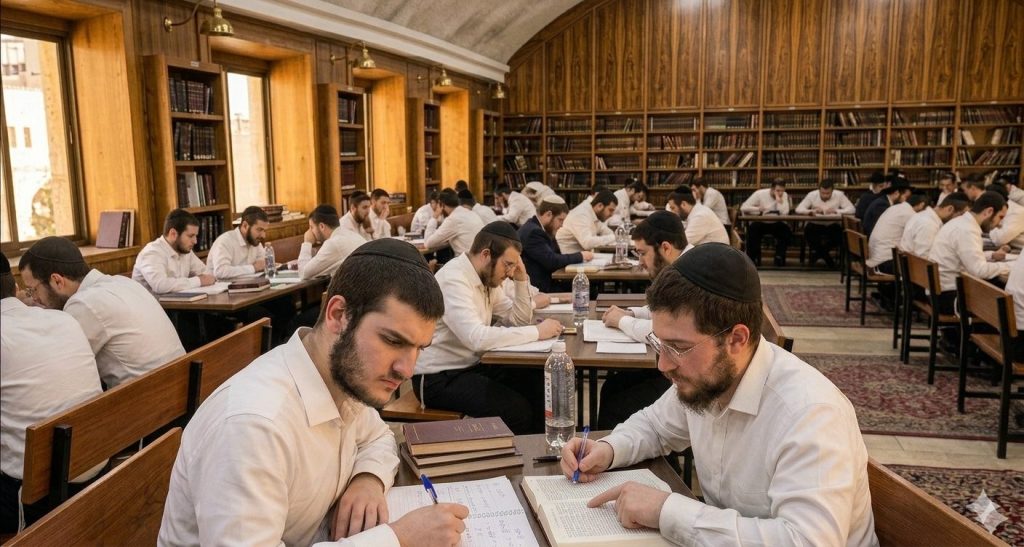
It was like learning to swim by being thrown in the ocean. Terrifying. Exhausting. And, somehow, exhilarating.
After my first year, the yeshiva asked me to stay for a second.
That was when I knew: I hadn’t just survived. I had begun.
* * *
A year passed, then another. I grew. I learned. I found my footing.
After yeshiva, I was sent on shlichus – to Brazil, of all places – and I threw myself into it. Then I came back, received semicha, got married, and joined a kollel, building on everything I’d worked so hard to earn.
And somewhere along the way, I came full circle.
The yeshiva that had almost turned me away at the door? They asked me to teach there.
The same place that once wondered if I belonged – now trusted me to help shape the next generation.
But even then, something was stirring. I kept thinking about where I’d come from. About all the young Jewish men and women out there who were just like the twenty-year-old Immanuel Storfer – curious, searching, not quite sure where they fit in, maybe not even sure what they were looking for.
I knew what it felt like to be that person.
And I knew something else, too: there weren’t enough places for them to go.
* * *
That’s when I heard about an opportunity in Florida.
Rabbi Korf – yes, the uncle of the very same man who had handed me a menorah on a street corner in New York all those years ago – was looking to reopen a baal teshuva yeshiva in Miami. Something like Mayanot. Something that had existed once, then shut down, and needed someone to breathe new life into it.
I thought that someone might be me.
I flew down to Miami.
At first, it wasn’t simple. Rabbi Korf was busy. I kept hearing “tomorrow” and “let’s talk soon.” I sat around, waiting. Finally I walked in and said: “I’m here. Let’s start.”
We started.
But starting a yeshiva from nothing is not for the faint of heart. I didn’t have a building. I didn’t have a budget. I barely had a plan. I was still technically in kollel back in New York, not even living in Miami full-time.
What I had was a vision – and the memory of what it had felt like when someone finally gave me a place to grow.
So I started small: a ten-day program.
I found an empty shul willing to host it. I got a few rabbis to teach. I made a simple brochure. I reached out through Chabad Houses across the country, spreading the word any way I could.
And somehow – fifteen people signed up.
It wasn’t a full yeshiva yet. But it was something real. Something alive. And I couldn’t let it go.
* * *
Back home, I kept talking about it. Meetings turned into plans. Plans turned into sponsors. Sponsors turned into a real conversation about a real building with real salaries for the teachers.
About a year later, on my birthday, in the month of Elul, I wrote to the Rebbe. I was already dreaming about Miami, about what this yeshiva could become. And as I sat there with pen in hand, I felt something that I could only describe as a push. Keep going.
That same day, I ran into my old chavrusa – Rabbi Yisroel Geisinsky, who had been with me all through our yeshiva years. I asked him straight: “Do you want to go on shlichus with me? To Miami?”
He stared at me.
“You’re not going to believe this,” he said slowly. “This morning, during davening, I did something I don’t usually do. I added my own words. I said to Hashem: ‘Send me a shlichus.’ That’s it – just that. I asked for a shlichus.”
He paused, and then smiled.
“And then I walk out of davening, and within minutes, you come over and ask me to move to Miami with you.”
We looked at each other.
There’s a word in Yiddish – bashert. Meant to be. Some things you plan. Some things Hashem arranges. And when Hashem arranges something, you don’t argue.
We went to Miami.
* * *
We called it Torah Ohr – the Light of Torah.
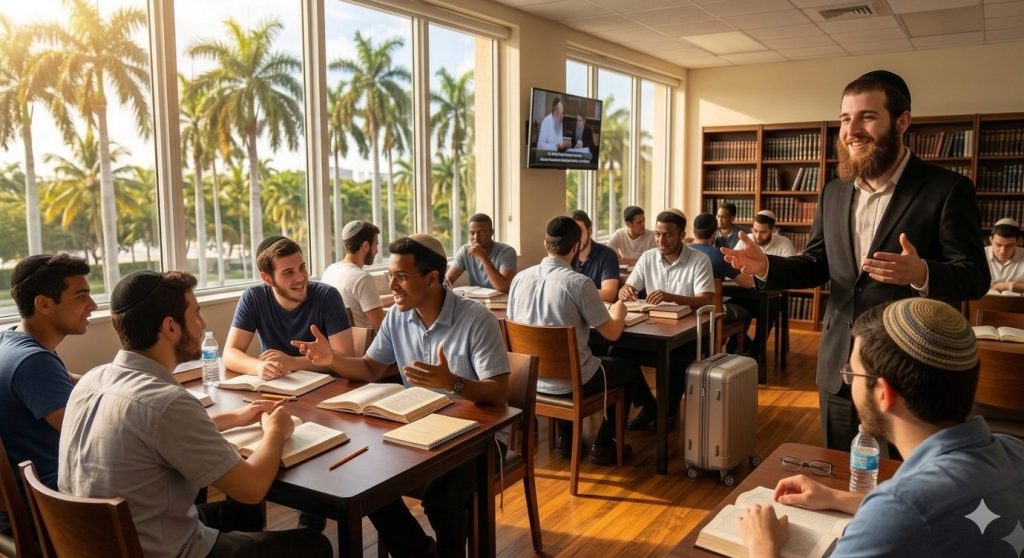
As I said, it started as that ten-day retreat. College guys from all over America would come down to Miami, sit in a Beis Medrash a few blocks from the beach, and get their first real taste of Jewish learning. Chumash. Gemara. Chassidus. Halacha. And between sessions, a little Florida sunshine never hurt.
But a funny thing happened. They didn’t want to leave.
And the ones who went home kept calling, asking: is there something longer? Can we come back?
So we built something longer.
Torah Ohr became a real, full-time yeshiva – not just a retreat, but a place where a young man could come for a month, three months, a full year, and actually build a Jewish life from the ground up. Real seder. Real learning. Real guidance.
Word spread fast. Students started coming not just from America, but from Ukraine, Brazil, Venezuela, Australia – because they’d heard there was a place in Miami that would take you in, wherever you were holding, and help you grow.
Years later, Torah Ohr is still growing.
And every time I see a new student walk through the door – uncertain, searching, a little bit lost – I see myself.
A kid from Teaneck who once heard the words “Are you Jewish?” on a street corner in Manhattan, and didn’t quite know what to do with the question.
It took a Mitzvah Tank, and a long Pesach walk, and a video of the Rebbe saying one word at exactly the right moment – and years of late nights with a Gemara and a patient chavrusa – to find the answer.
But that’s the thing about the answer.
Once you find it, you can’t help wanting to share it.
From a college student… to a Rosh Yeshiva — because Hashem had a plan all along.
Beis Moshiach #1501 • pp. 54-59
© 2026 Beis Moshiach Magazine. All rights reserved.
This article originally appeared in Beis Moshiach #1501. You are welcome to share it with friends and family by email or in print, provided that you do not change, add to or omit any part of it, you credit the author and Beis Moshiach, and you include a link to archive.bmoshiach.org (written out in full in printed copies).
To republish this article in a newspaper, magazine, book or website, please request permission in advance at [email protected].