From Crib to Classroom
Key Developmental Stages in Traditional Jewish Education
Every thing has a key – not just for doors or your mobile phone. The key is that secret which, once you identify it, is what drives a process, causes growth, flourishing, movement, and also enjoyment. Usually this key is hidden. You need to scratch the surface a little to find it. The freedom of every creature is the fulfillment of its abilities. If those abilities are imprisoned, growth stops and a process of deterioration begins, chas v’shalom.
If the key to a baby’s growth is unconditional love, by childhood that is no longer enough. It may be surprising to hear this; we have grown accustomed to thinking that love solves everything. There is indeed some truth to that, because love is the foundation of everything and the inner essence of everything – but it alone is not sufficient.
As a person grows and new abilities develop within them, their growth, their freedom, and the fulfillment of their potential also require the educator to develop new layers of engagement.
Psychology books define age two as “the first age of rebellion.” Experienced mothers say that age two is the first rebellion that never really ends. Having mentioned the freedom of every creature, we can guess that perhaps children rebel when their parents are not letting go enough…
In other words: if parents give the growing child the freedom appropriate to his stage of development, he will not feel the need to rebel. If we know what new abilities flow from the encompassing parts of the soul (the chaya) into its revealed powers – expressed in thought, heart, and action (mind, heart, and body) – we will also know in what areas and when to release them.
A New World
During childhood, roughly ages 3-12, cognitive abilities – that is, brain functions – gradually develop. The child opens up to a new world and to the possibility of a mind that governs the body and the heart. This period is actually divided into two: ages 3-6, and ages 6-12. If we look at what children are taught from preschool through first grade, we can understand which functions are developing.
At first, the mind’s control is truly on a very small scale. The child is required to control his bodily needs; when put to sleep he must learn to calm his body in order to fall asleep on his own; during gatherings he must sit quietly for a few minutes; during play he must consider others, and so on.
The communication between the brain and the other organs also gradually improves. When playing hopscotch, the jumps are more precise and the ball no longer slips through the hands too often. Concrete thinking functions also become more available: the ability to count, to associate quantity, to read, to compare, to interpret body language, and more.
With the development of these abilities, self-awareness and awareness of one’s surroundings slowly begin to develop. What enables this awareness is the intellect’s ability to define, and when the educator or parent defines and names emotions, the child receives an initial picture of his own inner world – and through it, of the inner world of others.
At this age, parents and educators lay the first foundations for understanding the soul. Each of us has feelings felt in the heart. Sometimes they are very strong and unpleasant. These come directly from our animal soul and they can influence our behavior in undesirable ways. Fortunately, Hashem has given us all the ability to cope with them through the G-dly soul which only wants to do good and the right things. In all our hearts there is a battle between the G-dly soul – which always wants to do what is good and right – and the animal soul, which sometimes struggles.
This is the opportunity to teach our children a simple process that will be accessible to them in times of difficulty:
Stop for a moment.
Physically feel the heart – place a hand on the heart. This helps the child, and also the adult, to feel the heart more and to comfort it.
Give the emotion a name – definition, reality.
Understand the animal soul as if to hug and comfort it.
Finally, say to yourself: “Despite the pain and sorrow, I choose to do what is good and right – to illuminate the world with the light that Hashem placed in my heart.”
Compliment yourself on the small victories.
This simple process allows us to manage emotion through the intellect, just as hands shape clay. This is because naming an emotion transforms it from an undefined, flooding tsunami wave into a familiar, defined, and bounded reality.
This frees our child from developing feelings of guilt, because he understands that we were all created this way – he is not different or bad, ch’v. It also instills in him the inner strength to overcome and “turn right” toward the positive, divine emotions that are the ratzon Hashem.
These are skills that it is important for parents to develop in children. This can be done through conversations about their emotional lives, by naming emotions, and through stories about the emotional experiences that appear in daily life and the ability to cope with them. How much calm and emotional resilience a child gains when he learns, already in preschool and school, the foundations for understanding his soul according to the Tanya.
Hello, First Grade
We have arrived at the exciting age of elementary school.
By age six, there is already some understanding of negotiation. This is proven by the long lines of children who come to buy candy at the neighborhood grocery store a minute before school, as well as the lively trading of Tzivos Hashem stickers they exchange with each other. Along with this commercial ability (what is worth more and what less?), social abilities also develop (what tactic will influence a friend to trade me the rare sticker?). These abilities are the beginning of emotional intelligence, which in Chassidic thought is called daas. At this age, the child gradually reaches intellectual maturity.
We are still not at the end of the road. In the next stage he will learn to feel others and to know himself. Internal awareness and daas will continue to grow and develop, but that’s in the future.
Opening the Heart
So how does our child’s freedom express itself at this age?
For this, he must be presented with challenges that will open his developing intellectual abilities, as well as opportunities and encouragement to use them independently.
To send him on errands, for example, to sort games and organize things at home according to his own understanding, and then to ask him for the reasoning behind his choices. You can also talk about the day that passed in a somewhat deeper way.
All of this must come against a backdrop of clear expressions of the natural, unconditional love that parents have for their child – the first layer of parenting. Just as we gave warmth and an abundance of love to the little infant even though he hadn’t achieved anything, and perhaps even did what many parents call ‘tikkun chatzos’.
Upon this layer, one builds an additional layer of respect toward the child – through appreciation, granting of independence, and the ability to trust him to do what is good. One should compliment, hug, take delight in him, tell him how unique he is, and believe in him that he will succeed.
Observance of Mitzvos
The commandments Hashem gave us are not detached from reality, but are tailored to the soul. The Torah defines the proper approach to observance of mitzvos and Torah study at each specific age.
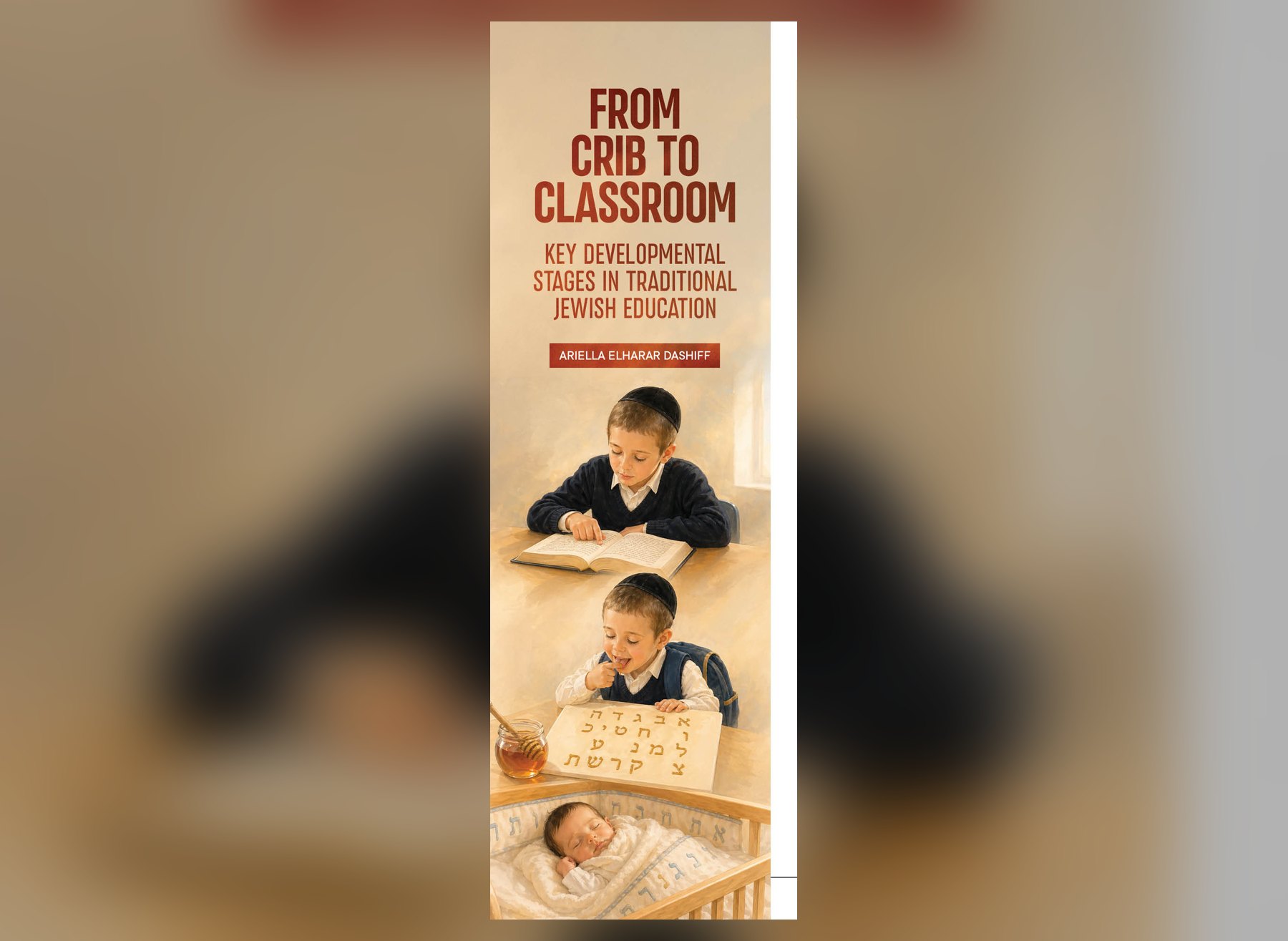
In early childhood – ages 3-6 – observance of positive mitzvos is primarily experiential, like a preparatory workshop for mitzva observance. You buy dalet minim for the child, have him kiss the mezuza, bring him to shul to absorb an atmosphere of holiness. Learning is also experiential such as letters written in honey, Torah stories.
However, regarding negative mitzvos, even at this age the father is obligated to warn and distance the child. But note: only the father is obligated to distance him. Others around the child – including the mother – may use their own judgment whether to distance, ignore, or redirect his attention.
In elementary school age, mitzva observance becomes more precise and defined, as befits the child’s cognitive and emotional abilities. Gradually, his father and mother guide him to become part of the whole of the Jewish people – within the family, the community, and the nation as a whole.
At this age as well, the father is always the one obligated to warn and distance, of course from a place of love and calm, but in an unambiguous manner. The mother and those around the child may act according to their own judgment – and they too only with love and calm.
To summarize briefly the “keys” to our child’s heart during childhood: present age-appropriate cognitive challenges; allow them independent action in areas where the child can function successfully with light parental support if needed; develop awareness and emotional regulation. In the area of positive mitzvos, parents must educate toward mitzva observance according to the child’s sharpness; and in the area of negative mitzvos, the father must distance them.
[Sources: 1) Rabbi Kornweitz, Machon Halacha Chabad / Hilchos Shabbos course. 2) Rabbi Arad / “Horim b’Rosh Tov”]
Beis Moshiach #1504 • pp. 46-48
© 2026 Beis Moshiach Magazine. All rights reserved.
This article originally appeared in Beis Moshiach #1504. You are welcome to share it with friends and family by email or in print, provided that you do not change, add to or omit any part of it, you credit the author and Beis Moshiach, and you include a link to archive.bmoshiach.org (written out in full in printed copies).
To republish this article in a newspaper, magazine, book or website, please request permission in advance at [email protected].