Three Days Alone in the Forest
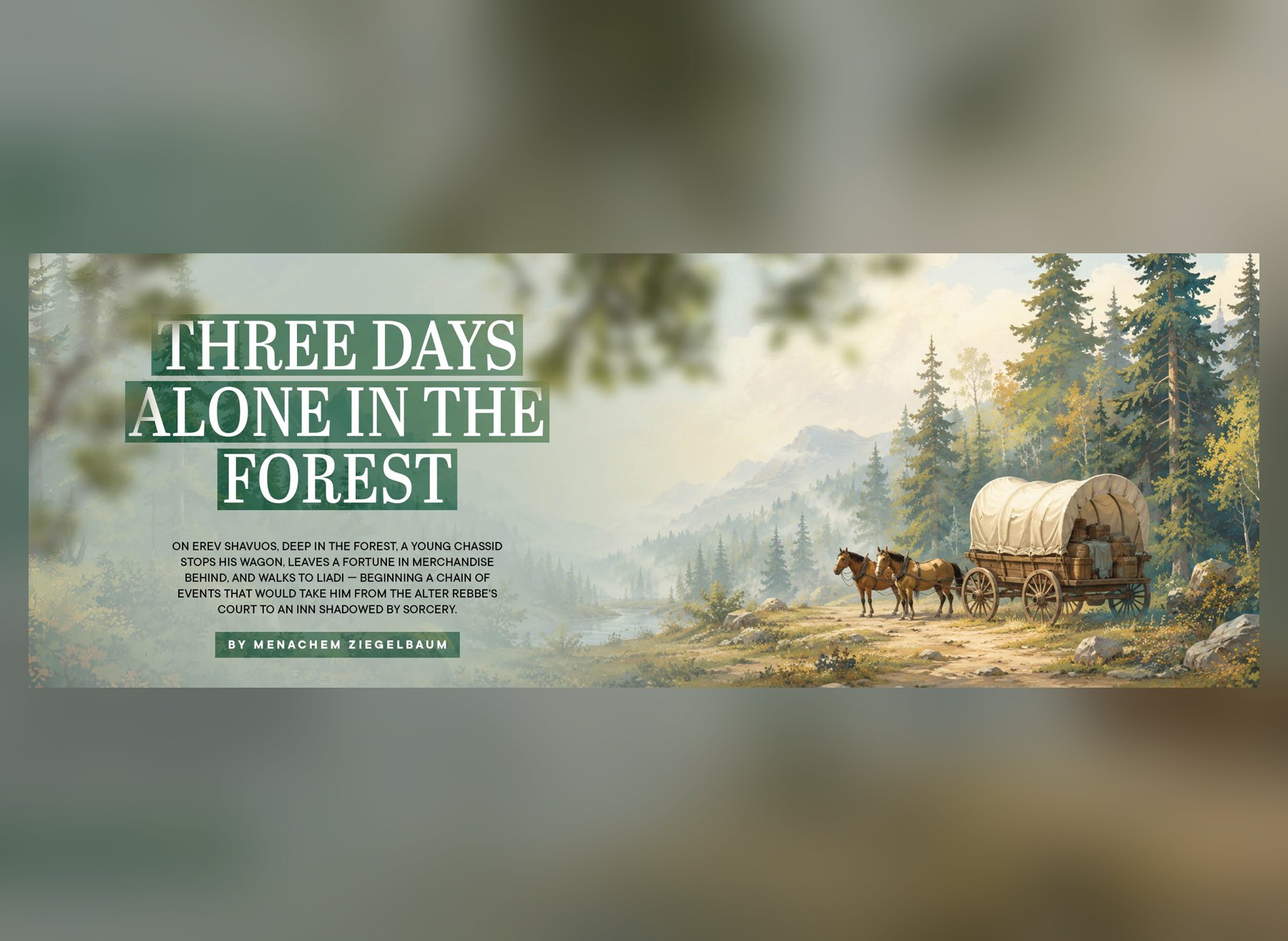
On Erev Shavuos, deep in the forest, a young Chassid stops his wagon, leaves a fortune in merchandise behind, and walks to Liadi – beginning a chain of events that would take him from the Alter Rebbe’s court to an inn shadowed by sorcery.
I
Chaim was a young scholar when he married Freida, the middle daughter of Reb Shlomo, a timber merchant. Since Chaim was considered an exceptionally gifted student, he merited being supported at his father-in-law’s table for seven consecutive years, during which he studied with great diligence and dedication.
Being a Chassid, he also devoted much time to studying Chassidus, particularly the writings that came from Liadi, the court of the Alter Rebbe.
For many years Chaim had the privilege of dwelling in the Alter Rebbe’s holy proximity, going back to his days as a young bachur, when he first came to Liadi to taste the flavor of Chassidus and remained for several years under the guidance of the Gaon Rabbi Yehuda Leib, the Alter Rebbe’s brother. When he married, he was forced to leave Liadi and live in his wealthy father-in-law’s home. This separation from the Rebbe’s court was harder for him than the splitting of the Reed Sea. Who better than he understood what it meant to sit in the Rebbe’s court without worries, to learn and learn without the affairs of this world disturbing him even in the slightest.
This is why he would occasionally travel to visit the Rebbe.
II
Difficult days came upon Reb Shlomo, the father-in-law. The timber trade from which he had earned an honorable living for many years collapsed within a relatively short period, and he took to his bed. The burden of supporting the family fell at once upon the shoulders of his son-in-law Chaim. Chaim was forced to leave the warmth of Torah and Chassidus and to try his hand at the fabric and textile trade.
His talent, his natural grace, and his father-in-law’s good name helped him forge a path in the world of commerce. Wholesalers extended him credit, and so he purchased fabrics in quantity and sold them at the small markets in his region, finding blessing in his labor.
It was the middle of summer. Chaim was deeply immersed in the world of commerce. He was at one of the large fairs, where he purchased a substantial quantity of both fine and simple fabrics, all according to demand, loaded his wagon, and set out on the road.
Three days of travel lay ahead of him, and Chaim prepared himself properly for the journey. He took the reins and handled the horses skillfully, climbing hills, descending valleys, making his way through vast fields. Even when he entered the dense forest, he found his way with ease.
Chaim had much time to think during those hours of driving, and his thoughts wandered far. He calculated how much profit he could expect from the deal he had just made. Then his thoughts continued to roll along to the trade that occupied him day and night, the fabric business, and how he had gotten into it in the first place.
In his mind he traveled back several years, to the days of his marriage, and even earlier, to his days at the Rebbe’s court. He saw himself as a bright young bachur sitting at a wooden table, studying with dedication and without worry. From time to time he merited hearing a maamar Chassidus from the Rebbe. Though it was not the rarest of occurrences, each such day became a day of celebration.
“Days of light,” he called those times in his thoughts. A fierce longing suddenly seized him. Chaim felt a tightening in his throat – he knew the tightening came from within. From the heart. From the soul.
“Today is Erev Shavuos,” Chaim mused to himself, and his heart grew heavy. He pictured Shavuos at the Rebbe’s court; the holiday he had merited celebrating there for several consecutive years until his wedding. The maamar Chassidus he had heard, the “thunder and lightning” he had witnessed and experienced, despite the lofty intellectual nature of Chabad Chassidus…
Warm tears streamed from his eyes without him even noticing.
Suddenly, like a heavenly illumination descending upon him – “I will go to the Rebbe right now!” he decided on the spot. “I will leave the loaded wagon here and walk on foot to the Rebbe. After all, it is only a matter of a few hours’ walk. And as for the merchandise – Hashem will help!”
Before he could have second thoughts, he stopped the horses. He took his tallis and tefillin, jumped down from the wagon, and without looking back began striding resolutely toward Liadi. He had to cross the forest, pass through two villages, and then a short while of brisk walking and Liadi stood before him in all its glory. Though Liadi was a small and simple settlement, to him it was a capital city in every sense of the word.
He arrived in Liadi just minutes before Yom Tov began. The first Jews were already making their way to shul and he ran quickly to the mikva to immerse before the holiday was ushered in.
When he entered the shul, the davening was already in full swing. In a quick glance he managed to spot several faces he remembered from his youth; men whose fortune had smiled upon them, allowing them to be with the Rebbe every day throughout the year.
When the Alter Rebbe turned around after the davening, he noticed Chaim with his penetrating gaze, and immediately whispered in the ear of his son, Rabbi Dovber:
“This young scholar is a true Chassid, a man of extraordinary mesirus nefesh!”
The Mitteler Rebbe did not understand the remark; what had this young man done to merit such lavish praise from his father? Only when the manner in which he had chosen to come to Liadi became known did everyone understand that the Alter Rebbe had seen with his ruach ha’kodesh all that he had gone through, that despite the danger and the great financial loss, he had left all his merchandise behind and come to be with the Rebbe for Yom Tov.
III
Chaim experienced two days of spiritual elevation. Two days of “thunder and lightning” on the festival of the Giving of the Torah. For forty-eight hours Chaim became a young bachur again, free of worries and cares. There was no limit to his joy when he merited hearing a Chassidic maamar from the Rebbe.
After Yom Tov he had a private audience. The Alter Rebbe asked him to recount in full detail the entire sequence of events that led to his coming to Liadi and Chaim told everything, omitting nothing.
Suddenly the Alter Rebbe’s face became aflame; he entered a state of deveikus for a few moments, and then replied: “Return to the place where you left your wagon, for it is still there, waiting for you. The merchandise too is completely intact.”
Although throughout the holiday he had tried to push thoughts of the wagon from his mind, he knew there was no realistic chance of finding it undisturbed. One would have thought nothing could have made him happier than this good news yet Chaim did not rejoice. His mind was not at all on textiles or on the upcoming fair. He burst into bitter tears:
“Rebbe, I want to return to a life of learning but what can I do when the burden of supporting my household rests upon me, and business matters disturb me beyond all measure?”
The Rebbe listened to these words, which came from a broken and sincere heart, and after a brief reflection advised him to lease an inn that would serve as lodging for travelers and sell whiskey. His wife would manage the inn’s operations, while he would be able to sit and engage in Torah study and avoda, devoting only a few hours to running the inn.
Chaim nodded his head in silence. Without adding another word, he stepped backward and left the “Holy of Holies.” After a short while he set out back toward the forest. His heart was calm and confident in the Rebbe’s promise, and he knew without a shadow of doubt that the merchandise would be in its place, complete and undamaged.
When he arrived, he was surprised to find beside his wagon a man who, by his dress, appeared to be a Russian nobleman. The man was smoking his pipe at leisure. It was clear he had been waiting there for a long time, and even now he was in no hurry to continue on his way. When Chaim approached his wagon, the Russian nobleman came over to him:
“Are you the owner of this merchandise?” he asked with interest. Chaim nodded affirmatively, and the nobleman continued:
“I have been waiting here for a long time. This morning I passed by and saw the wagon standing here. When I drew closer I saw it was full of valuable goods of every kind. I was astonished that no one was guarding it, and I waited to see who was the madman who had left such valuable merchandise here in the forest…”
Chaim smiled. “The wagon has been standing here for three days,” he replied calmly, and told the man what had happened to him.
The nobleman studied him for a long while, his gaze narrowing, visibly deep in thought about something.
“Your words have made an impression on me,” said the nobleman suddenly, with great feeling. “I have a good proposal for you. In the district over which I have authority, there is an inn, but no one to manage it properly. Since I can see you are an honest man of values, I am offering you the opportunity to lease the inn and manage it.”
Chaim recalled the Rebbe’s words before they had parted. He wondered to himself whether this was what the Rebbe had meant. But after a moment he replied in the negative:
“It is a fine offer,” he said, “but I have no ready cash to lease the inn from you and prepare it for receiving guests.”
The nobleman smiled good-naturedly and waved his hand dismissively: “I will lend you the necessary funds, and I am confident the inn will yield a handsome profit, so that within a short time you will be able to repay me.”
Now Chaim understood that this offer had fallen to him from Heaven, and that this was surely what the Rebbe had meant by his words. On the spot he shook the Russian nobleman’s hand, they exchanged their details, and parted in peace.
IV
Two exhausting weeks passed for Chaim and his family, during which he packed his belongings, loaded them onto several wagons, and together with his family moved to the nobleman’s estate. The nobleman received him with open arms, helped him in every way he could, and kept his word, lending him a considerable sum of money that helped him prepare the guesthouse for receiving travelers.
At the same time he began to integrate into the local community. He took his siddur and joined the Shabbos davening but it seemed to him that his fellow worshipers were giving him meaningful glances. He told himself they were simply curious about the new resident who had arrived but when these strange looks continued in the days that followed, he felt uncomfortable. Somewhere beneath the surface he sensed that some secret was being concealed, though he himself did not know in which direction to think.
Finally the ice was broken. Several Jews gathered around him, asked about his origins, his family, and his ways. The conversation unfolded for a few more moments, until someone volunteered to tell him things as they were:
“Indeed, you have leased a fine inn from the kind-hearted nobleman. This inn holds possibilities for decent profit but its virtue is also its flaw.”
Chaim looked puzzled and one of his new acquaintances volunteered to explain:
“Near the inn live a gentile couple whose livelihood is grinding wheat. But they are both sorcerers, and until now, every person who has leased this inn has not survived the year; either the leaseholder himself or one of his household.”
A silence fell. Chaim contemplated the meaning of the words that had landed on him like a thunderbolt on a clear day. Those around him shook their heads sympathetically. One of them added his advice:
“It seems the nobleman did not tell you about this and not without reason. But you can still leave the inn without any harm coming to you provided, of course, that you hurry to do so.”
Chaim sank into his thoughts. In his mind’s eye he saw himself standing before the Alter Rebbe who had advised him to lease an inn. He continued to trace the chain of events he had gone through, all of which testified to open hashgacha pratis, and it was to this that the Alter Rebbe had directed him. After deeply contemplating the meaning of these events, he grew somewhat calm. He understood that he was in “good hands,” and that he was not leasing the inn on his own judgment, but on the advice of the Rebbe and therefore he surely could not come to harm.
Chaim returned home, and without saying a word to his wife, recited Kiddush over the wine and broke into the sweet melodies of the Chabad niggunim he had learned in the Rebbe’s court.
V
Half a year passed. Chaim began to feel unwell. For several days he had been feeling that his head was heavy and that fatigue was beginning to take hold of him. At first he attributed it to the work. True, for most of the day he sat and learned, as the Rebbe had advised him but still, he thought, since he was not accustomed to bookkeeping, perhaps the weariness and weakness were understandable.
When his weakness deepened further, he understood it was no trivial matter. With his broad understanding, he grasped that his neighbors had something to do with this. “The time has come to travel to the Rebbe,” he thought to himself, and without revealing the true reason for his journey, he bid farewell to his wife and set out for Liadi.
He arrived at the Rebbe’s court on Erev Shabbos parshas Balak. He spent Friday night in bed at one of the local inns. He felt he could not go on any further and simply collapsed. Only the next morning, after an unusually long night’s sleep, did he drag himself to the Alter Rebbe’s shul. Despite being young, he simply fell into a chair near the entrance of the shul, as though he were an old man.
Someone suddenly shook him forcefully. It was the gabbai calling him up to the Torah. As he shuffled toward the bima, he could not understand why all the worshipers’ eyes were fixed upon him. Only later did he learn that in the middle of the Torah reading, the Alter Rebbe had suddenly taken the place of the gabbai and when he reached the fifth aliya called out for him by name. This was an extraordinary phenomenon and everyone marveled: how had the Rebbe even noticed his arrival?
Chaim struggled to clear his thoughts. He recited the bracha and tried to concentrate on the letters in the Torah but everything spun before his eyes, and he saw the letters “dancing.” Only the Alter Rebbe’s voice was clear, sharp, and strong. The Rebbe’s face was aflame, and his voice pierced the heavens:
“For there is no sorcery in Yaakov and no divination in Israel; now it shall be said of Yaakov and Israel: what has G-d wrought! Behold, a people that rises like a lion and lifts itself like a lioness…”
He was not certain, but it seemed to him that the Rebbe repeated the words “for there is no sorcery in Yaakov and no divination in Israel” several times. Afterward they told him the Rebbe had indeed repeated those words again and again, each time his voice growing louder. A great fear fell upon the worshipers. No one dared look upon the burning countenance of the Alter Rebbe.
From that moment until the end of Shabbos, Chaim felt his condition gradually improving. His strength began to return to him slowly. He still felt weakness, but he was able to stand upright as he stood in a private audience before the Alter Rebbe on motzoei Shabbos. That alone was an impressive achievement.
Without Chaim having opened his mouth, the Rebbe wished him a refuah shleima and turned his shining face toward him. Chaim almost burst into tears. He described briefly to the Rebbe the sequence of events and told him about his neighbors. The Rebbe nodded, as a sign that he knew and was well acquainted with the matter, and reassured him that no harm would befall him any longer.
VI
He was not surprised that when he returned home, restored, his neighbors came and told him of the sudden death of the neighboring couple at noon on that Shabbos. He calculated and found that the two had perished at precisely the same hour that the Alter Rebbe had read before him the part of the Torah that belonged to him.
(Adapted from “Sippurim Noraim”; Pninei HaKesser)
Beis Moshiach #1506 • pp. 28-33, 32
© 2026 Beis Moshiach Magazine. All rights reserved.
This article originally appeared in Beis Moshiach #1506. You are welcome to share it with friends and family by email or in print, provided that you do not change, add to or omit any part of it, you credit the author and Beis Moshiach, and you include a link to archive.bmoshiach.org (written out in full in printed copies).
To republish this article in a newspaper, magazine, book or website, please request permission in advance at [email protected].