The Pause That Set Up a Continuation
Chof-Ches Sivan, 5751 (1991). The mood at 770 was electric. Fifty years earlier to the day, the Rebbe and the Rebbetzin had stepped off a boat onto American soil, rescued from the flames of war-torn Europe. Now Chassidim had packed the building for a festive davening with the Rebbe that would be followed by the distribution of a special kuntres marking the golden jubilee of that miraculous escape.
After Mincha, a heartfelt blessing to the Rebbe by the Chassidim, a sicha, and then Maariv, the gabbai made an announcement: there would be a short 15 minute break, and then the Rebbe would distribute the kuntres along with dollars for tzedaka. Not all the kuntresim had arrived from print, and more importantly, the Rebbe had been at the Ohel that day and had not yet eaten. The break would give the Rebbe some time to rest.
As the gabbai finished his announcement, the Rebbe broke into a broad smile, turned to Reb Leibel Groner, and said – gesturing with his holy hand:
“Azoy vi m’hot machriz geven az s’vet zain a hefsek – iz a shod di tzeit, b’meila vet men machen a hemshech!” – Since it was announced that there would be a break – it’s a waste of time. Therefore, a continuation will be made!”
The Rebbe descended from his place on the platform, and to everyone’s surprise began a second sicha from the table generally used for distributing dollars for tzedaka, which lasted about seven and a half minutes, followed by the distribution of the special kuntresim.
The message was clear: The kuntres would get there when it got there. Until then: keep going.
Simple enough on the surface. But those words carried a principle that runs much deeper than the logistics of one momentous event. A hefsek – a pause – is never the end of the story. It’s a setup. What comes after isn’t just a resumption; it’s a hemshech, a continuation with renewed momentum.
As it turns out, that principle is the key to understanding one of the most striking – and least talked-about – episodes of the entire Nun-Aleph Nun-Beis era: the sudden quiet that fell over the Moshiach campaign after the thunderclap of Chof-Ches Nissan, and what it means for us today.
The “Silence” After the Storm
Anyone who learns the Dvar Malchus sichos regularly knows the feeling. Week after week, the Rebbe’s words hit like a freight train – Moshiach is here, Moshiach is now, the responsibility is ours, the time is literally up. And then, without warning, the energy shifts.
In the sicha of Shabbos Parshas Acharei-Kedoshim, the word “Moshiach” almost completely disappears, replaced by the more general term “Geula.” This wasn’t accidental – photographs of the Rebbe’s hagahos, edited galley proofs, make clear that it was deliberate and systematic. Then came the sicha of Parshas Behar-Bechukosai, which felt, on the surface, like any other sicha – the urgency of Chof-Ches Nissan nowhere in sight.
The same pattern showed up in real time. As the massive Lag B’Omer parades were being organized, the Rebbe suddenly instructed Tzeirei Agudas Chabad in Eretz Yisrael to tell the shluchim to drop the Moshiach signage – including the “We Want Moshiach Now” banners that had been a fixture of those parades for ten years running.
And then there was the matter of the belief of Chassidim that the Rebbe is Melech HaMoshiach. This concept always existed, but was generally hushed and whispered. After Chof-Ches Nissan came a groundswell of Chassidim publicly expressing that belief in signed Kabbolas HaMalchus declarations. That movement had been building toward a peak. Piskei din by leading rabbanim, and public letters by prominent mashpiim and shluchim on the subject had been received by the Rebbe with encouragement. The “Yechi” declaration had been cheered publicly with the Rebbe’s blessing. And then, abruptly, the brakes went on. Responses from this period show the Rebbe pushing back – sharply – against being addressed with the title “Melech HaMoshiach,” even in private correspondence1 – something Chassidim had been doing for years.
This is particularly striking given that the Rebbe himself, in a sicha from Simchas Torah 5746 (1985) which he edited before publishing, stated openly that the Nasi HaDor is Moshiach, and that he would have no objection if people understood this literally. That makes these sharp responses all the more arresting, and calls for a careful examination of the context.
What was going on? How could this be happening right now, at the very moment when – in the Rebbe’s own words – “all the appointed times have passed in the most literal sense,” when “Moshiach Tzidkeinu is coming immediately,” when “everyone points with their finger and says, ‘Hinei zeh ba’ – he has already come, in the past tense, in the moment just before this one”? Precisely in such a period, this pause lands on us?
One Tuesday in Iyar
Pin down the exact start of the pause and every piece of evidence points to the same date: Tuesday, the 16th of Iyar, 5751.
The day before, the Rebbe had distributed the Dvar Malchus (“Words of Royalty”) series of sichos, and had enthusiastically encouraged the crowd of Chassidim in 770 in their singing of “Yechi.” Twenty-four hours later, everything changed.
Tuesday was the set day for bringing the weekly sicha in for hagaha. It was apparently on that Tuesday that the sicha of Parshas Acharei-Kedoshim was edited the way it was. On that same day, the Chassid Reb Yossel Wineberg a’h received a message to stop talking about the subject – “un afileh nisht b’remez” – not even by hint – following remarks he had made about the identity of Moshiach in this generation on his radio program three days earlier on Motzoei Shabbos, while the Rebbe was listening live.
This was later reported by Rabbi Wineberg himself at a gathering for Kabbolas HaMalchus at 770 on Chof Shvat 5752.2 He noted there that throughout the years, whenever the Rebbe had something to say about his broadcasts, he would say it immediately — making it all the more significant that here, the response came only on the following Tuesday.
Also on that same Tuesday, the Rebbe sharply rebuked the editorial board of Kfar Chabad, which had asked his approval to run a piece by Reb Yoel Kahn a’h explaining the Chassidishe belief about the Rebbe being Moshiach (which, by the way, was based entirely on the Rebbe’s own talks!). The Rebbe’s response was unambiguous:
“If, rachmana litzlan, something even remotely like the enclosed gets published – shut the paper down entirely first. The enclosed is simply absurd.”
The next day, Erev Lag B’Omer, came the instruction about the parade signs. In the days that followed, responses went out rejecting the use of the title “Melech HaMoshiach” in letters to the Rebbe.
“New” Opposition
But the most revealing document from that same Tuesday is the Rebbe’s response to the journalist Reb Shmuel Shmueli שי׳, the editor of the New York based Yisrael Shelanu, a popular Hebrew-languge weekly that was geared to the large Israeli community in the United States, who worked with the Mateh HaOlami L’havaas HaMoshiach, a group of activists that coordinated activities of bringing Moshiach after Chof-Ches Nissan. Shmueli had submitted a piece he planned to publish under the headline: “The Lubavitcher Rebbe encourages group of his students who crowned him as Moshiach.” The Rebbe’s response landed like a bombshell:
Regarding publication on the topic of Moshiach, etc. – based on results in the interim – according to the information that has reached [me] thus far – the writing and publication of recent times has generated new opposition to expanding the study of Chassidus connected to this. Debates, and especially debates in print – as with all debates – the questions land easily and the answers, not so much. And it would seem – given the current situation – that a pause in this for a period of time is more advisable.
Reading the Fine Print
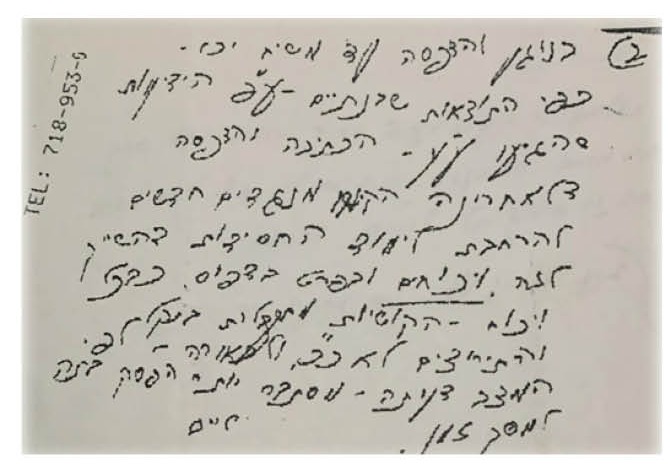
Read that response slowly. Really slowly.
Count the qualifiers: “based on results in the interim.” “According to the information that has reached me thus far.” “It would seem.” “Given the current situation.” “More advisable.” “For a period of time.” Six of them – in one short paragraph!
Shmueli himself, at a farbrengen he later addressed at 770, read the response aloud and hammered each one of those phrases. He wasn’t being defensive. He was making a point: the Rebbe was not issuing a blanket, permanent ruling of ‘no’. He was responding to a specific situation, based on specific information, with carefully hedged language that practically begged to be revisited once the information changed.
Even if you want to argue that the Rebbe was simply being gentle with this particular recipient – and that’s a reasonable argument – you still can’t escape the plain meaning of the words. Reports were reaching the Rebbe that the recent intensity around Moshiach was backfiring – that it was generating opposition and making it harder, not easier, to spread Chassidus. Based on those reports, he was calling a time-out.
[The phrase “according to the information that has reached me ad eis atah, thus far” is reminiscent of how the Rebbe refers to Jews who others would call “secular” as not keeping Torah and mitzvos l’eis atah – for the time being – hinting that the situation is expected to change. The same reading seems to apply here.]
Multiple testimonies from the period confirm that complaints of exactly this kind were flowing to the Rebbe – from several rabbanim and activists, mainly from Eretz Yisrael. Most specifically, Reb Yossel Wineberg3 – who was close to the Rebbe’s secretary Reb Leibel Groner a’h said in that same 20 Teves speech that on that very Tuesday, word arrived from Eretz Yisrael that the Moshiach campaign was threatening Chabad’s access to IDF bases and other communal frameworks.
“The Writing and Publication of Recent Times”
Something important worth clarifying here: “The writing and publication of recent times” that have generated “new opposers” to spreading Chassidus that the Rebbe referenced, seems to include, first and foremost, the Rebbe’s own sichos! That’s perhaps why in the hagaha of the sicha of Parshas Acharei-Kedoshim the Rebbe crossed out “Moshiach” again and again and “toned down” the message. Mah she’hu oseh, omer l’Yisrael laasos – what he does, he tells the Jewish people to do. And one by one, prominent Chassidim and mashpiim received responses moving in the same direction.
[An important disclaimer: A Chassid doesn’t rush to conclude that a given ruling came down because of some inaccurate report. The practical obligation is to follow the Rebbe’s directive without question, unless and until he says otherwise. But acknowledging that such a dynamic exists is legitimate and well-documented.]
This is worth reading alongside the sicha of Parshas Shemini 5718, about the students of the Arizal who hesitated to follow his offer to go immediately to Yerushalayim – “we need to tell our wives first” they said – and thereby delayed the Geula. When it comes to coronation and kabbolas ha’malchus, which by definition depend on the arousal from below, hesitation and second-guessing have real consequences.
To be continued
Beis Moshiach #1509 • pp. 10-13
© 2026 Beis Moshiach Magazine. All rights reserved.
This article originally appeared in Beis Moshiach #1509. You are welcome to share it with friends and family by email or in print, provided that you do not change, add to or omit any part of it, you credit the author and Beis Moshiach, and you include a link to archive.bmoshiach.org (written out in full in printed copies).
To republish this article in a newspaper, magazine, book or website, please request permission in advance at [email protected].