
Was The Churban Avoidable?
In the summer of 5708 (1948), Mr. Benjamin M. Horowitz — an industrialist living in Crown Heights who became drawn to Lubavitch after the Rebbe Rayatz settled there — wrote to the Rebbe on the story of Yavneh in that month’s Talks and Tales. He asked why Rabbi Yochanan ben Zakkai pleaded before Vespasian, “Give me Yavneh and its scholars,” rather than for Jerusalem itself — suggesting Rabbi Yochanan held back because he knew G‑d had decreed the city’s destruction. The Rebbe answered in two letters: the first dated 21 Av 5708, and a fuller follow-up dated 11 Elul 5708 after Mr. Horowitz wrote again.
The First Letter — 21 Av 5708
Your question No. 2 concerns the story of Jabneh (‘Let’s Visit Jabneh,’ T.&T. of current month), particularly the plea of Rabbi Jochanan ben Zakkai, “Give me Jabneh and its scholars.” You asked, why did not Rabbi Jochanan plead for Jerusalem instead? Your own suggestion was that since Rabbi Jochanan knew that G‑d had decreed the destruction of Jerusalem, he did not want to act against G‑d’s wish.
While your suggestion is an interesting one, it cannot, however, be applied to this case. Any Divine decree concerning the fate of an individual, and especially that of a community, can be rescinded by Teshuvah, prayer, and good deeds. Consequently, the idea you suggested could not have served as a basis for Rabbi Jochanan’s request.
The Talmud, dwelling upon the same question, gives two explanations of Rabbi Jochanan’s apparent failure to plead for Jerusalem: a) It was a case of temporary beclouding by G‑d of the intellect, and b) Rabbi Jochanan was afraid that if he asked for too much, he would get nothing.
The first explanation itself requires elaboration. Why should his intellect have failed him at such a crucial moment, which was so abnormal for such a great man? Here is where your suggestion can be fitted in: Because the decree was already in force, G‑d caused Rabbi Jochanan’s intellect to fail him.
The Follow-Up Letter — 11 Elul 5708
Mr. Horowitz wrote again, doubting whether Chazal had fully recognized Rabbi Yochanan’s greatness. The Rebbe replied:
On the greatness of Rabbi Yochanan ben Zakkai: You seem to be of the opinion that our Sages did not fully evaluate the greatness of Rabbi Jochanan ben Zakkai. This is not so. Suffice it to quote several references: i) As to his knowledge of the Torah and sciences: “If all the skies were parchments, and all the trees quills, and all the seas ink, it would not suffice to record all the wisdom he had learned from his teachers” (Mesichta Soferim 16,8). ii) As to his wisdom in mundane matters: “Since Rabbi Jochanan ben Zakkai died, there is no more brilliance of wisdom” (i.e. secular wisdom – Maharsho) (End of Mes. Sotah). iii) His greatness as a leader of Israel: “Moses was in Egypt forty years, in Midian forty years, and leader of Israel forty years… Rabbi Jochanan ben Zakkai engaged in business forty years, learned from the sages forty years, and was leader of Israel (Nassi) forty years.” (Sifri, end of Berachah). Thus Rabbi J. b. Z. is likened to Moses.
On our standing to second-guess the Sages: In endeavoring to appraise the events that took place during the time of the Destruction, the political situation at that time, the temper of the Romans, the possibilities of peace, etc., how can we who are more than 1800 years removed from that time, and who are lacking almost any reliable documents of that time or the century following, save the Talmud, how can we express an opinion which is at variance even in the smallest degree with the expressed opinions of men who actually lived at that time or in the century following? This would be the case even if it did not concern the Talmud, but an ordinary historical document or book.
All the more so, since the opinions were expressed in the Talmud which, by Divine Providence, are therefore part of our Torah-sheb’al-peh, and are of equal sanctity. Here there can be no question as to the veracity of the matter, but only an effort to try to understand and explain it as reasonably as we can.
That Rabbi Yochanan did not view the Destruction as inevitable: There is conclusive proof that Rabbi Jochanan ben Zakkai did not regard the Destruction as something unavoidable or irrevocable, in the fact that far from accepting it with resignation, he tried, immediately before his going to Vespasian, to influence the leaders in Jerusalem to make peace with the Romans and thus save the city and the Beth HaMikdash, and only after these attempts were fruitless, he went to Vespasian to try—in Rabbi Jochanan b. Zakkai’s own words—bring “perhaps some small salvation.”
A Closing Word
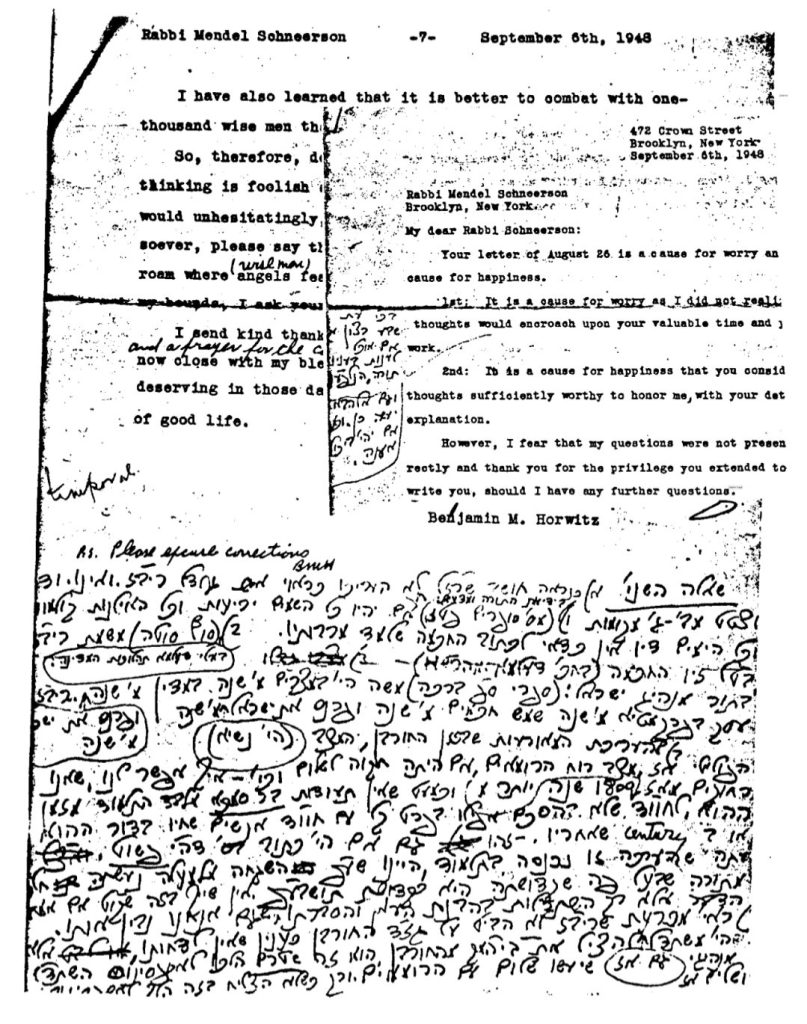
Mr. Horowitz had written that if his thesis was faulty, the Rebbe should tell him frankly to stick to his business and leave such questions aside. The Rebbe declined:

Just imagine—for thousands upon thousands of years, your soul (and the soul is the essence of every Jew) has been engaged in Torah, and after our life on this physical earth the soul again returns to engage in Torah and delve into the depths of its wisdom for a period which is endless and everlasting; but in the meantime, for a period of some scores of years, the A-lmighty has given you a business to attend to. How can you consider the business your chief and exclusive occupation, and the Torah as something incidental or subordinate?
These letters touched on a further matter as well—Horowitz’s question on the parsha of Eikev and the reward for “minor” mitzvos—which was discussed at length in the same correspondence and will, please G‑d, be published in a future issue.
Beis Moshiach #1514 • pp. 4-6
© 2026 Beis Moshiach Magazine. All rights reserved.
This article originally appeared in Beis Moshiach #1514. You are welcome to share it with friends and family by email or in print, provided that you do not change, add to or omit any part of it, you credit the author and Beis Moshiach, and you include a link to archive.bmoshiach.org (written out in full in printed copies).
To republish this article in a newspaper, magazine, book or website, please request permission in advance at [email protected].

