Kiddush on a Cap of Grape Juice
One minute, they were living regular lives, the next, they were shoved into a car, kidnapped, and driven away to Gaza.
They were packed into one small room in an apartment hideout – two Jewish boys in the lion’s den.
After a while, time disappeared. There were no calendars. No clocks. No night or day. Just darkness, fear, and the same question in their heads: How long can I live like this?
So, they came up with a plan. Every morning, Itai would say the date of the month – whatever he thought it was. Then, Omer would answer with the day of the week, as well as he could guess.
And whenever the day felt too long, whenever the fear got louder, they’d repeat the same words to each other, over and over.
“Just a little longer,” Itai would whisper.
“Just a little more,” Omer would answer. Some days, they said it dozens of times.
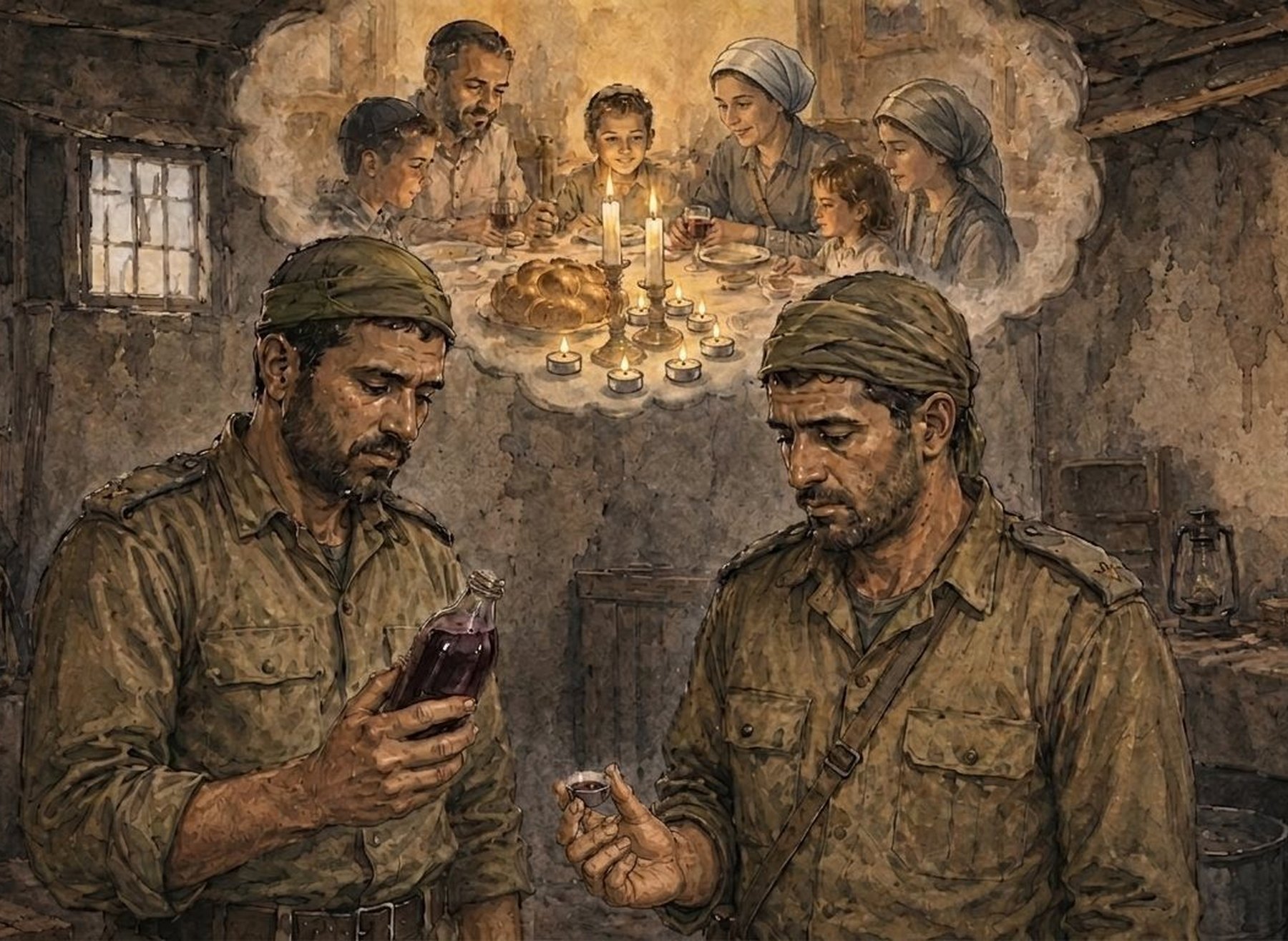
During their first Shabbos in captivity, Omer perked up at a sudden memory popping into his hungry, tired head. “Back home,” he said quietly, “we make Kiddush every week.”
Itai looked at him. “…Here?”
Omer nodded. “Yeah. Here, too. I need grape juice.”
Itai almost laughed; it sounded impossible. Where were they going to get grape juice?
But then, not long after Omer had asked for it, a Hamas guard arrived with a mini bottle of grape juice.
Hashem had slipped something holy through the cracks in the walls.
But Omer was already thinking ahead.
“What if we’re stuck here for years?” he asked. “This bottle has to last.”
So, they were careful. They poured a bit into the bottle cap, just enough for Kiddush. Itai took a sip, then Omer. Then they put the rest back and hid it again.
That little bottle became their prized Shabbos treasure. Week after week, they guarded it like it was gold. It reminded them who they were. One week, after Kiddush, Omer said, “We should do Hamotzi, and dip the bread in salt.”
Bread? Salt? When the guards brought them food, it was usually just plain pita and water. Sometimes they’d get small snacks. They didn’t have Challa or a salt shaker, but they did have one small bag of salted pretzels.
So every Shabbos, they’d take out one pretzel, scrape off the salt, and dip their pita into it. Shabbos was still Shabbos, even here.
Omer’s parents later learned how little food their son had. How hungry he was, how weak he became… And still, he saved a bottle of grape juice and a few pretzels… for Shabbos.
As the long months dragged on, something else was happening too. During his captivity, Omer had begun keeping Shabbos.
At the same time, far away at home, his mother, Shelly Shem Tov, had made a promise of her own. During that terrible, hard year, she took upon herself to begin keeping Shabbos too. She committed to it on Shabbos of Parshas Mishpatim.
Exactly one year later, on the corresponding Shabbos of Mishpatim, her son Omer was released.
His parents later related that sometimes the Hamas terrorists guarding him gave him reading material left behind by IDF soldiers operating in Gaza. One of those things became a great source of Chizuk for him: a copy of Dvar Malchus, the weekly Chabad publication. That edition included the weekly Chumash, Tehillim, and Tanya. It became a lifeline in the darkness. On the cover was the name of an IDF soldier: Yoel Elbaz.
A video of Omer’s bedroom, left just as it was before he was taken by Hamas, showed something beautiful. On the wall hung a picture of the Rebbe. Beside his bed was a Chitas—a single-volume sefer of Chumash, Tehillim, and Tanya. And in Gaza somehow that’s exactly what he had access to.
When word of it spread through Shuls, homes, and schools, people started whispering Omer and Itai’s names in Tefilla.
When Omer was finally released – after 505 days – people had a lot of questions about what he’d been through.
“That little bottle lasted half a year,” he said. “I made Kiddush with it again and again. The grape juice didn’t spoil. The bottle didn’t run out. It was my own little miracle.”
Omer had told Itai, “It’s not enough to make Kiddush. We have to keep Shabbos properly.” When Itai came home and told Omer’s family, they didn’t fully understand.
“Keep Shabbos?” they said. “I bet it was hard not to keep Shabbos – there was nothing to do, right? You weren’t driving, you weren’t on your phones…”
Itai nodded. “That’s true,” he said. “But we had flashlights. Hamas gave one to each of us. It was the only way to get around in that dark, closed-off room. When Omer decided to keep Shabbos, he turned off his flashlight before sunset every Friday. We’d spend Shabbos that way… in total darkness for twenty-four hours.”
When Shelly heard that, her heart broke with a strange mix of pain and pride. It was like Omer and Itai didn’t even need the flashlight. The light of their Neshamos was enough for them to see what truly mattered.
Omer and Itai weren’t holding a Shulchan Aruch in that room. They weren’t trying to impress anyone. They were kidnapped before they learned all the Halachos. They just did what a Jew does when everything else is taken away: reaching for Hashem with whatever they had – just a few drops of grape juice, and the salt from a single pretzel.
five bus bombs and nobody hurt
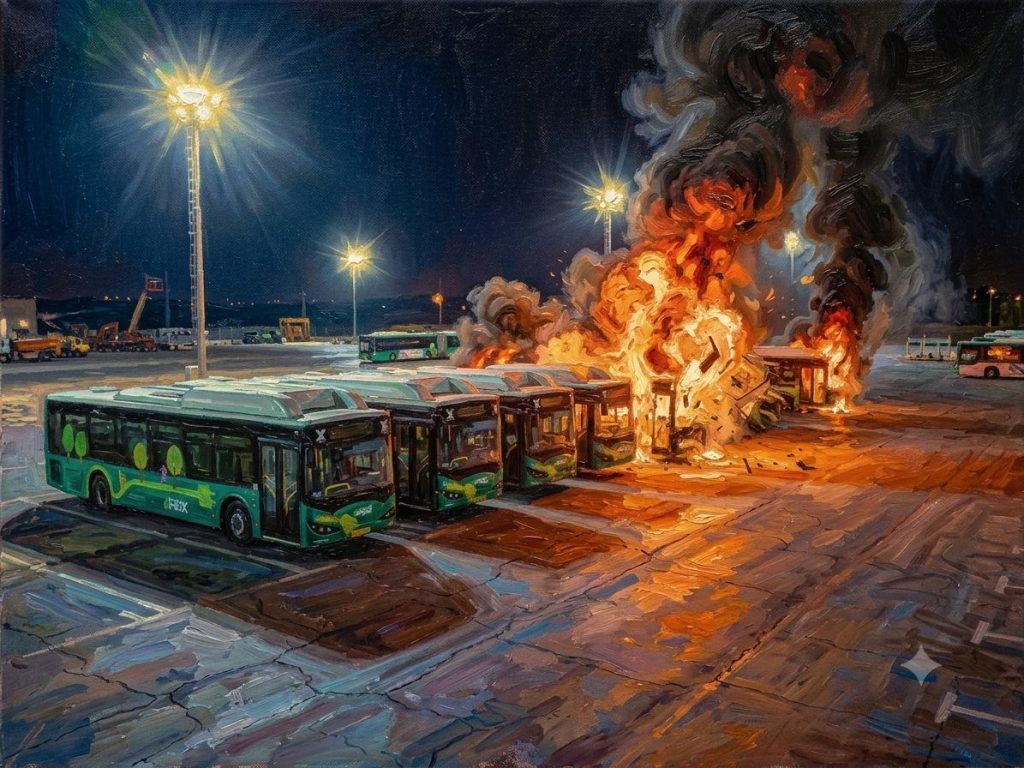
Late Thursday night – February 20, 2025 – the buses had finished their routes, and the drivers had gone home. Around Bat Yam and Holon, just south of Tel Aviv, buses were parked for the night at separate lots and stations, only a few blocks away from each other. Quiet streets.
Then, a security guard’s radio crackled. “Bat Yam – near the stadium,” a voice said. “Something’s off. I hear a weird popping sound – like… pop-pop-”
BOOM!
A huge explosion.
The guard fell backwards as a wall of heat blasted his face. Flames shot up from the bus. Smoke rolled upward, thick and black, swallowing the streetlights.
Within minutes of a second explosion, another voice came through – sharper. Even more urgent. “Another bus – same area, around the corner! We might be under attack!”
And then, a few minutes later, “Third one!” someone shouted. “Holon – another bus, near Wolfson Medical Center!”
Sirens wailed. Firefighters raced in. People stood at windows in their pajamas, half-awake and confused, trying to understand what they were seeing. Were people hurt? What had exploded? What was going on?
In the command room, phones lit up like fireworks. A police commander looked around the table and said, plainly. “These weren’t accidents. These were bombs.”
An official blurted out, “Were there passengers?”
The commander answered quickly, “Negative. Thank G-d, all the buses were empty. They were parked after finishing their routes… this must be a threat.”
Everyone let out the breath they’d been holding. But the next question came immediately.
“How many buses exploded, and where are the bombs coming from?” an officer asked.
“Three exploded,” the commander said, tapping the map. “But they were parked in separate places. I’m worried there are more.”
A minister leaned forward. “Then we stop everything,” she said. “No buses leave their lots. No trains. No light rail. We check every single vehicle, tonight.”
An aide hesitated. “Stop all public transportation?”
“Yes,” the minister said. “Because if there are more, the next one won’t happen in a parking lot.”
Orders went out. Drivers for the late-night bus routes were told to pull over and inspect their buses. Parking lots, terminals, and stations were searched. The message was simple: “Look everywhere. Under the bus. Inside the bus. Any bag, any package, anything that doesn’t belong – report it immediately. Do not take chances.”
Not long after, another call came in.
“We found two more devices,” an officer reported. “On buses nearby. They hadn’t exploded yet, Baruch Hashem.” The room went quiet again, as everyone processed the information.
“…Five?” someone whispered.
“Five,” the officer confirmed. “All similar. We also learned they all had timers. There was a glitch somehow.”
A security official rubbed his forehead. “If they were on timers,” he said slowly, “then they hadn’t planned for them to go off at nighttime.”
A different officer murmured, “…they were likely meant for morning rush hour, when the buses would be packed with people.”
Everyone pictured it: Friday morning. Crowded streets. People squeezed in for a normal day, backpacks, shopping bags, suitcases – and then…
A police commander said it in a low voice. “If this had gone off when the buses were full… it could have been hundreds.”
Someone looked down at the report. “Do we know exactly where each one was parked?”
The officer pointed. “The first explosion was near Bat Yam Sports Stadium. Another nearby within minutes. Third, about fifteen minutes later, near Wolfson Medical Center in Holon.”
Then he added, “And for one of the buses – someone noticed something suspicious, alerted the driver, the bus emptied… and it exploded shortly after.”
A minister swallowed hard. “So, someone noticed,” she said.
“Yes,” the officer replied. “And that’s part of why nobody was hurt.”
Another officer read from a note. “One device had writing on it,” he said. “It said: ‘Revenge from Tulkarem.’”
A security official spoke, careful and serious. “Tulkarem is an area which the army has been raiding, looking for terrorists. Try to stop attacks before they happen. Since the war began, those raids have been happening more often…”
“So this message…” an aide said slowly.
“…means they’re trying to tell us, ‘We’re fighting back,’” the security official said. “They want everyone to know who’s responsible. They want credit.”
“…Five bombs,” the minister said, after a moment of silence, “and not one person was hurt. What a miracle…”
Nobody cheered or laughed. This could have been really tragic. But in that room, more than one person had the same thought: Hashem runs the world.
Not long after, a group of Yidden gathered near the burned buses and said the prayer of Nishmas. It was emotional to stand there and see the blackened shells, knowing that, Baruch Hashem, not a single person was hurt.
Beis Moshiach #1515 • pp. 55-58
© 2026 Beis Moshiach Magazine. All rights reserved.
This article originally appeared in Beis Moshiach #1515. You are welcome to share it with friends and family by email or in print, provided that you do not change, add to or omit any part of it, you credit the author and Beis Moshiach, and you include a link to archive.bmoshiach.org (written out in full in printed copies).
To republish this article in a newspaper, magazine, book or website, please request permission in advance at [email protected].