
What Really Strains The Rebbe?
Every Sunday, yungeleit (young married men) gathered in 770 for a study session, and Rabbi Shneur Zalman Halevi Duchman took it upon himself to track who attended, periodically sending the Rebbe the week’s attendance lists. Submitting one such batch, covering several weeks at once, Reb Zalman added an apologetic aside: he worried that the lists, however routine, were an imposition on the Rebbe’s busy schedule—while explaining that “it is clear to me that this gives them a boost to strengthen themselves and come to the study session.” In his holy response from 10 Kislev 5725 (1964), the Rebbe circled the phrase מטריח זיין—“to trouble,” and responded thus:
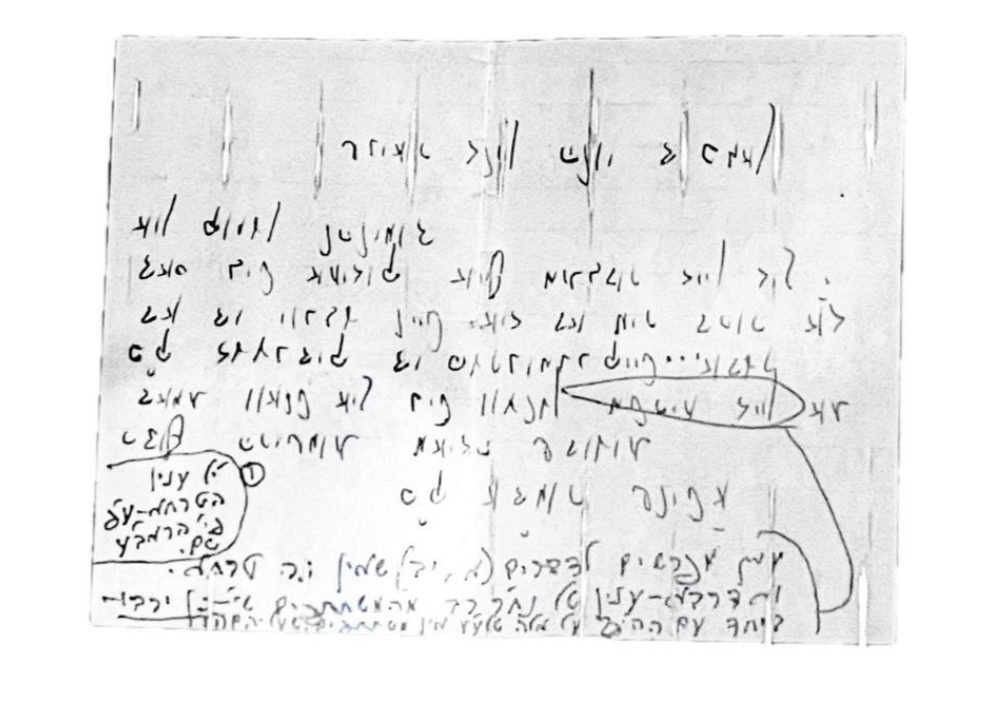
עיין מפרשים לדברים (א, יב) שאין זה טרחא. ואדרבא—ענין של נח”ר [=נחת רוח] רב מהמשתתפים שי’—כן ירבו—ביחד עם ההיפך על אלה שלע”ע [=לעת עתה] אין משתתפים, שעליהם י”ל [=יש לומר] ענין הטרחא —ע”פ פי’ הראב”ע [=הרב אברהם אבן עזרא] שם.
See the commentators on Devarim (1:12), that this is not a tircha (=a strain). On the contrary—it is a matter of great nachas (=satisfaction) from the participants שיחיו, may they increase. This comes together with the opposite regarding those who do not, for now, participate—about whom one could indeed speak of ‘tircha,’ as per Rabbi Avrohom Even Ezra’s commentary there.
* * *
EDITOR’S NOTE: Rashi (following the Sifrei) reads “tarchachem” negatively—that Bnei Yisrael were “tarchanim,” quarrelsome litigants. The Even Ezra reads the same word differently: “tarchachem” is the labor of explaining the mitzvos to “anashim pesaim,” the unlearned—tircha not as a complaint about the people, but as the effort of reaching them. The Rebbe applies this precisely: the tircha of the shiur lists belongs not to those attending, but to the ongoing work still owed to those who have not yet come.
(Likkut Maanos Kodesh 5725, Maaneh 87.)
Beis Moshiach #1515 • pp. 6-7
© 2026 Beis Moshiach Magazine. All rights reserved.
This article originally appeared in Beis Moshiach #1515. You are welcome to share it with friends and family by email or in print, provided that you do not change, add to or omit any part of it, you credit the author and Beis Moshiach, and you include a link to archive.bmoshiach.org (written out in full in printed copies).
To republish this article in a newspaper, magazine, book or website, please request permission in advance at [email protected].

