The House That Came Back Cheaper
Sudbury, Massachusetts, was not the kind of place where a shliach could arrive and find a ready-made community waiting outside his door. It was quiet. Spread out. Full of trees, large lots, and homes sitting far apart from each other. It was about eighteen to twenty miles west of Boston, but it did not feel like the city. The town covered around forty square miles and had only about nineteen thousand people. When the rabbi first came, someone asked him, “So who do you know here?” He answered honestly, “Not a soul.” Before moving, he had met only one family and bumped into one other woman. That was it. No crowd. No minyan. No list of supporters. Just a town, a mission, and a lot of unknowns.
So he started doing something he hated. Cold calls. He found Jewish-sounding names and picked up the phone. “Hello, my name is Rabbi…” Sometimes there was silence. Sometimes suspicion. Sometimes politeness. “We just moved to Sudbury,” he would say. “We’re starting Chabad, and we’d love to hear your thoughts about the Jewish community here.” One person said, “That’s very nice, Rabbi, but I don’t think you picked the right town.” Another said, “There really isn’t much happening here Jewishly.” Someone else said, “Good luck, but I’m not sure people will come.” He would hang up, take a breath, and call the next name. Slowly, one conversation became one visit. One visit became one family. One family became two. Two became four. It was not dramatic at first. It was slow. Quiet. One soul at a time.
The first programs were small, but they were real. The Purim party had four families. “Four families,” someone said. “That’s not a lot.” The rabbi smiled. “It’s four more than yesterday.” Then came a Model Matza Bakery, and more young families came. The first Pesach season arrived so early that they were not ready to make a Seder yet, but by Shavuos they had their first minyan. They advertised a program in a hotel, and around one hundred people showed up. The rabbi looked around the room and thought, “They are here. The Jews are here.” Soon there were shiurim, holiday programs, Hebrew school, youth activities, and camp. The Hebrew school started with two children. Then four. Then more. Years later, the Sunday school would have around forty children. But at the beginning, every child felt like a world.
For years, they rented space. First one office. Then another unit in the same building because they needed more classrooms. Every time they grew, they had to squeeze again. “We need a real home,” someone said. “I know,” the rabbi answered. “But everything is too expensive.” He kept getting daily real estate emails, watching every listing that came through. Most were impossible. Too small. Too hidden. Too expensive. Wrong zoning. Wrong location. Wrong everything. “Anything today?” his wife would ask. “Nothing,” he would say. And then one day, there was something.
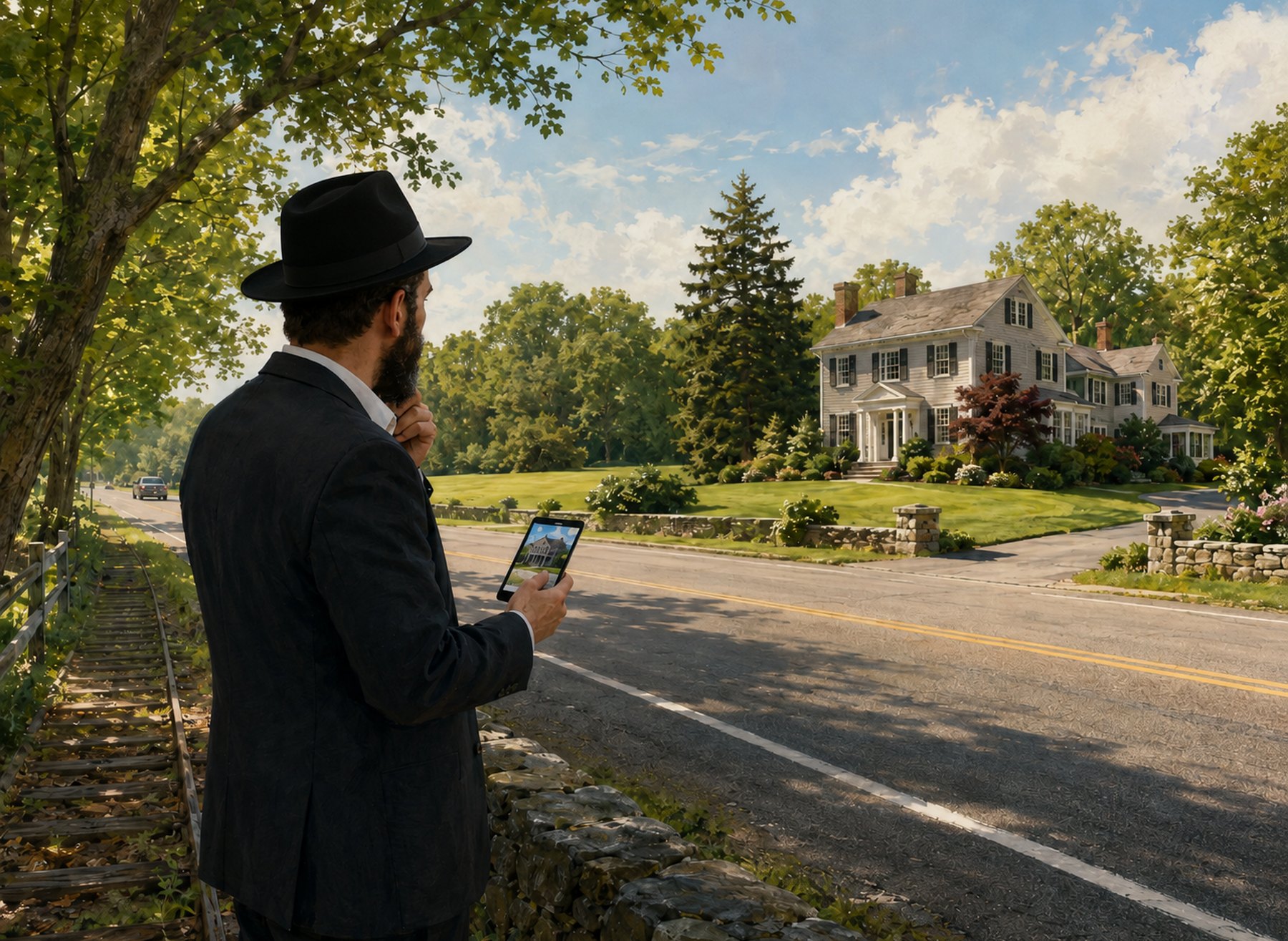
He saw the listing and stared at the screen. A short sale. $830,000. A large house on a large piece of land, very close to where he lived. It sat on a busy street, which could be good for visibility. The house was set back about two hundred feet from the road. There were no real neighbors pressing close on either side. One side had a big field. The other had an old railway. The property was beautiful. The rabbi looked at it and thought, “This could work.” Then the next thought came right behind it: “How in the world could we make an offer? We have no money.”
For six weeks, he carried the thought around. He opened the listing. Closed it. Opened it again. “You’re still looking at that house?” someone asked. “Yes,” he said. “I can’t stop looking at it.” Finally, he went to see it. The woman who owned the home was a devout Christian woman. She had poured herself into that house. She had placed pieces from the Old Testament into the walls. She had built it with love and meaning, hoping it would be a home for her family. But there had been a divorce. The mortgage became too much. She could not keep it. When she heard that a rabbi wanted to buy the house and turn it into a Chabad center, she became emotional.
She told her realtor, “Do not show it to anyone else.” The realtor asked, “Are you sure?” “Yes,” she said. “I want them to have it.” When the rabbi came to take pictures for fundraising, she understood why he was there. “This is G-d,” she told him. “I did the work, but maybe the real purpose of this house is for you.” The rabbi listened quietly. She looked around the home she was losing and said, “If you get it, that will be my comfort.” It was a painful moment. She was losing her house. But somehow, the thought that it might become a holy place gave her peace.
There were two banks involved, and negotiations began. The rabbi, his attorney, supporters, and donors worked for months. The price came down from $830,000 to $650,000. In Sudbury, where foreclosures were almost unheard of because it was such an upper-middle-class area, that number felt unbelievable. “This is a miracle,” someone said. “Maybe,” said the rabbi. “But we still have to close.” They planned. They fundraised. They imagined where the shul would be, where the classrooms could go, where the kitchen might be, where children would run. The building felt close enough to touch.
Then the phone rang.
The rabbi was on his way to a Model Matza Bakery. About 150 people were waiting. Children were ready to roll dough. Families were coming. Pesach energy was in the air. He answered the call, and it was his attorney. The attorney’s voice was heavy. “Rabbi, I need to tell you something.” “What happened?” “The banks are foreclosing tomorrow.” The rabbi stopped. “What do you mean?” “I mean it’s over. The deal is gone.” “Gone?” “Gone. The property is going to auction.” The rabbi held the phone and said nothing. Six months of work. Six months of hope. Six months of fundraising, planning, imagining, pushing—gone in one sentence.
But there were 150 people waiting for matza. So he put the phone away and went inside. Someone saw his face and asked, “Rabbi, is everything okay?” He took a breath. “Let’s make matza,” he said. He smiled for the children. He showed them the flour and water. He helped them roll the dough. He spoke about Pesach, freedom, and emuna, while inside he felt the building slipping away. Sometimes a shliach does not get to fall apart when he wants to. The program is starting. The children are watching. The mission keeps moving.
The next day, he went to the auction with one or two people. As soon as he walked in, he knew. There were about eleven serious bidders in the room. They had money. They were ready. This was not going to be a quiet little auction where nobody noticed the property. The bidding began, and the numbers climbed quickly. $700,000. $750,000. $800,000. Higher. The rabbi stood there and watched the house move farther and farther away. Someone near him whispered, “Can we do anything?” He shook his head. “No.” The bidding went up toward $800,000 or $900,000. It was over.
When he came home, his wife and children were waiting. They did not need to ask. They saw it on his face. Still, one of them said, “What happened?” He looked at them and said three words: “Gone. It’s gone.” The house became quiet. Not angry quiet. Crushed quiet. The kind of quiet where nobody knows what to say because everyone had allowed themselves to hope.
Then the rabbi sat down and wrote an email to about twelve balabatim (supporters) who had been helping with the effort. He did not write, “I understand this.” He did not write, “This is easy.” He wrote the truth a Chassid has to hold onto even when it hurts. He wrote that they firmly believed everything Hashem does is for the good. He wrote that whatever happened that day was the best thing that could have happened, whether they understood it or not. Before he sent it, he looked at the words. “Do I feel this?” he wondered. Maybe not fully. But emuna is not only what you feel when the music is playing. Sometimes emuna is what you write with a broken heart because you know it is true even before you can see how.
They tried another property. It did not work out. Time moved on. Seven months passed. The house from the auction became a closed chapter. Or at least that is what everyone thought. Then one day, the rabbi’s phone rang. He looked at the number and recognized it. The auction company. His stomach tightened. “Oh no,” he thought. “What now?” He answered. “Hello?” The voice on the other end said, “Do you still want the property?” The rabbi stood still. “What?” “The property. Do you still want it?” “What happened?” he asked. “The buyer walked away. He couldn’t sell it. The second buyer doesn’t want it either. You can have it for $580,000.”
For a moment, the rabbi could not speak. “Five hundred eighty?” “Yes.” “Not six-fifty?” “No. Five-eighty.” He almost laughed, but not because it was funny. Because it was impossible. The building that had been lost at auction had come back. Not at the same price. Not more expensive. Cheaper. Seventy thousand dollars cheaper than the original deal they had been fighting for. After all the heartbreak, after the auction, after the email, after the words “Gone. It’s gone,” the house was back on the table.
He went back to the email he had sent after the auction, the one where he had written that everything Hashem does is for the good. He opened it and read his own words. This time, they felt different. Seven months earlier, he had written them with pain. Now he could see what they meant. He hit “reply all” and wrote, “Now we understand.”
But the story was not finished. The auction company gave them thirty days to close, but it ended up taking around three months. Then came permits. That took about a year and a half. The building had to be brought up to code as a public space. Walls had to come down. A parking lot had to be built. A kitchen had to be created. Classrooms, a library, event space, and proper rooms for programs had to be planned and paid for. Someone said, “I thought the miracle was getting the building.” The rabbi smiled tiredly. “That was the first miracle. Now we need the next one.”
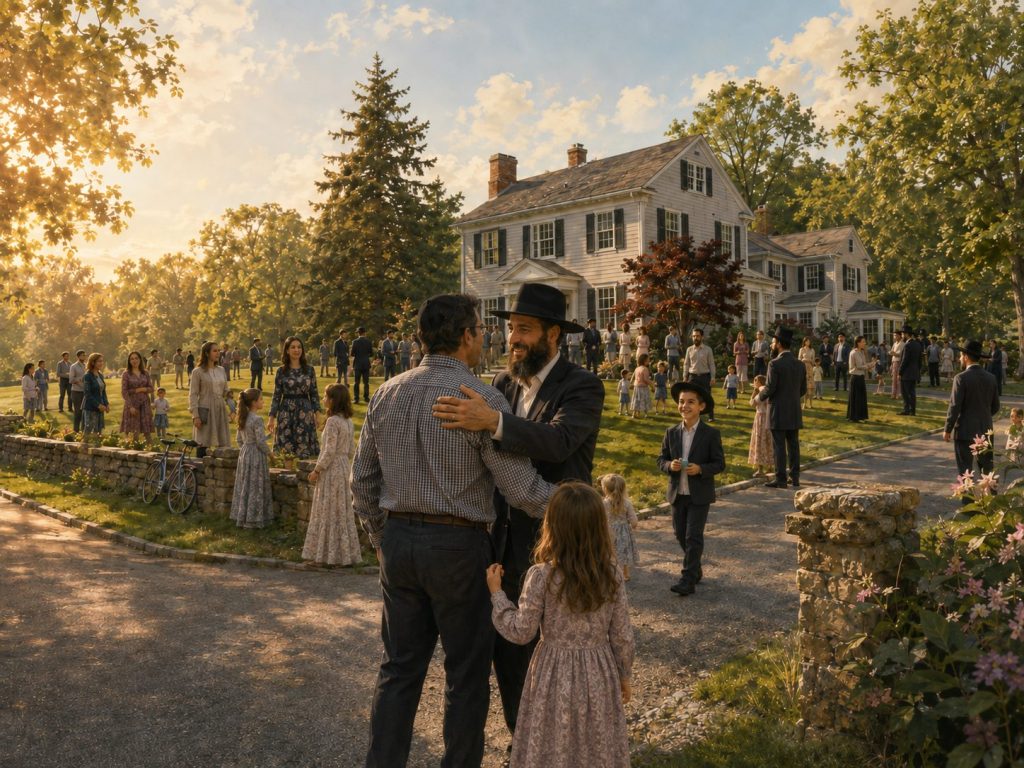
Slowly, it came together. In 5777 (2017), the Chabad House finally opened. About three hundred people came to the celebration. The same house that had been lost, mourned, auctioned away, and then returned, was now filled with Jewish life. People walked through the rooms and said, “This is beautiful.” Children came for Hebrew school. Families came for programs. The minyan grew. The classes grew. The camp grew. The house that had once belonged to one family became a home for an entire Jewish community.
Later, during Covid, the property became an even bigger blessing. The large outdoor space, the two acres of land, the nearby field, the deck, and the big tent allowed people to gather when indoor programs were difficult. Children ran on the grass. Families spread out safely. Deer and wild turkeys sometimes passed near the field. Someone said, “Can you imagine if we had ended up in a tiny office somewhere?” The rabbi looked across the property and answered, “Hashem knew what we needed before we knew.”
When the children heard the story, one asked, “But why did Hashem make them lose it first?” The rabbi smiled. “Because sometimes we only see one page of the story.” “And Hashem sees the whole book?” another child asked. “Exactly,” he said. “At the auction, we thought the story ended. But Hashem had only turned the page.” “And the price went down?” “Yes.” “So when it looked worse, it was actually getting better?” The rabbi nodded. “That is the lesson.”
In South Africa, Rabbi Shishler saw a property across the street that looked perfect, but it was too expensive and full of fruit trees he would not cut down. Someone else bought it, cleared it, failed to build, and then the land came back ready for a Chabad House.
In Sudbury, the rabbi found a beautiful property, worked for months to buy it, lost it to foreclosure and auction, and then seven months later it came back even cheaper than before.
A child might ask, “So were the buildings lost or not lost?” And the answer is: they looked lost. They felt lost. Everyone thought they were gone. But Hashem was not finished. Sometimes Hashem hides a brachah while He prepares it. Sometimes He says “not yet” because the blessing still needs to become better. And sometimes the very thing that breaks your heart today becomes the thing that makes you say tomorrow, “Now I understand.”
Beis Moshiach #1520 • ט״ו אלול תשפ״ו • pp. 55-59
© 2026 Beis Moshiach Magazine. All rights reserved.
This article originally appeared in Beis Moshiach #1520. You are welcome to share it with friends and family by email or in print, provided that you do not change, add to or omit any part of it, you credit the author and Beis Moshiach, and you include a link to archive.bmoshiach.org (written out in full in printed copies).
To republish this article in a newspaper, magazine, book or website, please request permission in advance at [email protected].