Two Thousand Years Later…
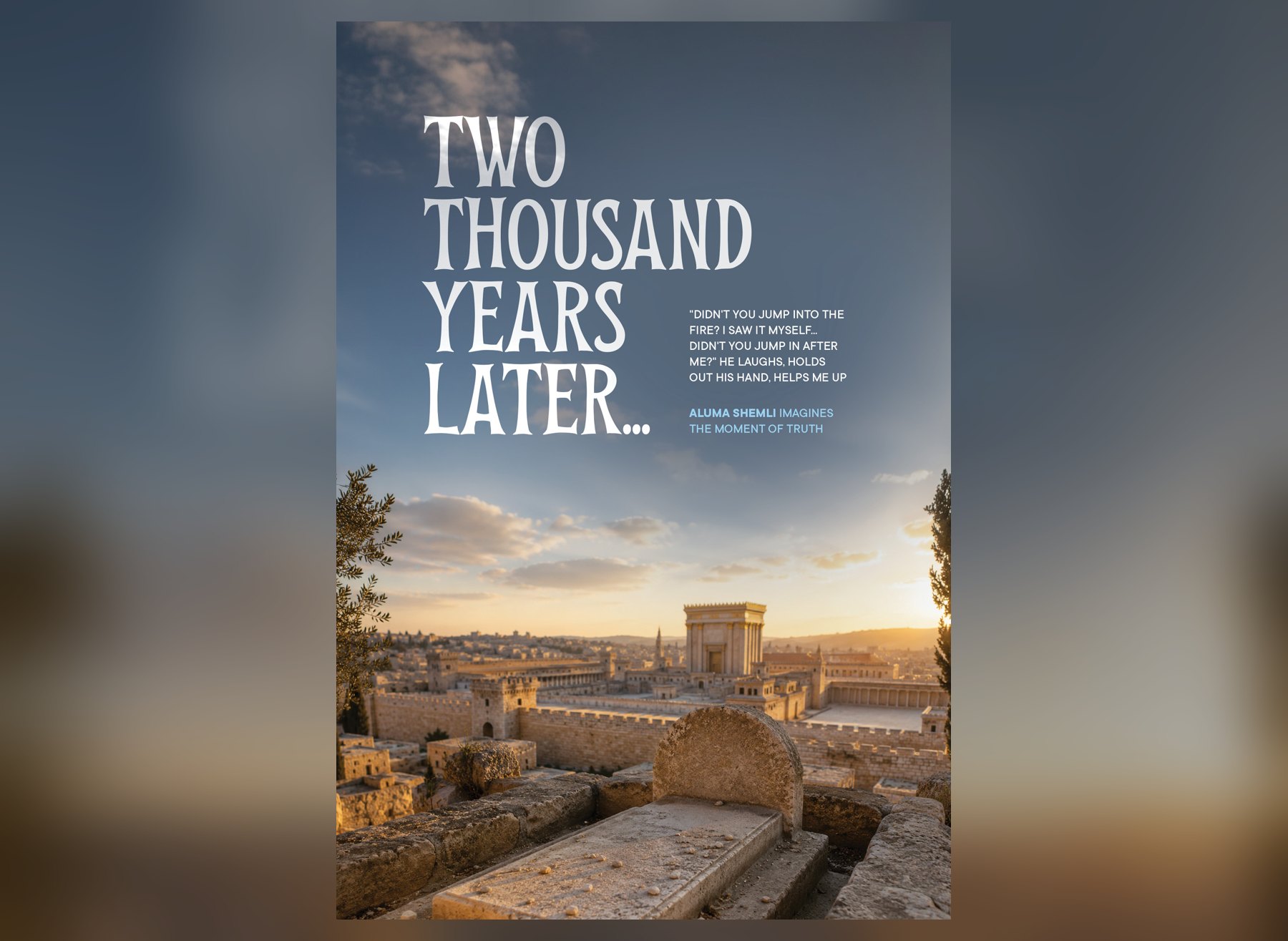
Aluma Shemli imagines the moment of truth
“Didn’t you jump into the fire? I saw it myself… Didn’t you jump in after me?” He laughs, holds out his hand, helps me up.
I wake up, not yet opening my eyes, shivering. The first thing that hits me is the smell. Not the smell of ketores, not of the mizbayach or of sheep wet from rain. It’s a smell of… burnt bread mixed with tar, as if someone decided to scatter it into the air in enormous quantities.
A strange feeling fills me; I’ve never woken up like this! When did I go to sleep? When did I fall asleep? I reach my hand to the side, searching for the cold, smooth floor of the Beis HaMoked. Confused, or maybe dazed, but I haven’t forgotten my mishmeres (watch). I am a kohen of Beis Chilkiya!
Not a cold floor—earth.
What?
I bolt upright, feeling the sun beating down on me. Blinded. Since when do I sleep outdoors?
I look up, rub them. And what is this outdoors? Rocks, grass, a frightening roar above me. I shrink back.
“Chananya!” Azarya’s deep voice. “Good to see you!”
I raise my eyes carefully. He’s really standing over me, his kind eyes looking at me. That roar behind me tightens me up again. I study him. The tunic and the sash and the turban, the broad shoulders, the big beard with a few gray hairs. As if everything’s normal. “Hey!” I sit up straight. “Look at you! Didn’t you jump into the fire? I saw it myself!”
“Didn’t you jump in after me?” He laughs a deep, hearty laugh, holds out his hand, helps me up. My bones creak as if I hadn’t moved them in at least a year. “I think this is the Resurrection of the Dead, Chananya.”
Boom.
I put a hand on my chest. The pulse was there. Fast, pounding, alive. Wow. I’m breathing. I’ve risen from the dead.
All at once I remember that night of horrors, after weeks of face-to-face battle with those cruel, ugly Babylonians. Hungry, wounded, exhausted, and stunned from the loss of the tamid (daily offering), we tried until the very last moment to defend the Mikdash. We didn’t believe they would really succeed in… a shiver. That moment when we realized we had failed, when we handed back the keys…
“The Resurrection of the Dead!” I smile, confused. “Apparently really, because… well, never mind what happened. What’s the date?”
Azarya shrugs his big shoulders. “So, back then, Yirmiyahu spoke of seventy years of exile, right? So apparently they’re over now.”
“Seventy years!” I lose my breath. “That means I could work my mishmeres alongside my great-grandson? Or my great, great-grandson?”
“No…” He really laughs. “Because you hadn’t had children yet back then. But maybe I… how would I even recognize them?”
Another growl from above me.
“Azarya, I think there’s a lion or some other predator behind us…”
He laughs, but this time his laugh is troubled. “That’s not a lion, Chananya. It’s… I don’t know. Turn around.”
I turn around. Father in heaven! We’re standing on a mountainside; a few dozen cubits above us there’s a low iron fence, and behind it strange iron carriages are roaring. They race as if harnessed to tigers, but… but no. There’s no tiger leading them. Only… only wind, and smell. A shocking tar smell.
“Phew…” Azarya starts climbing the hill, using his big, rough hands. “They invented things in the meantime, while we were gone, huh?”
I’m a little afraid, but in a split-second decision I join him. Can you even die again after the Resurrection of the Dead?
The path the carriages race along is well paved. A smooth black substance binds the packed earth firmly to the ground. Azarya feels it, puzzled. Walking is easier than on dirt, but the heat burns our feet. We move forward slowly alongside the painted carriages, breathing hard, staring. Every so often a carriage stops next to us, someone inviting us to get into these small, fast little compartments. Azarya refuses everyone, smiling.
“Where are we going?” I remember to ask.
“To the Mikdash, Chananya! This is supposed to be the watch of Beis Chilkiya now, isn’t it?”
I nod. Sure, but where’s the road to Yerushalayim?
A man comes toward us. His shirt is strange and short, and his pants are long and black. On his head he wears an overturned metal pot or is it not metal? In his hands, a small, glowing, blinking tablet. He’s looking at it.
“Excuse us,” Azarya addresses him with a smile. “What day is it today?”
He looks up, looks at us, his eyes widen, round. “Elokim, where did you come from?”
“From the ground, there,” I point in some undefined direction. “Looking for the road to Yerushalayim.”
He nods, chuckles. “This is Yerushalayim, and your costumes are pretty impressive. Where’s the film crew?”
What is he talking about? And why does he spit out words so fast?
“What year is it, sir?” Azarya insists, gently.
“’86, bless you… looks really authentic!”
Is he speaking Lashon HaKodesh? One moment he’s understandable to us, the next not…
“’86!” Azarya’s eyes light up, he whispers to me, “Less than fifty years have passed! Maybe someone’s still alive?”
“Did you know King Tzidkiyahu?” I hurry to ask. “Do you know what happened to him? Or Gedalia son of Achikam?”
He looks at me, laughs out loud. Then he points the little blinking tablet at us, once horizontally, once vertically. More people surround us, also pulling out those same fast glowing tablets.
“King Tzidkiyahu… you mean the one from the churban of the First Beis HaMikdash? Two thousand years ago?”
“The first?” Azarya mutters. “The one and only…” His legs are actually trembling; I hold him so he won’t fall.
The man with the pot on his head lifts himself with a quick jump onto a metal donkey with large, glowing eyes. With that roar we’ve already learned to recognize, he shoots off onto the paved road, merging among the colorful carriages.
“The First Beis HaMikdash…” Azarya is still murmuring. “You’re saying there were more in between?”
“Where is Yerushalayim?” I ask the people surrounding us, still supporting him.
“This is Yerushalayim,” someone laughs at us. “Maybe you want to reach the Kotel?”
The Kotel? Which wall exactly? Endless walls surround us, some smooth and others rough, some painted with giant pictures, as if made of clear glass. Some rise dozens upon dozens of cubits high. Dizzying.
“I want to go to the Mikdash,” I sigh.
“Go straight, straight,” one of them tells me. “You’ll reach Shaar Yaffo (Jaffa Gate) and ask again there.”
Jaffa Gate! A nice name they gave the western gate. Jaffa Gate… at least I know Jaffa, and its big port too. I place my hand on Azarya’s shoulder, and we start walking straight ahead. At first we’re silent for a mile. Then Azarya looks at me, his eyes no longer as happy as they were before.
“Two thousand years have passed and nothing has changed…”
“Everything has changed!” I’m surprised. My eyes can’t get enough of looking at the carriages, at the lights flickering red and green atop the pillars, at the strange, short clothing of the people rushing in the street. At the shops, most of which I don’t even understand what they’re selling…
“Same thing…” He shrugs. “Once everyone hugged their idol under their arm, today they’re glued to a glowing rectangle. And only we, Beis Chilkiya, are looking for the road to the Mikdash.” A sigh breaks through his body.
I look around again with different eyes, understanding what he means. People are hugging this thing, talking to it, looking at it with longing eyes. Maybe this really is the new idolatry after two thousand years of exile?
“What do you want from them?” I try to give them the benefit of the doubt. “Who knows what they went through during all these years of exile at the hands of those lowly Babylonians! And without a Mikdash too, Azarya? Where could they get strength and light from?”
“You’re right.” Azarya straightens up. He surveys for a moment the crowds filling the street. “You’re right. Good reason to get to the Mikdash as fast as possible. There’s a lot of work, Chananya!”
We start running. Not long after, the wall comes into view. Not our wall, by any means, but it’s clear. Our wall didn’t hold up against Nevuzaradan’s army. Good that we built a new one, only what was the idea of building it in the middle of the city and not around it entirely?
It’s not easy to run after Azarya, but it’s good this way. Much better than before when he walked hunched over, not happy about the life given back to him…
People start running with us, excited. It seems suddenly everyone understands that something is happening, that life won’t continue to be as it was until now. Around us hundreds more people in a variety of clothing and appearances, maybe from every generation that has passed since then, maybe.
“What’s for sure,” Azarya grabs my hand, runs faster, “is that kohanim who still know what to do—that’s just us, right? So run!”
I run until my breath is short.
Above us, giant metal birds fly by in swift flight, creating a deafening noise. I no longer ask questions, knowing that in this generation, in this time, anything can happen…
The Mikdash!
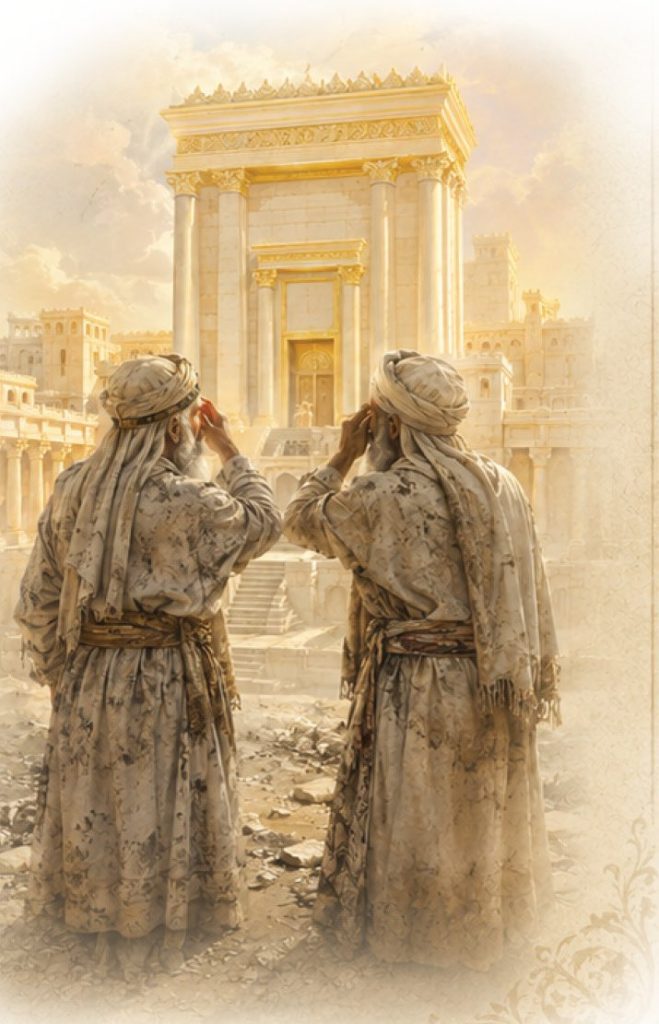
This is it! This smell, this air! This light! I start to breathe, start to yearn…
Azarya wrinkles his nose. “What is this Mikdash? Where are Yachin and Boaz? Where is Solomon’s Sea?”
“Probably with the Babylonians, but look, feel the holiness, breathe!” I reach my hand out to nowhere, excited.
“I don’t know what to tell you…” He mutters under his big mustache—hasn’t changed in two thousand years!
“Iron in the Mikdash? The size of the courtyard, these huge gates, I don’t know what to tell you… this isn’t the Mikdash we left, it’s not. Feels like I woke up in the wrong generation…” He’s not pleased, sorrow on his face, it pains me.
I stand and stay silent.
I have nothing to say and it saddens me. Thirty-some years back then plus another little bit is like a brief time in this era. I’ve always stuck close to Azarya, he explains things to me, he shows me things, he makes me happy. And now he’s here, beside me, and I have no way to help him!
“Hashem!” Without noticing, the words whisper from my mouth, “Azarya is truly Your faithful kohen! Even back then, in Yerushalayim, he never bowed to Baal, never even dreamed of it! He never left the Mikdash or Yirmiyahu, the kohen from Anasos. In the final moments, after a lost battle, he returned the keys to You and jumped into the fire that burned our Mikdash. You chose to raise him! For the sake of this new Mikdash, give him light!”
Suddenly silence falls, stillness.
Even the little tablets stop blinking. A wondrous path forms among all the myriads upon myriads filling the courtyard. The king enters. He strides quickly, smiling, nodding his holy head to each person. He raises his holy hand to inspire the bursting song.
“The king!” Azarya falls on my neck, glowing, embracing me. “Chananya, a king from the House of Dovid! It’s him, there’s no question at all. Only we, who still merited to see a king, know it, right?”
I nod, not taking my eyes away, not willing to miss the moment.
“Even if everything is different, and there’s no trace of what we knew. Even if the Mikdash is different and the laws are different and the language is different,” Azarya is moved, “if there’s a king from the House of Dovid, there’s everything. I’m at peace! Because that’s really everything, isn’t it? What does all the rest matter?”
It really doesn’t matter… I nod.
Not at all. Even if everyone reaches toward him with glowing rectangles and whispers to them in excitement.
“I have found Dovid My servant; with My holy oil I have anointed him!”
Beis Moshiach #1521 • כ״ב אלול תשפ״ו • pp. 48-51, 52
© 2026 Beis Moshiach Magazine. All rights reserved.
This article originally appeared in Beis Moshiach #1521. You are welcome to share it with friends and family by email or in print, provided that you do not change, add to or omit any part of it, you credit the author and Beis Moshiach, and you include a link to archive.bmoshiach.org (written out in full in printed copies).
To republish this article in a newspaper, magazine, book or website, please request permission in advance at [email protected].