Spices and Secrets — Chapter 12
Recap: When Zecharya returns home from yeshiva he is alarmed to discover ambulances and paramedics swarming near his building. As he feared, they are heading toward his apartment. His father had collapsed and one of the medics thinks it’s “Broken Heart Syndrome” due to the stress Tzadok experienced when he was arrested and imprisoned.
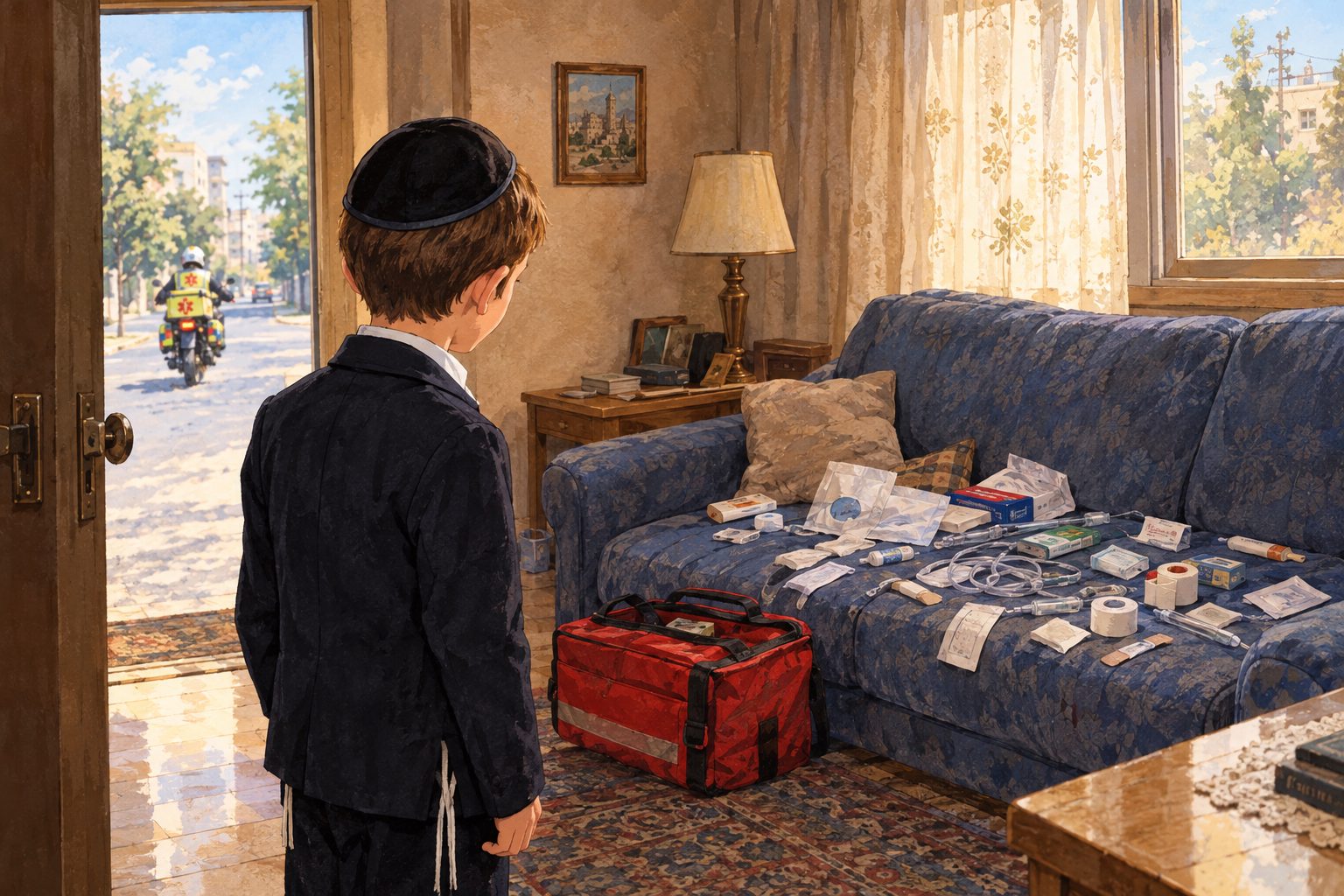
Zecharya watched as the paramedic on his ambucycle disappeared into the distance. Then he turned around and went back inside.
He found an empty apartment. On the couch were leftover paraphernalia like adhesive dressings, various tubes, bandages, and medical tape which the paramedics had used just a few minutes earlier. The atmosphere was gloomy and Zecharya didn’t know what to do with himself. His mother had joined the ambulance, traveling along with his father to the hospital. He supposed she would return later at night. He would be on his own and had to be mature.
He went outside and waited for time to pass. His father had finally returned home from prison and then suddenly had to be hospitalized, his condition uncertain. Zecharya felt that the heavens were going to cave in on him. There was a limit to how much a young child could bear.
The next morning Zecharya was absent from school. With his mother’s permission (she had returned home late at night) he went with her to visit his father in the hospital. They took two buses to get there.
Zecharya entered the big hospital with his mother. The high ceiling in the lobby and the entire building were very impressive and overwhelming. It took him a few minutes to adjust to his surroundings. He quickly concluded that it was preferable to be healthy in a simple home than in a place which, though beautiful, was full of pain and suffering.
They walked the long corridors until they reached the right department. They went over to the receptionist and asked for the number of Tzadok’s room. She kindly told them “Room 8” and smiled.
Zecharya stood in the doorway and hesitated. He peered inside, looked left and right, and saw his father lying in bed with his eyes open.
“Abba!” he exclaimed and he went over to hug him.
Tzadok tried to smile though not too successfully. He was too exhausted. He was attached to tubes and machines unfamiliar to Zecharya; they frightened him. He and his father spoke a little and then Zecharya went off to a corner. He wanted to allow his parents to speak privately.
“Did you speak to the doctors?” asked Tzadok.
She considered what to say and then gently said, “I managed to call this morning and arranged to meet with them later today. From what I understood, your condition isn’t great. The doctors haven’t yet found the problem and they are exploring several possibilities.”
Several doctors entered the room with the senior doctor in the center. He was easily identifiable by his gray hair. The other, younger, doctors looked at him admiringly.
When the senior doctor began to speak, one noticed a heavy Russian accent.
“We need to take some blood samples in order to do an important test.” He then began a short lecture to the young doctors. Zecharya barely understood a word of it because it contained numerous, long, complicated medical terms.
In the meantime, Tzadok weakly held out his hand and a nurse who had accompanied the doctors inserted a needle into a vein and withdrew blood into some plastic tubes.
The doctor gave a fake smile and left the room, leaving Tzadok with a bandaid over the area from which blood had been drawn.
“Abba, I pray that you will recover,” said Zecharya.
Tzadok felt for his son but didn’t have the strength to help him.
“I also pray for that,” he said faintly. He took a long, deep breath. “B’ezras Hashem I’ll return home healthy and we will get back to our routine.” He reached out and lightly caressed Zecharya’s face.
About two hours later, the doctor came back in and said, “Please come to my office.”
Zecharya’s mother left the room with Zecharya following her. He didn’t know whether it was okay to go along with her or he should remain with his father. In any case, he followed her. Doctors, nurses and orderlies walked here and there, with the orderlies pushing patients, some on gurneys, some in wheelchairs. Some patients even walked on their own.
At the end of the hallway appeared a white door with a sign in red that said: “Doctors’ Room – No Unauthorized Entry.” The doctor pulled out a special chip from his pocket and tapped it on a small black square on the locked door. There was a quiet humming sound and the door slowly opened. They walked in and were surprised by what they saw.
The hospital hallways had plain floors and some were even very old. Past the white door though, everything—the light fixtures, plants, carpets, all were magnificent. On either side were large rooms and offices that were furnished with the finest furnishings.
With the doctor in the lead, his mother following him, and Zecharya trailing behind, they passed by the offices as they looked around curiously. Doctors and staff sat on large green chairs and typed quickly on computers.
The Russian doctor stopped at one of the offices. On the door was a sign which said, “Dr. Vladimir Mendlowitz” in gold.
“Please come in,” he said courteously.
Zecharya’s mother sat down and motioned to Zecharya to wait near the door. The air conditioner was on and the room was pleasantly cool. Doctor Vladimir sat down in a large chair and got to the point.
“Your husband is suffering from a serious case of poisoning,” he said. Zecharya and his mother were stunned.
“Poison?! Again?”
The doctor nodded.
“This incident follows the dozens of patients who came here last week, all suffering from the same poisoning. Your husband came much later than the other patients but we are still convinced that it’s the same poison because the poison found in his body is identical to the poison found in the other patients.”
Zecharya, who wasn’t supposed to be listening, was surprised. How could this be? The police had already arrested the Arabs who poisoned his father’s food and caused dozens of people to be hospitalized!
Zecharya made a mental note. He wanted to check out something else that was bothering him too.
“May I ask a question?” Dr. Vladimir agreed and Zecharya said, “When my father suddenly collapsed, one of the medics said he might be suffering from Broken Heart Syndrome, so how could you say he is suffering from poisoning?
The doctor smiled.
“You’re a smart boy. The medic thought your father was suffering from heart problems but when your father arrived here, we saw it was not related to the heart. We examined his blood and discovered he is suffering from a highly toxic poison!”
To be continued
Beis Moshiach #1527 • י״ב חשון תשפ״ז • pp. 60-62
© 2026 Beis Moshiach Magazine. All rights reserved.
This article originally appeared in Beis Moshiach #1527. You are welcome to share it with friends and family by email or in print, provided that you do not change, add to or omit any part of it, you credit the author and Beis Moshiach, and you include a link to archive.bmoshiach.org (written out in full in printed copies).
To republish this article in a newspaper, magazine, book or website, please request permission in advance at [email protected].