Don’t You Know Me?
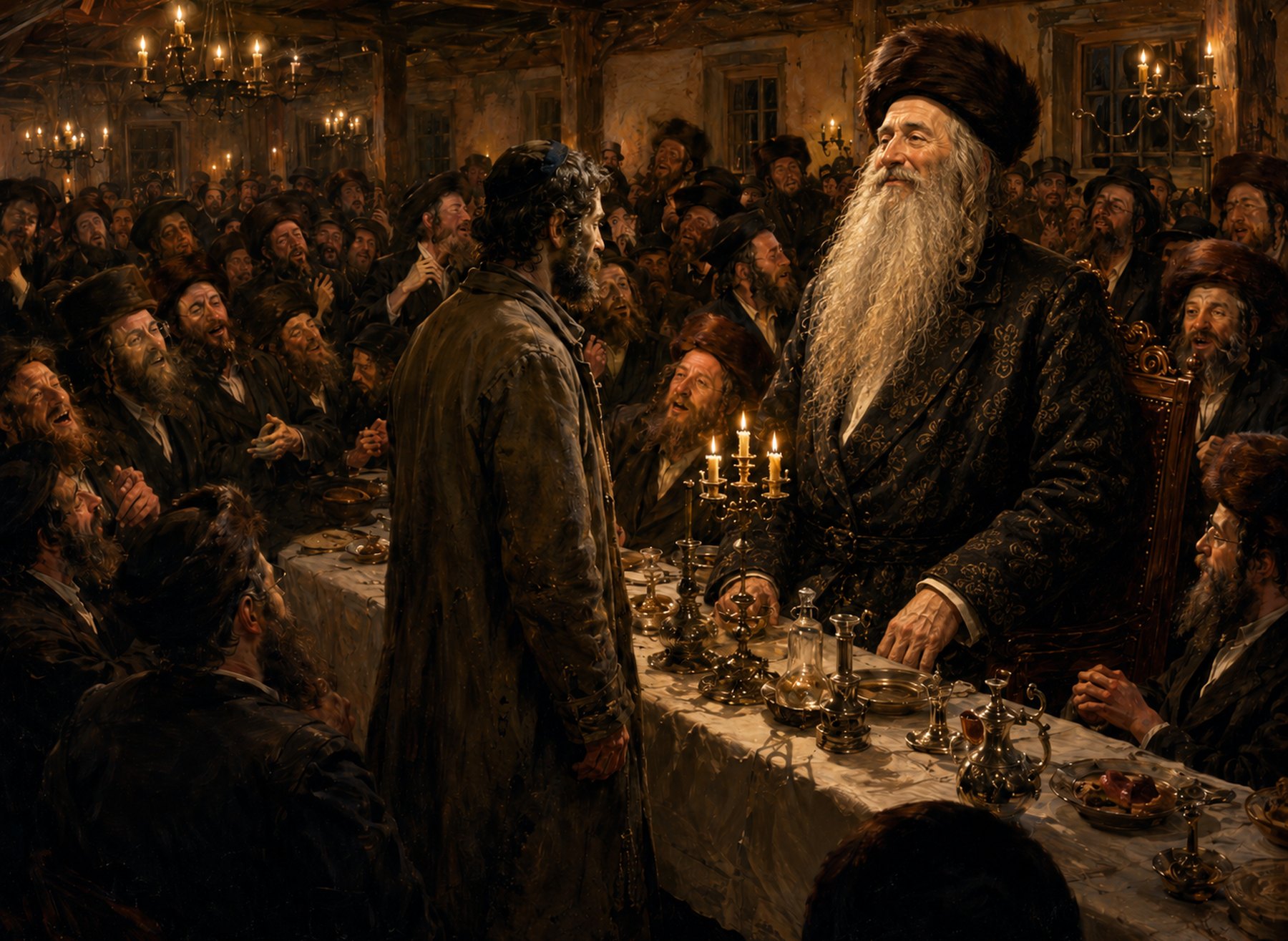
The stranger didn’t say a word. He didn’t push his way forward, and he didn’t ask anyone for a place to sit. He didn’t introduce himself to the Chassidim standing near the door, or whisper a message to the gabbai. He simply walked into the room where the holy Rebbe of Kuzmir was holding his Friday night tisch, found a place directly in front of the Rebbe, and stood there, staring.
The room was full. Several hundred Chassidim had gathered to spend Shabbos near their Rebbe. Some stood pressed against the walls. Some leaned forward from behind the table, trying to catch every word. Others stood on their toes, hoping for just one clear look at the Rebbe’s holy face. The air was warm from so many people standing together. The candles gave off a soft glow. The sound of singing filled the room, rising and falling like waves.
The Rebbe of Kuzmir sat at the head of the table, surrounded by his Chassidim. His face shone with the joy and holiness of Shabbos. When he sang, the Chassidim sang with him. When he paused, the room became still, waiting for the next word, the next niggun, the next spark of Torah. For the Chassidim, this was more than a meal. It was the sweetest part of Shabbos. The whole week seemed to fall away, and their hearts could rise a little higher.
But the stranger didn’t seem to be carried by the singing. He didn’t sway with the crowd. He didn’t close his eyes in dveikus. He only stared at the Rebbe’s face.
At first, no one thought much of it. Many people came to Kuzmir to see the Rebbe. Kuzmir wasn’t a large city, but it was a town with a long history, an old market square, Jewish life, and travelers passing through. And above all, it had become the home of Rabbi Yechezkel Taub of Kuzmir, one of the great Polish Rebbes of his generation.
Some brought questions, others carried in their troubles. Some came because they needed a bracha. Some came because their souls were thirsty, and they wanted to be near a tzaddik. A stranger at the tisch wasn’t very surprising.
But this stranger was different.
He didn’t look like a man waiting to ask for advice. He didn’t look like a man enjoying the niggunim. He looked like he was trying to remember something. His eyes flicked over the Rebbe’s face again and again, as if he were searching for a sign.
The tisch continued. The Rebbe sang with holy joy, and the Chassidim sang along. The Rebbe said words of Torah and Chassidus and the Chassidim listened in awe. The stranger stayed where he was, silent and watchful. At last, the Rebbe bentched, wished the Chassidim “Good Shabbos,” and went into his room. The crowd slowly began to leave. People wished each other Good Shabbos, and made their way out into the cold night.
The stranger left too.
No one stopped him. No one asked him who he was. No one asked why he had been staring at the Rebbe for so long.
* * *
The next morning, the same thing happened again.
The Chassidim gathered around the Rebbe for the Shabbos day meal. Once again, the room filled with singing, Torah, and the warm feeling of being near a holy tzaddik. And once again, the stranger appeared. He stood in front of the Rebbe, just as he had the night before, and stared.
Now people began to notice.
Who was he? Why had he come back? Why did he keep looking at the Rebbe that way? If he needed something, why not just ask? If he had a question, why not just speak? If he was just another visitor, why did he look so serious?
Still, the stranger said nothing. He only looked.
The Chassidim watched him from the corners of their eyes, but no one wanted to interrupt the holiness of Shabbos. The Rebbe continued the tisch, and the stranger continued staring. After the meal, everyone left again, and the mystery remained.
* * *
Later, as Shabbos was nearing its end, the Chassidim gathered for Seuda Shlishis. This was a very holy time. The light outside was fading. The world was growing quieter. Inside, candles were lit on the table, as was the custom, and their flames trembled gently in the dim room. The Chassidim gathered close, waiting to hear the Rebbe say Torah.
The Rebbe of Kuzmir began to speak with great emotion. His words were filled with holiness and awe. He spoke in a way that lifted the hearts of those who heard him. The Chassidim listened so deeply that they almost forgot where they were. It felt as if the room itself had become higher, as if the walls of the little shul had opened toward Shamayim.
And, naturally, the stranger was there once again.
This time, he did something that made the Chassidim even more curious. He took one of the candles off the table and held it up to see the Rebbe’s face more clearly. The light fell across the Rebbe’s nose and cheeks, and the stranger stared even harder. It was as if one more look, one more moment, one more detail might finally help him remember.
The Rebbe continued saying Torah. Then, suddenly, he stopped.
The room became still. The Rebbe looked straight at the stranger and called out, “Why are you staring at me? Don’t you know me?”
The words seemed to pass through the whole room. Don’t you know me?
The Chassidim didn’t understand. What did the Rebbe mean? Had the Rebbe met this man before? The Rebbe didn’t explain. Afterward, he took a becher of wine, bentched, and after Maariv made Havdalah on that cup. The holiness of Shabbos slowly gave way to Motzei Shabbos. The Chassidim began to leave, but the Rebbe’s words wouldn’t leave their minds.
* * *
Among the Chassidim was Reb Elazar. Some versions say he may have been a shochet. He’d heard the Rebbe’s words, and he knew they were not ordinary words. Tzaddikim didn’t speak for no reason. If the Rebbe had said, “Don’t you know me?” then something deep was hidden here.
So, when the stranger left, Reb Elazar quietly followed him.
The streets were dark and quiet. The sounds of the tisch faded behind them. The stranger walked ahead, not turning around. Reb Elazar followed at a distance until they reached a side street where no one else was passing. There, he stepped forward and spoke.
“Please,” he said, “tell me. What’s going on with you and the Rebbe?”
The stranger looked at him. For a moment, he seemed unsure whether to answer.
“It is an old story,” he said shortly.
But Reb Elazar was not satisfied.
“No,” he said. “Please. I need to know. The Rebbe’s words were not simple. Tell me what happened.”
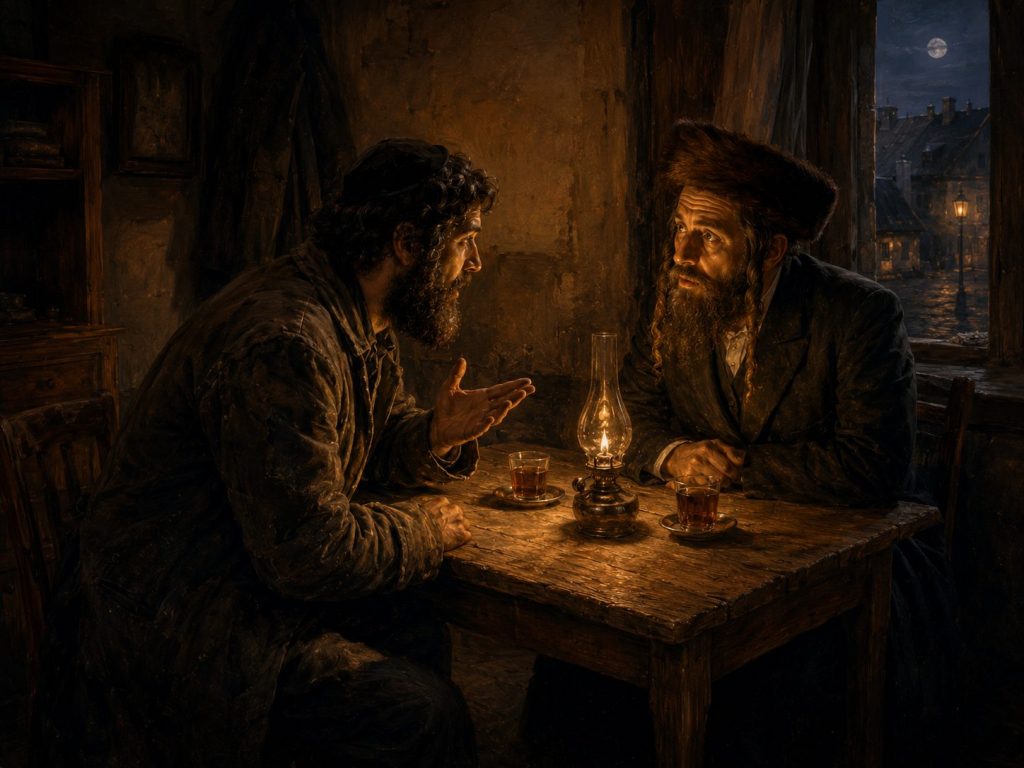
The stranger was quiet. Then he said, “If you truly want to hear it, come with me to my hotel, and I’ll tell you everything.”
Reb Elazar followed him to the place where he was staying. When they arrived, the stranger asked that tea be brought for himself and for his guest. They sat down at a small table. For a few moments, neither of them spoke. Reb Elazar waited, his heart beating quickly. He knew he was about to hear something unusual.
At last, the stranger began.
* * *
“Twenty-two years ago,” he said, “I passed away.”
Reb Elazar stared at him.
“You… passed away?” he whispered.
“Yes,” said the stranger. “Listen, and you will understand.
“Twenty-two years ago, I was a melamed (teacher) for small children. I was a poor man. My wife and I had two little children, and we had almost nothing. We lived on dry, black bread with a bit of garlic. We didn’t have meat or fish. We didn’t have the things other people enjoyed. But I didn’t complain. I wasn’t bitter. I accepted my life from Hashem, and I was happy with what He gave me.
“My work was to teach young children. That was my life. I wanted my children and my talmidim to grow up as ehrliche Yidden, Jews who would follow the way of Hashem. I didn’t need comfort. I didn’t need riches. If I could raise another generation to love Torah and mitzvos, that was enough for me.
“Then I became very sick. It was a terrible sickness in my lungs. The doctors gave me medicine. They spoke to my family gently and told them not to worry. They said that, soon, I’d get better and come home. But I understood the truth. I saw their faces. I heard the way they spoke when they thought I was not listening. They didn’t believe I would live much longer.
“I was only twenty-two years old.
“It was hard to imagine such a thing. A young man, only twenty-two, leaving this world so early. A wife becoming a widow. Two little children becoming fatherless. Who would take care of them? Who would guide them? Who would teach them how to live as Yidden?
“And then it happened. I left this world.
“It’s known that when a person is first niftar, he doesn’t always realize right away that he’s passed away. He still thinks he’s alive, in this world. That’s what happened to me. I knew I couldn’t stand up, but I didn’t understand why. I saw my family crying, but I thought they weren’t listening to me. I wanted to speak to them. I wanted to tell them I was still there.
“Then the Chevra Kadisha came. They began to prepare me. My wife cried. My children cried. And then, I understood. I had died.”
* * *
“At that moment, my heart broke. But not for myself. I wasn’t thinking about myself. I was thinking only about my children. What would become of them? Who would guide them in the way of Hashem? Who would teach them Torah?
“My neshama began to separate from my body. I felt myself rising higher and higher. I didn’t know where I was being taken. I felt myself going around and around, not understanding what was happening.
“Then I saw thousands and thousands of neshamos.
“A young man came over to me and asked, ‘Who are you, and where are you going?’
“I recognized him, and I cried out, ‘Maybe you can tell me why they took my neshama at such a young age! How could they do this? What will happen to my children? Who will take care of them?’
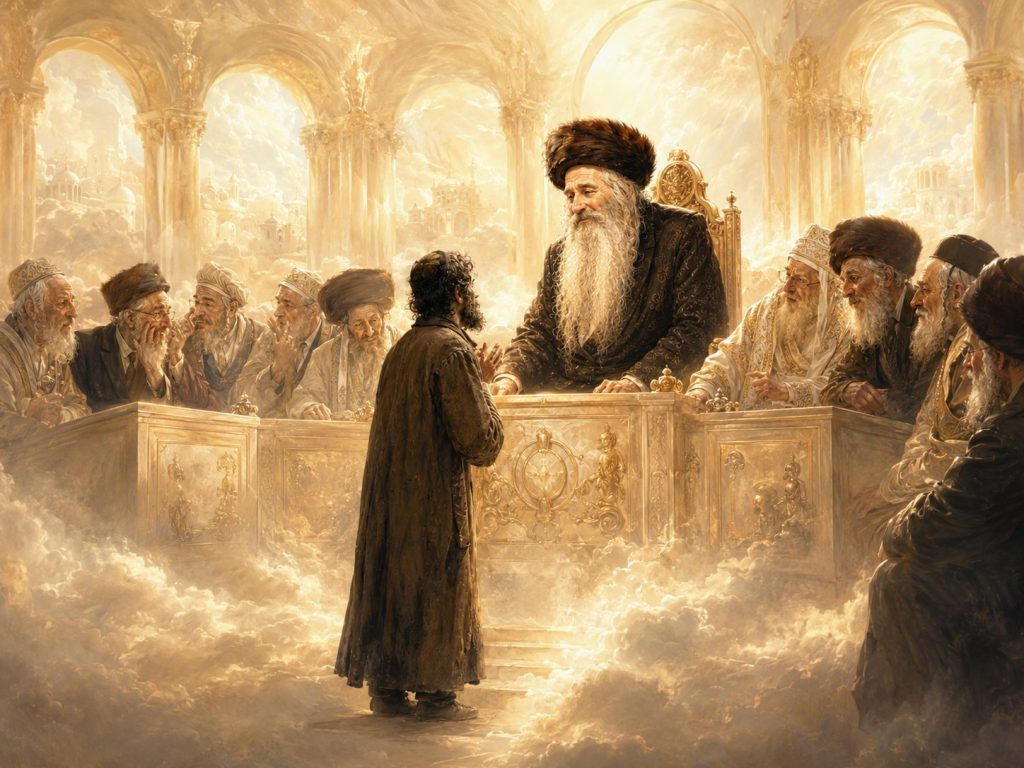
“The neshama answered me and told me that I was in a high heichal, a high level in Gan Eden. The exact name was not clear, but he pointed into the distance and said, ‘Not far from here is the Beis Din shel Maalah, the Heavenly Court. Every neshama that leaves this world and is pure is brought there.
“Then he told me a secret.
“He said, ‘When you arrive, look carefully. The dayanim (judges) are sitting there. Among them sits one of the tzaddikim of the generation. He still lives in this world, but he’s so great that his neshama is brought Above to sit with the Beis Din shel Maalah. The others are there without their guf, because they have already left the physical world. But this tzaddik is still alive. Go to him. He’ll understand. Through him, true judgment will come.’
“And then the neshama disappeared.
“I headed toward the place he’d shown me. When I reached it, I stood far away, full of awe. I looked carefully at the faces of the dayanim, trying to know which one was the tzaddik who still lived in this world.
“It didn’t take long.
“The judge sitting in the middle called to me from far away. His voice was soft and gentle.
“‘What do you want?’ he asked.
“As soon as I heard his voice, I began to cry. I cried like I had never cried before. I couldn’t even get one word out of my mouth.
“The tzaddik spoke sweetly. ‘Say what you have to say,’ he told me. ‘I will listen.’
“With all my strength, I cried out, ‘How can a young father be taken from the world and leave behind little children? Who will guide them? Who will teach them to follow the way of Hashem?’
“The tzaddik looked at me and asked, ‘Is this your only concern – that your children should grow up in the way of Hashem?’
“I answered, ‘Yes. That is my whole concern. What kind of life did I have? My whole life was poverty and darkness, but I accepted it all, so I could raise another generation.’
“The tzaddik turned to the other dayanim. They spoke together. They discussed the matter. I stood there trembling, waiting to hear what they would decide.
“Then the tzaddik called me forward.
“He said, ‘Your words are pure and honest. It is clear you’re speaking the truth. Therefore, the Beis Din has decided to leave you in the physical world for another twenty-two years.’
“And that’s exactly what happened.
* * *
“Those who had accompanied me to the levayah (funeral) were still there when it happened. My body had been brought to the cemetery, and the matzeivos stood all around, silent and cold. The people who had come with me were filled with sadness. They thought they’d come to do a final kindness for a young father, only twenty-two years old, who had left behind a wife and two little children.
“And then, suddenly… I sat up.
“For one frozen moment, nobody moved. Nobody understood what their eyes were seeing. A man they’d just brought to the cemetery was sitting up alive. Then, the screams began. People cried out in fear, some raced away as fast as their feet could carry them. In a moment, the whole cemetery emptied. The people who had come to bury me were gone.
“I was left alone among the stones. The air was still. The ground was cold. Everything that had happened rushed back into my mind – my sickness, my family crying, the Chevrah Kadisha, my neshama rising Above, the Beis Din shel Maalah, and the soft voice of the tzaddik who’d promised I would live another twenty-two years.
“I was alive. Not in a dream, not in a vision. Alive. When night came, I stood up and began to walk home. Every step felt like walking between two worlds. A short time earlier, I had been in the Beis Din shel Maalah. Now, my feet were touching the earth again. A short time earlier, my family had been crying over me. Now, I was walking back to them.
“When I reached my house, the shock was impossible to describe. The man who had been taken away for burial was standing at the door. There were cries and screams. My family couldn’t believe their eyes. But it was true. I had returned.
“The news spread quickly. First through the town, then farther and farther, until the whole Galicia heard about it. Everywhere, people spoke about the young melamed who had passed away and come back to life. They called it techiyas ha’meisim. A man had returned from the dead. For a while, it was all anyone talked about.
“But people are people. Time passes. New troubles come. New stories are told. Slowly, the wonder faded. The world moved on. But I never forgot. How could I forget? Every day I lived after that was a gift someone else had returned to me.
* * *
“I knew the tzaddik who had helped me in the Beis Din shel Maalah was still alive somewhere in this world. I’d seen his holy face. I’d heard his gentle voice. I had to find him. I had to thank him.
“So, I began to travel. I went through Galicia and Hungary, from town to town and from city to city. Wherever I went, I asked about tzaddikim. Whenever I heard of a great Rebbe, I tried to find out if, perhaps, he was the one I had seen Above.
“At first, the image of his face was clear in my mind. I felt sure that if I saw him again, I’d know him right away. But I searched and searched, and I didn’t find him. After a long time, I grew tired and returned to my city.
“Still, I never stopped thinking about him. Whenever a guest visited from another city, I’d ask about the tzaddikim he knew. I would tell my story and describe what had happened to me. Maybe someone would know who I was looking for.
“But the years passed. Slowly, the picture in my mind became less clear. I still remembered the story, the tzaddik’s kindness. I still remembered the voice. But the exact image of the tzaddik’s face began to fade.
“Then, I turned forty-four.
“When I reached that age, my heart trembled. Twenty-two years had passed since I was offered twenty-two more years. The time I was granted is almost over. How could I leave this world without seeing the tzaddik? How could I go back Above without thanking the one who had spoken for me?
“Finally, one day, I met a man and told him my story. He listened carefully. Then he asked me, ‘Do you remember anything about the tzaddik? Any siman?’
“I said, ‘Yes. I remember certain signs. But the clearest siman is that he was very tall. He was a head taller than the rest of the dayanim. Even the hats of the other dayanim didn’t reach his head.’
“When the man heard that, he became excited.
“‘I know who that is!’ he said. ‘It must be the holy Rebbe of Kuzmir. Everyone knows he’s the tallest tzaddik of the generation. When they make him a hat, it has to be specially ordered. Even his walking stick has to be made special, because of his height.’
To be continued
Beis Moshiach #1516 • pp. 54-59
© 2026 Beis Moshiach Magazine. All rights reserved.
This article originally appeared in Beis Moshiach #1516. You are welcome to share it with friends and family by email or in print, provided that you do not change, add to or omit any part of it, you credit the author and Beis Moshiach, and you include a link to archive.bmoshiach.org (written out in full in printed copies).
To republish this article in a newspaper, magazine, book or website, please request permission in advance at [email protected].