Diamonds From the East

Mrs. Shterna Sarah Kanelsky’s memories of her mother, Rebbetzin Chaya Esther Zaltzman a’h, a woman suffused with a sense of shlichus all her life, who saw every Jew as a diamond, who proved that age is just a number on a passport.
Chaya Esther walked through the streets of Malakhovka, excited and holding an exceptionally impressive certificate. Despite all the challenges, she had managed to complete her studies with great distinction. Now the whole future lay before her, and the gates of academia were wide open.
A few minutes later, that certificate was consumed by fire. She threw it into the flames with her own hands. She withstood the test. Where did this talented young girl draw the strength to give up her dream? From the home she grew up in.
She passed through many stations in her life, and in all of them she continued to hold fast to the eternal values she absorbed in childhood. She did not surrender in Russia, and she did not give in in the United States. In every place and every situation, the same eternal fire burned within her.
In this article, Mrs. Shterna Sarah Kenelsky takes us on a moving journey through the stations of her mother’s life.
A Match Made in Heaven
“My mother, Mrs. Chaya Esther, daughter of Rabbi Yehuda and Bas Sheva Boterashvili a’h, was born in Georgia on 12 Adar 5696 (1936) and passed away on Erev Yom Kippur, 9 Tishrei 5765 (2004). On her mother’s side, she was from the distinguished Chein family, descended from Reb Peretz Chein, one of the great Chassidim.
“My grandmother Bas Sheva’s father was Reb Meir Simcha Chein, a Chassid of the Rebbe Rashab and the Rebbe Rayatz. In her father’s home, my grandmother absorbed a chinuch of uncompromising mesirus nefesh, and she passed this mesirus nefesh on to her five daughters. My mother, Chaya Esther, was the second daughter in the family.”
Mrs. Chaya Esther’s father, the Gaon and Chassid Rabbi Yehuda Boterashvili (Kolasher), also had a fascinating life story. “He was the only son of his parents, Rabbi and Mrs. Mordechai and Rosa. Rabbi Shmuel Levitin, a shliach of the Rebbe Rashab to Georgia, was impressed by the gifted boy and explained to his parents that they must send him to the Tomchei Tmimim yeshiva. My grandfather was a young boy when he arrived at the yeshiva in Rostov. Since he was born and raised in Georgia, he did not know a word of Yiddish. In the yeshiva he understood nothing, but he burned with a fierce desire to learn and to understand. He fasted for three days and prayed that Hashem would send him a chavrusa willing to teach him Yiddish so that he could learn Nigleh and Chassidus and understand everything deeply. Hashem accepted his prayer and sent him the right people. After four years at Tomchei Tmimim, my grandfather received semicha for rabbanus and dayanus, and also a certificate as a shochet, mohel, and sofer.”
The shidduch between Rabbi Yehuda and Bas Sheva involved Bas Sheva’s nephew, the renowned Chassid Reb Berke Chein: “At that time, Reb Meir Simcha went in for a yechidus with the Rebbe Rayatz and the Rebbe asked him whether he had already married off all his children. He answered that he had one more daughter, the youngest, but she was only seventeen and a half. The Rebbe Rayatz replied that this was the right time to begin looking into a shidduch and gave his bracha. Immediately, Reb Meir Simcha asked his grandson, Reb Berke, to find a fine bachur for his daughter Bas Sheva.
“Reb Berke suggested the young man RebYehuda Kolasher, because he had been very impressed by his davening, and the bachur was invited to Reb Meir Simcha’s home for a midday meal. After the meal he recited Birkas HaMazon, concentrating, as was his custom, on every single word. Reb Meir Simcha was impressed and took him as a son-in-law for his daughter. The wedding took place in Nevel, where the Chein family lived, on the instruction of the Rebbe Rayatz. Immediately afterward, the young couple left on shlichus to Georgia, to Kolashi.
“My grandfather became the Mara d’Asra and leader of the community there. My mother was born while on this shlichus. Living conditions were hard, with scarce bread and meager water. But my grandfather was determined to continue the shlichus his Rebbe had given him. Even the persecutions did not frighten him. One day he was summoned to the local post office, and there they detained him so that he would not interfere with the Communists’ plan to turn a shul into a school. My grandfather was locked in an office on the second floor of the post office, but he was not afraid for a moment. He was certain that Hashem would help him. He prayed and jumped out of the window. Miraculously, he was not hurt. He immediately returned to his community and prevented the Communists from carrying out their plan. As a result, he was forced to flee Kolashi.”
A Soldier at the Front
After a difficult period of wandering, the family merited to be reunited, and they settled in a wretched one-room apartment in Moscow. But they were not allowed to live there in peace. “Not long afterward, when the Nazis bombed the city, my grandfather, my grandmother, and their little daughters fled to Karaganda in Kazakhstan. My mother, Chaya Esther, was only four years old then, and she went through all the hardships along the way.
“Even during the war, my grandfather remembered that he was a shliach, and he served as mohel and shochet in his new place of residence. There were about two hundred Jewish families there. My grandfather performed brissim in secret, with true mesirus nefesh, and my grandmother would recite Tehillim with the girls during those times, praying that Hashem would protect him.”
In the middle of the war, Reb Yehuda was drafted into the Red Army and sent to the front. Bas Sheva was left alone with the girls. She prayed for her husband, and despite her anxiety over his fate and the harsh conditions, she continued to raise her daughters in Torah and mitzvos without compromise.
“During the battles my grandfather was severely wounded, and his life was saved only thanks to the instruction of the Rebbe Rayatz to be careful with the mitzva of washing hands. My grandfather was very careful about this throughout the years. When he packed his knapsack before going out to battle, he put in an iron cup for negel vasser. The bullet that struck him passed through the cup in the knapsack, and the cup absorbed some of the force of the impact, and so his life was saved in a miracle of miracles. The bullet stopped two centimeters from his heart. With his last strength, wounded and bleeding, my grandfather crawled and searched for help, until they saw him and took him to the nearest hospital.”
After the war the family was reunited and settled in Malakhovka, a suburb of Moscow.
“My grandfather ran a business there. He sold fabrics, not officially, of course. Trade was forbidden… But mainly he was the rav of the underground community. He shechted chickens, officiated at weddings in his home, circumcised babies, baked matzos, and answered halachic questions. On Sukkos he always had a lulav and an esrog, and people would come to his home to recite the bracha on the dalet minim. My grandparents’ home was the address for everything Jewish. Beyond that, anyone who needed a hot meal or a place to sleep would go to them and be welcomed graciously in their home.
“My grandparents even hid Chassidim from the secret police in the attic of their home. One of those Chassidim was the nephew Reb Berke Chein. He hid in their home for several years, and my grandmother Bas Sheva would bring him food late at night, so that no one would see or hear anything.”
This was the home in which Chaya Esther grew up: a Chassidic home, steeped in mesirus nefesh. A home of hachnosas orchim, underground Chassidic farbrengens, and a burning flame of hiskashrus.
A Certificate Turns to Ash
“My mother was forced to attend the Soviet school, but she never desecrated Shabbos or Yom Tov,” says her daughter, Sterna Sara. “She was very smart and talented and she finished her school studies with great distinction. When she brought the certificate home, she was sure her mother would be proud of her. She showed it to her and said she wanted to continue studying. She knew that her high grades would open all doors for her and allow her to be accepted to a prestigious university.”
But Bas Sheva understood the great danger. Academic studies bring countless challenges, and only a few students manage to remain faithful to Torah.
“My grandmother turned to my mother in tears and said: ‘Chaya Esther, it will be very hard for me to do what I must do, but you will help me. We will cry together, but we will do this together and Hashem will help us.’ She lit a flame on the gas stove in the kitchen. ‘We are going to burn this certificate,’ she declared. ‘It will be very hard for both of us. But together we will continue to guard the Jewish ember that was given to us as an inheritance.’ Mother and daughter brought the certificate close to the fire, and the precious paper quickly turned to ash. They both cried, hugged, and cried. But they remained strong and my mother did not go to university.”
In those days Reb Berke Chein was hiding in the home of Reb Avrohom and Bracha Zaltzman in Samarkand. Having previously been involved in the shidduch of his aunt Bas Sheva, he now got to take part in the shidduch of her daughter as well:
“My father, Reb Chaim Dovber Zaltzman, was blessed with a mighty voice and he very much wanted to study at the conservatory and develop his voice. My grandfather, Reb Avraham Zaltzman, and also Reb Berke Chein strongly opposed this, but it was hard for him to accept this. At some point Reb Berke decided to suggest to my father’s family the shidduch with my mother. When he proposed the shidduch to my grandfather, he said to him: ‘With Bas Sheva Chein, the mesirus nefesh they invested in the girls is on a very high level.’ And he suggested that my father travel to Malakhovka to meet my mother. Boruch Hashem, the shidduch came to fruition, and my parents were married on 15Tammuz 5715 (1955).”
A 72-Hour Journey Every Month
After the wedding the couple decided to move to Samarkand, both for the education of the children who would be born and for parnassa.
“In Samarkand too my parents had difficulty making a living, and they decided to move to Dushanbe in Tajikistan. But there a new challenge arose: there was no mikva. The nearest mikva was in Samarkand, a 36-hour journey away. And so every month my mother set out on a journey lasting over 72 hours. Along the way she had to change trains several times.
“It was challenging not only in terms of time but also cost. When my father brought home his salary once a month, he would immediately set aside half the sum for the trip to the mikva. The remaining half barely sufficed for food and urgent expenses.
“When my mother finally arrived at her destination, sometimes a great deal of work awaited her there. At times the mikva was full of boards, nails, and construction debris that ignorant non-Jews had thrown in, and she had to labor for hours to clean the immersion pool. And in winter there was terrible frost, thirty or forty degrees below zero, and in such conditions my mother would immerse, and the next day begin the journey home to Dushanbe. When my father accompanied her to the train he would bless her to have a good trip, and from that moment on he would pray that she return home safely.
“Later my parents and their friends, Reb Dovid and Sarah Mishulovin a’h, decided to build a mikva together in Dushanbe itself. They built a mikva that was kosher according to the strictest standards. At first only my mother and Mrs. Mishulovin used it, and afterward word spread to other women, and they too merited to observe the laws of family purity b’hiddur. When my mother told me about those days, she would note with emotion that this mikva still exists to this day.”
Excuses for the Shkole
“After some time Reb Berel and Mrs. Chaya Esther returned to Samarkand and as the children grew, a new and complex challenge awaited them: chinuch.” Mrs. Shterna Sara Kanelsky shares her memories of those days:
“My older brother, Yosef Yitzchok, hid in the house for many years. I was only five and a half, but I remember this moment as if it happened today. We were alone at home, my mother and I. Suddenly the doorbell rang. I don’t remember whether the door was unlocked or whether they simply pushed it open by force, but two uninvited guests, representatives of the Soviet Ministry of Education, burst into the living room. They asked in a stern voice: ‘Is there a boy here named Yosef? Where is he? He does not appear at school!’ In the eyes of the authorities, a parent who did not send a child to Soviet education was a criminal.
“My mother kept amazing composure and said to them: ‘He is not here, he is in Moscow, with my sister.’
“They shouted that they didn’t believe her and began searching the whole house. I remember my mother’s look very well. Her face was white as chalk. She looked at me when they weren’t looking; she couldn’t say anything, but I understood exactly what she meant. I knew that my brother Yosef Yitzchok, who was then eight and a half, was playing in the yard. I understood at that moment that I had to run and warn him. If they found him and realized that my mother had lied, my parents could be sent to prison for a long time.
“I slipped outside, found him playing in the yard and whispered to him: ‘Uninvited guests came looking for you, hide right now!’ He fell on his face in fright, hid in the tall grass, and said he wouldn’t move until I let him know the danger had passed.
“They searched the house for two and a half hours. They went from room to room, moved everything, opened all the closets, and rummaged through all the drawers angrily and aggressively. My mother stood there and could not stop them. In the end, they left in great disappointment, said nothing, and only wrote something in a notebook.
“When the danger passed my brother came home and my mother fed him and gave him water while trembling all over. My father came home later and didn’t recognize her. My mother, who was a young woman, had aged ten years from the terrible tension.
“My brother continued hiding in the house until he was fifteen. (Today, boruch Hashem, he is the father of fourteen children and grandfather to many grandchildren, a rabbi and shliach who works with Russian speakers and Israelis in Toronto, and he merited that all his children are shluchim. I see all this as reward for those days.)”
The parents tried to hide their other children as well, but at some point it was discovered and there was no longer a choice. “In the end we were forced to go to school. On Shabbos we stayed home, and boruch Hashem, we never desecrated Shabbos or a Yom Tov. Every Monday I would stand by the door and ask my mother what excuse to present this time. My mother was blessed with a sharp memory, and always remembered which excuses I had used recently, and helped me find new ones. We have 248 limbs and 365 sinews, and every week she found a new excuse connected to a different limb. Our parents registered each of the children at a different school on purpose, so that no contradictions would emerge among the excuses. Father would drive us with mesirus nefesh on his bicycle, in rain and snow and frost, to different ends of the city…
“One year, when I was already in third grade, an inspector came into our classroom and asked each student in turn to state their name and nationality. I was the only Jewish girl among 500 students in the school, and I knew that everything I saw or heard at home was a deep secret. I had never told anything in class about what went on at home. Now, when I realized that I would have to say in front of everyone that I was Jewish, a paralyzing fear gripped me.
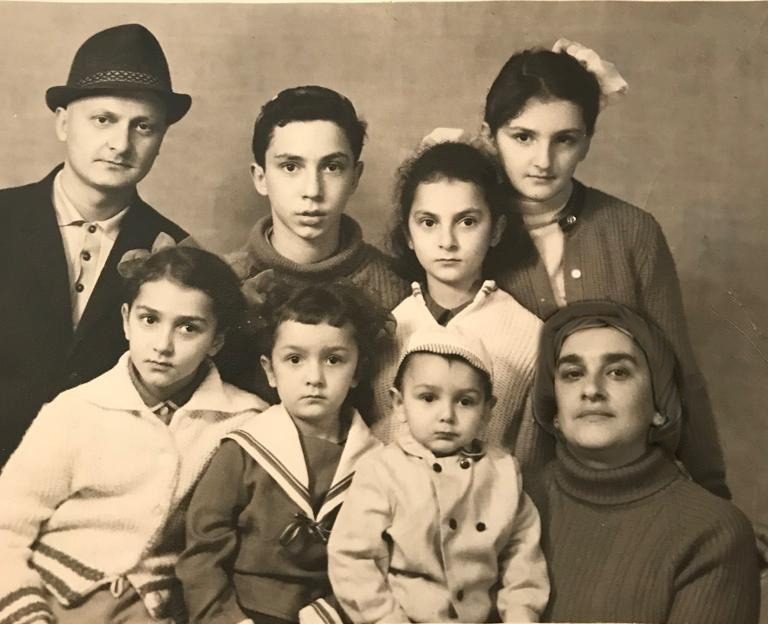
“There were 39 students in my class, and I was among the last in line. I trembled. I said: ‘Hashem, help me.’ I was afraid that if I revealed I was Jewish, I would get my parents into trouble, but I had been raised at home that one must not lie. When my turn came I stood up, and with my head bowed I mumbled that I was Russian. I convinced myself that since I was born in Russia, I was allowed to answer this way, and it wasn’t a lie.
“The inspector, who was already standing in the doorway of the classroom, turned to me in front of everyone and said: ‘Sit down, Zaltzman, you are Jewish.’
“It is impossible to describe the fear I experienced at those moments. My heart pounded wildly, and suddenly I felt a very painful stab in my back. A boy sitting behind me had stabbed me with a wooden ruler. ‘You’re a zhidovka, you hid from us until today that you’re Jewish, shame on you,’ he said to me at the beginning of recess. Immediately several boys surrounded me and beat me. The girls tried to protect me, arguing that I was a good girl and an excellent student. I was saved from the lynching by a miracle. I left school in the middle of the day, the pain was terrible, and blood was seeping from the wound in my back. When I got home I fell face down on the floor and cried out: ‘Mama, I’m not going to the school of the goyim anymore!’
“My mother comforted me, hugged and kissed me, and tended to me devotedly. Unfortunately, I had to go to school the next day as well. I couldn’t afford to miss unnecessary days, since I had to be absent on Shabbos…
“And another episode from those days: one day the school decided to hold a concert for the parents, and all the children who could play any instrument were enlisted for the performance. I played the violin and took part in the rehearsals and then I learned that the concert would take place on Shabbos. On Friday at the end of the day, the homeroom teacher of third grade approached me and asked to talk with me. I could not lift my eyes to her. ‘Ask your mother to let you come to school tomorrow, you have a main part, playing the violin, don’t let us down’… she pleaded with me. ‘You don’t have to do anything else at school, you don’t have to write, just come with the violin.’ Of course I did not come.
“That Monday was especially hard. I tried to do everything not to meet the teacher’s eyes. All day I tried to avoid her. At some point she approached me and said: ‘You didn’t come, Zaltzman, huh? You mother didn’t give you permission.’ I didn’t look at her; I burst into tears like a third-grade girl. I didn’t answer her at all, and life went on.
“We managed to survive those difficult years thanks to my mother’s resourcefulness. With her great talent she would embroider and sew all sorts of beautiful things, scarves, sweaters and more, and give them to the administration, the teachers, the inspectors, so that they would keep quiet and overlook the shemiras Shabbos.”
An Underground Yeshiva at Home
During their time in Samarkand, many Chassidic families turned to Reb Berel and Mrs. Chaya Esther Zaltzman. These families could no longer hide their children from the authorities but refused to send them to Soviet education. For the boys, going to school meant not only the challenge of keeping Shabbos, but also sitting for long hours bareheaded and without tzitzis. “We lived in a very large house. In the yard there were fruit trees, and at the very end stood a low structure, partly underground. It was impossible to notice it without knowing it was there. My parents turned this structure into an underground yeshiva. They took fifteen bachurim into their home from nearby cities. The bachurim, who were fourteen to sixteen years old, sat for hours in that room and studied with a special teacher that my father found. They learned Gemara and Chassidus and learned to become mekushar to the Rebbe. It involved real mesirus nefesh. In the yard we also had a large pool, and the bachurim used it as a mikva.
“My father kept the yeshiva’s existence secret; he didn’t even tell his own father, lest he say to him: ‘Berele, what are you doing? You are endangering your children’s lives’… And so my parents took care of the boys on their own, without any support.
“This continued for four years. All those years my mother cooked, not only for us, a family of eight, but for fifteen more yeshiva boys. She also did the laundry herself for the family and for the boys. When the boys got sick in the cold winter days, and it was impossible to call a doctor to the house or take them to a clinic (after all, their stay in our home was not legal, everything was underground), my mother tried to prepare natural remedies for them.
“The bachurim were young, almost children. Often they made noise in the yard and in the house. My mother trembled with fear. If one of the neighbors heard that there were more children in the house, he might inform on us, and everyone would be in danger. Despite everything, she continued to host the boys in our home with mesirus nefesh.”
Beis Moshiach #1532 • pp. 46-51, 52
© 2026 Beis Moshiach Magazine. All rights reserved.
This article originally appeared in Beis Moshiach #1532. You are welcome to share it with friends and family by email or in print, provided that you do not change, add to or omit any part of it, you credit the author and Beis Moshiach, and you include a link to archive.bmoshiach.org (written out in full in printed copies).
To republish this article in a newspaper, magazine, book or website, please request permission in advance at [email protected].