The Man They Couldn’t Break
As heard from his son, Reb Pinchas Tevel
Pinchas Tevel heard many stories from his father, Avrohom Tevel. Some were about the war. Some were about Siberia. Some were about coming to America and starting again. But all carried the same message: someone may think they control you, but really, a Yid is only ever in Hashem’s hands.
* * *
Part 1: Rosh Hashana in Dinov
Avrohom’s story began before Pinchas was born, in the town of Dinov, Poland. It was Erev Rosh Hashana, 1939. There came a knock at Avrohom Tevel’s family’s door.
Knock, knock, knock.
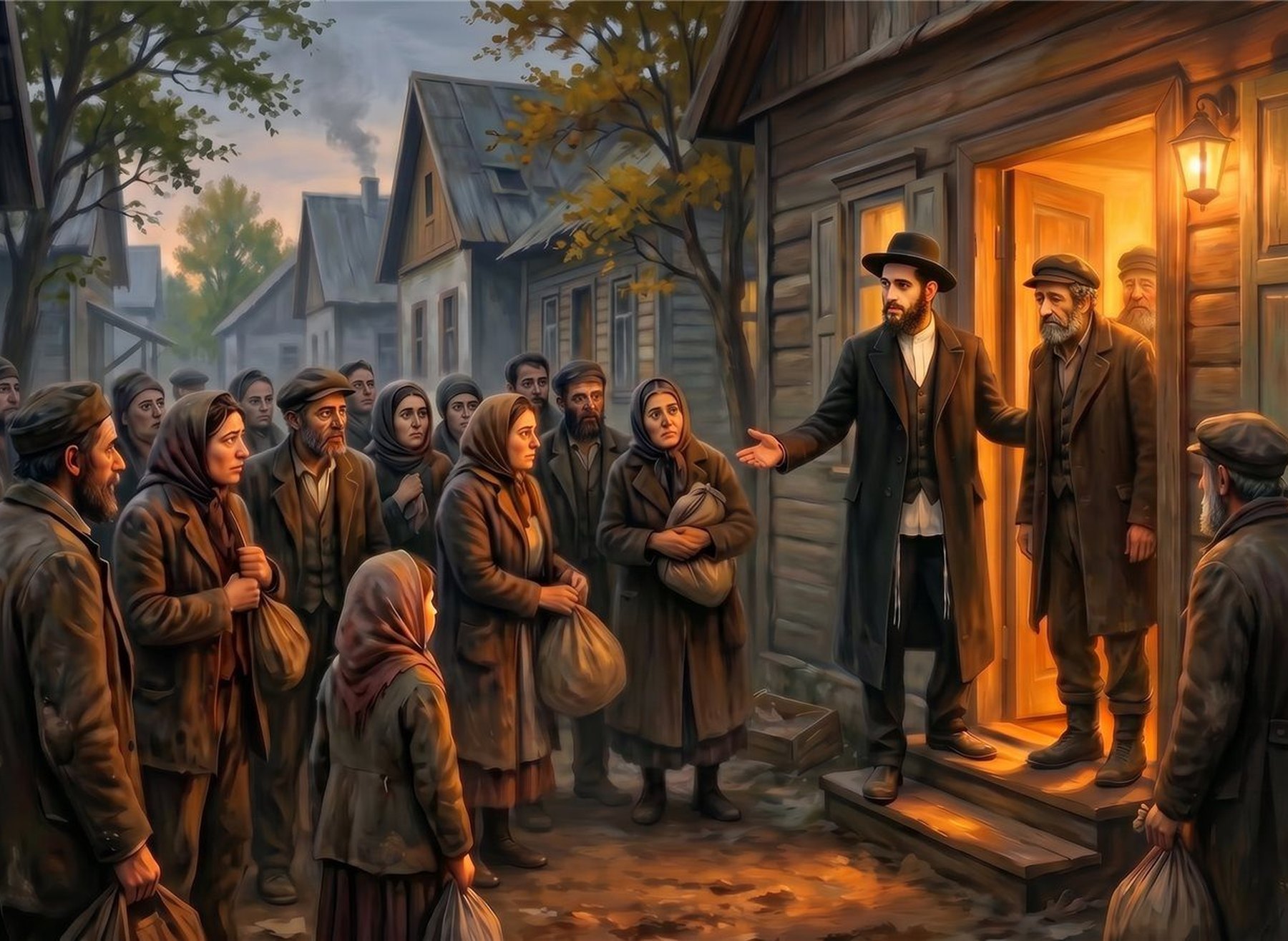
The family inside grew still. Who could be visiting now, so late, so close to Yom Tov? When the door opened, they found a group of Yidden outside. They looked exhausted. Their clothing was worn from the road, and their faces seemed heavy with fear.
“Please,” they begged. “We’re from a nearby town. The Germans reached our area only a day or two ago. They began killing Yidden right away. We barely escaped with our lives. We have nowhere else to go. Can we come in?”
There were twenty of them altogether—fourteen men and six women. No children.
Avrohom’s father looked at them and understood immediately. The war had begun two weeks earlier, when Germany invaded Poland. Now the danger had reached closer and closer to Dinow. These frightened Yidden had escaped from nearby towns with almost nothing, leaving their homes and belongings behind. They were looking for one thing: a safe place to hide.
“Of course,” he said. “Come in. The attic is yours. Whatever food and drink we have, we’ll share with you.”
The frightened group stepped inside. For the first time since their escape, they could breathe. They were still afraid, of course. Everyone was afraid. But now they were inside a Jewish home. They had not been turned away. Another Yid had opened the door.
They climbed up to the attic. Downstairs, the family prepared for Rosh Hashana as best as they could, but everything was different now. The terrible war had reached their area.
That night was Rosh Hashana. In the morning, they davened, and the shofar was blown. Even in such a dark time, when the world outside was filled with fear and cruelty, the cry of the shofar rose up to Hashem. It was a cry without words, from the heart of every Jew. A cry that seemed to say, “Avinu Malkeinu, our Father, our King, please have mercy on Your children!”
For a while, the day passed peacefully.
Then, on Rosh Hashana afternoon, everything changed.
Avrohom’s father had gone down to the cellar. Maybe he was bringing up food, maybe wine. No one remembers for sure. But while he was downstairs, he suddenly heard a German voice upstairs, speaking to his wife.
The voice was harsh and threatening.
“Give up the men you’re hiding,” the German said, “or I’ll shoot you right now.”
In a split second, Avrohom’s father understood everything. The Germans had arrived in Dinov and were searching for all the men and taking them away. His wife was standing there, facing down a Nazi with a gun. Twenty Yidden, fourteen of them men, were upstairs in the attic, as well as his own family. If the German searched the house, he’d find them all.
There was no time to think or gather the family. No time to make a plan. There was only one moment, and in that one moment, Avrohom’s father made his choice.
He walked up the stairs with his hands raised.
“I was hiding down here,” he said.
The German was satisfied. He’d found someone, and that was enough. He pointed his rifle at Pinchas’ grandfather and ordered him to come quickly.
The family watched as he was taken away.
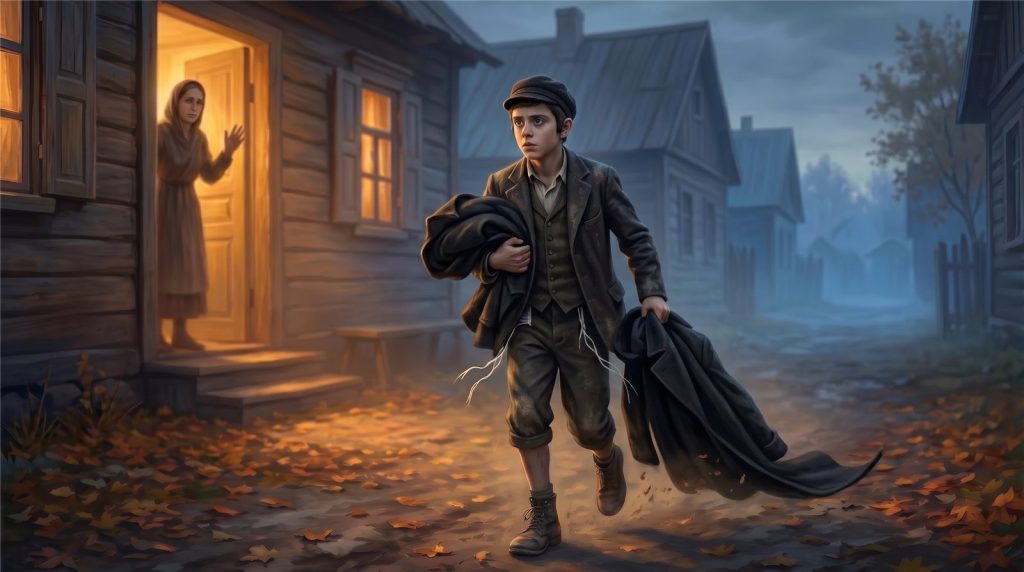
One of the family’s younger boys was still a child. His mother quickly handed him his father’s coat. “Run,” she told him. “Bring this to your father. It’s cold. He should at least have a coat.”
The boy ran outside with the coat in his arms. He wanted to do what his mother had asked. He wanted his father to be warm. Maybe, in his young heart, he also hoped that if he reached his father, he’d somehow be able to help him.
But when he came near the Nazi, the man barked at him cruelly.
“He won’t need that anymore!”
The boy turned around and raced back, crying. His mother took the coat from his hands. No one needed to explain what the Nazi had meant. A little while later, they heard gunshots.
Avrohom was already a young adult then. When he heard the shots, he, of course, thought instantly of his father. Maybe he’d been killed. Maybe his body was lying somewhere nearby. He couldn’t just sit inside and do nothing.
He took a tallis and went out. If his father had been killed, he wanted to give him a Jewish burial. That was the least he could do.
But before he could find anyone, shots rang out again.
Bullets flew in his direction. One passed this way, another whizzed the opposite way – by miracle only, they missed him. There was no time to search anymore. Now, he had to run for his life.
He ran into the forest.
It was the forest he’d known since childhood. As a boy, he’d ride his bicycle through those trees. He knew the paths, the turns, all the hidden places. Now, all those childhood rides became part of Hashem’s plan to save him.
He ran deeper and deeper into the forest, heading east. He ran until he crossed into the part of Poland that was under Russian control. He was alive, but his family was still behind him. His mother, his brothers, his sisters – they were still in danger.
He couldn’t go back himself. It was too dangerous. Then, he saw a Polish man with a large wagon.
Speaking to him in Polish, he said, “I’ll pay you. Go to this address. Tell the mother of the house that Avrohom said not to ask questions. Tell her to pack the children and whatever she can grab, and leave right away.”
The man agreed.
He went back to the house and delivered the message. When Avrohom’s mother heard Avrohom had sent him, she didn’t argue or ask for explanations. She understood that if he’d sent such a message, there was no time to waste. She packed the children, took whatever she could grab, and climbed onto the wagon.
They didn’t know where they were going. They didn’t know what would happen to them. They only knew they had to leave.
The wagon brought them into Russian-controlled territory. For a brief moment, it seemed they’d escaped the Germans. But safety didn’t last long.
* * *
Part 2: Siberia
Soon, the Russian authorities found them.
“You are Jews from Poland?” they asked. “Do you want Russian passports? Do you want to become Russian citizens?”
The family understood what that could mean. If the older boys became Russian citizens, they might be sent to the front lines of war. Some of them were already adults. Others were close to that age.
“No,” they answered. “We don’t want Russian passports.”
The Russians did not like that answer.
“Oh,” they said. “You don’t want Russian passports? You don’t want to become Russian citizens?”
Then, they sent them away.
To Siberia.
The journey was long and terrible. They were placed on trains and carried far away from the world they’d known. They were hungry, frightened, and unsure what waited for them at the end of the tracks.
When they finally arrived, they were shown the place where they would live. It was a small hut with no real floor, only mud beneath their feet. Back in Poland, they’d lived in a normal home. They hadn’t been rich, but they’d lived like regular people. Now they were standing in Siberia, looking at a hut in the mud, trying to understand how this could be their new home.
Then an announcement was made. Everyone had to gather outside.
A Russian commander stood before them, dressed in his uniform, with medals shining on his chest. He looked proud and powerful, as if he controlled their lives completely.
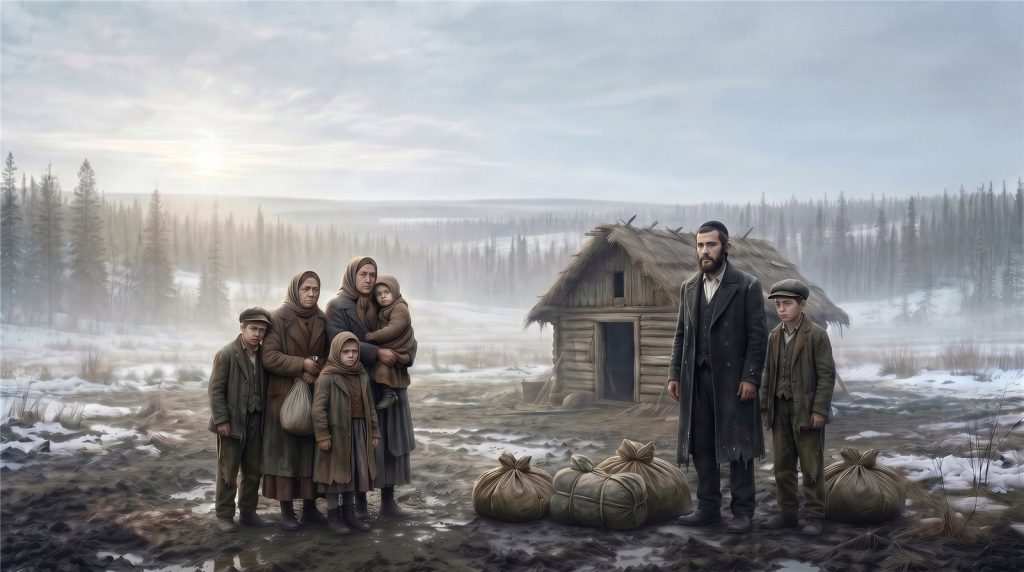
“Now that you’re here,” he told them, “don’t even start wondering, ‘When will I leave this place? How will I leave this place?’ Because you never will. You’re here forever. The only thing you should think about is how to do your work better and better. If you work well, maybe you will get some small benefits.”
Those words entered their ears like heavy stones.
Never leave.
Here forever.
No future.
No hope.
Years later, Avrohom would tell Pinchas about that speech. And then he’d say, “Pinchas, that man who told us we’d never leave Siberia never left Siberia himself. One day, he dropped dead there. But we left. Baruch Hashem, we came to the Rebbe. We built families.”
* * *
In Siberia, every day was difficult. The family was far from home, far from a shul, and far from the Jewish life they’d known. There was no Jewish calendar hanging on the wall. There was no newspaper arriving with the date. There was no one to announce, “Tonight is Shabbos,” or “Yom Tov is coming.” Out there, in the wilderness, the days could have melted into each other, until a person forgot what made one day different from the next.
But Avrohom’s mother, Miriam Bella, didn’t let that happen. From the day they were put on the train to Siberia, she took out a pencil and paper and began making her own calendar. She counted the days carefully. She marked when Shabbos would be. She kept track of the weeks, one after another, so that even in Siberia, her family would not forget the rhythm of Jewish life.
One day, before Yom Kippur, she gathered her children and spoke to them in her Polish Yiddish. “Tonight is Yom Kippur,” she told them. “Now we can eat whatever we have, because right before Yom Kippur starts, we must stop eating. For twenty-five hours, we won’t eat. It’s the holiest day of the year: Yom HaKadosh.”
There wasn’t much food to eat. Maybe only a piece of bread, or less. But whatever they had, they ate before the fast began. Then, in a hut with mud beneath their feet, far from home and far from any shul, they kept Yom Kippur.
Later, another Rav joined the Yidden in Siberia, and he was able to guide them with halachic questions – what they could do, what they could not do, and how to keep mitzvos in such a difficult place. But even before that, Miriam Bella had already shown her children what mattered. The Russians could take them far from home, but they could not take Shabbos and Yom Tov out of their hearts.
The work in Siberia was backbreaking. They had to chop huge trees by hand. There were no machines to make the work easy. Two men would stand on opposite sides of a tree with a large saw, pulling it back and forth, back and forth, until the tree finally gave way. They had to be careful how they cut it, because if a tree fell in the wrong direction, someone could be badly hurt.
One of Avrohom’s brothers, Reb Zvi Hirsch Tevel, was a great talmid chacham. Before the war, he studied in the famous Yeshivas Chachmei Lublin, where only serious talmidim were accepted. Even in Siberia, after long hours of hard work, Torah was still his life.
Whenever he had a break, he would sit with whatever papers he had and learn. Around him was Siberia, but in his mind and heart, he was with the Torah. One day, a Russian commander saw him sitting and learning.
“What are you doing?” the commander demanded.
Reb Zvi Hirsch answered politely, “I am studying.”
“What are you studying?”
“I’m studying Torah,” he said.
The commander did not understand. “What is Torah?”
So Reb Zvi Hirsch explained as simply as he could. He told him that, many years ago, when the Jewish people left Mitzrayim, Hashem gave them the Torah at Har Sinai. He explained that Torah is the life of a Jew, and that from Torah we learn how to live and how to serve Hashem.
The commander stood there, looking at him. Reb Zvi Hirsch didn’t know what would happen next. In Siberia, a person never knew. Would he be punished? Would the commander take away his papers? Would he be sent back to the trees?
But then the commander said something no one expected.
“From now on, you won’t chop wood anymore. I’m giving you a different job. You’ll sit in the watchtower and serve as a watchman. There, you can study as much as you want.” It was an open kindness from Hashem. In the middle of Siberia, a Russian commander himself gave a Yid a place where he could continue learning Torah. When a Yid holds tightly to Torah, Hashem can move even a Russian commander to help him learn.
Beis Moshiach #1512 • pp. 55-59
© 2026 Beis Moshiach Magazine. All rights reserved.
This article originally appeared in Beis Moshiach #1512. You are welcome to share it with friends and family by email or in print, provided that you do not change, add to or omit any part of it, you credit the author and Beis Moshiach, and you include a link to archive.bmoshiach.org (written out in full in printed copies).
To republish this article in a newspaper, magazine, book or website, please request permission in advance at [email protected].