Shabbos Is Shabbos – In Siberia or in Brooklyn

Previously: On Rosh Hashana of 1939, Avrohom Tevel’s father gave his life to protect twenty Yidden hiding in their attic, and Avrohom escaped through the forests, later sending word that saved the rest of his family. Refusing Russian citizenship, they were exiled to Siberia, where a commander swore they would never leave. Yet his mother kept a handmade calendar so the family would never lose Shabbos and Yom Tov, and his brother held so tightly to his Torah that a commander gave him a watchman’s post just to let him keep learning.
The story of Reb Avrohom Tevel, as heard from his son, Reb Pinchas Tevel of Crown Heights
Part 4: Shabbos in America
At the wedding, some relatives from her side came. They’d been in America for years already. Some of them were no longer so close to Yiddishkeit, but when they heard that their refugee relatives were planning a wedding, they came to celebrate. As they sat together, they spoke about how they could help the young couple.
“These young people need a start,” one relative said. “The groom needs a job.”
One of the relatives, a man named Charlie, owned a factory on Long Island that made parts for airplanes.
“Let him come work in my factory,” Charlie said. “He’ll be able to support his wife.”
So after the wedding, Avrohom went to work. He took the Long Island Rail Road, and came to the factory. The foreman showed him what to do. Usually, it took time to train a new worker. A new man might make mistakes. He might break parts. He might need to be shown again and again.
But Avrohom was different.
Show him once, and he understood. He worked carefully and quickly. He didn’t waste time, and he never made careless mistakes. The foreman was amazed.
“I never had a worker like this,” he said. “He learns everything right away.”
All week, Avrohom worked hard. Then Friday came. Around noon, he went to the locker room and took his coat. The foreman noticed. “Abe, where are you going?”
“I’m going home,” he answered. “Tonight is Shabbos.”
The foreman stared at him. “What are you talking about? We work here today. We work tonight. We’ll work tomorrow.”
Avrohom looked at him calmly.
“You can do what you want,” he said. “But I’ve never worked on Shabbos. I don’t work on Shabbos, and I never will.” The foreman was upset. He didn’t want to lose such a good worker.
“You can’t just leave,” he said. “Come to the office. We have to speak to Charlie.”
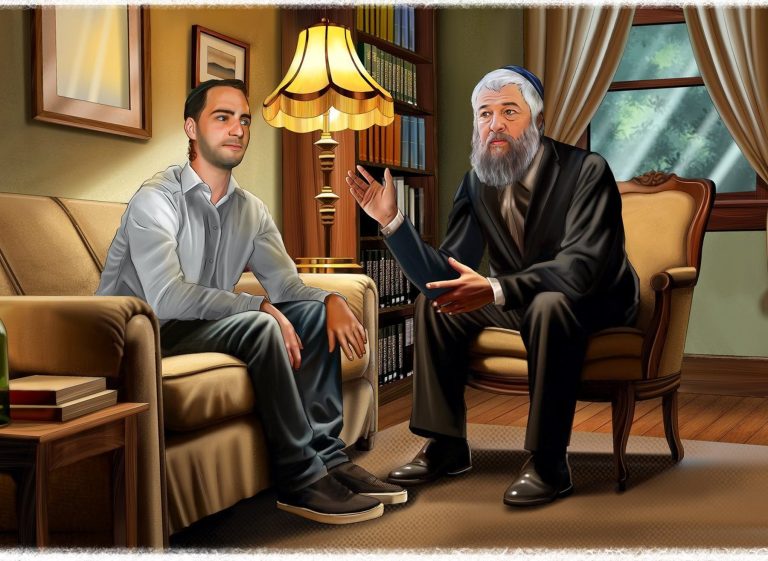
They went into Charlie’s office. Charlie sat behind a large desk. He was the boss, and he knew it. “What’s going on, Abraham?” he asked.
The foreman explained, “I’ve never had a worker like Abe. He’s exceptional. But now he says he’s leaving—because of Shabbos.” Charlie turned to Avrohom.
“Listen, Abraham,” he said. “This isn’t the shtetl in Europe. This is America. Here, we work Friday. We work Saturday. You have to understand that.”
Avrohom wasn’t shaken. He’d run from Nazis. He’d crossed through forests and over borders. He’d lived in Siberia, hearing powerful men say things that turned out to mean nothing. Charlie, with his big desk and factory and cigar, did not frighten him.
He looked at Charlie and said, “America, Siberia, Poland—wherever I am, I never work on Shabbos. Shabbos is Shabbos in America, in Australia, wherever a Jew may be.”
Charlie didn’t like that. “In that case,” he said, “don’t bother coming back on Monday.”
Avraham smiled. “So be it.”
The foreman tried to argue. “Charlie, you can’t do that. He just got married. His wife may soon be expecting. You can’t just fire him.” Charlie leaned back and said, “Don’t worry. I’ll take care of him.”
But he didn’t take care of him.
Avrohom went home for Shabbos, and on Monday, he did not return.
* * *
Part 5: The Laundromat
A few months passed. In those days, Long Island wasn’t filled with shopping centers, the way it is today. Many families would travel to Brooklyn on Sundays to shop. Some went to Brownsville, where there was a large department store called Fortunoff. Many families also didn’t have washing machines and dryers at home, so they brought their laundry to a laundromat, where workers washed, dried, and folded the clothing for them.
One Sunday, the foreman from Charlie’s factory came to Brownsville with his family’s laundry. He walked into a laundromat and handed over his clothes. Then, he stopped.
In the back of the store, he saw someone familiar.
“Wait a minute,” he said to the worker writing up his ticket. “That man in the back—does he work here?” The worker looked over. “Him?” he said. “That’s my boss.”
The foreman couldn’t believe it. “Your boss? He owns this place?”
“Yes,” the worker said. “He pays my salary.”
“Call him,” the foreman said. “Please. I want to speak to him.”
The worker went to the back, and Avrohom came out.
The foreman stared at him. “Abe! I don’t believe it. You own this place?”
Avrohom smiled. “Yes, thank G-d.”
“You people are amazing,” the foreman said. “You just came here from overseas, and already, you own a business.”

Avrohom smiled again. Then he said, “I have a very important message for you to give Charlie.”
“What message?” asked the foreman.
“Tell Charlie that if he ever loses his factory, he can come work for me.”
The foreman laughed. That was Avrohom Tevel. He had suffered, but he was not broken. He had lost so much, but he still stood tall. He had been sent to Siberia, but Siberia had not taken away his Shabbos, his emuna, or his pride in being a Jew.
For years, he worked hard in that laundromat. It was difficult work, but after everything he’d lived through, hard work didn’t scare him. Later, he wanted to sell the business. At a farbrengen with the Rebbe, between the sichos, Chassidim would sometimes go over, say l’chaim, and ask for a bracha. Pinchas went with his father. His father asked the Rebbe for a bracha to sell the laundromat, and the Rebbe gave him a bracha.
Soon after, three men came and bought the business.
A few months later, they met Avrohom again.
“How’d you do it?” they asked him. “We’re three people, and this business is exhausting us. How did you run it alone?”
Avrohom only smiled. They didn’t know what Siberia had taught him. They didn’t know what he had already carried. After surviving what he had survived, work was work. Hard, yes. Tiring, yes. But not terrifying. Not impossible.
* * *
Part 6: The Rebbe’s Protection
There was another story from those years, a story Pinchas remembered from when he was a child.
His family lived on S. John’s Place in Crown Heights. Pinchas’ parents owned the whole building, and one of the tenants who lived in the house was a Ukrainian man who drank heavily. Pinchas’ mother was very wise. She understood Russian, but she never let the man know. When she spoke to him, she used English, so he thought she didn’t understand a word of Russian.
One day, as she walked into the building with the children, the man was sitting drunk, near the steps. He began muttering to himself in Russian. Then he said something terrible. Looking at the Jewish family, he muttered that he wished he could “do to these Jews what he had done to the Jews in Babi Yar.”
Pinchas’ mother froze. She understood every word.
Babi Yar was a place in Ukraine where many thousands of Jews had been murdered during the war. She was frightened. Had this man been one of those awful murderers? She went to her father and told him what she’d heard.
Her father, R’ Shmuel Yitzchok Reitzes, listened carefully and said, “Find out his name, and his mother’s name. I’ll write to the Rebbe.”
Pinchas’ mother had to be careful. She visited the man’s wife in a friendly way, brought some apples, and made conversation. Slowly, gently, she found out the names she needed. Her father wrote to the Rebbe. He wrote that this man had said such a thing while drunk, and that he wanted the Rebbe to know.
Within about a week, the man became unwell. An ambulance came and took him away.
He never came back.
* * *
From Dinov to Siberia, from Siberia to Samarkand, from Germany to America, and from America to the Rebbe, Avrohom carried one truth with him, one he passed onto his son. People may shout. People may threaten. People may say, “You will never leave!” People may say, “This is America, and here, you work on Shabbos.” But a Yid does not belong to them. A Yid belongs to Hashem.
Siberia couldn’t keep him. America couldn’t bend him. And no matter where he stood – in Poland, in Siberia, in Germany, or in New York – Shabbos remained Shabbos, and a Yid remained in Hashem’s hands.
Beis Moshiach #1513 • pp. 56-59
© 2026 Beis Moshiach Magazine. All rights reserved.
This article originally appeared in Beis Moshiach #1513. You are welcome to share it with friends and family by email or in print, provided that you do not change, add to or omit any part of it, you credit the author and Beis Moshiach, and you include a link to archive.bmoshiach.org (written out in full in printed copies).
To republish this article in a newspaper, magazine, book or website, please request permission in advance at [email protected].