Twelve Verses. The Whole Torah.
50 years ago, In 5736, the Rebbe declared a “Year of Education” and requested, among other things, that every Jewish child memorize the Twelve Pesukim and sayings of Chazal. In subsequent months, the Lubavith Youth Organization published a pocket-size booklet containing the twelve pesukim in Hebrew, transliteration, and English translation – illustrated, annotated, and designed to reach even the youngest Jewish child. On the occasion of the booklet’s release, the following article (in book review style) appeared in – the Torah journal edited by Rabbi Meir Amsel – in the Sivan-Tammuz 5736 issue (no. 232). It’s content is based upon primarily, the sichos the Rebbe spoke in in Iyar of that year in relation to the 12 Pesukim. Articles of such nature published in HaMaor were shown to the Rebbe before publication – and it is highly probable that the Rebbe reviewed this article as well.
A free translation appears here:
On the Publication of the “12 Passages” Booklet for Jewish Children
There is a tradition among Chassidim that when the Tanya of the Alter Rebbe first reached the holy R’ Levi Yitzchok of Berditchev, he examined it and declared: The author has performed a wondrous feat here – he has “contained” so great a Master of the Universe within so small a book…
And indeed, our Sages and leaders have taught us that within all of Torah and mitzvos there lies hidden this great, wondrous, and supernatural power – for the Torah and mitzvos are “the wisdom and will of the Holy One, blessed be He,” and just as He is utterly infinite and without limit, so too is His wisdom and will, since He and His wisdom and will are one. Yet “wherever you find the greatness of the Holy One, there you find His humility,” for He contracted His will and wisdom – which are boundless – into the 613 commandments of the Torah and their laws, as stated in the Tanya.
It would appear that the power of this wondrous contraction and concentration embedded within the Torah is itself beyond all limitation – to the point that certain verses function as a kind of all-encompassing gateway to the entire Torah.
That is to say: while every verse, word, and letter of the Torah is an inseparable part of the whole, and one must not sit and rank or weigh one portion or passage of the Torah against another, for it is all one substance and one unity – and when you grasp any part of it, you grasp all of it – nevertheless, there are certain Torah verses and rabbinic sayings that openly radiate as luminaries of light, streaming and shining with all the brilliance of Torah-light, casting their glow across every facet of its splendor.
Generalities of Torah
Just as we find that certain mitzvos are “general” or all-encompassing commandments, so too are there matters of Torah whose sweeping and comprehensive content is expressed in a particularly striking fashion. As R’ Akiva said of the verse “Love your neighbor as yourself” – “This is a great principle of the Torah”; and in a similar vein, we find Hillel the Elder’s response to the one who came to him wishing to convert on condition that he be taught the entire Torah while standing on one foot: “That which is hateful to you, do not do to your fellow [which is the fulfillment of ‘Love your neighbor as yourself’ – Tanya, ch. 32] – that is the whole Torah, and the rest is commentary” (Shabbos 31a).
A “contraction” of this nature – in the manner of the small containing the great – finds particularly striking expression in the appearance of a booklet small in size yet rich in content and virtue; a booklet of surpassing and incalculable value in the field of Torah education, designed to bring positive results in drawing the hearts of Jewish children close to the spirit of Torah and mitzvos.
The Year of Education — and a New Campaign
In the wake of the serious situation currently prevailing in Jewish life and Judaism at large, and especially as it pertains to the condition of our brethren in the Holy Land, and in continuation of the bold measures that have been taken toward strengthening and fortifying Torah and Judaism among our people – namely, the well-known mivtzaim:
[Mivtza Torah; Mivtza Tefillin; Mivtza Mezuza; Mivtza Tzedaka; Mivtza Bayis Malei Sefarim (Yavneh V’Chachameha); and with particular regard to the women and daughters of Israel: Mivtza Neiros Shabbos Kodesh; Mivtza Kashrus; Mivtza Taharas HaMishpacha]
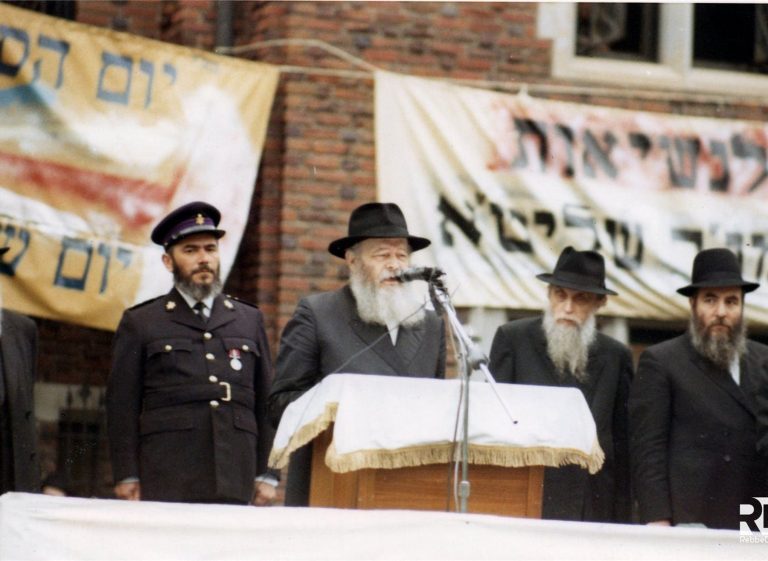
– the Rebbe שליט״א saw fit to proclaim an additional campaign: the Campaign for Torah and Mitzvos Education, and this year was declared “The Year of Education.” In connection with the Education Campaign, the Rebbe שליט״א expressed his request and earnest appeal that every man and woman endeavor to learn and review Torah verses and rabbinic sayings and repeat them until they can be recited – or meditated upon – by heart, at all times and in every situation; and to “educate” others as well, particularly Jewish children, to do the same – for the Torah magana u’matzla, it shields and protects.
Based on the verse “From the mouths of babes and sucklings You have established strength… to silence the enemy and avenger,” the Rebbe שליט״א pointed out that this power – “to silence the enemy and avenger” – operates with special and heightened force when the “strength” of Torah comes “from the mouths of babes and sucklings.” It is therefore vital that Jewish children – boys and girls – learn Torah verses and rabbinic sayings by heart, so as to repeat them, speak them, and meditate upon them at every available moment.
Furthermore: each child should, in his or her own way and according to his or her nature, influence their friends to learn and review the verses and rabbinic sayings – for the concept of chinuch (educating others) applies even to “a five-year-old learning Scripture,” as the Gemara (Bava Metzia 85b) relates at length regarding Rabi Chiya’s activities in this sphere – prompting Rabbeinu HaKadosh to exclaim, “How great are the deeds of Chiya!”
Through this – to preempt the enemy and nullify all their schemes. As it states in Bereishis Rabbah (65:16) that Avnimos HaGardi said to the nations of the world: “Go and examine their synagogues and houses of study – and if you find children there chirping in their voices, you cannot prevail against them, for thus did their Father promise them, as it is said: ‘The voice is the voice of Yakov’ – as long as the voice of Yakov is present in the synagogues, the hands are not the hands of Esav…”
The Twelve Pesukim
Taking into account the great impact that Torah content has on the spiritual course of those in whose memory it is engraved, the Rebbe שליט״א proposed twelve Torah verses and rabbinic sayings (listed below), whose foundational and sweeping content is sufficient to stir deep feeling and spiritual attachment to Torah and Jewish identity – and which can also be readily explained to young children.
The verses and sayings, as noted, number twelve – four verses from the Written Torah, four rabbinic sayings from the Talmud, and four from the Tanya – and they are as follows:
* * *
A Small Book — For Great Things
“One only urges the already-eager” – for it is precisely because the eager are swift to fulfill a mitzva. The members of Tzeirei Agudas Chabad (LYO) acted quickly and printed all twelve verses and sayings in a small booklet (pocket-size) in luminous and eye-catching lettering, the entire booklet adorned with colorful decorations radiating beauty and splendor.
These passages appear both in their original sacred Hebrew letters (fully vowelized) and in transliteration, accompanied by an accurate English translation so that children whose primary language is English may understand them as well.
To attract and delight the child’s heart and eye – in the spirit of “Your Torah is my delight” – the booklet features beautiful and meaningful illustrations, each image expressing and highlighting the essence of the verse or saying to which it belongs. The illustrations, rendered in various colors, are the work of a skilled artist gifted as well with educational sensibility, who succeeded in mastering his task and distilling in fine strokes the central theme of the verse (or saying) under discussion.
Following each verse or saying, its translation, and its illustrations, there comes a brief explanation (in English) that clarifies and interprets – in an accessible and appealing style – the core idea of the verse and the moral lesson and guidance it offers for Jewish life.*
At the conclusion of the booklet there are four pages (“MY REPORT”) in which each child (boy or girl) records the names of the friends upon whom he or she has acted to encourage the learning and review of the above verses and sayings. Upon sending these pages to Tzeirei Agudas Chabad, the child receives prizes – both for his or her own learning and for efforts to spread Torah and Judaism among their peers.
* * *
In summary, one may say: this “small booklet” intended for “the small” – is destined for great things! It is poised to fulfill far-reaching purposes in the field of educating Jewish children in Torah and mitzvos, and its primary and immediate goal is: to magnify Torah and make it glorious, and to engrave it upon the lips of the young children of beis rabban – in whom lies the power and the strength “to silence the enemy and avenger.”■
Beis Moshiach #1505 • pp. 4-7
© 2026 Beis Moshiach Magazine. All rights reserved.
This article originally appeared in Beis Moshiach #1505. You are welcome to share it with friends and family by email or in print, provided that you do not change, add to or omit any part of it, you credit the author and Beis Moshiach, and you include a link to archive.bmoshiach.org (written out in full in printed copies).
To republish this article in a newspaper, magazine, book or website, please request permission in advance at [email protected].