The Baby’s Resting Place
When you were born, Hashem chose your Neshama to come here for a reason. When you were born, your body was tiny, but your Neshama was not. The Neshama is always important and special, right from the start. Keep that in mind as you go along in this story.
Please meet Mr. David Kakon from Westmount in Montreal, Canada. Hashem made him smart and busy, and he made a lot of money. David gave a lot of Tzedaka. Remember what Tzedaka means? It means “doing the right thing.” If a person has a lot of extra money, the right thing to do is to share it. That’s why Hashem gave it!
Okay, so this nice man, Mr. Kakon helped many people, Shuls, and Yeshivas. One of his projects was helping the MADA Center of Montreal, which makes free meals and food boxes for thousands of people who need it. He paid for them to build a big, beautiful center. Now, he bought a huge machine that can make 500 Challahs at one time! Imagine how many families would happily enjoy that Challah on Shabbos!
Usually David doesn’t spend that much time in the free-meal building. There are cooks there, dishwashers, vegetable peelers, and many volunteers. They were always busy, sometimes sweating, making yummy food for the people of the community to come and take. Today, though, David was watching his friend the electrician, Mr. Moryossef, hook up the new Challah-making machine. It had to be ready right away.
Just then, the phone rang. The person who answered soon said, “I’m sorry I don’t speak French. Hold on please.” Then he shouted, “Does anyone speak French here?” Actually, many people speak French in Montreal. Mr. Kakon said, “I do,” and he took the phone.
“Bonjour, monsieur,” said the man on the line. That means “Hello, mister.”
“Oui,” said Mr. Kakon.
“My name is Lior. Today is your lucky day,” said the caller. “I would like to give 13,000 to build a Mikva for the Rabbi of MADA Center, Rabbi Chaim Shlomo Cohen.”
Quiet.
“Hello, is anyone there? I said, I would like to donate $13,000 right now for the Mikva in honor of my brother.”
“Sure, Lior. I will call Rabbi Cohen and get right back to you.”
That seemed like a nice thing. Certainly a surprise. David quickly called the rabbi and told him about Lior and the donation.
“David,” Rabbi Cohen said. “That’s nice and everything, but a Mikva costs hundreds of thousands of dollars to build. Not $13,000. That’s almost enough to pay for the light and water bills for the Mikva building, not the whole thing. I’m telling you it’s a drop in the bucket…”
“One fish in the sea,” agreed Mr. Kakon.
“Yes! And I really don’t want to cause a misunderstanding. We already have plans and everything. We don’t need it. Thank you, David.”
David hung up with Rabbi Cohen and quickly called Lior back.
“Hello, my friend. How about you tell me: What makes you want to donate money for a Mikva? And why exactly $13,000? Let’s discuss this.”
“Well, since you are asking, I will tell you my story.”
My family and I grew up in a big city in France called Montpellier and we were very happy. I went to Shul on Shabbos and to a Jewish school in the afternoons. Baruch Hashem, my mother was expecting a new baby. But after he was born and came home, he became very sick. He had a dangerous disease and did not get better. Soon, my tiny brother passed away.
My mother and father cried. My father stopped crying, but my mother couldn’t stop. Her neighbor came to visit and said, “Your baby is so small. It’s okay to bury him in the non-Jewish cemetery.” (That was a big mistake, not what the Torah allows, and certainly not what is good for the Neshama.) “Try to forget about him. It will only make you sad. One day you will have another baby. He will be healthy and you’ll be happy again. You’ll forget this whole sad story. Just don’t think about it.”
“But he’s my baby. He’s Jewish.”
“Yeah, but he’s so small so it doesn’t matter. Just get over it.”
My mother listened to this neighbor. Our baby brother was buried quickly. And my mother tried to forget that she ever had a baby, like the neighbor said.
Baruch Hashem, we had a new baby, called Ron. And we both grew up.
Many years later, Ron, who already had his own wife and children and a job, had nightmares.
Every night when Ron fell asleep, he would hear a baby screaming. Waa waa waa.
When he woke up, he was a little upset, but went on.
The next night – waaaaaa waaaaaa – all he heard was screaming and crying. It was the sound of a baby who was very sad or maybe even hurt.
This was getting scary.
Every night – waaa, waaa, waaa.
Ron was really upset. He decided to go to a big rabbi who learns Kabbalah and can help people with his special knowledge.
Ron walked into Rabbi Pinto’s office at his appointment time. Rabbi Pinto looked at Ron; he saw someone tired and worried. He listened to the story about Ron’s nightmares and the sounds of the baby crying.
“Tell me,” said the rabbi. “Did you ever have a brother?”
“Yes, I have a brother, Lior.”
“Did you ever have another brother?”
“Well, yes. My mother had a baby, but he passed away.”
“Go and find out. Where is he buried? Was he buried like a Jew should be?”
“I don’t know…”
“You must look into it! Right away.”
“Okay, Rabbi, I will.”
Ron went home, and felt some hope. He called the cemetery in Montpellier. An old man answered the phone.
He said, “What do you need to know about people who were buried 35 years ago? I have no idea who you are talking about! Did he even have a name?”
“I need to know. This is important to me. Is there anyone else in the office that I could speak to?”
“No, it’s just me. Mister, your question is strange. That was a long time ago. No one here remembers the grave of your brother. Sorry.”
Ron was about to cry. He didn’t know what to do. He was afraid to go to sleep and hear the screams at night. And what about his baby brother – where was he buried and was he in a bad place?
Since Ron now lived in Paris, a seven-hour drive away, he was stuck. Would he ever find his brother? The only thing Ron could think of doing was to call the Chabad rabbi of Montpellier. The Shliach’s son answered the phone and listened to Ron’s whole story.
“Sure,” he said, “I will tell my father and he will call you right back.”
The Chabad Shliach and his son began driving the older streets of Montpellier. They walked into the non-Jewish cemetery; all over they saw quiet graves, tall grass, and broken metal gates. What now?
They looked around but did not see anything with Ron’s family’s name.
They drove 30 minutes to the other side of town and looked through the little windows in a tall cement wall of another cemetery. The caretaker let them in, but all they saw were stones with non-Jewish names. Nothing there.
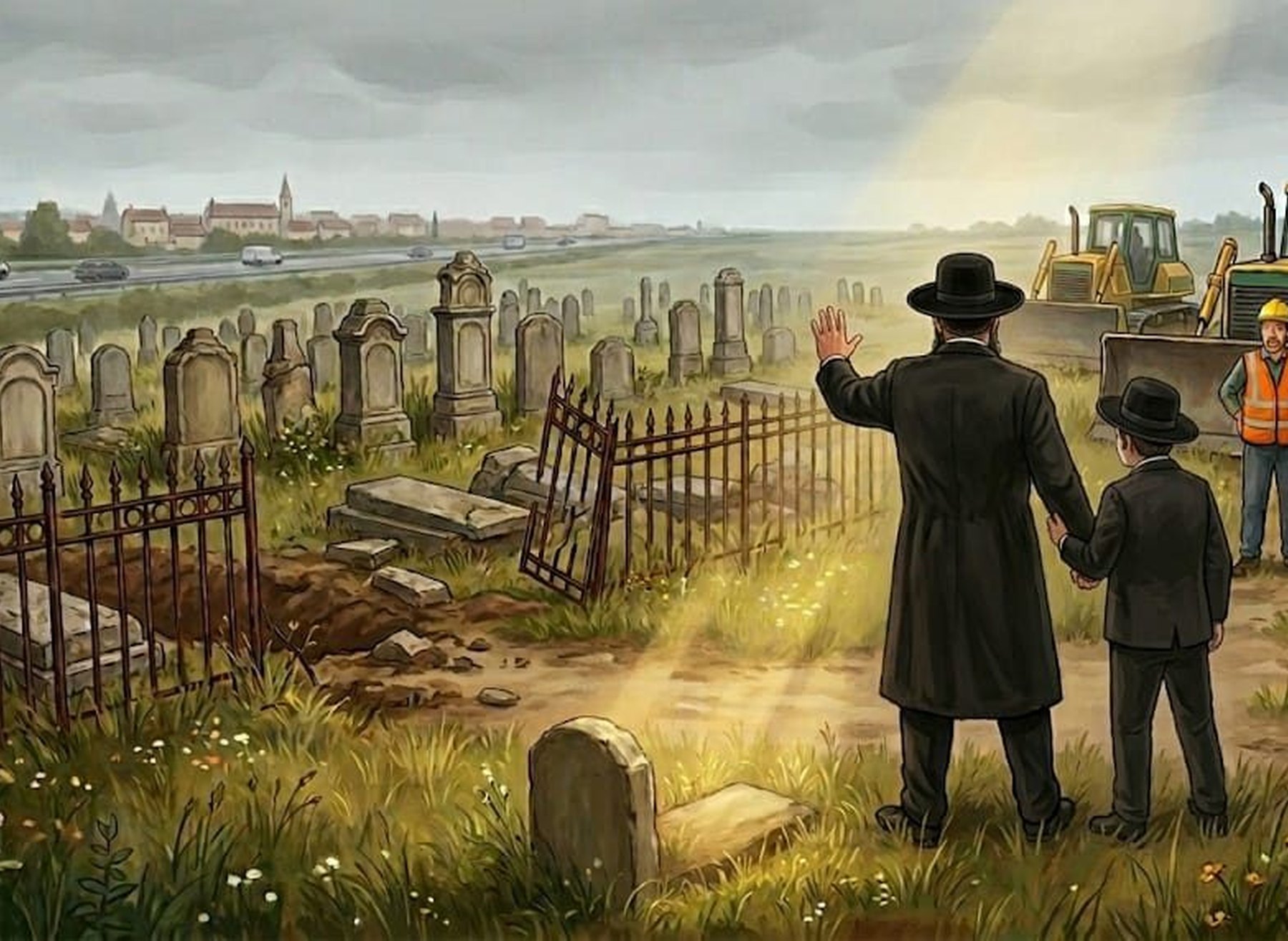
Finally, as they were getting sad and tired, the rabbi and his son found another old cemetery near the highway. They asked the workers standing around if they remembered a grave of a baby with the name of Lior and Ron’s family.
“Uh, yes, do you mean this one?”
“Yes! That’s it!”
The workers were shocked. “But how did you know to come today?”
The Chabad rabbi looked up and saw huge green and yellow bulldozers ready to destroy the whole row of graves.
“Why are you digging up the graves?” asked the Chabad Shliach.
“That’s our job, mister.”
“Why?”
“That’s the law here in Europe. Families have to pay taxes every 10 years for their family’s grave. You don’t pay, you lose the grave. We gonna get rid of all of them. Make room for new graves.”
“Don’t! Please stop,” said the rabbi, and gave the workers enough money for all of the taxes.
As soon as he got home, the Shliach called Ron and said, “We found your brother.” He explained how he saved the grave from being bulldozed and how if they did not come that day, it would have been too late.
“Thank you, thank you, Rabbi,” said Ron. “I will get on the next flight from Paris to care for my baby brother.”
They went with a Minyan to the goyishe cemetery. With shaking hands they removed the coffin of Ron and Lior’s baby brother from the ground, wrapped it in a Tallis, and that night, they buried it again in a Jewish cemetery as every Jew should be. The small group of people said Kaddish and Tehillim. Some people cried. Ron thought about his mother and how her heart always hurt for her baby. She would always miss him.
No matter how big or small, a Jewish Neshama can only rest when it is in the right place, among our own people. It is a big deal. Even for a small baby.
Ron took a deep, deep breath and closed his eyes. Now he could sleep at night. There would be no more screams, since now his brother’s Neshama was happy.
“Wow – what a story,” said Mr. David Kakon.
“Yes,” said Lior. “Since then, as Rabbi Pinto told us to do, we raised a lot of money slowly but surely, in order to write a new Sefer Torah in honor of our baby brother’s Neshama.”
“That’s very nice,” said David.
“Yes, and there was $13,000 left over after we finished the Torah, bought a beautiful sash, covering and crown, and danced with it into Shul.
“So we want to give the rest of the money to Rabbi Cohen’s Mikva.”
“Let me tell you what, Lior. I am so glad your brother was laid to rest with the Jewish people. Take the money and do something good with it. It won’t really help the Mikva, since Rabbi Cohen is already raising the money for it, and 13,000 is not enough.
“How about this: I heard of new, young Shluchim moving to help Jews in the new huge hospital being built, called McGill University Health Centre in Montreal. It also has a very good children’s hospital. They are trying to build a Shul in their small center. It will be for families that need to come to the hospital. Families who have, sadly, a very sick child in their family. The Shluchim will open a place where they can come and eat good Kosher meals and find snacks and books to read. Where they can be cheered up and rest if they need to.”
“Ah, like my family probably needed when my baby brother was sick so many years ago.”
“Exactly.”
“It’s a perfect match! Thank you for this idea.”
“Okay, so I will put you in touch with them. The name is Rabbi and Mrs. Partouche. Have you ever heard of them?”
“Did you say Partouche?”
“Yes, Partouche. You can call him – ”
“Excuse me, Mr. David Kakon. Partouche is the name of the rabbi in Montpellier who found our brother’s grave.”
“Wow! That’s incredible.”
“Yes! I can’t believe it.”
Later, David Kakon called his young friend Rabbi Partouche of McGill University Hospital. He asked, “Did you hear of Ron and Lior and the story of their baby brother’s grave? They want to donate money in honor of the baby’s Neshama…”
“Of course, I remember. I was the boy who drove around town with my father. I remember those bulldozers. We helped save his brother’s body so that his Neshama would be at peace.”
What a day, thought David Kakon as he finally slumped onto his couch with a tea in his hand. What a day!
Just a few months later, David Kakon got a picture sent to his phone: Ping! It was a brand new, wooden mini Aron Kodesh built near the children’s hospital. On the velvet Paroches it said: This is to keep the memory of our baby brother alive and to thank the wonderful Partouche family for bringing peace to him and all of us.
Beis Moshiach #1506 • pp. 56-59
© 2026 Beis Moshiach Magazine. All rights reserved.
This article originally appeared in Beis Moshiach #1506. You are welcome to share it with friends and family by email or in print, provided that you do not change, add to or omit any part of it, you credit the author and Beis Moshiach, and you include a link to archive.bmoshiach.org (written out in full in printed copies).
To republish this article in a newspaper, magazine, book or website, please request permission in advance at [email protected].