In Lubavitch There Are No Doubts
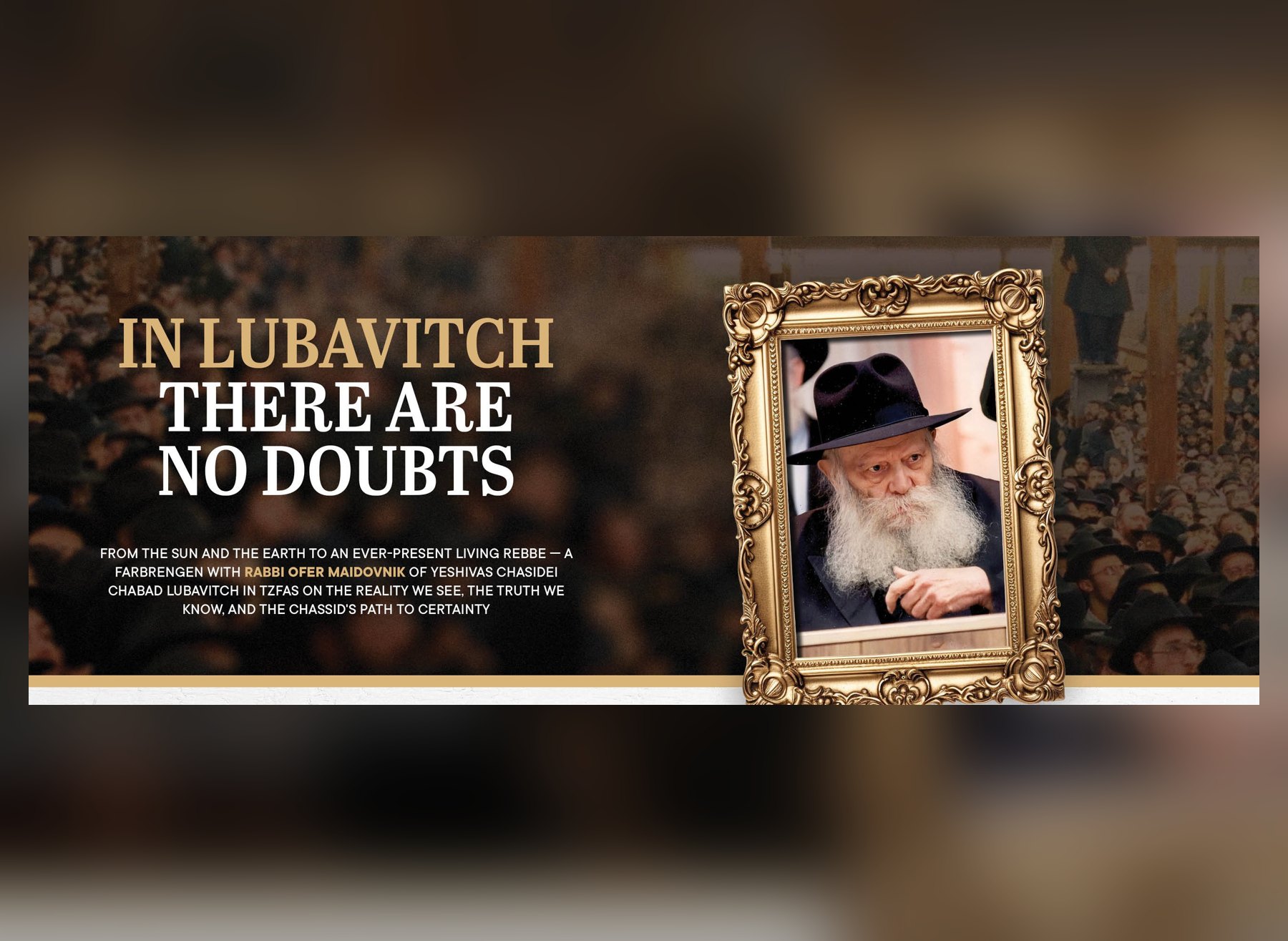
From the sun and the earth to an ever-present living Rebbe – a farbrengen with Rabbi Ofer Maidovnik of Yeshivas Chasidei Chabad Lubavitch in Tzfas on the reality we see, the truth we know, and the chassid’s path to certainty
I have a friend who serves as a rabbi at an academic institution, and through this role he became acquainted with various distinguished professors. Once, he had the opportunity to speak with one of them—a man of vast knowledge and science, with expertise across many disciplines, from mathematics to astrophysics. During the conversation, my friend stated with complete certainty that the sun revolves around the earth, and that the earth stands motionless.
The professor stared at him in astonishment: “Until now I considered you an intelligent person.” In the professor’s eyes, it was utterly absurd that an intelligent person could say such things, things he considered obviously irrational. He simply couldn’t understand how his friend, apparently a wise and educated man, kept “slipping back” into the fanatical and backward views of the ultra-Orthodox.
My friend responded that the Lubavitcher Rebbe held the same view. This the distinguished professor truly could not accept. After all, even he considered the Rebbe to be an intelligent and learned man.
Seeing where things were heading, the professor suggested consulting his son, himself an astrophysicist, who was due to visit that week. They agreed to let him read what the Rebbe had said and written on the matter, and then give his opinion.
My friend photographed the Rebbe’s words from the booklet Emuna U’Mada (Emuna and Science) and gave them to the professor. A week later, the professor returned—having been bested—with his son’s response: “This is scientific. It cannot be refuted.”
In the letter quoted in Emuna and Science, the Rebbe explains that since Einstein established the General Theory of Relativity, when two bodies are moving relative to each other, it is scientifically impossible to prove which one is revolving around which. It could be that the first object is moving, or it could equally be that the second object is moving backward, making it merely appear as though the first is moving. Accordingly, when speaking of the sun and the earth, scientifically, it is impossible to prove which revolves around which, because everything is relative. Indeed, the Rebbe adds that a scientist who definitively declares the sun to be stationary is taking a plainly unscientific position, since science cannot compel or declare anything absolute.
In general, from within the world of science, nothing can be stated as a finished fact. But since we come from a position of emuna—even though it cannot be scientifically proven which revolves and which stands still—we believe with simple and absolute emuna that this is how it is, because we know it from Koheles where it states, “And the earth stands forever.”
[As the Rebbe once wrote to Professor Yirmiyahu Branover a’h, in addition to the fact that heliocentrism is “contrary to the plain meaning of numerous verses (the sun came to set, and others…),” there is a broader principle: “The Torah (and therefore its giving) is the foundation of all creation, even the physical. Therefore, even in the physical realm, Mattan Torah is the foundation and center that stands still, and around it the hosts of heaven also revolve.”]
The scientific world operates according to probability. When discussing the motion of the sun relative to the earth, science argues it is more probable to say the sun is stationary, because when viewed that way, all the calculations are much simpler. But in truth, this is not scientific at all.
It is fascinating to note: the same scientific world which claims to follow the laws of probability avers that when it comes to the origin of the universe, the laws of probability do not apply. Science claims that if there is even a one-in-billions-of-billions chance that the world came into being on its own, exactly as we see it, and that this persisted over billions of years—suddenly probability no longer counts; suddenly everything is possible.
Already in the works of the Rishonim, they posed the simple argument: there is no place in human reason to say that a cat struck a bottle of ink, and the ink spilled onto a page in the form of a perfectly rhyming poem. It is simply illogical. And far more so, when it comes to the complexity of the world, with its immense embedded wisdom and its tiniest particular details, it is simply illogical and improbable to say the world created itself. Yet here, suddenly, the scientific world ignores the laws of probability and human reason, and finds a way to entrench itself in the claim that the world came into being on its own…
The scientific world, as the Rebbe says in that excerpt, is constantly seeking to raise doubts and questions. On every absolute matter it finds something to challenge, always trying to say “but maybe not?” and “maybe it’s otherwise?” And truthfully, it’s not only the scientific world—it’s the world in general. In this world, nothing is absolute. One can always doubt and question. The very nature of the world is to raise doubts and uncertainties.
This is in fact the meaning of the word olam (world) from the root heelem, concealment. The world conceals and hides G-dliness, and one must know not to be swayed by what the world says, not to be caught up in doubts and uncertainties, but to walk confidently with the truth and know that we are on the right path, knowing there is nothing other than what the Torah says.
Hashem’s Truth Is Eternal!
Part of the nature of the “tachton” that Hashem created is the sense that everything is open to question. Once, everyone knew clearly and simply that the earth stands still and the sun revolves around it until a group of people arose, distinguished and knowledgeable professors, who argued against the entire world and decided that the opposite was true: that the earth revolves around the sun.
Years passed, and the world accepted this as solid fact. Slowly it penetrated deeper and deeper, to such an extent that today, in ultra-Orthodox newspapers, in their Torah supplements, whenever they discuss the hilchos kiddush ha’chodesh and matters related to the movement of stars, they write as simple fact that the sun is stationary and the earth revolves around it and merely say that “some say otherwise.”
Sometimes they explain that Rambam and his school, who wrote explicitly that the earth stands still and all the stars revolve around it, simply did not have access to today’s calculations and were unaware of modern scientific discoveries and that had they lived today, they would certainly have agreed that the sun is the stationary one…
But the Rebbe stood against the entire chareidi world and forcefully maintained that the words of the Torah are true and eternal. What is written in the Torah is eternal truth, and “the earth stands forever.” It is the sun that revolves around it.
The world casts doubt on everything. From its perspective, everything is possible—“but maybe this way?” It always raises doubts and uncertainties; even when something is written explicitly, it will look for ways to question it.
One must know and remember what the Rebbe says: the Nasi HaDor must be in a physical body, and it cannot be otherwise. Even if the world objects and raises doubts and uncertainties, and even if the chareidi world joins in, one must know that this is the truth, and nothing will help or change that.
The Nasi HaDor Has Not Died!
The Medrash relates that Moshe complained to Hashem: why does He wish to put him to death when he had not violated any of the sins punishable by death? Hashem answered that he was dying because of the sin of Adam, because when Adam sinned with the Tree of Knowledge, he brought death into the world.
At first glance, one might ask: what was so great a sin of Adam? After all, “the Torah preceded the world by two thousand years,” and the Torah already said, “this is the law: when a person dies in a tent,” meaning the concept of death existed even before the world was created, as it is written in the Torah. So why is Adam blamed for bringing death into the world?
(In the Medrash Tanchuma it is explained that this is the meaning of the pasuk, “nora alila al bnei adam—awesome in deed toward humanity”—that although the Torah preceded the world by two thousand years and the concept of death was already written in it before creation, Hashem arranged for things to be clothed in the actions of the created beings, so there would be a “pretext,” as it were, for His will. As Adam said to Hashem: “Had You not ordained death for creatures, would You have written it thus? You have merely come to hang the blame on me. This is ‘awesome in deed toward humanity.’”)
In the Zohar it’s explained that there is a distinction. The very concept of death as written in the Torah, “when a person dies in a tent,” would have existed even without Adam. But the taste of death, that did not exist before.
Let me illustrate with a parable: when we were little children, the delight of dinner was watching our mother put margarine on the pan, and seeing it slide from side to side, slowly melting and gliding. When times were rushed, this pleasure was taken from us, and mother would take a fork and quickly mash the margarine across the pan.
The analogy: had it not been for Adam’s sin, when a person completed his role in the world he could simply depart and pass to another world—as Eliyahu passed from world to world—without even feeling it, just like the melting margarine…
But the taste of death, with all the rituals and grief as a person leaves this world and the body ceases to receive life-force, that began because of Adam’s sin.
Based on this, one might be tempted to explain, ch’v, that the teaching “Yaakov Avinu did not die” means not that he is alive now, but only that Yaakov did not experience the taste of death; the passing itself still occurred, and his physical body did indeed die and cease to receive life-force. One might think that such an explanation would reconcile everything: the world would be right, the Torah would be right, and everything would fit perfectly.
But the truth is, one cannot say this. Yaakov Avinu did not die.
There is no such thing as a world without the leader of the generation. There is no room to pay attention to what the world says—when the Torah says something, it must be clear to us that this is how it is. I expound the verse literally: the Rebbe is alive!
When people discuss the internet, one can ask “where is the internet located?”—and no one can give a precise answer. Yet it is a reality that exists. Even if you cannot touch or physically sense this reality, it is present and functioning, connecting people and storing vast repositories of information. It exists.

The same applies to the Nasi HaDor. Even if he cannot be measured by empirical and scientific means, this is the truth, and it cannot be denied.
Doubt Is Permitted — the Question Is About What…
People are often beset by doubts about what is true, whether they are on the right path, and so on. Sometimes a person thinks these doubts are helpful, guiding him toward the truth.
About this it is said “and the Canaanite heard,” and Rashi explains that this was Amalek who “changed and ruled in Arad.” When Amalek senses a certain weakness (the departure of the Clouds of Glory), he immediately comes to fight and his method of warfare is casting doubt. Amalek equals, in gematria, the word safek (doubt), and by planting doubts within a person, he weakens him in his avodas Hashem.
One must know that all the doubts that come to a person actually come from Amalek.
In 5753–5754, an article was published in the “Opinions” column of the weekly Kfar Chabad under the name of Rabbi Yosef Yitzchok Chitrik, in which he wrote that we must know it is permitted to have doubts. We do not know everything, and sometimes we are allowed to say “I don’t know.”
And this is true.
It is told of two Chassidim who passed through a town of zealous Misnagdim who wanted to vent their anger on them, suspecting them of being Chassidim. Before taking action, the Misnagdim wanted to test them, to verify they truly were Chassidim, so as not to harm innocent people unjustly.
It was decided that the test would consist of asking them to say something about Chassidim and something about their Misnagdim and from the way they responded, it would be determined whether they were members of “the sect.”
When asked, one of the Chassidim replied: “Chassidim think about themselves all day, and Misnagdim think about G-d all day.” The Misnagdim accepted the answer, were appeased, and released them.
Once outside the town, the Chassid’s companion asked him: “How could you say such things? It is surely wrong to speak that way about the community of Chassidim, even to save ourselves…”
His companion replied that he stood by his words and had meant them sincerely: among Chassidim, it is settled that G-d is a true and eternal reality and the constant doubt is whether they themselves exist, whether their own reality is genuine or merely imaginary.
Among the Misnagdim, by contrast, their own physical reality is taken as certain and obvious and all the doubt is about G-d, whether He is truly real or merely an imagined, virtual reality.
By the same token, we too are permitted to doubt. We may doubt whether we exist, whether we have true reality, and so on. But regarding what the Torah says, regarding the Rebbe’s teachings, we may not entertain any doubts or hesitations, ch’v. It must be clear to us that this is the truth, without any change or evasion.
The following week, another column appeared in the same section under the name of Rabbi Levi Yitzchok Ginsburg a’h, in which he continued the above point with a story in the name of Reb Mendel, which I myself had the privilege of hearing from him directly:
In the time of the Vilna Gaon, some of his finest talmidim went to Berlin to study general knowledge, because the Gaon encouraged such studies, saying: “Whoever lacks one hand in the external wisdoms will lack four hands in the wisdom of Torah.”
Most of the students who went to study in Berlin were poisoned there by the venom of kefira, and returned without Yiddishkeit, Torah, or mitzvos. In Chassidic circles, these students of the Gaon were called “Berlinchiks.”
One such Berlinchik was passing through Liadi. On one occasion, when the Chassidim were sitting together at a farbrengen, this young man dismissed the practice of mayim acharonim, saying: “Mayim acharonim is optional.” The Alter Rebbe emerged from his room and remarked: “A worm is gnawing at him.”
Sometime later, this young man entered for a private audience with the Alter Rebbe, who asked what he did for a living. He replied that he traded with his father-in-law’s dowry money. The Alter Rebbe told him that since his business required frequent travel, he should take the opportunity on his next journey to stop in Karlin and have a private audience with Rabbi Shlomo of Karlin.
On his next trip, the young man fulfilled the Alter Rebbe’s instruction and stopped at Karlin on his way to the fair. As he stood in the anteroom before the yechidus, he heard Rabbi Shlomo pacing his room like a caged lion. Suddenly the door flew open, and Rabbi Shlomo burst out in a storm and cried: “But perhaps after all—there is a G-d?!”—and went back inside. This repeated several times. After a number of repetitions, the young man felt that this was his message, and continued on his way.
Not long after, the worm gnawed and gnawed at that young man, just as the Alter Rebbe had said, until he fell away from the derech of Torah and mitzvos.
Years passed; the Alter Rebbe passed away. Some time later, the Russian government decided to build a new railway line. As in Russia, the officials took a map of the country, drew the railway route with a ruler straight across Russia from side to side…
Among the places the railway was planned to pass through was the cemetery of the town of Haditch—the resting place of the Alter Rebbe. The gedolei ha’Chassidim consulted among themselves about what could be done to annul this harsh decree, and decided to organize a dignified delegation to the Minister of Transportation, to appeal to him to reroute the railway line. And so it was.
After navigating the many bureaucratic obstacles and finally being admitted to the minister’s office, the minister received them warmly and asked whether they recognized him. The Chassidic leaders were astonished and didn’t know where he was going with this. The minister said: “I am the one about whom the Rebbe said a worm was gnawing at me. And indeed, not long after, I fell away from the derech of Torah and mitzvos.”
The minister took out herring and a bottle of l’chaim from the cupboard, and sat down for a farbrengen with the Chassidim. In the course of conversation, he told them about the Alter Rebbe’s instruction to go to the Karliner Rebbe—“Know,” the minister said to the Chassidim, “that from that day forward, no matter how far I sank and whatever I did—in every place and in every situation, the words of the Karliner accompanied me: ‘But perhaps after all—there is a G-d?’”
And of course, the railway route was redirected away from the town of Haditch.
When Reb Mendel finished his story, he asked those gathered: “Why did the Alter Rebbe not say this to the young man himself? Why did he need to send him to Karlin to hear those words? Could he not have said it himself?”
Reb Mendel answered the question himself: “In Lubavitch, there are no doubts.”
Chassidim must know: in Lubavitch there are no doubts. The entire world is consumed by doubts—from the world’s perspective, one can question and challenge everything. But one must know: in Lubavitch there are no doubts!
Our path is clear and paved. We have the words of the Rebbe MH’M blazing with fire, and we must walk with them without compromise. It must be settled within us that every word of the Rebbe is holy of holies—without embellishment and without pretense— and through the power of this emuna in his holy words, we will conquer the world and bring the revelation into actuality. L’chaim!
Yechi Adoneinu Moreinu V’Rabeinu, Melech HaMoshiach L’Olam Va’ed! ■
Beis Moshiach #1510 • pp. 12-18
© 2026 Beis Moshiach Magazine. All rights reserved.
This article originally appeared in Beis Moshiach #1510. You are welcome to share it with friends and family by email or in print, provided that you do not change, add to or omit any part of it, you credit the author and Beis Moshiach, and you include a link to archive.bmoshiach.org (written out in full in printed copies).
To republish this article in a newspaper, magazine, book or website, please request permission in advance at [email protected].