Coping With A Loss
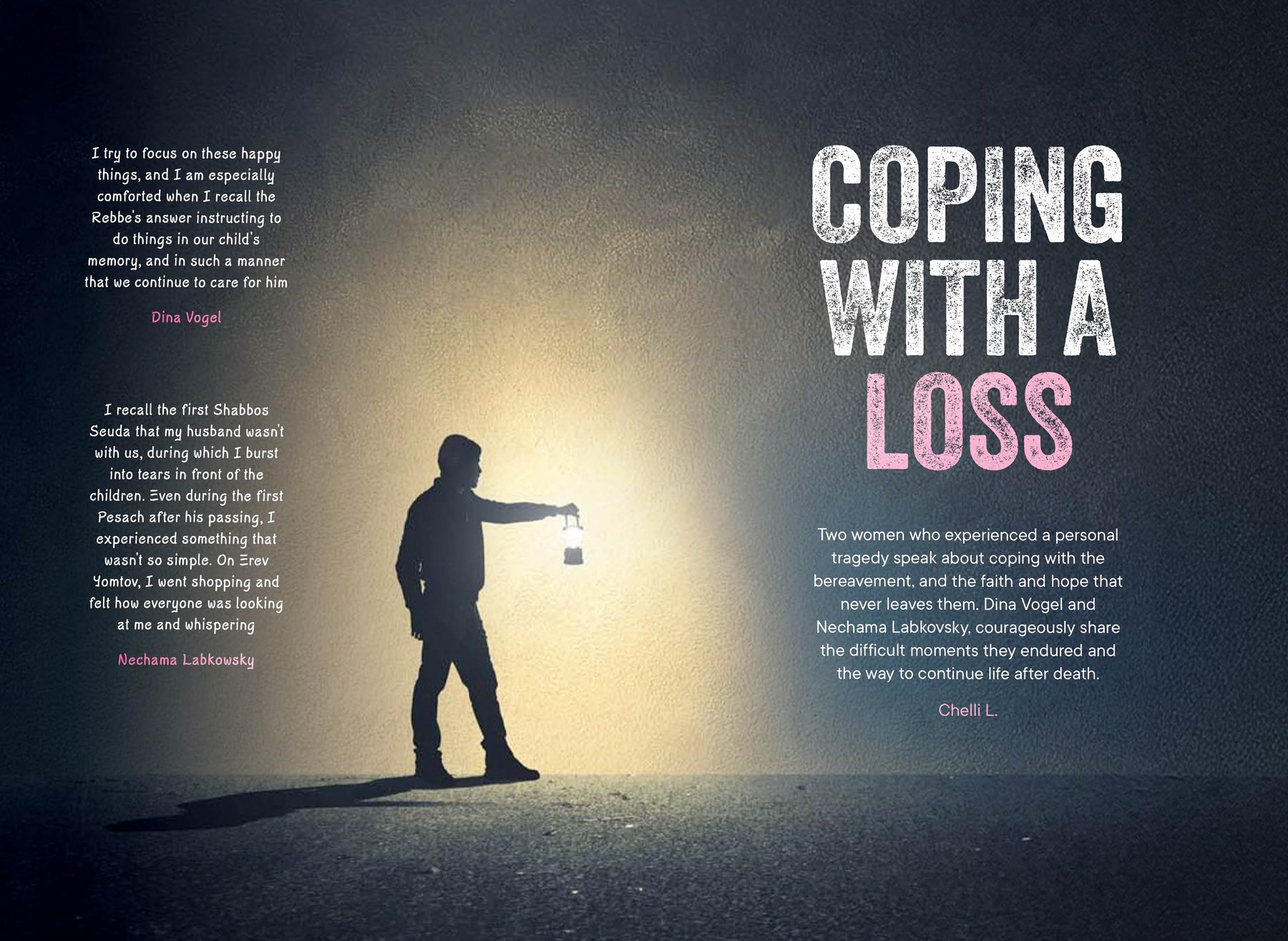
Two women who experienced a personal tragedy speak about coping with the bereavement, and the faith and hope that never leaves them. Dina Vogel and Nechama Labkowsky courageously share the difficult moments they endured and the way to continue life after death.
“I Lost A Four-Month-old Baby”
Dina Vogel:
Twenty-nine years ago, just prior to the Yamim Noraim of 5755 (1955), we emigrated from the United States to Eretz HaKodesh. I was nearly four months pregnant at the time. In my sixth month, I had a miscarriage and felt very weak afterwards. I told myself that if Hashem sees that I have the strength, He’ll give me another child, and if Hashem will think that I need a break in order to recover properly, He’ll give me this time.
Not long afterwards, we were blessed with the birth of a son. I felt that he was a special child, a beautiful gift from the Aibishter. At his Bris, we gave him the name Menachem Mendel.
When Menachem Mendel was four months old, he suddenly passed away from sudden infant death syndrome (SIDS), commonly known as crib death. There had been no warning signs whatsoever, and our anguish was very deep.
A few hours later, they took him for burial. They didn’t tell us where the gravesite was, as in a case when a child dies at such a young age, they bury him in a communal grave.
With all the pain and anguish, I felt that these were four months of shlichus when we were privileged to raise a soul that came into the world to accomplish a certain tikkun (spiritual correction) for a short time. When I saw what had happened to my baby, I asked the Rebbe about it and picked Igros Kodesh Volume 18 – ‘Chai’.
At the time, not only didn’t I have the emotional strength to write a letter, I couldn’t even read the reply I received. I simply folded the page to mark the place where I had opened, intending to read it later. I knew that only the Rebbe could console me in such a moment.
During the ‘shiva’, I asked our local Rav to open the volume of ‘Igros Kodesh’ where I had marked the place and read it to me. The Rav opened the sefer, began to read, and then said, “Wow!”
I suddenly saw people gathering around him with stunned looks on their faces. At this point, I now asked for the Igros to read it for myself. The Rebbe’s reply was simply amazing! There were two letters. In the first letter (#6743), the Rebbe writes to a family that lost an infant child, may G-d protect us! He notes that he had heard about the passing of an infant from the local shliach in their place of residence, Rabbi Fogelman from Worcester, Massachusetts.
The Rebbe then proceeded to explain that a connection between children and parents is eternal, and the child will always be bound to the parents with a connection of the soul. You can do a great deal for him; every mitzva and good deed that you do increases in good for the child. Every addition and strengthening of your faith in Alm-ghty G-d – not to cast aspersions on His works – will produce a spiritual intensification in memory of the child.
In the next letter, the Rebbe gave a bracha for bestowing good news on joyous matters in the most revealed sense. The date of the letters was the third of Adar Sheni.
A year later, on the second of Adar Sheni, my daughter Rikki was born! It was as if the Rebbe blessed her on the day after she was born. As I had felt, the Rebbe truly was the only one who could console me – whether regarding the child I had lost or the tremendous comfort in the form of this wonderful little girl.
In the first seven years after the petirah, it was quite difficult for me to feel true joy. I am extremely connected to my children. During the period when the baby passed away, I was at home with him throughout the day, and the connection was very strong. However, life goes on, and more children came afterwards, bringing with them much simcha and nachas. I try to focus on these happy things, and I am especially comforted when I recall the Rebbe’s answer instructing us to do things in our child’s memory, and in such a manner that we continue to care for him.
I feel that we were honored with a unique privilege – to receive a lofty soul that came into the world to make a small correction, and we were the ones chosen to be the home to take in this unique neshama.
On the same day Menachem Mendel passed away, we made a film of him laughing out loud for the first time. He left us a joyous memento of him!
My Late Husband’s Dying Wish
Nechama Labkovsky
I specifically want to start by sharing with you my motto in life, a motto that helped me to continue pressing forward after losing my husband, of blessed memory.
Facing every challenge in life, a person can either collapse or cope. The easiest choice is to have a breakdown, as then they will feel like miserable wretches and people tend to take pity on poor and unfortunate souls. This is the easy option, but it isn’t a worthwhile one, because it leaves us in a despondent state and we can’t get out of it. We find ourselves enveloped by a covering of self-pity, sinking more deeply into it.
The second choice is coping, and this proves to be much harder and it requires a considerable amount of work. When you cope, you smile at everyone during the day and cry at night. However, this is a far more advisable choice. Based on my personal experience, I can safely say that in the merit of my choosing to cope, I have managed to move on and continue living. I repeatedly give over this message to any widow who needs to hear it.
I was widowed at the age of forty-three. My husband, R’ Yisroel Rizel a”h had been terminally ill for a year. When we became aware of his illness, he requested two things: a) to be buried at Har HaMenuchot Cemetery in Yerushalayim; b) that I should remarry after he’s gone. I pleaded with him not to talk that way. “With Hashem’s help, you’ll be healthy and we’ll live together again as a family.” However, Hashem wanted otherwise.
A week before his passing, he asked our eldest daughter to make certain that I would get married again. He was a very special person, a truly noble soul. In fact, his words gave me the strength to remarry. I don’t think that I would have done it if it hadn’t been his dying wish. I wasn’t even willing to consider the idea.
When I was widowed, I had five children – two married daughters, two eighteen-year-old twin boys in yeshiva, and my youngest, a girl at age seven, who didn’t have much time to know her father, as she was only six when he became ill. She at least had the opportunity to say goodbye to him baruch Hashem; she was with him on the day before the petirah. The twins were at an age when they really needed a father.
After the petirah, I felt that I was left alone in the world. I had already lost both my parents, and the loneliness was quite intense. While I had the children, I didn’t want to cause them any pain, and when I was near them, I tried very hard to be strong. But when they weren’t at home, I would break down. The feeling of emptiness was far more than usual, because during the final year before the petirah, I was constantly at my husband’s side. I nursed him at the hospital day and night, and as a result, I had to leave my job. This was no simple situation, but I always had someone to speak with, and suddenly I had no one!
The pain was so great that I could feel it physically.
I remember the first Shabbos meal after my husband’s passing, during which I burst into tears, and this was in front of the children. During the first Pesach after the petirah, I also had a difficult experience. On Erev Yom Tov, I went shopping and felt everyone looking at me, whispering about the poor widow. Even when I returned to work, I once noticed that one of my colleagues said ‘my husband’, and then immediately went quiet. “Please, friends!” I told them, “I want you to treat me normally. I have no problem with you speaking about your husbands. On the contrary, I’m happy that you have husbands…”
While my world had been shattered into fragments, I wanted the people around me to continue their routine lives and make no changes because of me. I didn’t want them to be dragged down over the pain and anguish I was feeling. I preferred that they be happy as always, and they should especially feel good around me.
Dealing with parnassa matters wasn’t all that easy either. It felt as if half of my life had just been cut off.
My mother had passed away when I was sixteen, and my father was i when I was twenty-nine. Thus, my husband’s petirah was the third death I had experienced. Nevertheless, I never had a feeling of questioning my faith or any doubts towards Hashem. There were, however, times when when I turned to Him and asked, ‘What do You want of me?’
On the other hand, there was a clear feeling that this was the situation where Hashem had placed me, and that’s the way it was going to be. It’s like a couple going out on shlichus. They know that there will be difficulties, but they don’t get preoccupied thinking about them all day long. While the difficulties exist, the choice of how much we should deal with them and how much space to give them is ours. So, I continued living, mainly for the children.
I returned to work. I knew that the children needed me healthy and strong, both physically and emotionally, and this is what helped me to lift myself up. In addition, I felt that my husband and I had built a family together, and now I was the one remaining to ensure its continued existence. I felt that with my efforts in maintaining my strength and being there for my children, I am also continuing his shlichus.
Somewhere deep in my subconscious, I always knew that Hashem was with me. This knowledge was clear and firm at all times. I don’t think that I could have managed to continue living or remarrying if G-d had not given me the strength for this. The very fact that I continued my normal life was a miracle that Hashem made. He also sent me a caring and supportive family. My husband a”h’s family was extremely cooperative and they were there for me, as were some amazing people from the neighborhood. All of these fine shluchim provided me with much-needed assistance.
* * *
During the initial period after my husband’s passing, I was not in a position to think about how I will live my life from now on. I had no plans, living every day as a new adventure in a complex spiritual avoda for my remaining family, not just for myself.
As I noted earlier, I never would have considered remarrying if my husband hadn’t asked me to do so. It just didn’t feel right to me. However, this was his request, and even my father-in-law encouraged me to get married again. One of the factors that led to this decision was my determination not to be a burden to my children. I didn’t want them to be constantly worrying that I shouldn’t be alone, taking turns bearing the responsibility of caring for me. Thus, I thought that if I would remarry, they would have peace of mind knowing that I’m not alone and someone is taking care of me. This way, their routine will not be disrupted.
Several years later, I married Rabbi Yosef Yitzchok Labkovsky, the Rebbe’s shliach in Marseilles, France. After the wedding, I went out on shlichus, and this made it possible for me to undergo a profound change in my life, a change that healed me and enabled me to get past the pain more easily.
The community accepted me as I am. For them, I wasn’t “the widow.” They didn’t know my past history, and this made me feel better. I felt myself growing out of my period of mourning. Things had also been going well for me beforehand – I really loved my job at Beis Rivkah in Kfar Chabad and the women I worked with. However, the shlichus made it possible for me to create something new, and to be in a state of giving, and as we know, giving keeps a person from getting bogged down.
Dedicating myself to this new shlichus really helped me in dealing with the situation that exists to this day. I felt that I had been transformed from someone receiving to someone giving support. People no longer have to take care of me, now I take care of others. I think that if I had stayed in Eretz Yisrael, I wouldn’t have grown to be what I am today.
We now have a widow in the community. She doesn’t know how to drive a car, as her late husband did all the driving. I encouraged her to take driving lessons, making her more willing to use a vehicle. I told her: “Don’t ask for favors from others, don’t be dependent upon people. Get up, do something, take action, choose life. Of course, you can cry and let it all out when things get hard. However, remember that you must get up to avoid being left as some forlorn soul dependent upon others for your whole life.”
It was very important to me to encourage people who experienced personal loss to get out. Granted, it hurts terribly and you need to give them room for the pain. However, the choice to continue living is also what Hashem wants.
I want to give special mention to ‘Colel Chabad’, who helped us and provided much support after the loss. On one occasion, I participated in a holiday vacation for bereaved women organized by them. Mrs. Rochel Wilhelm spoke there, and this vacation gave me tremendous strength. They also were most helpful in arranging special programs for my little girl, e.g., after-school group activities, and I am most grateful to them.
In conclusion, I have a message for all those women reading me now. Sometimes, when we meet someone bereaved, we move to the other side of the street, trying to avoid her with embarrassment, not knowing what to say. One request: We need you! Don’t disregard us. Come over and say something. Gently show an interest. We’ll be pleased to engage in such interactions.
Beis Moshiach #1420 • pp. 40-45
© 2026 Beis Moshiach Magazine. All rights reserved.
This article originally appeared in Beis Moshiach #1420. You are welcome to share it with friends and family by email or in print, provided that you do not change, add to or omit any part of it, you credit the author and Beis Moshiach, and you include a link to archive.bmoshiach.org (written out in full in printed copies).
To republish this article in a newspaper, magazine, book or website, please request permission in advance at [email protected].