Workaholics Anonymous
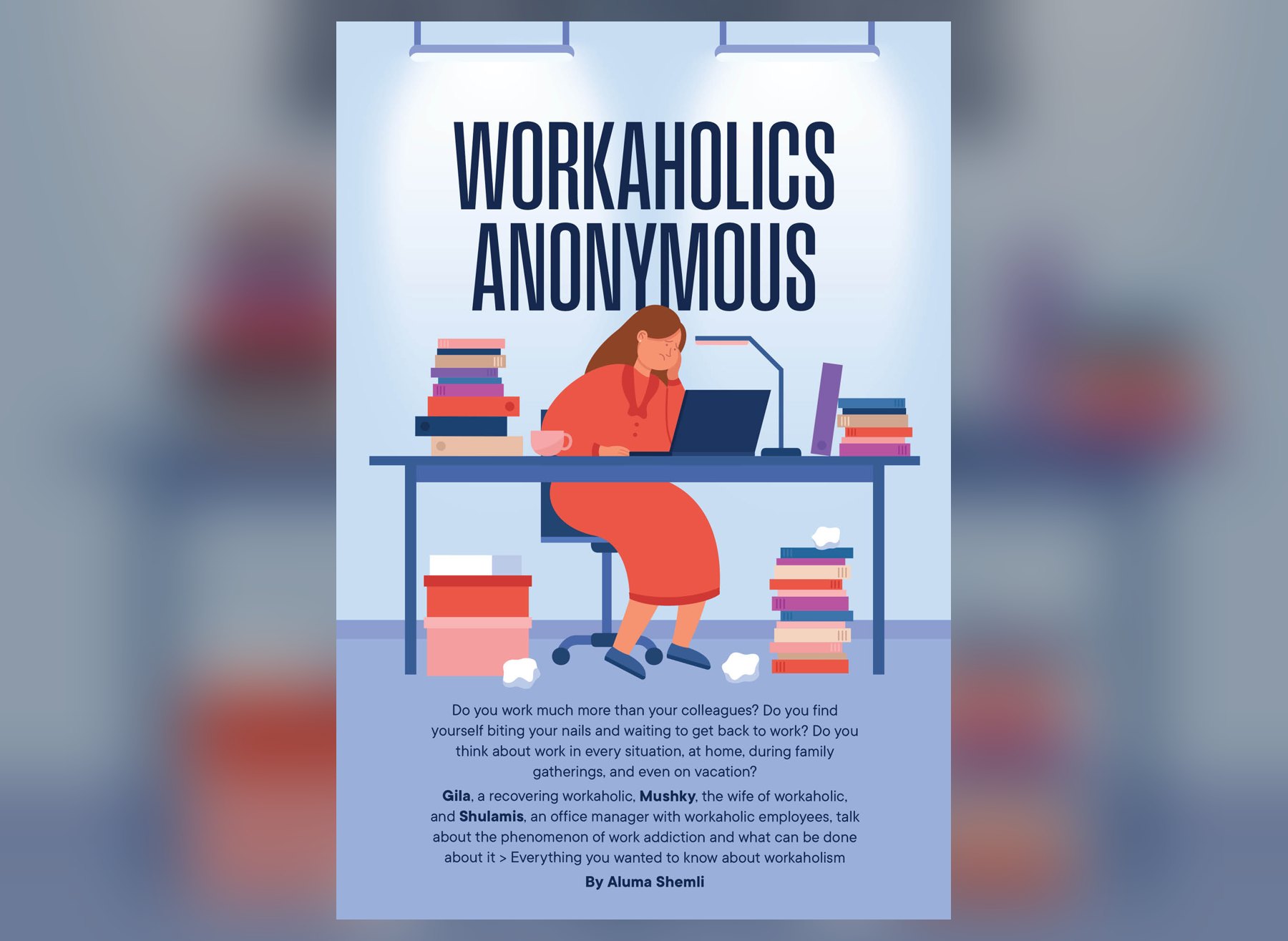
Do you work much more than your colleagues? Do you find yourself biting your nails and waiting to get back to work? Do you think about work in every situation, at home, during family gatherings, and even on vacation? Gila, a recovering workaholic, Mushky, the wife of workaholic, and Shulamis, an office manager with workaholic employees, talk about the phenomenon of work addiction and what can be done about it. Everything you wanted to know about workaholism
There is such a thing as being addicted to work. To those among us who can’t wait to get out and head home, it doesn’t sound true. Addicted to work? Most people are addicted to vacation, to rest… Who loves to work? And we’re not talking about someone with a high work ethic or someone ambitious who wants to get far. We’re talking about a full-blown addiction, including dealing with actual withdrawal.
Gila was addicted to work and today she is in the withdrawal process. Mushky is married to an addict, in her opinion; he doesn’t agree with her diagnosis. Shulamis manages an office and tells about the problems (yes!) that exist among addicted employees.
Listen to your loved ones!
Devoted Versus Addicted
Gila’s story:
I was addicted to work. It took me a long time to realize this because unlike other addictions, the addiction to work is one you take pride in. I felt like an excellent worker, industrious, with a high work ethic so that nobody else could do things as well as I could.
Obviously, I worked the maximum hours. I arrived at 7:45, early, and taught until four and stayed on. Once for a meeting, once to talk to a mother, with the principal, with the coordinator. I would finally get home, what could you do. At school the only ones there were maintenance people. But the work came home with me. I had continuing education courses to attend and meetings. I always had to buy prizes or gifts for the staff or a new curtain for the music room. Even when I was home, I would be busy with work. Preparing a lesson, on the phone with another teacher arranging a special program for a special occasion, searching the computer to find yet another interesting game or professional test or work page. Designing something impressive for the parents or for the classroom wall or for a course that I attended.
Friends and teachers who worked with me looked at me with admiration. What a dedicated teacher, capable of everything, who never said ‘no’ about anything, always finding the time for everything. Who did everything perfectly.
The ones who didn’t look at me admiringly were my mother and my husband. They were less pleased. My mother got really upset. “You have a husband and children! You didn’t marry a school, Gila!” When we would meet she wasn’t even willing to listen to me talk about my job. That offended me. It was my entire life and she was denying that! I knew that I couldn’t ask her for help. She’s a good mother, ready to watch the kids for three days when my husband and I go on vacation, hosts me and my sisters after we give birth, even for a month, but when it comes to my job? She would say ‘no.’
I would beg, “Ima, Yaakov can’t watch them tonight and I have a critical continuing education course!” Her heart was like a stone. “Do you think I’m going to help you so that you can be away from home yet another night?”
My husband doesn’t get angry. He keeps quiet. My salary is our main income and so he does what he can to make it easier for me. He sends off the children, is there when they come home, he babysits at night, takes them where they need to go, and after I got my license he gave up the car and hardly said a word. But what I really want, genuine admiration for my devotion to my job, is not there. He prefers not to speak. He does everything and is quiet.
The few times I insisted on hearing his opinion about my job he only said, “I’m waiting for the moment when you will relax, that you will finally be happy.” I didn’t know what he meant. “I am very happy,” I said. He chuckled and didn’t respond.
It reached the point of health problems. Not life-threatening ones but difficulty sleeping, borderline blood pressure, ominous blood sugar levels. We sat with the family doctor and he spoke about slowing down, about rest and relaxation. He explained that at my age I shouldn’t be having these blood test results. He cautiously asked about my daily schedule. Before I could reply, my husband said that I was a workaholic. That was the first time I heard that word in connection with myself. Of course, I protested. The doctor asked some questions, listened to my answers with a forgiving smile, and asked me to get professional help. The moment work affects health is the time to stop.
I went home and looked up information on this subject. I read a lot, about the traits of those who are addicted to work and about the differences between them and employees who are devoted; it only looks the same at first glance. I now understood what my husband said. I went for therapy.
In the first stage, I realized that someone addicted to work is exactly like any other addict who is running away from something. Running away from problems and from areas of life where they are not successful. A strangling work load is his way of covering up and avoiding that which is difficult. I worked on clarity with myself and with my therapist about what I was running away from. It wasn’t easy to suddenly face the truth and realize where my devotion to my job came from.
I made slow progress in two areas. First, I limited myself to normal hours at work. I learned with the help of my husband to say ‘no,’ to stop the training sessions and courses, to stop working when I got home.
Second, together with my sensitive therapist, I worked on the areas that I ran away from. We examined where I could improve myself, what I could change and what I needed to learn to accept. She resolved to bring me to a state where I wouldn’t need to run away and consequently, would stop looking for where I could invest my energies instead of the home.
Another interesting thing that I discovered is that often people with attention deficits like me are more inclined to fall into workaholism. The pressure for the attention-challenged to prove himself makes him go above and beyond what is required. Moreover, such people find it hard to switch from task to task and this can cause them to get stuck emotionally and cognitively in their work.
My message to women like me is listen to your loved ones. When they say: You spend all day working, you’re forgetting your house, they aren’t just annoyed and judgmental; they are sending you a message. They see what you don’t see. Today, when I look back I realize what my mother was always telling me and I blush.
Married To Work
Mushky’s story:
I am married to a workaholic. Unlike all other addictions, this addiction is “respectable.” Nobody will dare to say that her husband is addicted to alcohol or to dangerous substances, but to say, “My husband is addicted to work,” is okay. This is said with a sigh mingled with pride. He is one of those industrious ones who forgets the entire world when he’s working.
It’s not at all easy. It’s an addiction in every respect and like every addiction there is an element of being out of control. When he opens the computer again, Whatsapp again, Zoom again, whether it is or isn’t connected to his work, you know that explanations won’t help. There’s nobody to be angry at. The only thing left is to thank Hashem that there’s Shabbos and that we are Chassidim. I’m trying to picture what it’s like for someone irreligious and know that he wouldn’t stop even on Shabbos.
Covid, whose ramifications we are still dealing with today, also made its contribution. Before Covid, the difference between home and work was physical. Not that that helped because he always stayed on late, came home late and still had work-related phone calls and documents to review, but officially, he was home and had finished work for the day.
During Covid, a lot of employers switched to working from home. When a person is in high-tech and it’s all on the computer and everyone is connected to everyone, what exactly is the purpose in bringing him to the office, to pay rent there and for air conditioning and parking when it can all be done from home? For some people, this made things easier for them, it eliminated travel time, time spent in traffic, even helped save on sick days. For us, it was a catastrophe.
There is no longer any limit on work. It’s possible to work all day every day. Today the world is so connected and attention grabbing. We can go out, sit and eat somewhere, barely exchange a word and he’s on the phone. Just sending, just responding, just reacting, just glancing. It has many names. I know that I can finish on my own and bentch.
He works from home. From the morning, when he opens his eyes, until late at night. During meals, during nap times, when I leave him with a sick child. It reached the point where he doesn’t sleep enough and he has no time to eat like a mentch. It’s a mazal that he has a good wife like me; otherwise, he would definitely live on store-bought food.
I sometimes try to talk to him, to show him what he’s missing. He doesn’t quite get it, doesn’t really understand. He explains to me about the high cost of living and financial security. He responds apologetically to my saying that I prefer he work less and we’ll have him more at home. He is under pressure that someone will be better than him, that he won’t meet his goals, that if he’s not connected for two days he’ll be out of the loop. He is under constant stress.
What is my role as the wife of an addict? To worry about him. To be there for him. To try and open his eyes and live from Shabbos to Shabbos. That is the day that we finally enjoy him, when he can talk and listen. At least during those hours when he is not making up for sleep from the whole, crazy week…
My final words are for managers: Don’t encourage people to be workaholics! Stop it in time! I imagine that these are the best employees, those who never say ‘no,’ who are always willing to take on another task. But it hurts them, their health, their families. That he never takes a sick day is no praise; it’s a blinking red light! Please don’t enable this craziness. Sometimes, it seems to me that the manager is the only one he will listen to, if he would be the one to say to relax a bit.
Overly Dedicated Employees
From the manager’s perspective:
My name is Shulamis. I’m a manager in a medical specialty clinic in a specific field which works with all the health services. Under me are doctors, nurses, technicians, secretaries and others. Over the years, I have met workaholics, mainly women. Often, the accusing finger is pointed at the manager or employer for encouraging people to dedicate themselves to their work and destroy their personal lives.
It’s true that at first glance, those addicted to work are easy employees. They don’t create problems, they don’t take vacation days, they don’t complain about too many hours and they jump to take tasks that others refused or simply didn’t show up for. But after working with them for a while the negatives come to light.
A workaholic thinks that only she can do everything well; she doesn’t delegate authority. Any task that comes their way is taken over exclusively, and she takes on many tasks. Often, she is unable to do everything herself. Things don’t go as they should, especially when hours of sleep and normal meals are forgone and they are very tired, can concentrate less, and are more irritable.
So yes, she will always take on more hours and another task but in the long run, it hurts her and the system. A healthy system needs pleasant and healthy employees. A worker who is addicted to work is tense and won’t eat and sleep normally and the house that she leaves behind makes her feel stressed and gives her guilt feelings. She really is not accomplishing more in the nine hours that she’s at work than the calm worker who is only at work for five-six hours a day and knows how to disconnect when necessary, rest and get energetically back to work.
Not every manager will agree with me, especially not those who are in businesses or organizations that operate with the approach of putting out fires, where there is constant tension. Over there, workaholics are a gift. But a calm, organized operating system is only adversely affected by work addicts. I, as a manager, will sometimes send an employee home, promising that we will manage without them, will not allow taking additional hours and tasks beyond what I think is possible and reasonable.
I had an employee who just didn’t leave. When I called her in for a talk she told me how hard it was to be an older single. “This is my way of escaping,” she admitted. I explained to her that work is not therapy and that she should go to a therapist and put all her energy into finding a chassan, not in my clinic. She was very angry with me for a while but she didn’t leave. Is she addicted or not?
Today, married with two children, she thanks me. Her life is full and calm and she doesn’t need to escape to work; at this point, she tries to run away from it… “Can I leave half an hour early today?” I laugh, refuse, and wink at her. She knows just what I mean.
Beis Moshiach #1425 • pp. 38-41, 47
© 2026 Beis Moshiach Magazine. All rights reserved.
This article originally appeared in Beis Moshiach #1425. You are welcome to share it with friends and family by email or in print, provided that you do not change, add to or omit any part of it, you credit the author and Beis Moshiach, and you include a link to archive.bmoshiach.org (written out in full in printed copies).
To republish this article in a newspaper, magazine, book or website, please request permission in advance at [email protected].