Mesibos Shabbos: Building Worlds, One Lollipop at a Time
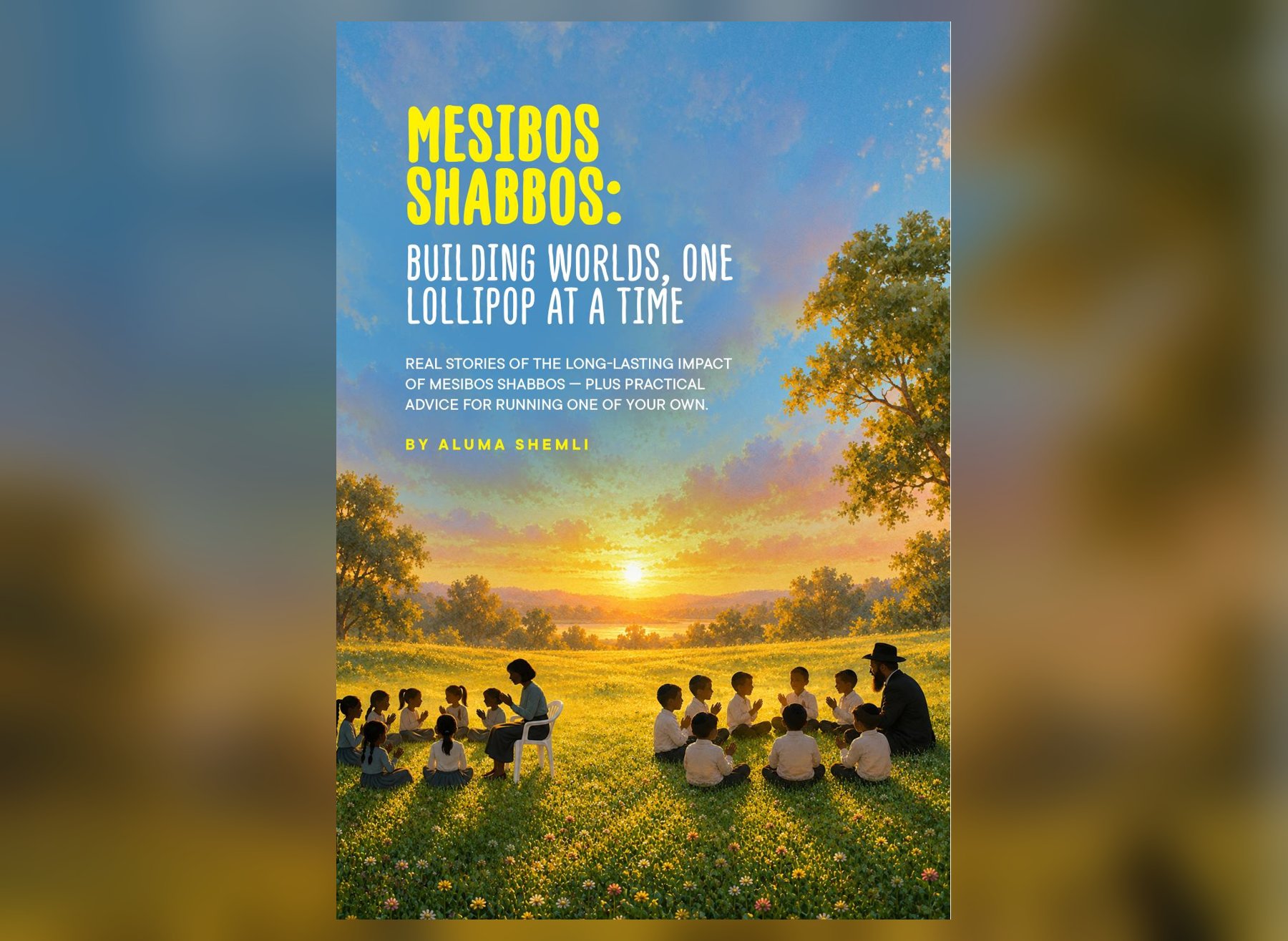
Real stories of the long-lasting impact of mesibos Shabbos — plus practical advice for running one of your own.
Mesibos Shabbos was among the first initiatives the Rebbe Rayatz launched after arriving in America in 5700 (1940). Established in 1941 through Merkos L’Inyonei Chinuch, it was one of Chabad’s earliest campaigns to reach the unaffiliated children of American Jewry—alongside the “Released Time” Torah classes for public-school children and the launch of Talks and Tales, the first English-language Jewish magazine for children, in 5702.
At a farbrengen in 5702, the Rebbe MH’M remarked on the program’s promise: “The Rebbe [Rayatz] has begun with Mesibos Shabbos; from here on, the world will be conquered.”
The Lag B’Omer parade—now one of the most recognizable events on the Chabad calendar—grew directly out of Mesibos Shabbos. The first parade was held on Chol HaMoed Pesach 5702, just half a year after the program began, as a central gathering for the children involved. To this day, the Lag B’Omer parades are officially organized under the Mesibos Shabbos banner.
Decades later, the program is still going strong. By Shabbos afternoon, after a long week of tests, classes, chores, and Tzivos Hashem duties, a counselor could be forgiven for wanting nothing more than a good book and a quiet nap—a calm afternoon to finally take a deep breath and relax.
But that’s usually not what happens.
Instead, with remarkable dedication, these counselors pull themselves together, put on their shoes, wash up, and grab a package of ice pops from the freezer or snacks from the cupboard. Week after week, they head out to a park or the shul and call out one passuk after another. They tell a story, break up a squabble by the window, hand out the sticky ice pops, and promise an extra one next week to any child who missed out today. Baruch Hashem, so many children show up!
Mothers come by to say thank you, to voice a complaint, or just to ask a question. And on Sunday, these young “soldiers in the field of Jewish education” sit down and write their weekly report to the Rebbe giving him so much nachas ruach.
It’s Not Such a Big Deal
Mrs. Henya Laine recalls:
I grew up on shlichus in Cleaveland, Ohio. I went in for yechidus with the Rebbe, together with my mother. I was a young girl at the time, just thirteen years old. The Rebbe said to me: “Your mother told me that you run the Mesibos Shabbos. Can you tell me what you do?”
I said: “Ah, it’s not such a big deal. We go around and bring all the girls from their homes, and take them to our house. We then give them something to eat, make brachos, sing songs, and dance. We tell a story out of Talks and Tales—this was all the learning material that was available in those days—and then make a bracha acharona and take them back to their homes.”
Why did I say “we”? Because I did this together with all my sisters, and each one had her own group at home. The Rebbe looked up at me, gave me a broad, ear-to-ear smile, and said: “What you’re doing is wonderful. You should continue.”
The Rebbe then began to heap so many brachos on me that I said to myself: ‘Wow, maybe this really is such a big deal.’
I thought to myself: In an instant, a young thirteen-year-old girl grew ten feet tall.
Sometimes we do something and we don’t see the results, so let me jump ahead several years, to when the Hebrew Academy of Cleveland celebrated its fiftieth anniversary. The administration decided to honor the work of my parents, Rabbi and Mrs. Kazen.
I told my sister Rivka: “I think that we should travel to Cleveland.” When we were there, almost everyone around us was Torah observant. Someone came up to us and said: “Do you know who I am? Look at me, Rivka! You were my counselor at the Mesibos Shabbos. We would come to your Shabbos parties. Most of us were public school students, many of us learned Jewish studies in the afternoon, and many of us eventually transferred to Hebrew Academy—and whoever you see here learning in a higher seminary program in Eretz Yisrael or elsewhere, each of us is a product of your mesibos Shabbos!”
Pesukim From Out of the Carpet
A frightened young woman turned to Yad L’Achim activists for help. Her story was heartrending. As a child, she’d emigrated to Eretz Yisrael with her parents from the former Soviet Union and grew up with no connection to Yiddishkeit. When she grew older, she met a young Arab man, and the two of them moved to an Arab village.
The couple had two daughters. It didn’t take long for the Arab man—so pleasant when they’d first gotten involved—to show his true colors. The Jewish woman suffered severe physical abuse. He also cut off her money supply and kept her from leaving the house, humiliating and abusing her. One day, she managed to flee the house by the skin of her teeth, but her daughters stayed behind with the Arab’s family in the village.
Sobbing and terrified, she turned to the Yad L’Achim activists, pleading with them to rescue her young daughters. The Arab father and the girls entrenched themselves in a building belonging to his clan, and it looked like rescuing the girls would be difficult. IDF soldiers agreed to secure the operation; however, they insisted that the girls be taken out of the house within a few minutes, without delay.
The house where the whole clan lived was full of children, boys and girls alike, so the mother was asked for some quick, reliable way to identify her daughters—something that would let the rescuers find them and get them out as fast as possible.
The answer was quite surprising: “The girls know the Twelve Pesukim!”
When the moment of truth came, the activists couldn’t find the girls. The family had apparently prepared for this and hidden them away. The mission to find two unfamiliar girls in a huge house full of people seemed to have no chance of success. Then one of the activists called out: “Torah!” “Tziva!”
After a brief silence, he heard childlike voices answering him from a rolled-up carpet.
Shocked, the young men released the girls from their hiding place and returned them to their worried mother.
“How did the girls know the pesukim?” they asked her, still in stunned disbelief.
“When I was a little girl,” she recalled with emotion, “there was a young man who would gather all the children every Shabbos in our neighborhood to a Mesibas Shabbos where we’d recite the Twelve Pesukim. He would hand out candies, and I loved going. One Shabbos, he gave each of us a sheet with the Twelve Pesukim on it, and he promised that anyone who learned them by heart before the following Shabbos would get a special prize. When I lived in the Arab village, and I realized my daughters were growing up with nothing Jewish about them, I decided to teach them at least the one thing I knew—the Twelve Pesukim.”
What a great merit this bachur or yungerman had, going out with children to say the Twelve Pesukim, never imagining that one day these pesukim would save two little girls from an Arab village.
Checks From the Mazkirus
Mrs. Rivka Zakutinsky tells her story:
We were twelve-year-old girls when our Sunday school in New Haven, CT took us on our annual trip to New York to see the Rebbe. We were very excited when we traveled on the train from New Haven.
Naturally, they told us who we were going to visit—they called him “the grand rabbi.” We felt a sense of awe and reverence towards him, and when he spoke with us, we could tell he genuinely cared about what was best for us. I was so inspired that I wanted to do something myself: start a Mesibos Shabbos club. I had the Rebbe’s address, so I wrote him a letter: “We want to establish a Mesibos Shabbos club, but we don’t have money for the refreshments we need to buy.”
How much would it cost anyway? Maybe three or four dollars at the time?
However, the Rebbe responded to me with a heartfelt letter: “I’m very proud that you want to do this, I encourage you to do this. I’ll make certain that Rabbi Chodakov will send you, from the office in my name, money to cover the expenses.”
We just had to send him the lists and the program—what we did, what we bought—and so I did.
Numerous children arrived, and together with my assistant, I told a story and taught them a niggun. We danced, made brachos, and by then an hour had already passed. And then, after Shabbos, I wrote a letter with a detailed list: “A marble cake for saying the bracha Borei Minei Mezonos, peanuts for Borei Pri HaAdama, and other candies for Shehakol…”
I would send the lists, and the checks would come soon afterwards…
Entire Worlds
Rabbi Eliyahu Gabbai, a dayan from Rechovot:
In my youth, I left the Litvishe yeshiva where I’d been studying and switched to a Chabad yeshiva. In the interim, I went to study electronics through a technological program associated with the IDF. Since I couldn’t manage to postpone my compulsory military service, I was assigned to a flight training squadron in the Israeli Air Force.
During this service, I decided to do mivtzaim and open a Chabad House on the Hatzerim air force base where I was stationed.
I would prepare boys for their bar mitzva, but primarily I made Mesibos Shabbos for all the children on the base. There were times when more than one hundred and fifty children participated in these Shabbos gatherings!
On one Shabbos, I was hosted by a wonderful Chabad couple in Beersheva. They had meaningful careers and were special people, but they hadn’t yet been blessed with children. During that Shabbos, I could only feel the quiet and the emptiness. We actually spoke about this on Motzoei Shabbos, and they told me how they’d done everything they could, physically and spiritually, to merit children of their own—but to no avail.
At that moment, I had an idea, and almost without thinking, I made an unusual offer: “All the merits I have from the Mesibos Shabbos, I give to you!”
Not long afterwards, they became parents.
Later, when I was a rosh yeshiva in Kiryat Gat, I was even privileged to teach their Menachem Mendel, the miracle child.
It seemed to us sometimes that the Mesibos Shabbos were not a big deal—just a few pesukim and a treat. We have to remember that the Mesibos Shabbos are whole worlds!
Shlichus Passing From Generation to Generation
Mrs. Shoshana Horowitz from Rishon L’Tzion shares her own personal experience:
When I was a girl, my mother would organize a Kabbolas Shabbos party. At the time, we lived in a ‘dati-leumi’ neighborhood, and there was no real opposition to our activities, except for once, when an annoyed neighbor sprayed us with her garden hose.
Truth be told, for us it was more “action” and excitement than an interruption…
Later, my older sisters took over, and by the time I was in fifth grade, the kids in our own neighborhood had outgrown the program, so we started walking to playgrounds farther away to find younger children.
I remember one girl whose mother wasn’t home because she’d just given birth. My father, hoping to keep us from getting bored, took us to a faraway playground he knew from his walk to the mikva. He simply started calling out the pesukim, and all the neighborhood children gathered around him. He repeated them with us a few times, and that’s how my sisters learned to run a Shabbos gathering in a public playground.
When I was still very young, before there was a Chabad House on every corner of Rishon L’Tzion, we would walk long distances on Shabbos looking for playgrounds full of children. I remember once, in eighth or ninth grade, standing in a park with large round benches and starting the mesiba. Suddenly, someone came over and started screaming at me. Startled, I ran out of the park, but the children were no fools. They all ran after me until we found a quiet corner, just to say a passuk and get a treat. My sister and I would walk along these paths, imagining that one day shluchim would come and do outreach on a much bigger scale than we ever could.
The years passed, and in my third year of seminary, I found myself in an amazing case of hashgacha pratis, serving as a dorm counselor with the municipal welfare department. I was responsible for high school age girls, from ninth to twelfth grade. On Shabbosim, the dorm would fall into total disorder. The senior staff wasn’t there, and the counselors felt this was their time to rest. Forty bored girls wandered around on Shabbos afternoon with nothing to do, which was a grand recipe for trouble.
Suddenly, I thought to myself: For years, I walked for miles with mesirus nefesh, searching for a few children in the parks and playgrounds—and here, Hashem had handed me dozens of girls who were just waiting for me. I took the candies I’d bought, opened Tehillims, and we started our activities. This quickly became a kind of tradition: all the counselors rest while I’m with the girls. Some of the dorm girls knew the pesukim, and it was very nice and quite moving. In the end, even the other girls asked me to say pesukim with them too, so they could get something for the soul as well.
Today, I live in Beitar Illit. On our first Shabbos in a building where we still didn’t know anyone, my husband went out to daven while I heard children playing outside. I wanted to get to know my new neighbors, so I just invited them in. Since then, the activities haven’t stopped—for more than ten years now.
Every Shabbos, a few minutes after candle lighting, the children are already knocking at my door. Even when I came home from the hospital after giving birth, when the house was upside down and I could hardly get to my feet, I opened the door.
My neighbors ask me: “How do you do it?” and I explain that with the baby and the other kids, I can’t really rest anyway. So at least I have a chance to do something good for someone else.
Not long ago, we had a farbrengen at our the shul and spoke about mesirus nefesh. I told them about my Kabbolas Shabbos, and one of the women said something that has stayed with me: “While this is perhaps your mesirus nefesh, these are the powers that the Rebbe gives us.” Because in all honesty, opening your house under all circumstances, even when you don’t feel well, doesn’t come from your own strength. It’s the shlichus, and that’s what sustains us.
The Atmosphere Before All Else: Investment With a Minimum of Effort
While the child won’t remember what candy he got, he will remember the “taste” and the atmosphere of the gathering.
Shabbos innovations: A nice tablecloth, a special chair for the “Shabbos Abba/Imma,” or a regular fixture placed in the center. All of these create a festive feeling without much work.
Niggun of the soul: Combining a quiet, moving melody (think “Keili Ata” or “Ani Maamin”) with the conclusion of the gathering creates a moment that leaves a sense of longing for the next time.
The Personal Connection: The Way to Conveying the Message
The message goes down much better when there’s a real connection between the counselor and the child.
A minute of attention: Devote a moment at the end of the gathering for a short talk with one of the kids—a good word about his life, or asking about his well-being, builds a sense of trust that lets the message penetrate his heart.
Who Loves Mesibos Shabbos?
The story of the Mesibos Shabbos in Beit Shean started many years ago, when the shliach Rabbi Yaakov Shmulevitz, of blessed memory, was still a young man of sixteen or seventeen. He was just beginning to grow close to Chabad himself, and he organized Mesibos Shabbos with tremendous enthusiasm. But to his great disappointment, he failed to see his efforts bear any fruit.
The children came, listened to a story, recited pesukim, and they left. He was certain that people would come flooding to Chabad, and that even bigger changes would follow—but that’s not what happened.
Then the Rebbe wrote him the following letter, a letter that is an instruction for all of us:
The avreich, Yaakov Aryeh, sheyichye
Shalom u’Vracha!
Regarding what you write, that sometimes you don’t see actual results from the efforts in spreading Yiddishkeit and the mivtzaim—it is a great wonder: How can you know what is accomplished in the heart of your friend, which our Sages, of blessed memory, say is hidden, similar to ‘When will the kingdom of the House of Dovid return?’ (Pesachim 54b). And furthermore, Chazal has promised that words that emerge from the heart enter the heart, etc.
The necessity for learning Chassidus in our times is explained at length in the kuntres Eitz HaChaim, and in many other places.
Later, on his shlichus in Beit Shean, the Mesibos Shabbos became legendary. The children in Beit Shean would call them “the Lubavitcher Rebbe’s,” and there were those who even got confused and thought that Rabbi Shmulevitz himself was the Lubavitcher Rebbe…
At first, they would sing a new composition based on a well-known children’s song:
“Who loves Mesibos Shabbos? Mommy and Daddy do! Who loves Mesibos Shabbos? Sabba and Savta too!”
Rabbi Shmulevitz later created a song that accompanied the Mesibos Shabbos over many years, based on the melody of the Miami Boys Choir rendition of “Shiru Lo”:
“Come to the house, the Chabad House, Mesibos Shabbos—come out, come out! Five o’clock sharp, don’t be late, hurry on over, don’t hesitate! Songs and stories and pesukim we’ll say, candies for everyone, come out and play. Everybody leaves with a smile, no one loses out—stay a while! So come on home, come to the mesiba, come to the house—the Chabad House, hurrah!”
Today, thirty years later, Rebbetzin Chana Shmulevitz meets people who come up to her and say: “Today we’re Torah observant—we became baalei teshuva and made that commitment ourselves. But you should just know that it all started with you, at your Mesibos Shabbos. Back then, the seed was planted, the spark was ignited, and only years later did it start to blossom.”
Even the mayor of Beit Sheean made a point of saying at the Lag B’Omer parade: “I personally would come to the Mesibos Shabbos in the home of Rabbi Yaakov, and I received a popsicle from him!”
Beis Moshiach #1528 • י״ט חשון תשפ״ז • pp. 42-47
© 2026 Beis Moshiach Magazine. All rights reserved.
This article originally appeared in Beis Moshiach #1528. You are welcome to share it with friends and family by email or in print, provided that you do not change, add to or omit any part of it, you credit the author and Beis Moshiach, and you include a link to archive.bmoshiach.org (written out in full in printed copies).
To republish this article in a newspaper, magazine, book or website, please request permission in advance at [email protected].