The Wall That Wasn’t There
From Avraham Avinu’s river to R’ Leizer’s runway: how faith passes through walls and tests
“Avrohom Avinu was tested with ten nisyonos, and he withstood them all.” Chazal told us this not only to describe Avrohom Avinu’s tremendous greatness, but also to reveal that by standing firm through his nisyonos, he passed the strength to face them down to all future generations.
As the Targum Yonasan says on the passuk “Nasata l’yereiecha neis l’hisnoseis mipnei koshet selah”—You gave those who fear You a trial because of the truth of Avrohom, forever.” The Rebbe Rayatz says in one of his maamarim that every Jew has something of the Avos within him, and so every Jew has the strength to face nisyonos just as Avrohom Avinu did.
The Rebbe Melech HaMoshiach shlit”a (in the maamar “Nasata L’yereiecha,” Yud-Beis–Yud-Gimmel Tammuz 5736, Sefer HaMaamarim Melukat vol. 1, p. 185) expands on this and explains the place of a nisayon in our lives.
The Challenge of a Nisayon
Our avodas Hashem is made up of three parts: positive mitzvos, prohibitions, and nisyonos.
1. Positive mitzvos are the easiest to keep. They call for doing, for action.
2. Prohibitions are harder, because the yetzer hara often tempts us to sin, to do something we’re not allowed to do. In terms of the inner work of the soul, they demand more effort; we have to invest more.
3. Nisyonos touch an entirely different place in the soul. On the one hand, a nisayon isn’t real. It’s an illusion. It looks to us like a towering wall, something impossible to get past, but in truth it’s nothing. On the other hand, a nisayon can bring us down very hard, ch’v.
Overcoming a nisayon takes particularly great effort, the Rebbe explains, because a nisayon is something beyond reason and understanding. It has nothing to do with the intellect. You can’t “calm it down” with a logical explanation. You can’t convince it.
When a Jew finds it hard to keep a mitzva, the G-dly soul can step in to help. It can explain to the animal soul why keeping the mitzva matters, persuade it, even promise that it will pay off.
But with a nisayon, there’s no one to talk to. When a person faces a hardship that blocks him—a struggle with health, with parnassa, with any kind of pain—the intellect stops working. You can’t sit down and explain, persuade, and clarify. Not with nice words, and not with firmness. The nisayon just stands there, unmoved, as if nothing can affect it. There’s no logical handle to grab hold of. It’s like the Satan, who turned himself into a river on the way to the Akeidah. There’s nothing you can do against it. You can’t convince a river to disappear, dry up, or run away.
Maaseh Avos
So what do we do to withstand a nisayon? We make a strong decision, one that goes beyond reason, not to be shaken no matter what.
When I firmly decide that this nisayon will not bring me down, it melts away and vanishes, because it was only an illusion to begin with. Like Avrohom and Yitzchok, who kept walking through the river until the water reached their necks, and then it dried up. They paid the river no attention. They didn’t look for ways to dry it up or go around it. They simply decided it would not stand between them and their destination, the place Hashem had spoken of. Nothing could weaken their resolve. If Hashem said to go to Har HaMoriah, that’s where they had to go, no matter what.
Their strong emuna is what dried up the river. When the Satan saw he couldn’t contend with them, because they paid him no attention at all, he disappeared.
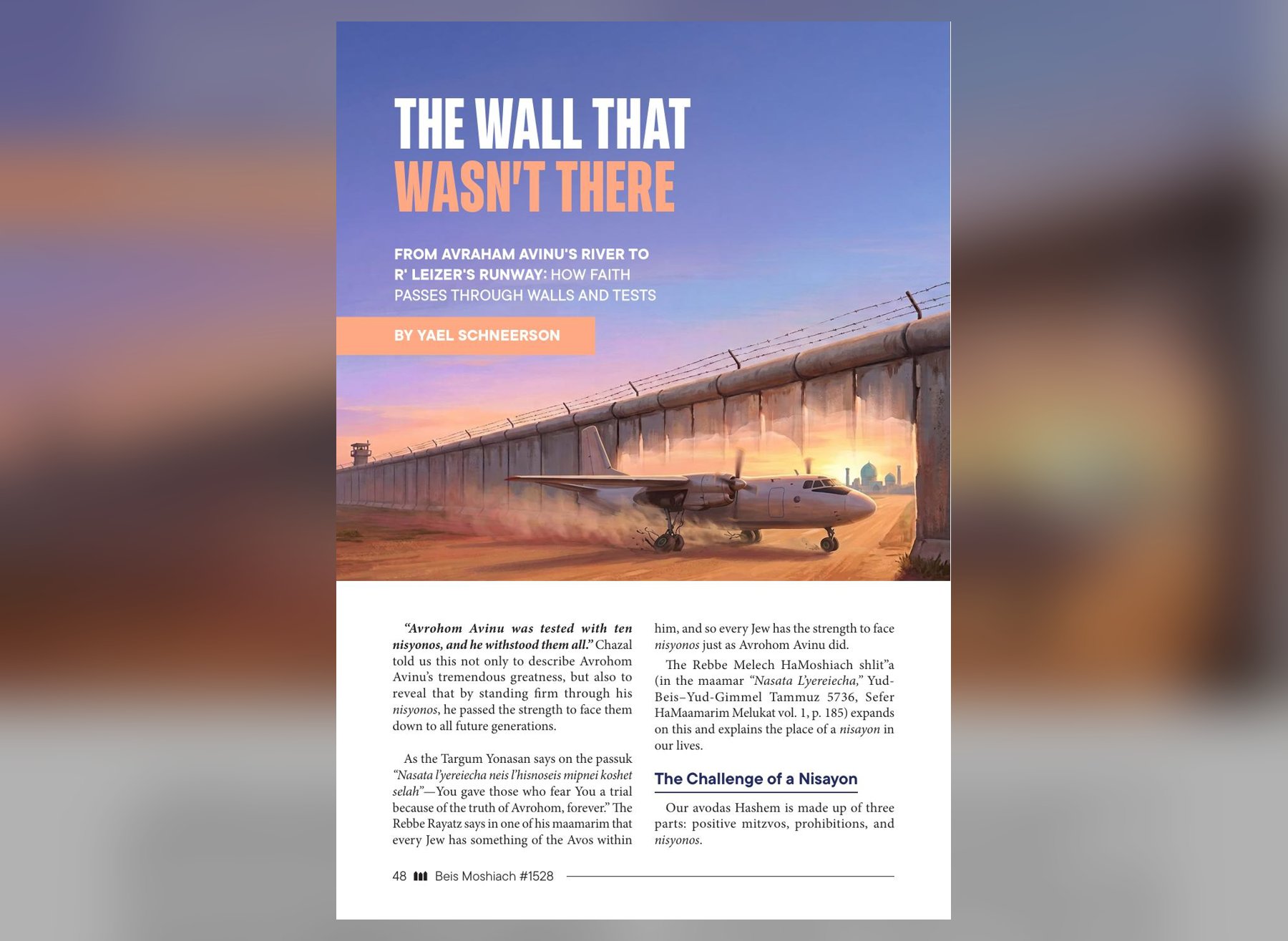
There was a famous Chassid of the previous generation, a man of tremendous mesirus nefesh: Reb Leizer Nanes. He was held in the Soviet labor camps for twenty years, went through a great deal of suffering, and at the same time experienced tremendous miracles. Through all those years, against all odds, he never once worked on Shabbos, never ate non-kosher food, and kept his beard and peyos. What carried him through every hardship, even in moments when death stared him in the face—and there were many—was a bracha for long life he had received from the Rebbe Rashab as a child.
Some time after his release, while still in Russia, he and his wife traveled to visit friends in Samarkand. They boarded a cargo plane headed there. When they reached their destination, Reb Leizer noticed that the pilot wasn’t landing. When he asked why, the pilot answered that he couldn’t release the plane’s landing gear, and there was only enough fuel for another ten minutes in the air. But if he landed on the plane’s belly, the plane and its passengers would be in danger.
Reb Leizer simply told him that he had merited a tzaddik’s bracha for long life, a bracha that had protected him through twenty years of hard labor in the camps. And so he was certain no harm would come to him. “So,” he told the pilot, “you can land the plane safely! Everything will be fine!” And so it was. Even though the plane had to land on its belly, not one passenger was hurt.
If we think about this story for a moment, there’s a nisayon here. His emuna is being put to the test. After twenty years of struggling day in and day out, Reb Leizer travels to rest and recharge a little with his friends—and here, once again, his life hangs in the balance. Of all things, the very plane he’s on runs into danger! Reb Leizer isn’t shaken. He doesn’t sink into sadness or despair. He doesn’t ask, “Why is this happening to me, of all people?” or “What will happen now?” He’s above all of that. He’s sure of the Rebbe’s bracha, and it’s clear to him that nothing will happen to him. And in fact, the landing ends safely.
How We Can Face It
The nisayon is here, and the question is how I relate to it. Do I give it room, so that it settles into my heart, sways me, shakes me, drags me down, torments me? Or do I rise above it, with a strong decision that nothing will change my truth, nothing will damage the bond between me and HaKadosh Baruch Hu?
Knowing clearly that a nisayon is really an illusion lifts us above it and makes it shrink and fold. The moment I’m sure of this, I expose the lie of the evil that’s trying to bring me down, and then it falls on its own. Its entire existence depends on its ability to frighten and alarm. The moment we’ve exposed it and tell it, “You’re not really real. You only came to test me. You were just sent by Hashem to see how I’d respond”—it dissolves into itself.
This is the deeper meaning of “neis l’hisnoseis”: a neis is a banner raised high. When a person withstands a nisayon, he rises, he’s elevated, he reaches entirely different places, higher than anything he’s known until now. Because that’s the true essence of a nisayon: to lift us up. As we said, a nisayon comes from a source that’s beyond reason. So when we withstand it—not by wrestling with it, but by rising above it with a strong decision not to be shaken by it—we reach a much higher spiritual place: the place of the essence of the neshama, the innermost, most essential part of a person, a place where the sitra achra has no control at all.
In many of the stories of the hostages who came home to their people and their families in the recent war, you can see this very thread: standing firm before the terrorists without being shaken by them, even when some of them were told to convert to Islam; connecting to HaKadosh Baruch Hu precisely from that low place; making the effort to keep every mitzva they possibly could—davening, kiddush, or fasting on Yom Kippur. And when they stood firm, no terrorist could overpower them. That is what ultimately brought this nisayon to an end and brought them home safely, baruch Hashem.
The evil folded before them. And with Hashem’s help, we will all soon merit to see how it melts away and vanishes completely, in every area, with the Geula Shleima, which will come teikef u’miyad mamash, end every nisayon this galus holds within it, and bring all of us to an exalted place of revealed G-dly light.
Beis Moshiach #1528 • י״ט חשון תשפ״ז • pp. 48-51
© 2026 Beis Moshiach Magazine. All rights reserved.
This article originally appeared in Beis Moshiach #1528. You are welcome to share it with friends and family by email or in print, provided that you do not change, add to or omit any part of it, you credit the author and Beis Moshiach, and you include a link to archive.bmoshiach.org (written out in full in printed copies).
To republish this article in a newspaper, magazine, book or website, please request permission in advance at [email protected].