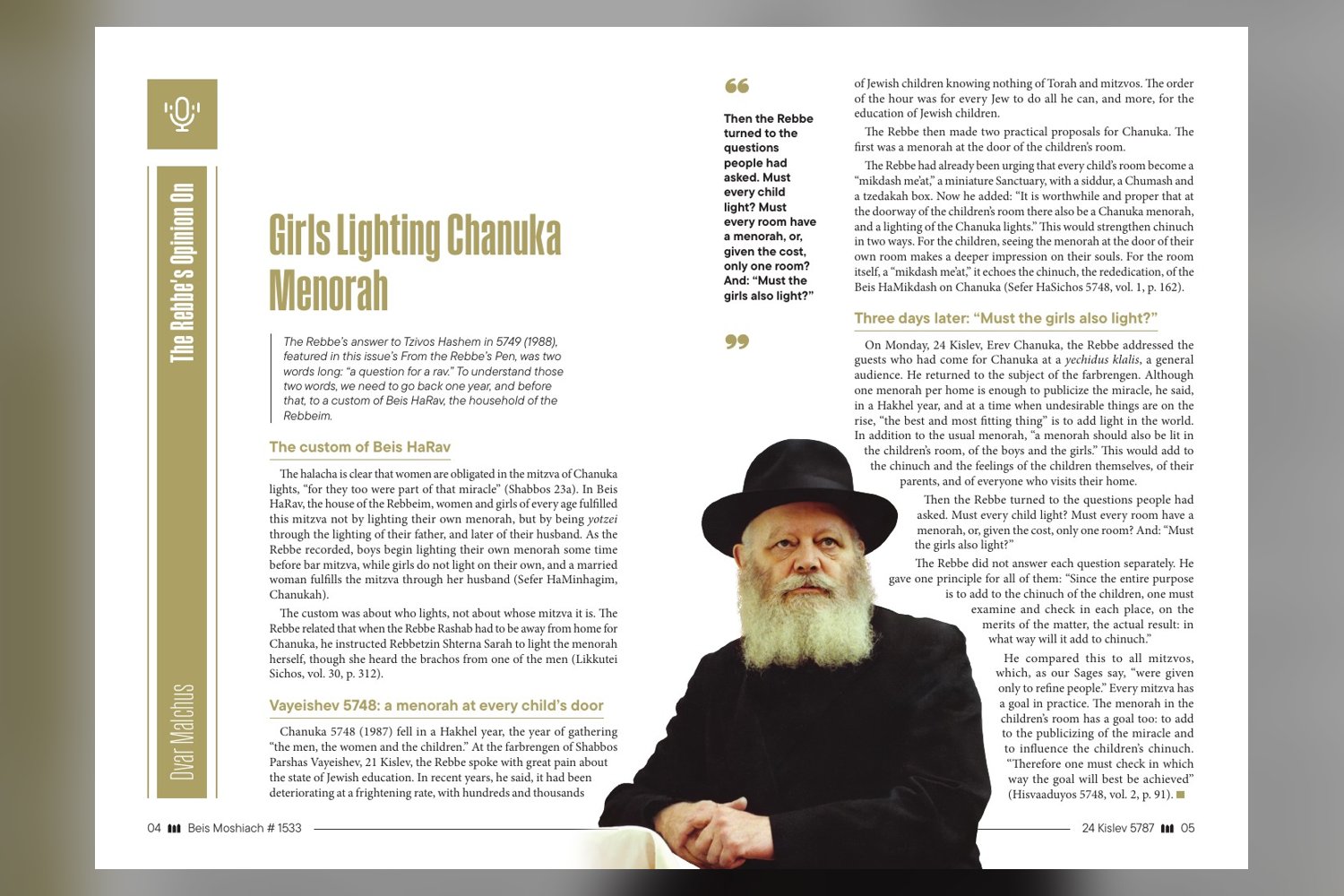
Girls Lighting Chanuka Menorah
The Rebbe’s opinion on
The Rebbe’s answer to Tzivos Hashem in 5749 (1988), featured in this issue’s From the Rebbe’s Pen, was two words long: “a question for a rav.” To understand those two words, we need to go back one year, and before that, to a custom of Beis HaRav, the household of the Rebbeim.
The custom of Beis HaRav
The halacha is clear that women are obligated in the mitzva of Chanuka lights, “for they too were part of that miracle” (Shabbos 23a). In Beis HaRav, the house of the Rebbeim, women and girls of every age fulfilled this mitzva not by lighting their own menorah, but by being yotzei through the lighting of their father, and later of their husband. As the Rebbe recorded, boys begin lighting their own menorah some time before bar mitzva, while girls do not light on their own, and a married woman fulfills the mitzva through her husband (Sefer HaMinhagim, Chanukah).
The custom was about who lights, not about whose mitzva it is. The Rebbe related that when the Rebbe Rashab had to be away from home for Chanuka, he instructed Rebbetzin Shterna Sarah to light the menorah herself, though she heard the brachos from one of the men (Likkutei Sichos, vol. 30, p. 312).
Vayeishev 5748: a menorah at every child’s door
Chanuka 5748 (1987) fell in a Hakhel year, the year of gathering “the men, the women and the children.” At the farbrengen of Shabbos Parshas Vayeishev, 21 Kislev, the Rebbe spoke with great pain about the state of Jewish education. In recent years, he said, it had been deteriorating at a frightening rate, with hundreds and thousands of Jewish children knowing nothing of Torah and mitzvos. The order of the hour was for every Jew to do all he can, and more, for the education of Jewish children.
The Rebbe then made two practical proposals for Chanuka. The first was a menorah at the door of the children’s room.
The Rebbe had already been urging that every child’s room become a “mikdash me’at,” a miniature Sanctuary, with a siddur, a Chumash and a tzedakah box. Now he added: “It is worthwhile and proper that at the doorway of the children’s room there also be a Chanuka menorah, and a lighting of the Chanuka lights.” This would strengthen chinuch in two ways. For the children, seeing the menorah at the door of their own room makes a deeper impression on their souls. For the room itself, a “mikdash me’at,” it echoes the chinuch, the rededication, of the Beis HaMikdash on Chanuka (Sefer HaSichos 5748, vol. 1, p. 162).
Three days later: “Must the girls also light?”
On Monday, 24 Kislev, Erev Chanuka, the Rebbe addressed the guests who had come for Chanuka at a yechidus klalis, a general audience. He returned to the subject of the farbrengen. Although one menorah per home is enough to publicize the miracle, he said, in a Hakhel year, and at a time when undesirable things are on the rise, “the best and most fitting thing” is to add light in the world. In addition to the usual menorah, “a menorah should also be lit in the children’s room, of the boys and the girls.” This would add to the chinuch and the feelings of the children themselves, of their parents, and of everyone who visits their home.
Then the Rebbe turned to the questions people had asked. Must every child light? Must every room have a menorah, or, given the cost, only one room? And: “Must the girls also light?”
The Rebbe did not answer each question separately. He gave one principle for all of them: “Since the entire purpose is to add to the chinuch of the children, one must examine and check in each place, on the merits of the matter, the actual result: in what way will it add to chinuch.”
He compared this to all mitzvos, which, as our Sages say, “were given only to refine people.” Every mitzva has a goal in practice. The menorah in the children’s room has a goal too: to add to the publicizing of the miracle and to influence the children’s chinuch. “Therefore one must check in which way the goal will best be achieved” (Hisvaaduyos 5748, vol. 2, p. 91).
Beis Moshiach #1533 • 24 Kislev 5787 • כ״ד כסלו תשפ״ז • pp. 4-5
© 2026 Beis Moshiach Magazine. All rights reserved.
This article originally appeared in Beis Moshiach #1533. You are welcome to share it with friends and family by email or in print, provided that you do not change, add to or omit any part of it, you credit the author and Beis Moshiach, and you include a link to archive.bmoshiach.org (written out in full in printed copies).
To republish this article in a newspaper, magazine, book or website, please request permission in advance at [email protected].