The Risks of an Emotionally Unavailable Mom
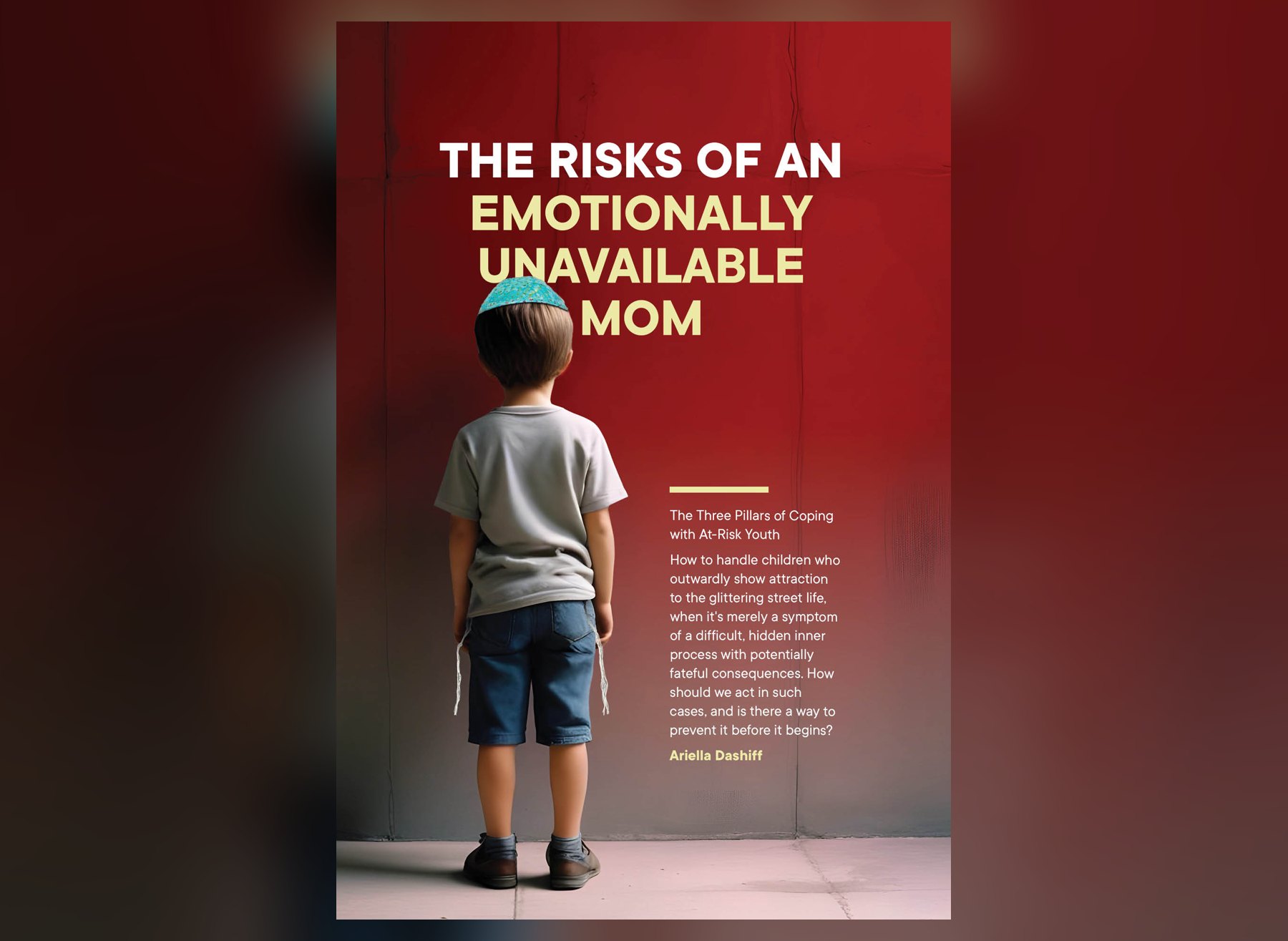
How to handle children who outwardly show attraction to the glittering street life, when it’s merely a symptom of a difficult, hidden inner process with potentially fateful consequences. How should we act in such cases, and is there a way to prevent it before it begins?
About the three foundations for dealing with children who outwardly seem attracted to the glitter of the street, but is actually only a symptom of a difficult, hidden process taking place inside them, the results of which could be fateful. How should we behave in such cases and is there a way to prevent it from happening?
The clock showed 12:45 after midnight. The little ones were long asleep. Esther had already finished polishing the windows, because she’s such a wonderful balabuste that she dedicates her nights to cleaning after an exhausting workday, but now she simply can’t fall asleep. The windows in the house are open, despite the mosquitoes, and every few minutes she visits another window and listens. Where is Maayan? We agreed she’d be back at 10:00. A 13-year-old girl roaming the streets at night. How will she wake up for school tomorrow? The anger kept rising. She can’t be trusted. She has no self-respect. What will they say in the moshav? Shame.
A little after three in the morning, the door opens quietly. Esther turns her gaze from her seat on the sofa and greets her daughter with a cold shower: “Hello, madame! Didn’t we agree you’d be back at ten? Do you know what time it is? Where were you? This can’t continue like this! You have time for friends, but you need be responsible too.” The mother’s complaints fill the room and already become part of the background scenery.
‘There’s no one to talk to,’ a thought crosses the mother’s mind, just before Maayan answers in an indifferent voice: “Nothing, just talking with friends,” and retreats to her room, locking it, leaving the living room empty. Esther knows that now she can go to sleep, but it’s a sleep that offers no rest.
The clock shows 12:45. In the afternoon. The little ones have long been at school, the mother is at work, the father is abroad, on business, and Maayan is in bed. If she gets up, it’s only to charge her smartphone.
How many painful stories like this are around us. Painful for parents, painful for children. The parents express their pain out loud, and the children, in secret. Sometimes they’re not aware of the pain, only the frustration. Sometimes they try to make it disappear, to ignore it, but even for this pain we should bless Hashem, because this pain is what will eventually lead to healing.
This article is written in tears and hope for youth who are seemingly coping alone, and the goal: mending that which is torn.
The street provides an abundance of twinkling lights, sounds, and glamour. Everything is possible, everything is allowed, just come and enjoy, take today – pay tomorrow. All the good of Eretz Mitzrayim, an endless celebration, on the outside.
That same street also provides an abundance of loneliness, inner lies, decay and mental illnesses, severe physical and emotional injuries – take today, pay tomorrow with your life’s blood and at double the price. And all these ‘attractions’ crouch at the doorstep of the home, if not inside it.
How should parents behave when they notice that their children, their dear sons and daughters, are falling into that reality that exists in our days, about which the Amoraim said “Yeisei v’lo achmineih” – let the Moshiach come, but I don’t want to be there to see it.
Turning the Wheel
Chaya Pollak, a therapist for youth and parents who need answers in this area, herself went through a very difficult path of wandering from a very young age, begging, sleeping on street benches, during which she learned the street “from the inside.”
With the Divine Providence that accompanied her, she picked herself up and rehabilitated herself. Today she works under the guidance of Shmaryahu Chen in the 12-step method, and makes every effort to raise public awareness through workshops and lectures.
Although she is relatively young, she is well-versed in the world beneath the surface, literally: the world behind the glittering street, and the emotional one, behind the faces that come to her for treatment.
The keywords in the interview with Chaya are parental availability, communication, and seeing the child. In her words:
The topic is very broad, but first I’ll say that what we see as a girl who has distanced herself from observing mitzvos, who wanders about at night, etc., is only the ‘visible process.’ There we also see a tendency to connect with low-quality company, excessive engagement with smartphones to the point of addiction, and many hours of sleep. There are no routines and taking responsibility. These are the symptoms that something is not right.
And like in physical medicine, in mental health too, if we try to treat only the symptoms, the situation gets worse. The ‘hidden process’ is actually where we need to focus, and the problem can start at a very young age, when the child’s basic needs are not met.
Every person has basic needs, physical and mental, whose fulfillment builds their personality – beyond the need to eat, drink and sleep, and they are:
The need for physical space – a permanent bed, an organized place for belongings, respect for personal items, so that they are used only with permission.
The need for mental space – to recognize the uniqueness of the individual, the child, their talents, their good deeds, and to give them a place of uniqueness in the family. As if they have a special role – the organizer or the cheerful one – to respect their wishes even if we can’t always fulfill them, but not to disregard them, and to listen to their heart’s whispers, even if they sound to us, adults, petty or unimportant.
Emotional nourishment – attention, listening, appreciation, affection and physical closeness; hugging, kissing, caressing. The soft physical touch stimulates the production of calming substances in the body.
In order to fulfill these needs, the parent needs to be available to the child, “to be there for them,” to feel and sense the child’s needs and feelings, to listen to their words and together try to reach a solution or meet the need through conversation.
In fact, these are very simple and small things that we need to pay more attention to: a shirt with the smell of detergent, the smell of home cooking, listening to the girl’s chatter when she comes back from school and being interested: what happened, what was fun, who did she sit next to, admiring a drawing of a girl in kindergarten and other similar things.
Education for Responsibility or Irresponsible Imposition
Chaya continues: Besides what I mentioned before, when parents are not emotionally available because they are too busy taking care of the house, work or, G-d forbid, a sick child, or their own personal difficulties, a more extreme situation can also arise, when the parent ‘throws’ responsibility on the child that is not appropriate for their role as a child in the family. For example, when parents impose responsibility for their younger siblings on their child when they themselves have not yet passed the age of ten.
There is a big difference between educating for responsibility and imposing responsibility. When educating for responsibility, the responsibility is the parent’s and the results are the parent’s responsibility, and if the child did not fulfill their role, we don’t get angry with them, but get them to do it – preferably with kindness, or we do it ourselves. There is supervision.
If we throw responsibility on the child that is not age-appropriate, it hurts them emotionally. They are not a parent! There is a distortion of boundaries here.
According to Chaya, the cause of the distancing of boys and girls from observing Torah and mitzvos does not stem from deep philosophical reflections and far-reaching thoughts, but much more earthy and close, “The way the parent or school mediates the Torah and mitzvos,” as Chaya defines it:
The greatest enemy of observing Torah and mitzvos is the negative feelings that are transmitted along with observing the mitzvos and guidance for them, feelings like fear, pressure, guilt.
Fear is the most common negative emotion that is transmitted along with guidance for observing Torah and mitzvos; fear of punishment, fear of G-d who looks for sins, fear that the shidduch will be ruined, fear of parents’ reaction, of ridicule from the environment.
The guidance for observing Torah and mitzvos should be done with joy and vitality, with lots of praise, to generate positive conditioning for the child, so that observing mitzvos will connect in their consciousness with fun and joy; and it’s never too late to open the door again.
Let’s all take Chaya’s words to heart and may we merit a good year, a good change, opening a new and happy page.
WITH LOVE
Hodaya is a mother of six, and her oldest daughter is already a teenager. What she learned from her own experience during the period when she was “off,” she applies in her home – and with great success.
Hodaya grew up in a standard frum home, supportive, loving and organized. Her parents tried to provide for all her needs and seemingly she lacked nothing.
“When I grew up,” Hodaya recounts, “I felt that there were things ‘I didn’t feel like doing,’ in matters of Yiddishkeit; I didn’t feel like wearing modest clothes, and why do we have to be so crazy about keeping Shabbos, and so on. The typical reaction in such cases was not long in coming: anger, arguments, coercion. In short, the relationship between me and my parents took a very unsympathetic direction, and I felt that they really didn’t understand me, that they didn’t see me. I missed their warmth and love, but I was willing not to receive that in exchange for independence, because at that moment I was like that and I wanted them to love me and respect me as I am, to accept the fact that this is how I chose.
I found outside what I was missing at home: they accepted me as I am, without preconditions and in a good mood even if I didn’t behave exactly as written in the book (simply because on the street there is no book).
Slowly I started to connect with a group that was in a similar situation to mine, we hung out a lot at night – in the city, in public gardens, and other dubious places.
It’s very important for me to note that I had red lines, those that I felt I could never cross. I never walked around in pants and didn’t travel on Shabbos, and I know that the fact that I had boundaries is thanks to all the good things they did provide me at home. After all, I came from a good home, with values, a home where they cared as much as they could for all my needs.
I remember that during that period my father would approach me without anger, with love, and say to me: “Hodaya’le, always remember that you are a bas Yisrael and that daddy always loves you.”
Over time I felt that what I had outside didn’t fulfill me, and I understood that this wasn’t what I was looking for. By Divine Providence, Chabad opened a midrasha for women and girls in our settlement, and brought Rabbi Yair Calev to teach Tanya, of course with the guitar.
I could come there exactly as I was, and no one said anything to me. On the contrary, the ones running it welcomed me cheerfully and invited me to come again and again. Rabbi Calev’s classes filled me with meaning and encouragement. I felt that the niggunim and the Tanya were cleaning me from within and giving me back my vitality and good feeling about myself. When I would take a step forward, even a small one, they encouraged and spurred me on to continue, and if I fell – it’s okay, they believed in me that surely the good in me would win. Rabbi Calev really revolutionized me on the inside.
Today my husband and I run our home with lots of encouragement, warmth and respect for the children, and I see the difference in my children. They are so proud when they perform a mitzva and come to tell me. I have a teenage daughter, and we are very close, and when she tells me: “Ma, I have friends who don’t love their mother,” it’s quite painful to hear.
DOING TESHUVA
Shoshana says:
The home where I raised my children was a very difficult home. My ‘method’ of education was punishment for every deviation from the straight path. I didn’t know at all how to raise a child, how to illuminate the good in them, everything was functional. Needless to say, this was also the relationship between me and my husband. Strong and happy children didn’t grow up in our home and we really didn’t understand why. When the oldest daughter started her search in other places, we panicked and pressed hard in response. It didn’t help, on the contrary. And then it dawned on us: we need guidance.
We started a process that took time and today, we are raising the younger ones completely differently and we see the results. We also opened our hearts towards the older one and brought her into it. She hasn’t yet done teshuva, but there is love and peace between us, and this is also a chazara b’teshuva.
Beis Moshiach #1432 • pp. 42-45, 46
© 2026 Beis Moshiach Magazine. All rights reserved.
This article originally appeared in Beis Moshiach #1432. You are welcome to share it with friends and family by email or in print, provided that you do not change, add to or omit any part of it, you credit the author and Beis Moshiach, and you include a link to archive.bmoshiach.org (written out in full in printed copies).
To republish this article in a newspaper, magazine, book or website, please request permission in advance at [email protected].