Family Chanuka Games
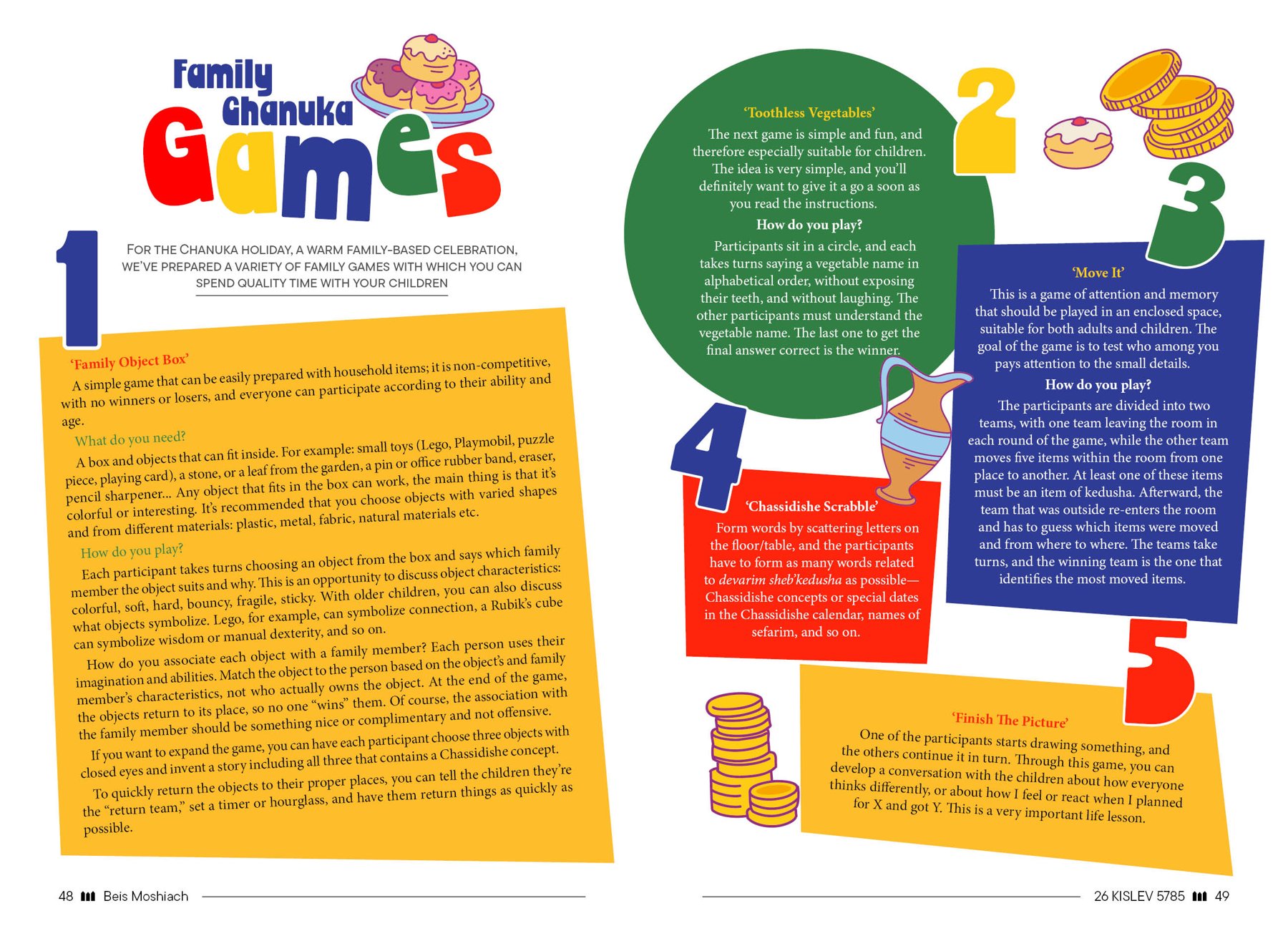
For the Chanuka holiday, a warm family-based celebration, we’ve prepared a variety of family games with which you can spend quality time with your children
‘Family Object Box’
A simple game that can be easily prepared with household items; it is non-competitive, with no winners or losers, and everyone can participate according to their ability and age.
What do you need?
A box and objects that can fit inside. For example: small toys (Lego, Playmobil, puzzle piece, playing card), a stone, or a leaf from the garden, a pin or office rubber band, eraser, pencil sharpener… Any object that fits in the box can work, the main thing is that it’s colorful or interesting. It’s recommended that you choose objects with varied shapes and from different materials: plastic, metal, fabric, natural materials etc.
How do you play?
Each participant takes turns choosing an object from the box and says which family member the object suits and why. This is an opportunity to discuss object characteristics: colorful, soft, hard, bouncy, fragile, sticky. With older children, you can also discuss what objects symbolize. Lego, for example, can symbolize connection, a Rubik’s cube can symbolize wisdom or manual dexterity, and so on.
How do you associate each object with a family member? Each person uses their imagination and abilities. Match the object to the person based on the object’s and family member’s characteristics, not who actually owns the object. At the end of the game, the objects return to its place, so no one “wins” them. Of course, the association with the family member should be something nice or complimentary and not offensive.
If you want to expand the game, you can have each participant choose three objects with closed eyes and invent a story including all three that contains a Chassidishe concept.
To quickly return the objects to their proper places, you can tell the children they’re the “return team,” set a timer or hourglass, and have them return things as quickly as possible.
Mrs. Yael Lavie Pitaro, an occupational therapist, talks about the contribution and importance of games and play.
Educational importance: Developing attention, concentration, thinking ability, and memory.
Physical importance: Developing gross and fine motor skills.
Cognitive importance: Encouraging problem-solving ability and developing imagination.
Social importance: Understanding rules, delaying gratification, encouraging cooperation, social norms, roles, understanding the environment, and recognizing the desires of others.
‘How Well Do You Know Me’
An empowering and heartwarming game that teaches the need to step into someone else’s shoes and see the good in them, allowing openness and the discovery of things you didn’t know about your loved ones.
What do you need?
Papers and pens, pencils, or markers
How do you play?
Draw a chart with the following columns: Name, Outstanding Good Trait, Favorite Food, Favorite Color, Respected Person, and Wish. In each round of the game, fill in the table regarding one family member, in order. The person being written about also writes about themselves, and at the end of each round, everyone reads what they wrote, and the degree of similarity is checked. You can add columns like: Talent, Words Often Used, Favorite Place of Residence, and more, as your imagination allows.
‘Toothless Vegetables’
The next game is simple and fun, and therefore especially suitable for children. The idea is very simple, and you’ll definitely want to give it a go a soon as you read the instructions.
How do you play?
Participants sit in a circle, and each takes turns saying a vegetable name in alphabetical order, without exposing their teeth, and without laughing. The other participants must understand the vegetable name. The last one to get the final answer correct is the winner.
‘Move It’
This is a game of attention and memory that should be played in an enclosed space, suitable for both adults and children. The goal of the game is to test who among you pays attention to the small details.
How do you play?
The participants are divided into two teams, with one team leaving the room in each round of the game, while the other team moves five items within the room from one place to another. At least one of these items must be an item of kedusha. Afterward, the team that was outside re-enters the room and has to guess which items were moved and from where to where. The teams take turns, and the winning team is the one that identifies the most moved items.
‘Chassidishe Scrabble’
Form words by scattering letters on the floor/table, and the participants have to form as many words related to devarim sheb’kedusha as possible—Chassidishe concepts or special dates in the Chassidishe calendar, names of sefarim, and so on.
‘Finish The Picture’
One of the participants starts drawing something, and the others continue it in turn. Through this game, you can develop a conversation with the children about how everyone thinks differently, or about how I feel or react when I planned for X and got Y. This is a very important life lesson.
‘Insights & Memories’
Scatter on the floor or table: objects/photos, and each participant is invited to take an object or photo and share an insight, memory, wish, or Chassidishe story related to the object in their hand.
Beis Moshiach #1440 • pp. 48-50
© 2026 Beis Moshiach Magazine. All rights reserved.
This article originally appeared in Beis Moshiach #1440. You are welcome to share it with friends and family by email or in print, provided that you do not change, add to or omit any part of it, you credit the author and Beis Moshiach, and you include a link to archive.bmoshiach.org (written out in full in printed copies).
To republish this article in a newspaper, magazine, book or website, please request permission in advance at [email protected].