The Dayan in the D9
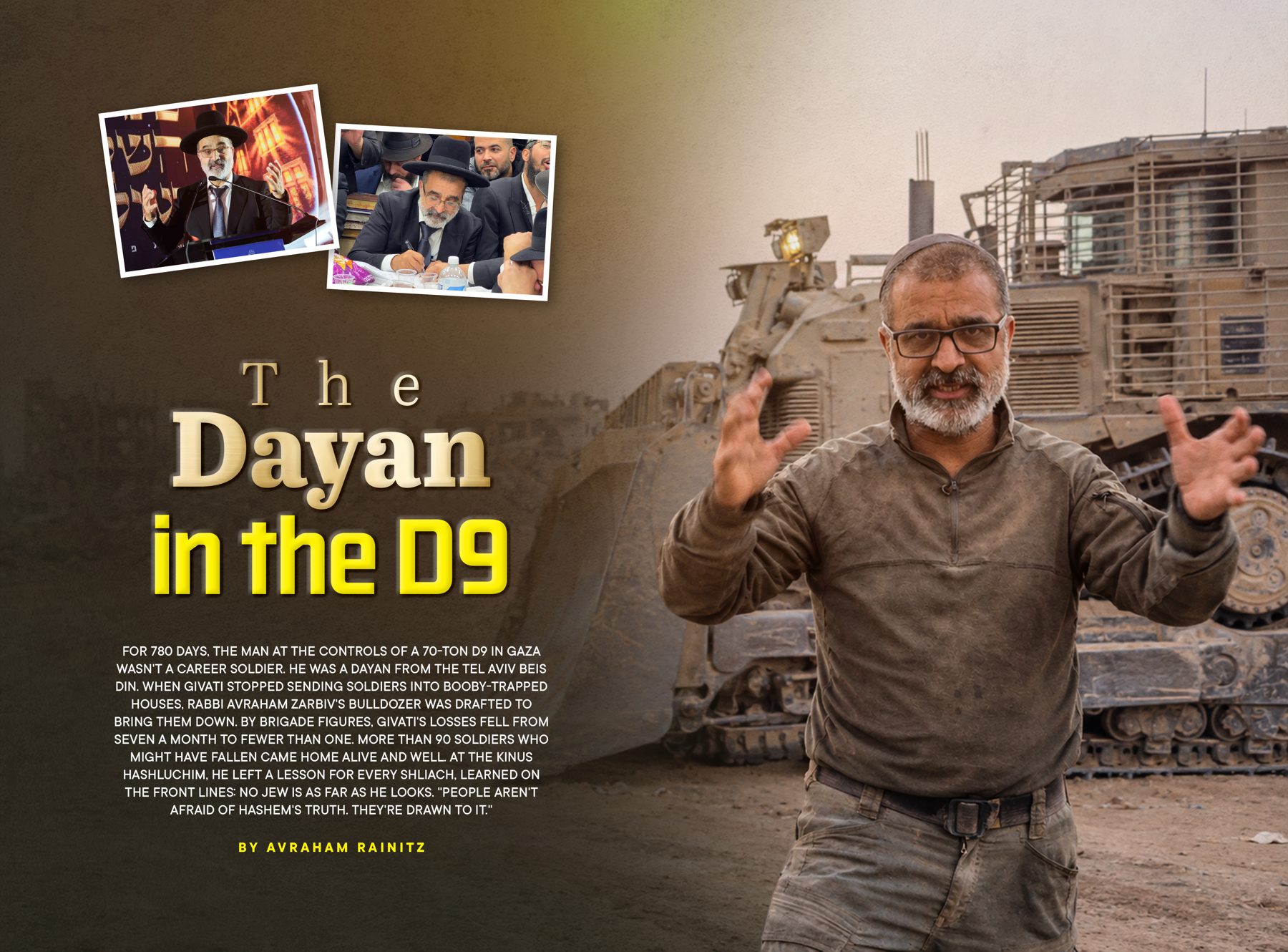
For 780 days, the man at the controls of a 70-ton D9 in Gaza wasn’t a career soldier. He was a dayan from the Tel Aviv beis din. When Givati stopped sending soldiers into booby-trapped houses, Rabbi Avraham Zarbiv’s bulldozer was drafted to bring them down. By brigade figures, Givati’s losses fell from seven a month to fewer than one. More than 90 soldiers who might have fallen came home alive and well. At the Kinus HaShluchim, he left a lesson for every shliach, learned on the front lines: no Jew is as far as he looks. “People aren’t afraid of Hashem’s truth. They’re drawn to it.”
Shabbos in Jabaliya is drawing toward evening. Since morning, Rabbi Avraham Zarbiv has sat alone in the bulldozer cabin. He has yet to taste anything and his hands and clothes are soaked in hydraulic oil. Before him stands the last building of the day: a long, five-story house resting on pillars.
His method follows a fixed order. He strikes the first pillar and pulls back, moves to the next, and continues to the last. When the house refuses to fall, he builds a ramp of sand, climbs it to ceiling height, and begins pushing at a steady rhythm, shove after shove. “The swinging method,” he calls it. It is work only for the brave, he attests, and is far scarier than an RPG, because no one knows in advance whether the house will fall forward or backward.
He pushes again and again, and suddenly all five stories collapse at once, all of them onto his blade. Five ceilings land on the vehicle. The seventy-ton bulldozer is lifted off the ground, and R’ Zarbiv feels himself being sucked into the first floor. It all happens in seconds, and in those seconds he makes one request of the Holy One, blessed be He: “Just not this.”

It was not the first time he had found himself under a five-story building, and precisely those moments, he says, were the hardest of all. “If I had a breaking point in this war, it was in those moments. Not the RPG, but the moment when you are suddenly alone under the ceilings, in the dark.”
He shifts into reverse, wrestles with the sticks, pushes, and suddenly breaks free. The bulldozer, which had been hanging in the air, lands with a thud on its tracks. A thick cloud of dust covers the area, and through it the company commander can see nothing. Over the radio he calls “Dubi Zarbiv,” the D9 (heavy duty bulldozer)’s call sign on the net (dubi=“teddy bear” in Hebrew), to take down one more house and close out the day. The answer comes immediately: “Dubi Zarbiv? Ask me first whether I’m alive.” It is followed by a request for a ten-minute break: Mincha and the third Shabbos meal.
And so, in the heart of the battlefield, a dayan of the Beis Din Rabbani in Tel Aviv davens Mincha of Shabbos. To the shluchim he testifies that none of them ever prayed “You are One and Your Name is One, and who is like Your people Israel, one nation on earth” as he prayed it at that moment.
The Rebbe’s Sirtuk
This is how the war years of Rabbi Avraham Zarbiv looked: a dayan who set aside his seat on the bench for a time and with no prior training, entered the cabin of the heaviest vehicle on the battlefield. He served more than seven hundred and eighty days of reserve duty in the war. At the Kinus HaShluchim this year, he spoke at the banquet and delivered a long address to the shluchim, and nearly every story he told ended in the same place: with Hashem.
He opened his speech with a confession. Had someone asked him two and a half weeks earlier whether he would stand on this stage, he said, there was no chance of it. The thought never crossed his mind. He had never left Eretz Yisrael and had never wanted to.
Then, in those very days, he attended the wedding of a relative, a Chabad Chassid. The guests danced before the chassan and led him to the chuppa, and in the midst of the celebration R’ Zarbiv noticed a detail that did not fit: the chassan was wearing a torn sirtuk covered in patches. A chassan in a patched garment on his wedding day? He went over to ask about it and the chassan answered in a single sentence: “It’s the Rebbe’s.” R’ Zarbiv was deeply moved. He continued to accompany the chassan to the chuppa, touching the fabric of the Rebbe’s sirtuk with reverence the whole way. When, the next day, Rabbi Elazar Peretz, a shliach of the Rebbe in Netanya, phoned him and invited him, on behalf of the Kinus committee, to come to the Rebbe and speak at the Kinus HaShluchim, he suddenly realized that the Rebbe had sensed him and had invited him. “And when the Rebbe invites, you come!” he says.
One Shekel, One Chitas
At the start of the war, before he went into Gaza, a Chabad Chasid approached him and handed him a coin, to make him a shliach mitzva. R’ Zarbiv was puzzled: he was going to war, where every step is a mitzva anyway, so what was the point of a shekel? Still, he took it. To those around him, who wondered why he accepted the coin after making a valid argument, he said that the man wanted to be a partner. The real reason he revealed only from the stage: “He is a shliach of the Rebbe. Before a war, am I going to get into trouble with the Rebbe?”
The story was forgotten until last year, when Rabbi Dov Halperin invited him to speak on Yud-Tes Kislev in Kfar Chabad. During the conversation Rabbi Zarbiv remembered the coin and also remembered where he had put it: in the small pocket of his ammunition belt. Two and a half years later he checked, and the shekel was still there. For him the conclusion was clear: he had to go to Kfar Chabad, complete the shlichus, and give the coin to tzedaka. And so he did.
Another story took place in Jabaliya, a year after the war broke out. In one of the apartments, R’ Zarbiv found a Chitas. Perhaps soldiers had left it there, he surmises; either way, a sefer like that must not be left behind and he took it in order to put it in a geniza. At the last moment he decided to keep it with him, and placed it in the tool bag inside the D9. Ever since, the sefer has accompanied him.
“This Chitas took dozens of RPG hits and dozens of explosive charges, and survived everything,” he says. Only at the end of the war, when he took it out of the vehicle, did someone tell him that a Chitas sefer is a segula for shemira and hatzala. Since then it has remained in his car.
A Private Pre-Army Preparatory Program
How does a dayan, a talmid chacham whose work sometimes touches on matters of pikuach nefesh, vanish from the Beis Din for three years? Part of the answer begins precisely a year before the war.
A year before it broke out, the day after Isru Chag Sukkos 5783 (2022), he was transferred, against his wishes, from the Beis Din in Ariel to the Beis Din in Tel Aviv. The first drive to Tel Aviv took four hours: he left at seven and arrived at eleven. To enter the city, he jokes, you need an entire division.
On the way back, one of his rabbi friends phoned him, and R’ Zarbiv poured out his heart. The friend offered practical advice: leave early, daven in Tel Aviv, and with the time remaining before the Beis Din opens, go to the ocean, swim and run, in the spirit of “a healthy and whole body is among the ways of serving Hashem.” R’ Zarbiv replied that he didn’t know how to swim, being a Yerushalmi, and was told he would learn. The next day, at six-thirty in the morning, a swimming instructor was already waiting for him.
From that day on he left home at five in the morning, davened with the vasikin minyan in Tel Aviv, and ran and swam in the sea for twenty minutes every day. He lost ten kilograms, developed a level of fitness he had never known, and arrived at the war in peak condition.
His mother saw in this a remarkable act of hashgacha pratis. That entire year, she told him, was nothing but preparation: he had had his own “pre-army preparatory program.” Without that year, he would not have been able to operate the D9 day after day, almost without a break.
Erev Shavuos in Rafah
A few months after the war broke out, the commander of the Givati Brigade made a decision that R’ Zarbiv calls “out of the box.” He identified that the engineering equipment companies (TZaMaH=tziyud mechonei handasa), the heavy bulldozers and Bagger excavators, had become a bottleneck. Every brigade needs them, and they are not always available. He decided to establish such a company within the brigade itself, with operators drawn from his own soldiers. The commander assigned the task to graduates of the Givati reconnaissance unit, R’ Zarbiv among them.
At first the company operated like any engineering equipment company: it opened routes ahead of the tanks so that the charges would explode on the blade, built embankments to protect the soldiers, and breached openings in buildings so that the fighters could enter and clear them. So it continued until Erev Shavuos 5784 (2024). That day, in Rafah, a Givati company commander went up into a building with a team of young fighters, after a dog, a drone etc. had been sent in ahead of them. The fighters stepped onto a field of explosive charges, the house collapsed, five of them were killed and ten wounded. R’ Zarbiv describes the disaster as one of the hardest the brigade ever knew.
In the wake of the tragedy, the Givati commander made what R’ Zarbiv calls “the most strategic decision of the entire war”: from now on, no one enters buildings. A suspicious structure is brought down from the outside and the fighters do not walk into the trap. It was a real revolution, he says. Some habits are like DNA and changing a method that had worked for decades is an extremely difficult process. Even good people did not understand it, and he himself, at the start of the war, never imagined such a thing.
To grasp the significance of the decision, he explains the enemy’s plan. Dozens of kilometers of tunnels and thousands of shafts were built for one purpose: to draw the IDF inside, into the alleys. A terrorist emerges from a shaft and throws a charge, and seven fighters are killed; another sticks a charge to a tank, and four are killed. That is what the first months looked like, he recalls, when roughly ten “cleared for publication” notices were released every day.
The new method, in his words, shattered the enemy’s entire doctrine of combat, and wherever it was applied the numbers of dead and wounded dropped almost to zero. According to brigade figures he cites, until the company began operating this way Givati lost an average of about seven fighters a month to enemy fire; since then the average has fallen to 0.43.
“In the eighteen months we worked in the Strip with the Givati Brigade, more than ninety fighters came home thanks to this action. This is not my statistic, but the brigade’s,” he says. Across the whole army, he adds, we are talking about hundreds. According to him, this drop is what made it possible to continue the campaign until the hostages returned, with the help of Heaven.
And all of this, he stresses, was nothing but siyata d’shmaya, which resulted from a single order: do not enter buildings.
An Insight from the Playground
He learned to operate the D9 almost entirely on his own. No one trained them, he says. An experienced operator sat beside him, and he tried a little at a time, like a child who takes his father’s car in the parking lot: reversing, raising the blade, lowering it, slowly, slowly. One day they told him he was going out on an operation as an operator.
Later he noticed tall buildings that no one had touched, and began bringing those down too. It is a complicated task: concrete beams fall on the vehicle, and the D9, whose height is about that of a first floor, does not let you see the top of a building of five, six, or even eight stories. When it was pointed out to him that, by the Engineering Corps rule, a bulldozer brings down one floor and a professional operator two, he replied with a smile that at his age he can’t see beyond two floors anyway. A quick-witted bystander immediately recalled the rule “A dayan has only what his eyes see.” And his father, a big talmid chacham, found a hint of his own in it: dayan (dayan) and dee-nine (“D9”), the same letters in Hebrew.
The method he became known for was born, of all places, on vacation. Before Sukkos 5785, the Givati Brigade was moved from Rafah to Jabaliya, and R’ Zarbiv went home for the first day of Sukkos. After davening vasikin his wife asked him to take the grandchildren to the playground.
One of his granddaughters asked him to push her on the swing. As usual, you push, and give the next push only at the end of the motion. The granddaughter asked for more and more, harder, and then he understood: when he pushes a house with the D9, he does it wrong, with short, successive blows. You have to swing the house and let it complete the whole motion, because what brings down a tall building is its own weight. Whoever stops the motion before it ends wastes a great deal of energy.
He went back home, found the family sitting on the couch, and announced: “I got an insight from Heaven!” They thought he had lost his mind, he says.
“What Do You Want From Me?”
Even earlier, on Erev Rosh Hashana 5785, the company was operating in Tel Sultan in Rafah, as part of the search for Sinwar. After the murder of the six hostages, traces of his DNA were found in a tunnel, and the forces understood that he was in the area. A few days before the chag they were ordered to dig a large trench that would reach the tunnel at a depth of thirty meters.
R’ Zarbiv, who had already been in the field for two weeks, informed his commander in advance that for Rosh Hashana he had to be home: he has a shul, and his mother was coming to him for Yom Tov. At twelve-thirty a loader arrived, a wheeled tractor, and the commander instructed the driver to take him and his bag on the bucket and bring him to Kerem Shalom, where his car was parked.
At the car he discovered that the bag had stayed in the loader’s bucket, which was already on its way back. By the time a jeep was sent to fetch it, it was two-thirty. Dusty and soiled with hydraulic oil after two weeks in the field, he got into the car, entered the code, and pressed, and nothing happened. The battery was completely dead, and not even the familiar click of the starter was heard.
He got out of the car, raised his hands, and put a simple question to G-d: What do You want from me? He could have left yesterday, and he stayed until one in the afternoon for the sake of the Almighty and His war against the enemies of Israel. And he immediately added: “Ribono shel olam, if You think I’ll get angry, I’m not getting angry. On Erev Rosh Hashana I don’t get angry. I’m with You.”
At that moment a student of his appeared, a fighter in the Oketz unit, and asked what he was doing there. Hearing that the Rabbi was stuck, he asked to try himself, entered the code and pressed the starter, and the car started.
The end of the story he regards as the main point: on motzoei Shabbos after Yom Tov the car would not start, nor on Sunday, and only a mechanic who replaced the dead battery solved the problem. At that moment, he says, the car started because he had spoken with Hashem and was moser nefesh.
Good Morning, Jabaliya
The Givati Brigade entered Jabaliya a few days before Hoshana Rabba 5785, and R’ Zarbiv joined it on erev Yom Tov. That night, in an apartment in Jabaliya, he recited the Tikkun Leil Hoshana Rabba and read Sefer Devarim, and in the morning he took the lulav and davened. Then he pulled aside the blankets hung over the window for blackout and looked outside. A year after the war broke out, he saw before him a built-up city, shops and houses, and was overcome by despair: where do you even begin?
That same day, a few minutes after setting out to work with the battalion commander, he absorbed what he calls “the explosion of a lifetime”: a ball of fire on the cabin window, so powerful that he felt his own body to make sure he was alive. Boruch Hashem, he told himself, I can continue. Over the radio net it was reported that Dubi Zarbiv had taken an RPG and was intact. The battalion commander ordered him to pull back, because the instruments had detected another launch. He retreated into an alley, and at that very moment took the second missile. He later found the remains of the missile, and in the video he filmed he is seen standing inside the D9 holding them, thanking the Holy One and reciting the blessing “Boruch podeh u’matzil.” He never forgot to give thanks, he says. And for him, that was “Good morning, Jabaliya.”
The battles that followed were among the hardest of the war. Thousands of terrorists remained in the area, surrounded, fighting for their lives, in battles that, he says, cannot be described. For two months, every evening, when he returned to the apartment, he checked whether all his comrades had come back, because he knew what he himself had been through.
One date stays in his mind: 6 Kislev 5785. Returning from an attack, he noticed that beside the “magnan,” the structure where they slept, a five-story house was still standing. He asked the company commander on the radio why, and went over to the house. When he brought down the last pillar, half the house collapsed. He pulled back, got out of the vehicle with a friend to clear the fallen blocks off it, and called to the Bagger operator to lift a large concrete beam.
As the Bagger approached, he heard a whisper, “Allahu Akbar.” The first time he attributed it to imagination, and likewise the second. But then, from a distance of twenty meters, fire was opened on them, and he saw bullets striking between his legs. He grabbed his friend and leapt with him into the D9, which was shielded from fire. Both survived.
The forces advanced and completed the mission. Only in the last month, in a conversation with the division commander, did he hear the full picture: the terrorist had been lying in ambush near the magnan, and had they not run into him, he would have penetrated it at night and Hashem yishmor the consequences of such an infiltration. The division commander defined it in a single word: a miracle.
In the confusion of combat, several days passed before he remembered that he had not made a video of thanks. By hashgacha pratis, he filmed it on Yud-Tes Kislev, opened by stating the date, recounted what happened on 6 Kislev, and ended by thanking the Master of the Universe. At that time, he admits, he was not thinking about Chabad at all and did not connect the two.
From Jabaliya the brigade moved to Beit Hanoun. Forty-five fighters fell there, and a year and a half after the war’s outbreak the place was still undecided. On the day Givati entered it, five fighters of the Chareidi Nahal were killed, and the brigade received an order to bring about a decisive conclusion. The problem was underground: the terrorists kept emerging from beneath the earth. The solution was found by one of the operators, who he describes as a very simple Jew.
He asked the battalion commander where the home of the enemy’s battalion commander had been, and was told the house had been bombed at the start of the war. But the operator insisted: if there is a battalion commander’s house, there is a shaft beneath it. He opened a map, drove out with a friend, started digging, and after two hours found a staircase. There, says R’ Zarbiv, the real conquest of lower Beit Hanoun began. Not sophisticated intelligence, he stresses, but the common sense of a simple Jew, and great siyata d’shmaya.
One day during the fighting, R’ Zarbiv met the Chief of Staff beside the D9. He climbed down from the vehicle, filthy from head to toe, and went over to greet him. These were hard days, a few months before the return of the hostages, and he told the Chief of Staff what was on his heart: “The Holy One, blessed be He, does not give half-things. He gives only complete things.” The Holy One had given victory over Iran and over Hezbollah, he added, and would give it here too; therefore we must not break, and the fighters are with him to the end. Commanders too, he tells the shluchim, need strengthening.
Living on the Edge
On Pesach, a year and a half after the war broke out, his wife asked him to transfer money through the bank’s app, and it turned out he didn’t remember the code: for a year and a half he had not logged into the account. The house, the bank, everything else did not interest him, he explains. He wanted to win the war.
The company quickly realized that repairing the vehicles in the field was also a critical point. In the regular Engineering Corps, a vehicle that breaks down goes out for repair for three or four days. The company’s people learned to repair on their own, and he himself replaced engine belts, filters, tilt-dozer hoses, and pistons, and also welded.
The expenses were high, and a large part of them he paid out of his own pocket. He explains this through the passuk, “with all your heart, with all your soul, and with all your might”: it is one mitzva, and whoever is willing to give his life does not set a limit on his money either. By the end of the war his account was almost overdrawn. When the hall burst into applause, he hurried to stop it: every shliach in his own Chabad House, he said, knows this day after day. For him it was the first time.
Only the Spiritual Endures
From the start of the war he took care to distribute short videos of thanks to Hashem for the miracles and wonders. At first he sent videos of three or four minutes on WhatsApp, and later someone opened a Facebook account for him. When he saw four hundred views one day, he wondered when he had ever given a class to four hundred people. Then they suggested TikTok, a word he says he had never heard before. The account was opened, and with Divine help each video reached hundreds of thousands of views, some a million or more.

For three years he almost never opened a sefer. He managed shnayim mikra v’echad Targum, and beside his bed lay volume three of the Mishna Berura. He began studying siman 308, the laws of muktza: he began the war at paragraph 1 and finished it in the middle of that same paragraph. Every night he opened the sefer, fell asleep after half a line, and the sefer closed on his face. Total exhaustion, he explains.
When his wife asked how he held up physically, he reminded her of the words of the Arizal in Shaar HaPesukim about the manna that fell in the desert. The Arizal asks how spiritual food can nourish the body, and answers that sometimes spiritual nourishment sustains the physical as well.
Then he told her: “The consciousness of the mission is what nourishes me.” He was, as he puts it, like a spring, a bomb of energy that cannot be explained physically and was not age appropriate.
His book, Ad HaNitzachon (“Until Victory”), he likewise does not see as a book of stories, but as a book publicizing the miracles and wonders and expressing Hashem’s love for us at this time.
A young woman he does not know wrote to him that she had read it from cover to cover over Shabbos, and that she had never gained yiras shomayim from anything else as she did from reading it. Letters like this, he says, came by the dozens, because Hashem speaks from within the book.
Tefillin on Shabbos, Tzitzis in Lebanon
Many of his stories deal with the rare spiritual awakening sweeping the entire Jewish people, across all its sectors. One Shabbos in Jabaliya he entered an apartment and found a soldier putting on tefillin. For a moment he thought he had mixed up the days, but no: it was Shabbos, and he himself had already davened Musaf and made Kiddush. The soldier did not understand what he was talking about. It turned out he hadn’t put on tefillin since his bar mitzva; during the war he decided to come back, searched online, and found a donor who gave him tefillin on one condition: that he put them on every day. R’ Zarbiv explained to him, of course, that one does not put on tefillin on Shabbos, but he was full of admiration for a Jew who had been so far and had become so close.
In Lebanon, in the village of Al-Khiam, he was sent to extract a Bagger that a house had collapsed on. When he got down from the bulldozer he saw many young soldiers in vests and helmets, with tzitzis. He was sure he had stumbled into a platoon of hesder yeshiva students, and asked one of them which yeshiva they learned in. The soldier replied that he had studied at Makif Bet high school in Ramla, and that none of them was religious. And when asked about the tzitzis, he answered in surprise that it’s a war, and everyone wears tzitzis, for divine protection.
When he told this story in Yokneam, a couple from Kibbutz Dalia, of the Hashomer Hatzair circles, approached him at the end of the talk. The wife said that at the start of the war she had experienced a spiritual awakening and began keeping Shabbos, and, without knowing how it is done, bought an urn and a hotplate. Later her husband joined her and decided to put on tefillin. Now he puts on tefillin every day, eats kosher, and goes to Torah classes, but, as she made sure to emphasize in order to tease him, he is “not religious.” He doesn’t want labels, R’ Zarbiv explains; he tries to keep the entire Torah, as long as no one calls him religious. There is Hashem in our midst, he says again and again, truly, there is Hashem in our midst.
Every month of Elul he went around with a shofar and blew it wherever he saw soldiers, and they gathered around him even in the middle of a battle. When he arrived at bases, they immediately asked him for a dvar Torah. From this he learned a lesson that he wants to pass on to the shluchim as well: “People are not afraid of the truth of the Holy One, blessed be He. They are drawn to it.” Sometimes, he says, we worry about how we will look, but the truth is the root of a Jew’s soul, the ‘food’ that suits it, and it is drawn to it.
Is Hashem in Our Midst?
The last story in the lecture he took from his childhood. When he was in sixth or seventh grade, snow fell in Yerushalayim and the Talmud Torah closed. His father, rosh kollel in the Idra of Rabbi Goren, took him on foot from Kiryat Moshe to the kollel, and in the afternoon it turned out that Rabbi Goren also loves snow: he came that day to give a shiur.
In that shiur, Rabbi Goren related that on the first day of the Six-Day War he instructed his driver to drive to Gaza. Asked what the connection was, he recalled Shimshon HaGibor, who in Gaza, on the hardest day, prayed: “Remember me, please, and strengthen me, please, just this once, O Hashem.”
Forty-five years later, on a long drive in the D9 in Jabaliya, R’ Zarbiv remembered that shiur and the passuk in which Yaakov Avinu blesses shevet Dan: “For Your salvation I have hoped, O Lord.” Rashi and the Targum say this tefilla was said about Shimshon. Since then, he says, that passuk was his soundtrack in the war, echoing in his head without pause. At the end of the lecture someone in the audience remarked that D9 is an acronym for Dan.
At the banquet he wanted to leave the shluchim with one dvar Torah, from the Netziv. In Parashas Beshalach the Jewish people ask, “Is Hashem in our midst, or not?” The Netziv wonders how a generation that had seen the pillar of fire, the pillar of cloud, and manna from heaven could ask this, and answers that the question did not concern that generation. It concerned the time when they would enter Eretz Yisrael and have to fight, sow and plow, settle, go out on shlichuyos, exert themselves and persuade Jews. Would Hashem be in their midst then too?
The answer, according to the Netziv, was given a thousand years later, on Purim. All the details fell into place: Vashti, the tree, Haman’s house, the first banquet and the second banquet. Am Yisrael saw that Hashem is in their midst. And for this reason they accepted the Torah out of love: “They re-accepted it in the days of Achashveriosh.”
“We are in a period of ‘Hashem is in our midst,’ and Am Yisrael are accepting the Torah out of love,” he told the shluchim. “More than a thousand shluchim of the Rebbe are sitting here, and our task is to reap the fruits.”
To the shluchim at the far ends of the earth he recalled the moments when it seems there is no chance: no chance of opening a Chabad House, no chance of leading an initiative, the donations vanish, and the shliach is left alone at the end of the world with no one beside him but the Rebbe and Hashem. In such a situation, he says, there is mesirus nefesh, and Hashem leads one by the hand. Self-sacrifice, and the recognition that everything belongs to Hashem, are the success of the shlichus. There is a shliach and there is a meshaleiach, and when the meshaleiach is such a one, the shlichus will be carried out, and it will turn out well.
At the 5752 Kinus HaShluchim, the Rebbe told the shluchim that the avodas ha’shlichus now is to be “mekabel pnei Moshiach Tzidkeinu b’poel mamosh.” Anyone in the hall who heard the “D9 dayan” speak about the Jewish people accepting the Torah out of love could hear in his words an echo of what the Rebbe says again and again: the Geula is already here, and all that remains is to open our eyes and see it.
Beis Moshiach #1533 • 24 Kislev 5787 • כ״ד כסלו תשפ״ז • pp. 12-21
© 2026 Beis Moshiach Magazine. All rights reserved.
This article originally appeared in Beis Moshiach #1533. You are welcome to share it with friends and family by email or in print, provided that you do not change, add to or omit any part of it, you credit the author and Beis Moshiach, and you include a link to archive.bmoshiach.org (written out in full in printed copies).
To republish this article in a newspaper, magazine, book or website, please request permission in advance at [email protected].