Hugs & Prayers on Their Own Path
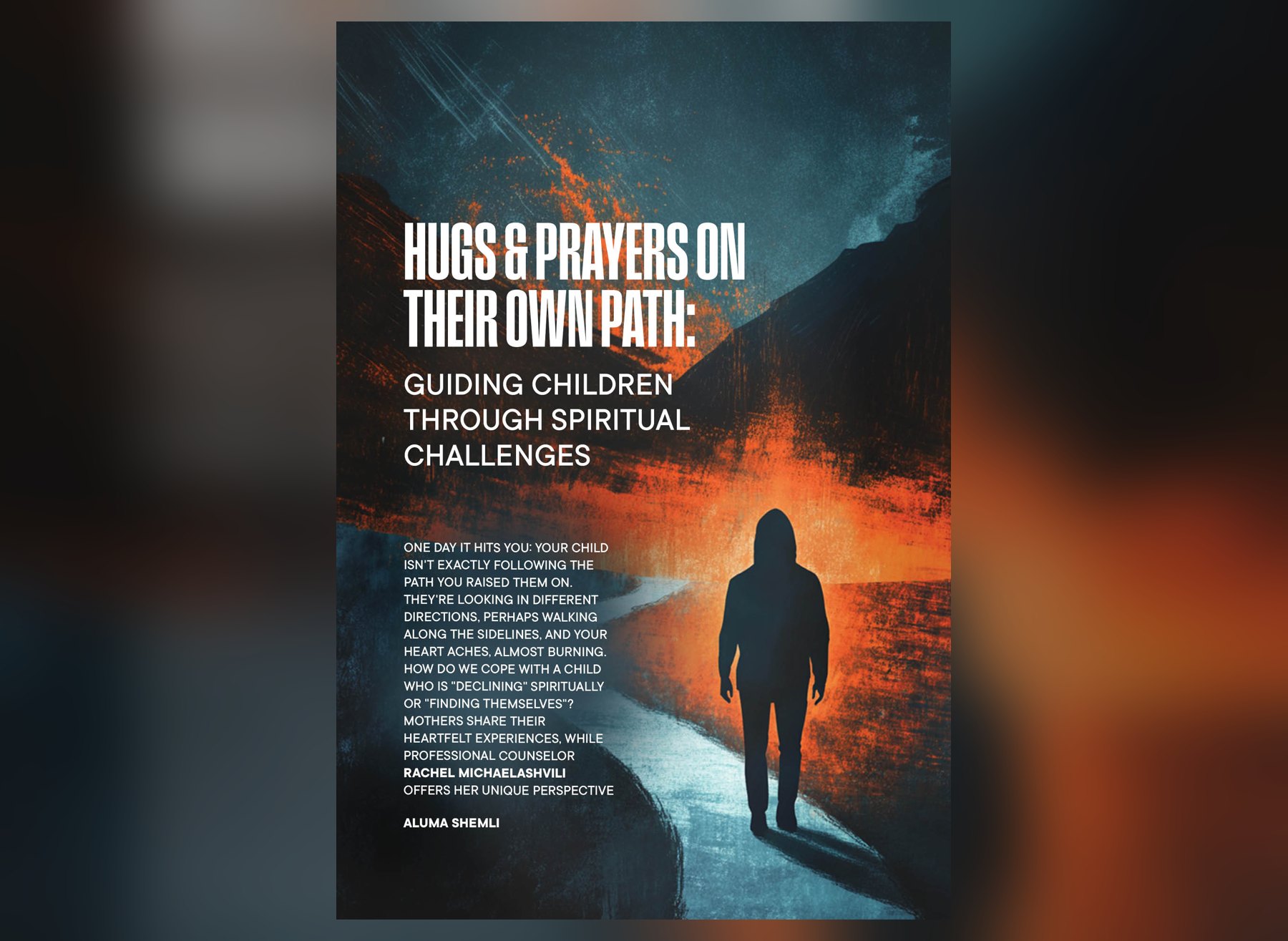
One day it hits you: your child isn’t exactly following the path you raised them on. They’re looking in different directions, perhaps walking along the sidelines, and your heart aches, almost burning. How do we cope with a child who is “declining” spiritually or “finding themselves”? Mothers share their heartfelt experiences, while professional counselor Rachel Michaelashvili offers her unique perspective
“Like every mother, I wake up the children in the morning, remind them of ‘Modeh Ani,’ get annoyed when the negel vasser water spills on its way to being poured out, and the little one crawls into it, slipping. Like every preschool teacher, I separate fighting children and patiently answer worried mothers’ questions. Plan parties and change decorations. Like every housewife, I do laundry and clean, shop and cook, take out the garbage in the middle of the night, gape at the electricity bill. But it’s all just ‘pretend,’ half of me. Because my other half is melting with worry and longing for my daughter. I have no idea where she’s wandering tonight, she has a new tattoo, the social worker called again.
“I’m searching for that pure baby, who had ‘Shir LaMaalos’ hanging over her crib, the little girl who was so excited at the Siddur party, the ten-year-old whose biggest dream was to have the Rebbe’s coin on a necklace, and I can’t find her beneath all the shells she’s wrapped herself in. I cry, feel faint, can’t sleep, but must continue the show of my life. Because I’m a mother and teacher and housewife. Not just the mother of…”
In recent years, there’s been endless discussion and awareness about children who go off the derech. People are dealing with and discussing this painful phenomenon more and more. Advice from educators and accusatory fingers pointed at the system or parents, countless ideas on how to minimize the damage and prevent the next cases.
This time, the mothers are the heroines of the article. Those righteous women who brought pure children into the world and guided them in G-d’s way with love and dedication, and now sit crying and weeping, not understanding what they did wrong. There are sleepless nights and guilt feelings flood them, as they wonder what could have been done differently.
Esther is a mother to a beautiful family with an older married son and several younger ones. Her second son chose a different path, for now; throwing behind him years of education, dedication, patience, and investment. He completely left home, barely maintains contact. She receives updates through other channels, usually unpleasant ones, from people who met him in real life or on social media, which she of course isn’t connected to.
For Chaya, it’s about her third daughter. She always had difficulty with the system and school rules, and at the beginning of high school, it came to an explosion and expulsion. Today she wanders between at-risk youth institutions willing to accept her on a trial basis until she drops out of those too.
Raising The Last Generation Of Exile
It’s not easy, but try to share with us the feeling of a mother whose precious son or daughter is off the derech.
Esther: At first you just feel shock. This is your tzaddik of a child, who would only go to sleep with a Chassidishe niggun before bed, said Tehillim with devotion and would make good hachlatos and write to the Rebbe. Is he really capable of talking in this style? Leaving the house without a yarmulka? Smoking? Then you try everything, convinced that he’s about to return and everything will be fine. If he just meets with this rabbi, gets this specific diagnosis, understands how much he’s harming himself, he’ll change. And spiritually too!

I went to the Kosel and Kever Rochel and said the entire book of Tehillim and made countless good hachlatos. It always seemed to me that soon, I too, would be sharing a story of ‘I promised and was saved.’ When nothing helps and the situation only deteriorates, there is great despair. The disappointment. Amazing dreams of a devoted Chassidishe child given to the Rebbe, of yeshiva gedola, of ‘Kevutza,’ of a Chassidishe daughter-in-law and sweet grandchildren – everything shatters into pieces that scatter everywhere. Every moment you’re stabbed anew and it doesn’t stop hurting. Every ‘Mazal Tov’ announcement about an engagement of a classmate of his, every time they talk about his ‘Kevutza year’ that he didn’t even get to reach. Every nice girl his age that you would have been happy to suggest your son to, if there was anything to suggest at all.
Chaya: First of all, pangs of conscience. Like a true Jewish mother, I first blame myself, and will always find something. If I had been more strict about washing hands by the bed, if I hadn’t forced her to keep mitzvos and made her hate them. If I had kept the mitzvos myself with more chayus, if I had given her more love. There’s no end to it. And even the other children, who thank G-d are growing up beautifully and giving us much joy, don’t extinguish this self-blame. Because I didn’t succeed in giving Mushky what she needed to grow up properly.
The second feeling is great shame. It’s not pleasant at all to be the mother of a girl who causes problems. It’s clear to me that people are gossiping, if not out loud then in their hearts. Saying to themselves: “Well, obviously, with her appearance, with their arguments, with the books they allowed in, what did they want, not to have such a daughter?” And those whom my daughter actually harmed, dragged their daughters into nonsense after her, or teachers whose lives she made bitter, I can’t even look them in the eyes, although everyone knows I didn’t agree to it and certainly didn’t encourage it.
What’s the main difficulty you deal with in daily life?
Esther: The main difficulty for me is in shalom bayis, that’s the truth. We live together in peace, until 120 G-d willing, and raise our children quite peacefully, relatively speaking. But every time an issue comes up related to our son, there are arguments. We completely disagree about how to treat him. I take a clearer and sharper line, not willing to accept certain behaviors no matter what. My husband has the approach of “love covers all transgressions” and is willing to accept him in any condition and give without conditions. Since our son left home on his own everything became a bit easier because there were fewer opportunities to argue, and still, it’s a painful topic that we don’t talk about. We bypass it and ignore it until we can’t anymore.
Chaya: I struggle with raising the children. Mushky comes home frequently, and we accept her as she is, with the pants and earrings everywhere, but it’s not easy at all. Never mind the little ones, I insist on tights, and they don’t make comparisons, but my daughters in late elementary and early high school don’t understand why I insist on a certain writing on a sweater that isn’t refined enough, when at home there’s a daughter who…
The little one whom I discover sitting next to her watching her screen. She promises it’s nonsense, but I prefer a content filter at a slightly higher level… Her comments at the Shabbos table, that she gets up from the table when her father starts reviewing the Rebbe’s sicha. I don’t know how it affects them; the day will come when I’ll have to do a damage assessment…
Strength To Carry On Life’s Journey
How do you cope? What strengthens you in difficult moments?
Esther: In a particularly difficult moment I went through with my son, a beautiful ‘vort’ came to me by divine providence. To all parents who have a child who left the path, you’re in good company. Even Avrohom had a son who strayed – Yishmael; and Yitzchok also had such a son – Eisav. Children who grew up in the best homes that ever existed and still turned out how they turned out.
I understood that this is a process that G-d destined for this child. Not necessarily something that depends only on me. That was a moment when I said to myself: “He’s already seventeen, for four years already from G-d’s perspective he’s an adult in every way and responsible for his actions. He received the best education both at home and in the yeshivos we sent him to. Now it’s in his hands. These are his choices and his struggle, and enough blaming yourself for everything.”
Since then everything is a bit calmer for me inside. I still daven for him every day and maintain contact with him, love from afar. However, I don’t take away his choice and responsibility for the consequences and load them onto myself.
Chaya: The only thing that sustains me is love. I simply love this child, no matter what. I look at her as if she has a serious illness, and this is truly one of the most unpleasant diseases of our generation, this decline. If she were physically ill, we would accept her as she is, have mercy on her and love her. Even if she were impatient, crying, angry. That’s how I love her now.
What really bothers me is society’s attitude. If she were indeed ill, G-d forbid, everyone would wrap us in loving hugs and try to give us strength. Today they only undermine us with annoying comments and incorrect accusations, especially when whoever says them hasn’t experienced anything, thank G-d.
A word to mothers in your situation?
Esther: First, relinquish all feelings of guilt. We’re not talking about a neglected or small child. You gave your son everything you could give him spiritually and physically (and your other children prove this), and even if you made mistakes sometimes, you never had bad intentions. He’s grown and making his choices. Stop blaming yourself.
Second, take care of yourself. Eat well, sleep well, exercise and do anything else that will make you more relaxed and happier. Your son himself and of course your husband and other siblings need you as a strong and calm mother, not a burned-out woman with bleary eyes. When you’re calm and happy, the whole house will be calm and happy. A good place to return to, G-d willing.

Chaya: Your daughter’s neshama was chosen to make a special and difficult journey in the world. Probably a very high soul with great powers, who is meant to face great tests and reach a special and high place. You, her dear mother, were chosen to be a partner in the journey. In you, G-d saw a faithful shliach to give her such a child, who is so not easy to raise. G-d trusted you to know how to give her love in any situation.
Pat yourself on the back, you’re among the chosen ones!”
A FEW WORDS TO A HEROIC MOTHER By Rachel Michaelashvili, Healing and Growth Mentor
Writing a few professional words to parents dealing with children who aren’t continuing on the path they were educated in is not a simple task. First of all, the spectrum is very wide. Starting with a girl who still goes to school normally, just arguing about skirt length, up to youth who have already left home and reached the most distant and dangerous places.
The parents themselves can be at different stages. Those in the midst of crisis, busy with self-flagellation, those not yet ready to part with the dream of a child who follows the path, those still in denial.
Nevertheless, there are several points that can benefit every mother wherever she is, and it’s important to raise them.
THE THIRD PARTNER
There are three partners in a person: Hashem, his father, and his mother. We, the mothers, need to always keep the third partner, Hashem before our eyes. I am committed one hundred percent to doing my part, to do everything in my power, to love, daven, try, attempt. I must take responsibility for my role, to educate and bring closer. But always remember that the third partner hasn’t left.
Everything that’s not in my hands – friends the child will meet, adults who will influence their life, those things that I know won’t be heard if I say them, and fall under the category of: it’s a mitzva not to say something that won’t be heard – here I bring in the third partner, pray to Hashem and ask that He watch over my child and be with them wherever they are.
The knowledge that I’m committed to my part one hundred percent but not alone, because I have an active and all-powerful partner – is very calming and encouraging.
There are two extremes in maternal behavior that most of us tend to reach. From one extreme – complete control. Fighting with the child, not agreeing, being the one who doesn’t give in, because “in my house they’ll behave how I was mechanech them.” From the other side, helplessness, despair. “I have nothing left to do, he does whatever he wants anyway. Everything is lost, it’s not connected to me anymore.” Both these places are incorrect, not proper. The responsible and humble place is – “I’ll do my part, and Hashem will do His part.”
THERE IS NO POINT OF NO RETURN
As a mother, I must remember and know that with Hashem there is no point of no return. In a moment of regret, of sobering up, of deciding to make a change, Hashem accepts with open arms. As soon as a person does teshuva, no matter how far they went and how much they messed up, they’re okay. With Hashem, it’s never too late.
Sometimes a mother only catches herself when the third child starts looking outward. She finally realizes she’s too critical, or not connected enough to the children, or any other thing that might have had an influence. The moment she returns, decides to make a change, Hashem accepts her with open arms and the change affects not only the coming children but also those who have already left. Every positive change a parent makes affects the children retroactively.
This is one of the miracles, one of the moving points in how Hashem deals with us. Naturally, if a person decides to save for retirement at age sixty, they’ll be told: “You remembered too late…” But in Yiddishkeit, one who puts on tefillin on their last day in the world repairs all those days he didn’t put them on. A woman who accepts upon herself the laws of family purity repairs even her children who were born not in purity, G-d forbid.
It could be that I was too critical, ruined my child’s life, and today they lack self-confidence and cannot develop. They might not have been in contact with me for years, but if I repair this place within my soul, it will affect my child’s soul too, no matter where they are and how much we’re even in contact.
Did you discover a mistake? Come to your senses? Don’t despair and never think it’s too late. Make the change within yourself, and it will affect your children wherever they are. Every spiritual elevation that parents make in any area affects their child’s soul, because parents and children are connected in an essential bond.
DIFFERENT AND COMPLEMENTARY APPROACHES
There are different ways to deal with a child who’s not on the derech and doesn’t continue the approach we educated them in at home. Parents are different, divided in their opinions, and naturally each of them chooses a different approach in their relationship with the child and their whims.
Remember that the difference between us, that we are divided in our opinions, is something that Hashem embedded in creation. And if so, this difference cannot interfere with chinuch, it cannot be an obstacle in managing the home and family life. The real obstacle is how I react to this difference between us.
Many couples feel anger and fight about how to act towards the child and hurl mutual accusations about who caused the deterioration. “It’s all because of your aggressiveness!” “It’s all because of your leniency!” The fights, arguments, lack of trust and accusations – this is what can harm the child’s chinuch. The difference itself not only doesn’t interfere, it’s even beneficial, as long as the conduct is proper and comes from an inner place focused on the child’s benefit and not the parent’s comfort.
If one parent acts with more gevura, it’s good for the child that there exists a possibility for softer and more accepting conversation in sensitive times with the other parent. When one is soft and accepting, it’s important that there be a boundary set by the other. The children themselves know that sometimes there will be a good conversation and sometimes a clear and sharp boundary. As long as the difference doesn’t cause us to fight, it’s very good for the children and their chinuch.
As a mother, even if you see that your husband’s reactions are very different, it’s important to internalize: different treatment doesn’t necessarily harm the child, the fight between you regarding that treatment will be several times worse.
Beis Moshiach #1443 • pp. 38-43
© 2026 Beis Moshiach Magazine. All rights reserved.
This article originally appeared in Beis Moshiach #1443. You are welcome to share it with friends and family by email or in print, provided that you do not change, add to or omit any part of it, you credit the author and Beis Moshiach, and you include a link to archive.bmoshiach.org (written out in full in printed copies).
To republish this article in a newspaper, magazine, book or website, please request permission in advance at [email protected].