SMAT – Chapter 36
Previously: The SMAT Team boys get together in the park for a meeting and end up saving a young boy named Shloimy from a collapsing tree. They are invited to a Seidas Hodaya at the home of Mendy’s Zeidy. They hear a fascinating story from Zeidy Chaim about Jewish life in Russia and are ready to hear more
Shmuli:
We all turned our gaze to Saba Chaim. We were all curious to hear this wise man’s answer.
“You’ve asked a good question!” said Saba Chaim congenially.
I thought that maybe Saba Chaim was starting to feel weary from so much talking but he found the strength to answer and did so, so lovingly!
“The saying is, ‘kinas sofrim tarbeh chochma,’ and it’s taken from Chazal in meseches Bava Basra.”
Saba stopped to take a sip of water and then went on.
“Jealousy is a destructive midda and it usually comes from small-mindedness, from thinking that someone else’s success diminishes us or our success, or that we don’t have the same potential as the other. Regarding this kind of jealousy it says, ‘Jealousy, desire and honor-seeking remove a person from the world.’ If we don’t remove this kind of jealousy from ourselves, it takes us out of this world, distracts us from what is really happening and causes us to have negative imaginings and feelings. But don’t worry! There is also positive envy, kinderlach! This is jealousy that gives us wings and the push to move forward, to want good things, like what happened with our holy Imahos. Do you know them?”
“I do!” said Daniel immediately and Saba turned to him and indicated that he should say what he knows.
“Sara, Rivka, Rochel and Leah, right?” asked Daniel, and he blushed.
“Right!” said Saba Chaim with a smile. “While Leah had children, Rochel remained childless. The Torah says, ‘Rochel was jealous of her sister.’ Do you know what Rashi says? Maybe your teacher will help us in the meantime while I catch my breath.”
Mendy brought a cup of tea to Saba Chaim along with a piece of honey cake while our teacher said, “Rashi says that Rochel’s jealousy wasn’t about Leah’s children, because she was happy for Leah. We know from earlier pesukim how loving they were. Rochel was jealous of Leah’s righteousness and good deeds, thinking that they were the reason Leah had children and Rochel did not.”
“Thank you,” said Saba and continued. “Jealousy of good deeds and good middos is what’s called kinas sofrim, positive jealousy which doesn’t cause bad feelings about others’ achievements but makes us want positive things for ourselves and others. It’s a jealousy that leads to wanting to improve, progress, do good.”
“Wow, Saba Chaim, thanks! I never thought of jealousy in that way before,” said Eitan, excited by the answer. It looked as though Saba had managed to encourage Eitan. We looked at Saba Chaim with real inspiration, and it seemed like we all got a better understanding of the meaning of positive envy.
Mendy motioned that it was time to go.
“Goodbye, Saba Chaim!”
We shook his hand like the adult Chassidim do in shul.
“See you soon, thank you, this was great!” Mendy said and hugged his grandfather. Saba Chaim escorted us out.
“Goodbye, kinderlach, come again.”
He waved and waited until we went down the last step.
“Mendy, I’m happy you took us to visit Saba Chaim. What a great idea!” Eitan said.
“Eitan? It’s just like when you joined the SMAT Team… Remember how it all began?”
Eitan smiled. He looked really happy and it was clear he got the message in the question.
Daniel:
When we left with the whole gang, I couldn’t hold back and I asked our teacher, “Can I ask you a question?”
“Gladly,” he said.
“How do you understand Shloimy even though he doesn’t talk?”
“Thank you for taking an interest. I see that this is important to you and that you care about my Shloimy. First of all, since he’s my son, I found a way to communicate with him. Sometimes it goes really well and sometimes I get stuck but then I look for another way to communicate. The main thing is to show lots of patience, to know that Shloimy surely wants to talk like everyone and my job as his father is to help him and give him all the tools to do so. The most important things are emuna, tefilla and regular practice.
“Usually, the family and school communicate with him through special games constructed especially for him and many other children. Often, we parents can understand him just from a look. We know him …”
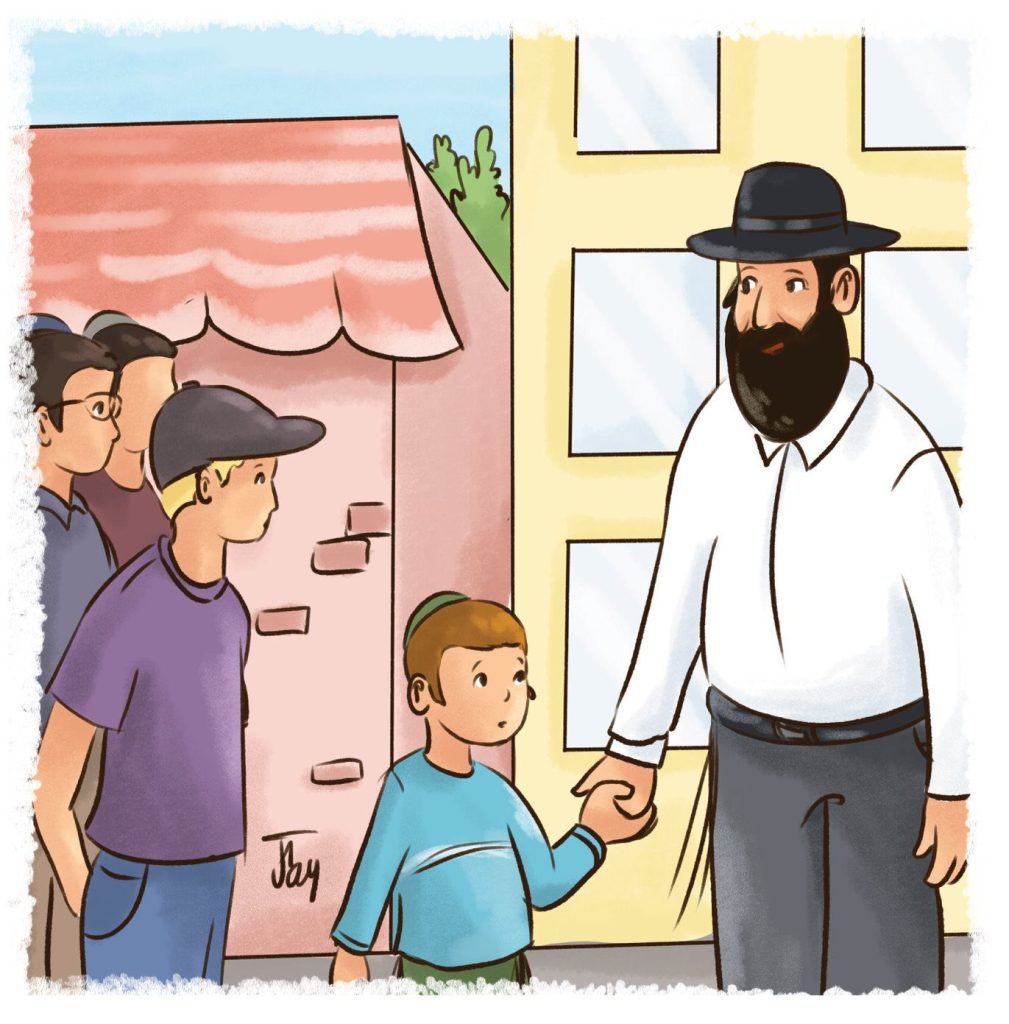
“Shloimy must be really happy you are his father!” I said, smiling. “Thank you and see you, Shloimy,” and I crossed the street toward my house.
Tanchum:
The next day, we met with Mendy, Shmuli and Avremi during recess and arranged to meet again with the whole gang at the clubhouse.
“I have an idea of how to help Shloimy,” I said to them at recess. “We need to let Daniel, Micha and Eitan know to come too.
“I’ll take care of that,” said Shmuli. We parted ways after arranging to meet at five o’clock.
I was excited about the get-together today.
“The incident with Shloimy stirred many thoughts and really got to my heart. We need to do something. The whole encounter with Shloimy and getting to know him was a string of hashgacha pratis. It must be for a reason,” I thought to myself.
I was the first to get to the clubhouse. I was ten minutes early. In the meantime, I put a bag of pretzels and a bottle of grape juice, that I brought from home, on the table, as well as small cups. Now, we will farbreng about my idea. I’m sure the others will like it, I thought.
“Hi Tanchum.”
All the guys came in together.
“Hi,” I said, pleased that they were all there.
We sat around the table. Shmuli poured the juice.
“Nu, Tanchum, tell us your idea,” said Shmuli curiously.
“Okay. Since the incident with Shloimy, I’ve been thinking a lot about how to help him. Boruch Hashem, I have an idea. Ori the MitzvaBot can help us! We’ll build a program with a game that will help Shloimy communicate. What do you think?” I asked expectantly.
Before they could react, I asked, “Shmuly, we might need help from your uncle. Do you think he would agree to help us again?
“For something like this? I think that…”
To be continued
Beis Moshiach #1443 • pp. 60-62
© 2026 Beis Moshiach Magazine. All rights reserved.
This article originally appeared in Beis Moshiach #1443. You are welcome to share it with friends and family by email or in print, provided that you do not change, add to or omit any part of it, you credit the author and Beis Moshiach, and you include a link to archive.bmoshiach.org (written out in full in printed copies).
To republish this article in a newspaper, magazine, book or website, please request permission in advance at [email protected].