Wherever You Go, I Will Go
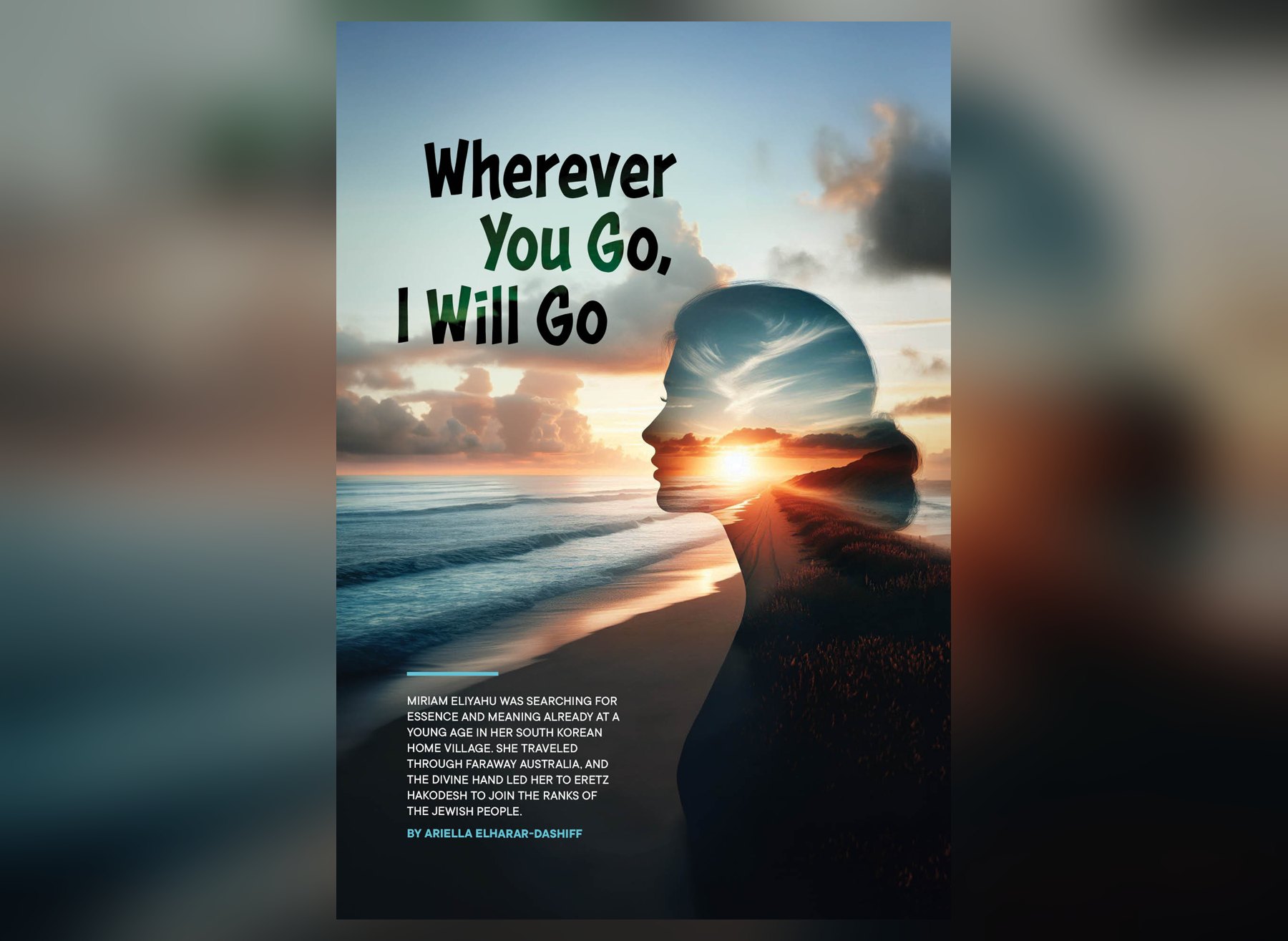
Miriam Eliyahu was searching for essence and meaning already at a young age in her South Korean home village. She traveled through faraway Australia, and the Divine hand led her to Eretz HaKodesh to join the ranks of the Jewish people
“Good morning, Ariella, how are you? Can you host some women this Shabbos?” The woman behind this message is Miriam Eliyahu, the individual in charge of hachnassas orchim in the Chabad community of Rechovot. She continues the tradition of community hospitality administered by Rebbetzin Shifra Levin, of blessed memory. Miriam, married to the shul’s gabbai, mother to Chassidic children, the eldest of whom is already married, a refined woman with a pleasant smile on her face – do I really know her? I see her in shul, but that’s it… She’s so modest, to the point that I think that I really don’t know her after all. She’s just there, a part of the human landscape. Now, as I started to write this article, I became most curious. It was clear to me that she has a unique life’s story, and I hoped that she would agree to share it with us.
Childhood And Adolescence
Maya was born in the city of Daegu, South Korea at the start of the 70’s to a simple and ordinary family – a father, a mother, and six children – a relatively large number for the Republic of Korea, and she is the youngest child. As in many places throughout the Far East, the education there was strict and competitive with aspirations for excellence. During the years of her childhood, she tried to search for the meaning of life. A wide range of religions exist in South Korea, foremost and most widespread among them are Christianity and Buddhism. The subject of religion prevails in the lives of most people only in a general way, i.e., not occupying a place of prominence. About Jews and Judaism, the average South Korean knew three general things: a) Jews are wise and intelligent people; b) Judaism was the first religion to recognize the One G-d; c) Jews have been persecuted throughout the annals of history, however, they have survived the hardships of the exile in the merit of Jewish education. For these reasons, Korea related to Judaism in a generally positive manner, although they hardly knew any Jews there.
Maya, seeking to understand “something” beyond the reality evident to the naked eye, read books and periodically investigated the issue. However, she felt as if she was groping around in the darkness. While she sensed that someone was leading her, she wasn’t certain where she was going, whether this was the right thing to believe in, and if so, why. As she prepared to finish high school, she gave up searching and decided not to waste her strength trying to understand mysteriously inexplicable things that have no great influence over her daily life in any case, and she set the matter aside.
When she was twenty-one years old, her father died. His passing was like a punch to the soul, sobering her suddenly to the clear and incisive realization that a person possesses a soul. This feeling was the deciding factor in tipping the scales towards spiritual faith, belief in G-dliness. “Even before this, I knew deep down that He existed, although I could still say to myself that the opposite was true. However, after my father’s death, I could no longer deny this clear feeling.” Yet, while she couldn’t evade the truth, it still had no practical meaning to influence her daily life.
In Search Of Inner Peace
Life continued. Maya completed her university studies with a degree in mathematics and began working as a college lecturer for young people in mathematics. She had a good job, took trips, and enjoyed her time participating in recreational activities. All in all, a seemingly pleasant and comfortable life. However, a feeling of emptiness cried out from her heart, a growing loss of meaning to life with the passage of time. As a result, Maya decided to put a hold on her routine existence and plan to continue her life elsewhere in some different and distant place – Canada. However, G-d had other ideas. Winter came, and the flight to frozen Canada soon became irrelevant. Thus, she was compelled to choose another location – Australia. This change of plans eventually led her to a connection with G-d.
The excitement and anticipation were great. A suitcase, a carry-on bag for the flight, and her heart pounding with exhilaration. After a journey lasting about ten hours, Maya landed down under in the land of the kangaroo. Australia was a new and interesting place with new people, and Maya encountered some breathtaking landscapes, and a different and fascinating way of life. However, in contrast to her expectations, the feeling of emptiness wouldn’t leave her.
With the objective of searching for new experiences, she arrived at the famous shoreline attraction, “Surfer’s Paradise”. There she met a pleasant young man, a Jew from Eretz Yisrael. When she returned to Korea, they remained in contact through correspondence and telephone conversations. Incredibly, the connection became serious. Prior to this, she had never wanted to get married and bring children into the world, but now her approach had changed. The young Israeli man, who eventually became her husband, came to visit her in Korea, and the two of them spoke about their future together. In the course of their discussions, he explained to her that in order for them to get married, she would have to convert to Judaism. While Maya didn’t have the slightest idea what ‘conversion’ was, she also clearly felt that G-d was taking her, a young and lost little girl, from her country of origin and placing her in the proper place for her – the place where her soul belongs.
Three months after his visit, she flew to Eretz Yisrael to consider the matter by getting to know up close the Holy Land and the Jewish People. She decided to go back to Korea to get organized, then return to Eretz Yisrael, and take this major step. Korea is a very homogenous country, and marriage to people from a foreign country is something quite rare. She told her mother about her plans to travel to Israel and settle there, and her mother, ever faithful to the traditional Korean restrained character, remained silent. After several days of this silence, she turned to her daughter and said: “Maya, what is Israel? I understand your desire to marry a foreigner, that’s fine. There are Americans, English, Australians – but what are Israelis? Why do you want to marry an Israeli?” Maya looked at her mother and replied: “Mom, I myself don’t know.”
A Korean Ruth
Maya came to Eretz Yisrael, began learning an unfamiliar language, and becoming familiar with the country and its direct straightforward people – with all that it implied. She lived in a house among the moshav’s cowsheds, steadily getting used to the culture that was so different from what she had known until now. Her host family accepted her warmly, doing everything in their ability to give her a home-like feeling. After about a year, she and the young Israeli man, Alon, together conquered the studies in the conversion ulpan, and thus there began a process that lasted about three years. Slowly but surely, the two realized that Jewish life demanded considerable investment and devotion. Alon felt his heart being drawn after the Torah, and he gradually started observing mitzvos, and Maya soon followed, yet in her customary style of being slightly wary and with much contemplation. Her approach was more rationalistic and hesitant, watching from the sidelines, doing it all because that’s what was necessary – and with kabalas ol. While she knew that Eretz Yisrael was her place and Am Yisrael was her people, she also felt the significance and her connection to mitzva observance. The Levinson family, the Rebbe’s shluchim in Tel Adashim, and the Magur family from Kfar Gidon brought them closer to Yiddishkeit, hosting them for Shabbos meals, devoting time for heartfelt discussions with them, setting personal examples for them on how to live a full family life with a house blessed with children, fulfilling mitzvos in joy and dedication.
The Great Day Has Come
The rabbinical court in matters of conversion invited Maya to be tested. She appeared on the appointed day after constant study and review. The judges asked her numerous questions on a variety of subjects. Detailed questions demanding considerable knowledge and intelligence. She replied to everything most astutely, however…her application was rejected. “You don’t have to become a Jewess,” the judges told her. “You can be a good person, fulfill the Seven Noahide Laws, and be connected to G-d in this manner.” Of course, they were right, but their words deeply annoyed her. “Who do you think you are,” she thought in her heart, “that you should tell me what’s good for me and what I really want?” What she didn’t know at the time was that this is exactly what the judges were waiting for: her anger and her determination… To be a Jew requires the attribute of stubbornness.
The rabbis’ rejection led her to consider the level of her will and desire in the whole process she was going through. She returned to the moshav and continued the process of learning and getting closer to Yiddishkeit, establishing new connections with pious mitzva observant Jews. Alon was already quite serious about keeping the mitzvos, and Maya realized that the time had come to reach a final decision – to make the commitment or abandon the effort. She had no desire to continue burdening the families who had invested so much in their kiruv efforts and to make the conversion process more pleasant and agreeable – without achieving the ultimate purpose. Eretz Yisrael and its people were most pleasing in her eyes. Their openness and candor gave her a feeling that she was truly at home – and yet, this was a major step! After some reservations, she decided to press forward with all her strength! To be a Jew as Hashem wants!
While she couldn’t seem to pinpoint the reason for this desire, she most definitely wanted it. Thus, she continued in her efforts to move forward despite the rejection and the difficulties. The rabbi to whom she was connected, R’ Levinson, entered the picture. When he saw the problems that they were enduring – he supported them, encouraged them, and urged them on – in cooperation with her conversion instructor, who by Divine Providence was also a Chabad Chassid.
Another year and a-half passed, and Maya again came to the Beis Din as she did on the previous occasion. This time, however, Rabbi Levinson also joined her. The rabbinical court accepted her as a Jewess, and immediately thereafter, she immersed herself in a mikva. Yet, in contrast to many others who underwent the conversion process, telling about the unique feeling of spiritual elevation, joy, and emotion, Maya, now known as Miriam, did not experience such feelings.
Jewish Life: The Struggle For Identity
The conversion went well (as did the wedding), and now real life began. “The real struggle,” Miriam said, “started after the conversion.” How do we deal with the Jewish way of life? Where is my personal character in relation to the new role I have accepted upon myself in the continuing process of Creation?
While Maya perhaps didn’t feel with a sense of true clarity the magic of the G-dly soul entering her body, she most definitely experienced the struggles with the animal soul… Since during her learning process she had already accepted upon herself the fulfillment of numerous mitzvos, getting used to wearing modest attire, eating kosher food, running a kosher kitchen, observing Shabbos and the unique mitzvos of the Jewish holidays – they didn’t constitute a truly significant challenge in her avoda. However, covering her head proved to be far more difficult, and as for wearing a sheitel, there was nothing to discuss! There was no way that she would put someone else’s hair on her head! The only other option was to wear a hat or a kerchief. In her eyes, a hat seemed more official, strange and a bit absurd. Okay, no hat; she’ll wear a tichel.
If until now she wasn’t committed to fulfilling mitzvos and observed just what was easy for her, since she had accepted chinuch with kabalas ol and obedience, now things were quite different, more serious, and obligatory. Without feeling a connection to mitzvos, it was hard for her to do something that went against her sense of inner identity. Two polar opposites within the heart struggling with one another. Sometimes, the tichel found itself on her head, sometimes she covered a part of her hair, sometimes she took it off completely. “During this period,” Miriam recalled, “I literally couldn’t look at myself in the mirror because I felt that I didn’t know the woman standing in the reflection in front of me. I was having a very hard time with all this. I didn’t know who I was.” Thank G-d, with the passage of time, some significant progress was achieved in a variety of areas. Even a sheitel no longer repelled her as it once did. However, she was still a bit hesitant. She knew the significance of what it meant to put on a sheitel: a public declaration that she is chareidi, a Lubavitcher – and she still didn’t feel that she was ready for this.
Alon’s progress in Torah observance went a little bit faster. The fire of Chassidus was already burning within him, but he went about it in a very refined way. He didn’t push, he didn’t nudge, he simply waited patiently – giving her all the time she needed.
And lo and behold, even the kashrus in the home reached a level attained by other Chassidim. During the Sukkos holiday, Alon and Miriam decided to host a community farbrengen in their sukka. The farbrengen was very uplifting. Miriam recalled the intense longing, something unique that she had never experienced before. Thus, for some reason, during the farbrengen, she felt that she did want to start putting on a sheitel. If until now she had doubts about how much she really belonged to the Chabad community and its customs, the Chassidic farbrengen aroused an inner desire and strength within her heart to be a Chassidic woman. At the end of Yom Tov, Miriam had a private discussion with one of her friends, and literally that same night, they went to buy a sheitel…
They arrived back at the house. Miriam came in wearing a sheitel, while Alon was stunned beyond belief. Deeply moved, he told her: “Now I can also start wearing a kapote and a fedora.” That was it. Miriam entered the next stage of her life – Chassidic life.
Sometime later, the Eliyahu family – Alon, Miriam, and their three children – relocated to Rechovot and continued their spiritual journey to get stronger in their Yiddishkeit.
Not long ago, Miriam was privileged to marry off her eldest daughter to a young bachur from Canada.

Miriam tells how the image of the Rebbe has a very powerful influence over her, encouraging her to reveal the spiritual strength hidden within her, enabling her to grow, to change, and to see what people don’t see. The Rebbe demands that she do what must be done without being affected by the outside world, challenging her to go beyond her physical limitations while enwrapping her with fatherly love in all her falls and disappointments. Throughout this journey, Miriam clearly saw the Rebbe accompanying her by Divine Providence and with endless love of Hashem every step of the way.
She felt that the time had come to give a little nachas back to Hashem and the Rebbe. Therefore, she chose to continue the path set by Shifra Levin a”h, and she resolved to make a connection between guests and hosts for Shabbos and Yom Tov meals in the community. Miriam felt that all the brachos she had received were in the merit of these activities and her hiskashrus to the path of her mashpiah, Rebbetzin Shifra a”h, about whom she spoke with such deep emotion. Her husband, Alon, also continued to follow the path of Rabbi Aryeh Levin a”h in his role as gabbai of the central Chabad shul in Rechovot, doing the job with unique grace and pleasure. May these activities continue in memory of their pure souls and for the Redemption of the Jewish People.
In conclusion, Miriam says that due to the tragic events endured by Am Yisrael over the past several months, she felt a deep pain in her heart while revealing anew and with even greater strength the beauty of the nation of Israel, engulfing her with feelings of great joy over being a part of the Chosen People. Miriam concludes her story with the heartfelt wish that G-d willing, we will merit the True and Complete Redemption very soon with kindness and mercy!
Beis Moshiach #1444 • pp. 40-45
© 2026 Beis Moshiach Magazine. All rights reserved.
This article originally appeared in Beis Moshiach #1444. You are welcome to share it with friends and family by email or in print, provided that you do not change, add to or omit any part of it, you credit the author and Beis Moshiach, and you include a link to archive.bmoshiach.org (written out in full in printed copies).
To republish this article in a newspaper, magazine, book or website, please request permission in advance at [email protected].