The Mashpia of Morristown & Sea Gate
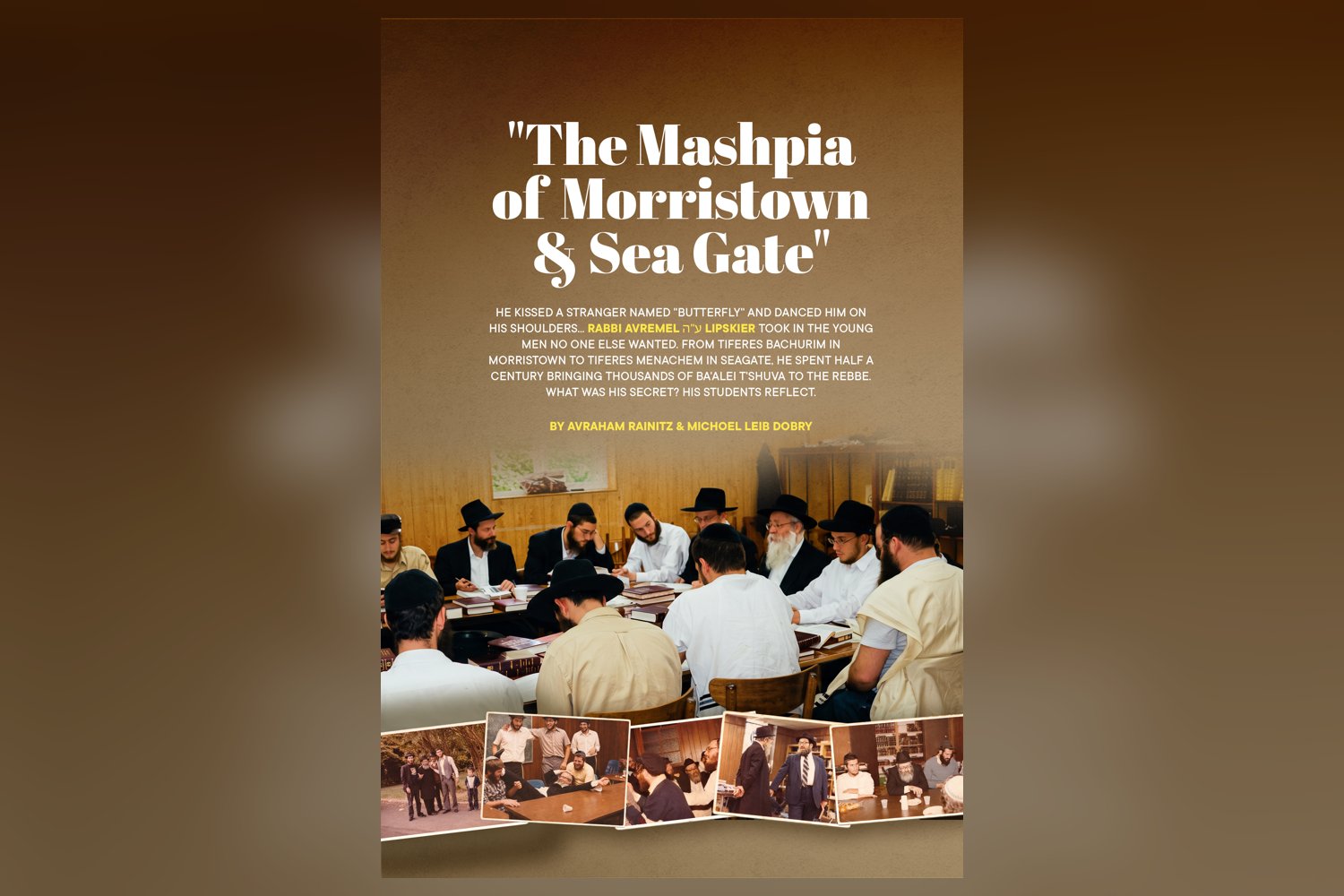
He kissed a stranger named “Butterfly” and danced him on his shoulders… Rabbi Avremel Lipskier ע”ה took in the young men no one else wanted. From Tiferes Bachurim in Morristown to Tiferes Menachem in Seagate, he spent half a century bringing thousands of ba’alei t’shuva to the Rebbe. What was his secret? His students reflect.
The Power Of A Chassidishe Farbrengen
“I still remember my first farbrengen,” said his student Rabbi Menachem Schmidt, one of the Rebbe’s shluchim in Philadelphia. “Rabbi Lipskier explained to us that the physical world is nothing but ‘shmorei ha’ofanim’, the dregs of the angels, and the true purpose is to find the sparks of holiness contained within it. That farbrengen lasted until six o’clock in the morning.”
“The true secret of success at ‘Tiferes Bachurim’ during its early years was the farbrengens of Rabbi Lipskier,” stated Rabbi Tuvia Teldon. “He knew his audience, and he knew our kelipa. If it weren’t for those farbrengens, Morristown would be just another stop along the way. He convinced us to remain and move forward.”
Dr. Lazerson considered himself to be a typical wild man. “Rabbi Lipskier conducted the farbrengens until the wee hours of the morning, and then he began to dance on the tables with boundless joy, quite often dragging me to join him. However, the farbrengens were also a time for making a cheshbon ha’nefesh. ‘Anyone can be holy in a shul,’ he would say. ‘The real test is how holy you are when no one is watching.”
“’I don’t know why you’re listening to me,’ he would say to us. ‘All I have is a hundred stories. That’s all,” recalled Rabbi Teldon.
And from all these hundred stories, he remembered one of them: Someone looking for the truth came to a palace where countless oil candles burned, one candle for each living person. The amount of oil in each candle showed how many years of living remained for that individual. When he saw his candle and how little oil was left, he secretly tried to pour oil into it from another candle. The man accompanying him grabbed his hand and said: “I thought that you came here in search of the truth…’”
“The truth isn’t always easy,” Rabbi Teldon said. “Rabbi Lipskier told this to us with all his might.
The farbrengens were not confined to the walls of the yeshiva. Rabbi Greenberg recalls a community farbrengen attended by a young couple whose attire clearly showed that they were not Torah observant. “Rabbi Lipskier got up with a bottle of ‘mashke’, jumped on the table, and said to them: ‘From now on, you’ll observe the Laws of Family Purity!’
“I said to myself: Oy vey, how will they react?!”… And then, he gave them a sweet smile, which melted their hearts. He could allow himself to do this, as his words came straight from the heart. He truly loved every bachur, and they felt this.”
“Nohr Vos Der Rebbe Zogt”
Once, at a farbrengen of bachurim in 770, one of the speakers started getting a little creative in his words. Suddenly, from the direction of the eastern wall, the voice of Rabbi Lipskier could be heard: “Nohr vos der Rebbe zogt!” [ = Only what the Rebbe says!] Everyone turned around. “Don’t start getting creative and doing everything in an interesting and amusing manner. Just tell the bachurim what the Rebbe says.” This, he truly believed with all his heart.
“He didn’t just teach me Tanya, he taught me how to learn Tanya,” said one of his students. “When people would ask him questions about what they had just learned, he would simply read the precise words from the Tanya again. While many teachers add from their own words as a means of explaining, Rabbi Lipskier showed that the Rebbe said what needs to be said, and we merely have to take notice.”
“I learned from him what is hiskashrus,” wrote another one of the early ‘Tiferes’ students. “He was a living example to someone for whom the Rebbe is the focal point of his life. I remember once a Yud-Tes Kislev farbrengen that had one main theme: If it weren’t for the Rebbe, we wouldn’t know about Moshe Rabbeinu, the Rambam, the Baal Shem Tov, or the Alter Rebbe.”
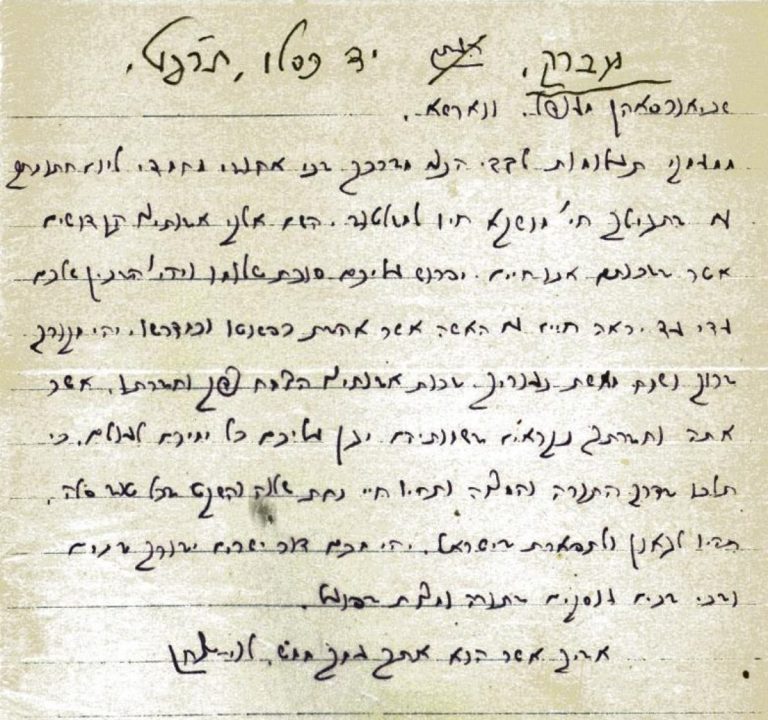
During the years when the Rebbe accepted students in ‘yechidus’ for their birthday, each one wrote a letter that included only two or three questions, and Rabbi Lipskier reviewed them beforehand.
“I don’t know why you deserve such a thing, you won’t know how to appreciate it properly,” Dr. Lazerson recalled R’ Avraham’s words preparing him for the ‘yechidus.’ “When you go in, don’t say a word unless the Rebbe asks you. Don’t sit, even if the Rebbe offers you a seat. Put a blank sheet of paper and a pencil in your pocket, and as soon as you leave, write down everything that the Rebbe said. Don’t speak with anyone, lest you forget!”
One year, all the birthday boys came in together, among them a bachur from Germany. Due to his impending return home to Germany, Rabbi Lipskier allowed him to ask twelve questions! After the yechidus, they all sat down and wrote what the Rebbe had said. “The bachur from Germany also pulled out his blank sheet of paper – however, it wasn’t blank! It was the letter he had written to the Rebbe. He had apparently given the blank sheet to the Rebbe, but the Rebbe responded to each of his twelve questions…”
When the Rebbe started farbrenging each Shabbos, Rabbi Lipskier asked whether it would be appropriate to hold a lottery to enable a different group of bachurim to come each Shabbos to the Rebbe. But the Rebbe didn’t accept the proposal, suggesting that the matter could lead to feelings of jealousy. Thus, the appropriate solution was to let anyone on any given Shabbos come to 770 if he so chose.
Rabbi Lipskier taught his students the various paths and routes to follow in life, even while they were heading somewhere. “Once I was traveling in a car alone with him on our way to a farbrengen with the Rebbe,” Dovid Lazerson recalled. “We stopped at a traffic light near a taxi, and the cabbie turned off the light over his roof, a sign that he was busy on a call. Rabbi Lipskier patted me on the shoulder: ‘Did you see that? The Baal Shem Tov teaches that everything a person sees and hears is an instruction in Avodas Hashem.” He then stroked his beard and added one of his favorite sayings: ‘Oy, Tatte zisser!’ And when I still failed to understand, he explained: This is something that a Jew can never do. Our light is always lit.’”
He also possessed that feeling of sensitivity on a single word. About fifteen years ago, Rabbi Motti Lipskier showed him the first copy of a kuntres he compiled. “In the preface, I wrote that in my next sefer, I would elaborate further. ‘Motti,’ he said to me, ‘what is this yeshus? My next sefer?’ A Jew doesn’t write that way, and he was so right. Since it came from him, it didn’t leave a bad taste in my mouth.”
Rabbi Lipskier took care of his bachurim, not just spiritually, but materially as well. He would go to considerable trouble to collect donations and raise funds for the needs of the bachurim.
“The one time that I saw my father involved with fundraising was for ‘Kupas Bachurim,’” recalled his son, Rabbi Mendel. “‘It’s so against my nature,’ he would say to me, ‘but I have to do it.’ On Erev Rosh Hashana and Erev Yom Kippur, he would walk around 770 with an envelope.” With this money, he would purchase hats and coats for the bachurim, pay their medical expenses, buy them eyeglasses, or give them matzos for Pesach. “One of the bakery employees told me that there was not enough money in the yeshiva’s coffers to pay for the matzos. So, he would pay out of his own pocket – borrowing from someone and slowly paying it back every month during the year.”
“The Rebbe Is Literally Chai V’Kayam”
In a “Beis Moshiach” interview after Gimmel Tammuz, Rabbi Lipskier was asked what draws young Jewish people to Chabad today.
“What’s the question?” he replied. “The Rebbe is literally chai v’kayam, and he works and influences us with his brachos and advice, as he did in the past, and with even greater vigor. In the past, we had a more ‘revealed’ connection, and today we are connected to ‘the essence.’ We really see numerous miracles, including through ‘Igros Kodesh’, and receive incredible answers. We see how the Rebbe is chai v’kayam. Bachurim come to the Rebbe in 770, and anyone with refined senses feels the Rebbe and the strengths he infuses us with.”
When there were those who claimed that it was hard for them to explain that the Rebbe Melech HaMoshiach is chai v’kayam, he replied: “When we learn the sichos of the Rebbe Melech HaMoshiach, we see answers to all our questions. The Rebbe gave over clear words on every subject in the world, and it’s possible to understand clearly how the reality can actually be the opposite of what appears before our physical eyes. The main point is that the Rebbe is the head, and it’s impossible to live without a head. Anyone who believes this has a real connection and receives strength from it.
“Even before Gimmel Tammuz, it was no easier to explain matters in Chassidus to a Jew coming from ‘the outside.’ I would say that now it’s even easier,” Rabbi Lipskier emphasized. “On the matter of Moshiach, the Rebbe worked from Above to below, and it’s quite easy to feel that the world is more ready, a ‘vessel’ to receive things. The point is that it’s forbidden for us to forget that the Rebbe, MH’M continues to act, today more than in the past.”
However, his words were not meant to be coercive. “The tmimim who come to us know a thing or two on matters pertaining to Moshiach,” he said. “The first avoda with them must be done with explanations and patience.” He saw the difference between generations specifically on this point: “Faith in the Rebbe is stronger and more revealed today than it was in the past. What’s amazing is that in the young people coming today, even those from a background totally distant and estranged from Yiddishkeit, their hearts beat with emuna.”
“On the matter of Moshiach, he was very strong,” recalled his son, Rabbi Mendel Lipskier. “There were those who said: In Hebrew, I write ‘Yechi’, in English, I need to write something else since they speak something else in Boro Park. With my father, if the matter is correct and it’s the truth – then it must be so. In every language, in Morristown, Boro Park, or Australia, he stood quite firmly and uncompromisingly for the truth.”
“He had an inner strength, and therefore, his influence was more internal. He didn’t need to make a lot of noise and he never looked for recognition,” said Rabbi Motti Lipskier on the evening of the ‘shloshim’ gathering held in his memory. “He would have hated the fact that people were standing here and talking about him.”
Rabbi Greenberg added that “I know that Rabbi Lipskier wouldn’t want us to speak about him. He would have preferred that we speak about Moshiach.”
In a booklet that the family printed in honor of the shloshim, the following words were inscribed on the memorial page: “He awaited the Redemption and prepared himself and his environment to greet Moshiach.”
“And if you knew Rabbi Lipskier,” wrote his student R’ Shlomo Rako at the end of his recollections, “it’s only fitting to proclaim: Yechi Adoneinu Moreinu V’Rabbeinu Melech HaMoshiach L’Olam Va’ed!
“Yankel, Will You Lift Me Up?”
“In 5756, I left the yeshiva in Morristown,” Reb Avrohom said, “and we eventually found an appropriate building in the Brooklyn neighborhood of Seagate. In Kislev 5758, we bought the building, and a new yeshiva for baalei teshuva opened. It was given the name “Tiferes Menachem.’”
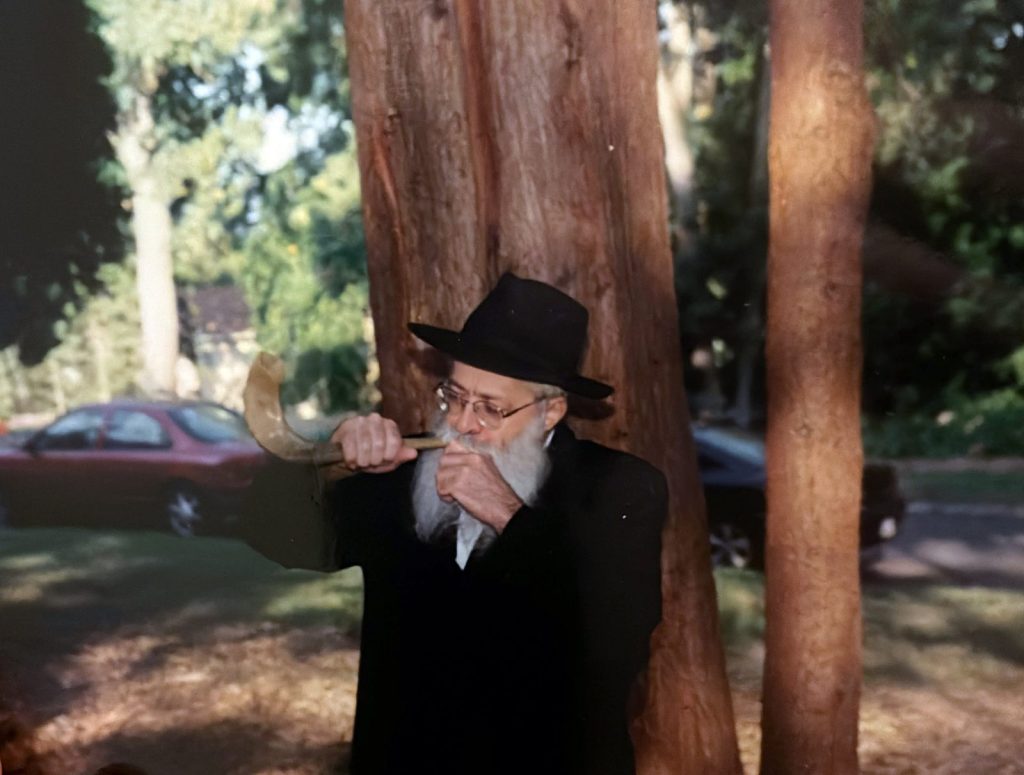
His son, Rabbi Mendel, saw this as the source of his strength: “A man of his age, who after half a century needs to start everything from the beginning, yet does it all with vitality and joy – this is something very unique.”
R’ Shmuel, one of the bachurim from Dnipropetrovsk, recalls his friend Avrasha, who came to the yeshiva almost by chance, although he didn’t intend to stay. “Rabbi Lipskier personally showed him the rooms, as if he was giving a tour to the queen of England: ‘Perhaps you’d like this room? Or maybe this one, with a porch and a view of the bay?’ Avrasha told me afterwards that at that very moment, he decided to stay.” Today, he’s a shliach.
One year on the seventeenth of Tammuz, R’ Shmuel returned from mivtzaim in Brighton Beach very disappointed. He had stood there for hours, but he put tefillin on only two people. “What do you mean? Two whole Jews put on tefillin!” Rabbi Lipskier responded and then added: “Shmuel, this is something very important. You have no idea what can come out of this.”
One winter, there was a very heavy snowfall in Seagate. “I got up early to go the mikva,” one of the students recalled. “The snow was about a foot deep, and I saw a lone set of footprints in the direction of the mikva. Of course, these were Rabbi Lipskier’s, and he had obviously arisen much earlier and came first to the mikva.”
R’ Shlomo Rako came to Seagate in 5759, and he asked if he could start davening with an Ashkenazic accent, “because I wanted to daven with the same pronunciation as the Rebbe.” With Rabbi Lipskier’s supervision, he learned the tefilla, section by section, until the weekday Shacharis took him about four hours.
Every so often, he would ask: “Am I an ‘oved’ already?” Reb Avrohom would smile and ask in reply: “Did you enjoy your davening?”
“Yes.”
“Then, you aren’t one yet.”
One morning about ten years later, R’ Shlomo quickly finished davening Shacharis in 770, looking a bit frustrated that the minyan was taking so long. Reb Avrohom noticed him and asked what had happened. “He held out his hand, shook my hand, and said: ‘Welcome to avoda,’ and then he simply continued walking.”
Rabbi Avrohom Lipskier spent his final years living in Crown Heights, his health growing progressively worse. “You were a man who embodied vitality and lebedikeit,” said his grandson Rabbi Leizer Mangel, “exactly what your health condition tried so hard to take from you. You confronted it defiantly, thereby giving the people you loved so many more years with you.”
During this past summer, on Shabbos Mevorchim Menachem Av, Rabbi Yaakov Verde made a farbrengen at a summer camp in the Catskill Mountains, and he recalled the early days of ‘Tiferes Bachurim.’
Rabbi Lipskier’s younger son, R’ Dovber, heard him, and a few days later, they arranged a video conference call between them. “It was hard for me to understand what he was saying. ‘Rabbi Lipskier,’ I said to him, ‘thank you for everything that you did for me. You made me into a Chassid, and you gave me the foundation upon which I have built my life.’
While Rabbi Lipskier’s body was broken, his mind was clear. Of course, he remembered me: ‘Ah, Yankel the mohel!’ he said happily. ‘I especially remember your farbrengens,’ I said. And then I heard his last triumphant word to me: ‘Smirnoff’s!’”
On the 28th of Elul 5786, just two days before Rosh Hashana, Rabbi Avremel Lipskier returned his soul to its Maker. “Rosh Hashana came and cancelled the rest of the ‘shiva’, then Yom Kippur, Sukkos, and Shmini Atzeres cancelled the rest of the ‘shloshim,’ said Rabbi Greenberg. “Who had time for sadness? Avremel Lipskier had none…”
At the ‘shloshim’ event held in Rabbi Lipskier’s honor, Rabbi Verde, one of the first five bachurim at the opening of ‘Tiferes Bachurim’, addressed the participants. “At our farbrengens, after we drank some Smirnoff’s, we would get up and dance. At one such farbrengen in 5733, everyone was relaxed and happy, and Rabbi Lipskier suddenly came over to me, grabbed my wispy beard, and pulled my face towards his: ‘Yankel, will you lift me up? Will you bring me out?’ I then suddenly realized that he meant a favor he wanted after 120 years, similar to a son learning and saying Kaddish in memory of his father… ‘Of course, Rabbi Lipskier,’ I said. ‘Of course.’
“And so, that night, Rabbi Lipskier’s ‘shloshim’, I said to myself: ‘I now can fulfill my promise.’ He said a short dvar Torah and then turned to his mashpia. “Rabbi Lipskier, I fulfilled my promise tonight. I said a brief dvar Torah for you, using the tools I acquired with your guidance, and with love for the Torah and Chassidus that motivates me at every moment of my life. Full circle, for me and for you.”
Beis Moshiach #1533 • 24 Kislev 5787 • כ״ד כסלו תשפ״ז • pp. 24-29
© 2026 Beis Moshiach Magazine. All rights reserved.
This article originally appeared in Beis Moshiach #1533. You are welcome to share it with friends and family by email or in print, provided that you do not change, add to or omit any part of it, you credit the author and Beis Moshiach, and you include a link to archive.bmoshiach.org (written out in full in printed copies).
To republish this article in a newspaper, magazine, book or website, please request permission in advance at [email protected].