Bubbies Discuss Bubby-hood
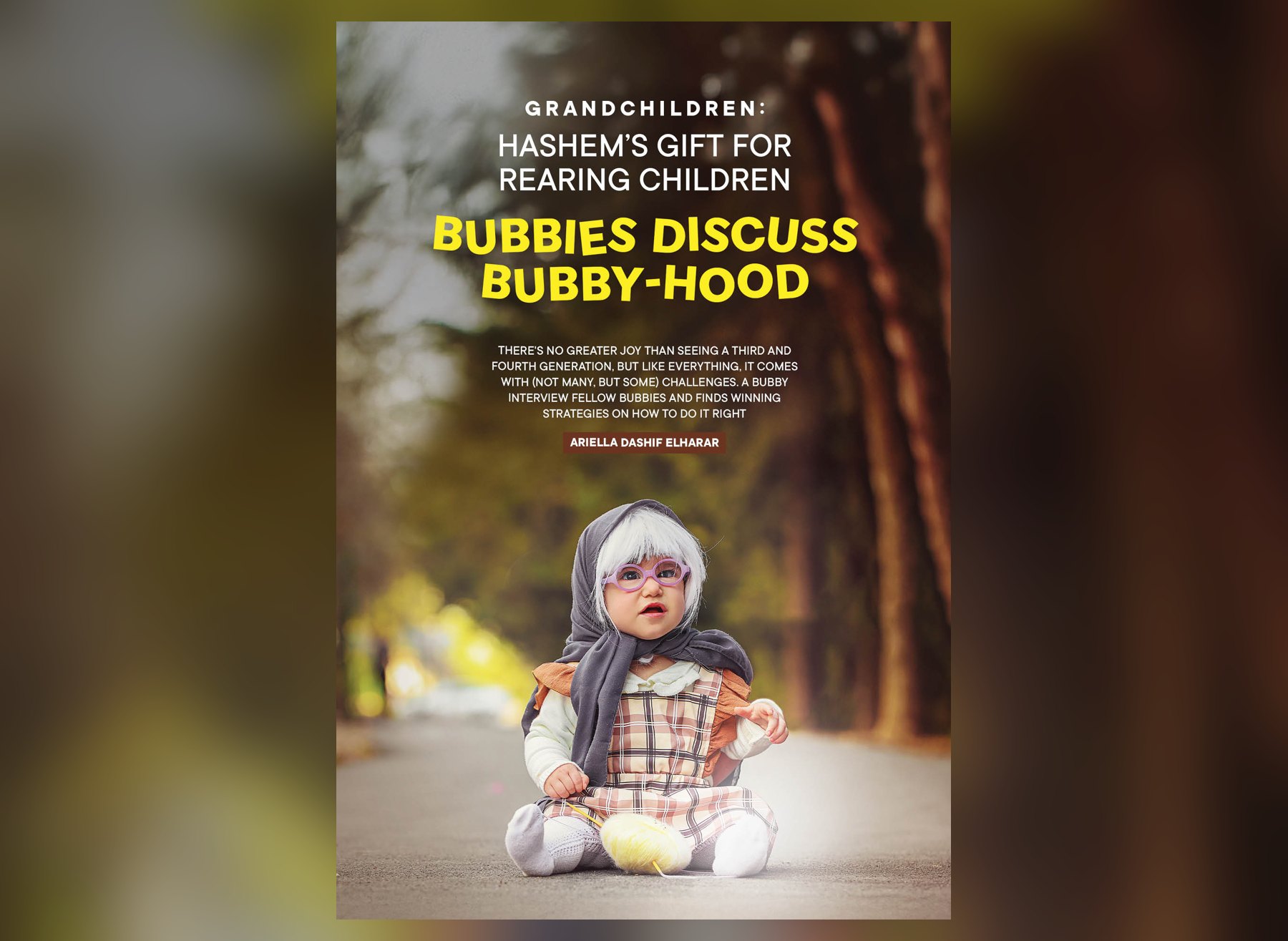
There’s no greater joy than seeing a third and fourth generation, but like everything, it comes with (not many, but some) challenges. A bubby interviews fellow bubbies and finds winning strategies on how to do it right
Being a grandmother is one of the most joyful gifts. Not only for the grandparents, but also for the grandchildren. The transmission of the mesorah is a gift that deepens the bond formed in the heart of the child to their family, nation, country, the Torah, and Hashem.
About Avrohom Avinu it says: “For I have known him, that he will command his children and his household after him, and they will keep the way of the L-rd… that the L-rd may bring upon Avrohom what He has spoken of him.” Hashem connects with Avrohom because He knows that Avrohom will pass on the emuna and the practical deeds to future generations, and that ultimately through them, Hashem’s promises will be fulfilled.
History is not a series of disconnected time segments called “generations.” History is a continuous sequence of life, creation, and a chain where each link is connected and nourished by the links before it. It has a starting point and marches toward its destiny – a destiny of goodness, purity, truth, and light. This is the role given to grandparents and their parents: “Ask your father and he will tell you, your elders and they will say to you.” This is why we are here! This is why we have been blessed with long lives in our generation.
I spoke with Ilana Yisrael, a well-known Chabad psychologist among Anash for many years, and a grandmother herself, to find out how to do this correctly… we sat down for a “grandmother chat” – a conversation between grandmothers.
A brief overview from Ilana regarding older people today shows that life expectancy is continuously rising, boruch Hashem. This phenomenon has implications for society as a whole as well as for the individual, and needs to be properly prepared for on the personal and collective level. These preparations also include medical, familial and end-of-life issues etc.
Grandmotherhood in the Age of Geula
Here are some phenomena related to grandparents in our time:
Unlike in the past, grandparents today are less available. Many grandparents continue to work for a significant time even after retirement age, so as not to cut into the assets they have accumulated and to ensure their children also benefit from them.
For the parents of the grandparents, who also reach older ages, there are complicated issues such as cognitive decline, inability to function, and various health problems. These circumstances mean that the grandparents, despite being parents themselves, also deal with taking care of the generation before them.
This situation creates a heavy load on grandparents. In the past, grandparents were responsible for looking after their grandchildren while the children’s parents were at work, and thus, they enjoyed a warm and loving home environment. Today, many grandmothers are busy with their own stuff and don’t have free time.
Ageism
According to studies, age discrimination is a common phenomenon in today’s society. While in traditional societies, older people are respected for the wisdom and experience they have gained, and for the recognition of their contributions to building a family and raising children and grandchildren, today, older individuals are often pushed to the margins of society.
The fast pace of life and rapid technological changes have created a significant gap between the abilities, way of thinking, and lifestyle of the older generation and the younger generation. Society admires youth, beauty, and the ability to handle the pressures that come with being young, and as a result, older individuals are seen as secondary to the young, which is, of course, unjust.
While aging can bring a decline in cognitive abilities and other functions, this is only partially true. It is mainly in very old age, and even then, many older adults still enjoy good cognitive and physical abilities.
Natural and modern medicine today offer effective solutions and guidance for improving the lives of older individuals. Awareness of the importance of nutrition, movement, cognitive engagement, and social contribution has increased. According to Rambam, it is indeed possible to live an active and meaningful life until old age.
According to studies conducted in Israel, about 70% of adults up to the age of 65, mostly women, continue to be part of the workforce. These facts align well with the Rebbe’s approach toward older people, which encourages involvement, activity, and living with the rest of the family, as this connection is meaningful for everyone.
Being a Grandmother in Chareidi Society
Before I continue with what Ilana has to share, I want to mention an interesting quote I saw on the “hamichlol.org.il” website (a moderated wiki-based website for ‘chareidim’): “The findings of studies… show a positive correlation between the level of religiosity in a community and longevity.” In other words, there is a statistical match between religious observance and longevity. This wonderful phenomenon is explained by Ilana Yisrael about the way of life of older people in the chareidi community: In secular society, older people are considered irrelevant because this society focuses on technological innovation, progress, youth, beauty, and economic power. In contrast, in the chareidi community, older people are valued for the wisdom of life they have acquired, for their knowledge of Torah and their observance of mitzvos, for the large families they have established, and for the fact that Hashem has blessed them with long life. The elderly do not become “irrelevant,” because they share a similar way of life with the young – a life of learning, close family relationships, shared time during Shabbos and Yom Tov, engagement in tzedaka and chessed, and earning a living according to halacha. Our advantage is that the most important knowledge for us – Torah based conduct and learning – remains relevant throughout life.
Being a Successful Grandmother
We have all experienced our dependence, as grandmothers, on the younger generation, especially in matters having to do with technology. (How, for heaven’s sake, do you work the self-checkout at the supermarket? Why does it keep beeping even after I put the scanned item on the counter? What if I want to remove one of the items from my purchase?)
But with all of that, we want to know how we can still fulfill our role and be particularly successful grandmothers. Do we have something to offer our know-it-all grandchildren, and what is the right way to give what we have to offer? Although grandmothers in our world are busy even at relatively older ages – with work, contributions to society, and personal development – grandparents have emotional and mental availability for future generations more than parents. A mother is mostly busy with work, raising children, and running the household. As time passes, the family becomes the most important thing in life (this has been proven in studies), so we want to invest in it, especially in the generation of grandchildren. There is so much joy in the relationship between grandparents and grandchildren. There is the possibility of experiencing such pure and simple love, untainted by the sensitivities that arise between parents and children.
There is not always a match between the parent’s personality and that of the child. Managing the home and children sometimes causes friction, complaints from children about parents, and vice versa. So, there is a new opportunity that arises in this type of relationship – providing love and commitment in a much simpler and emotionally enabling way.
Managing a Fruitful Relationship
It turns out that this love is very powerful. It has the strength to give children a sense of belonging to the Torah and to Jewish values.
How do we manage such a relationship and maintain good relations in the grandparent-child-grandchild triangle?
Children often need to build their independence, and they do not want us to intervene too much in their lives. It is important for them to maintain the boundaries of the new nuclear family they have created. Therefore, as grandparents, we need to be very careful not to express opinions that contradict our children’s views in front of the grandchildren. We need a lot of sensitivity to build a relationship where the children will see the grandparents as partners and not as interfering, critical, or potentially spoiling things.
Grandparents who know their place understand that they are not the direct educators of the grandchildren. They do not set the household rules and would do well to respect the parents’ authority with the grandchildren. This is a very important point. Even if something bothers me a lot, I will need to respect it.
Additionally, when visiting the daughter or son’s home, one should be particularly sensitive toward the daughter-in-law or son-in-law and what might disturb them.
The main problems begin when there is a disagreement about values. For example, grandparents who comment on their children’s unhealthy food choices…
Indeed, there are also instances, quite frequent, where the situation is the opposite: the grandparents want to spoil the children with chocolate and sweets, and the parents are the ones who oppose it. In such cases, the grandmother should think creatively about what she can give instead of sweets or what delicious foods she can offer that are approved by the parents.
If we truly want to maintain good relations and ensure that the grandchildren continue to have a relationship with us, we must be very careful. This is a point that needs to be front-and-center: Without a good relationship with the parents, there cannot be a good relationship with the grandchildren. And if the parents feel that the grandparents are a negative influence on the grandchildren, they will block the relationship from taking place.
It’s also important to mention the issue of grandchildren’s names. There are often expectations to name a newborn after a close relative, etc., but the younger generation chooses names as they see fit. We need to learn to let go of expectations and conduct ourselves with lots of humility.
It may create a feeling in the grandparents that they are being pushed aside. They may feel that they are not given enough space, or that they are not trusted.
The younger generation feels they know better about everything, and sometimes, honestly, they do. They have many sources of knowledge and experts they can consult who know more than we do. I’ll give an example. I always remember the hurt I felt as a mother and grandmother when no one asked me anything about nursing or baby care. Today, there is a lactation consultant in the clinic, and there are WhatsApp groups for new mothers. And the same applies in so many areas. We need to accept this, reconcile with it, and not get upset about it. Everything depends on how I choose to approach the situation.
If we continue with the example I gave – the lactation consultant has seen many mothers and encountered many different situations that I have not experienced. Indeed, she has more knowledge; it’s not that anyone is against us. We need to allow them to take charge, show interest, and learn from it.
Then what is the role of the grandmother?
The grandmother is much less needed for practical advice in these areas. Our children know how to manage without our advice. Our place is the emotional one: the embrace, the listening ear, and the love that no one else in the world can provide. They feel it, and they are very happy with every visit from the grandparents.
All of this is true if the grandparents are good and nurturing people who do not come with criticism or with the goal of ‘educating.’ If we want to impart education to this generation, it must be indirect, in the stories of tzaddikim that we tell them, in the memories of our lives that they begin to find interesting at some point. Many of us today have a personal story of teshuva which is good for them to hear because, in their eyes, the secular world seems free, magical, and wonderful – but all of this must be initiated by them. In my work in the clinic, I meet grandmothers who become very critical and “give a hard time.” From a grandmother like that the grandchildren will only want to run away.
Of course, a good relationship can give the parents a break, and this is a wonderful opportunity to offer the grandchildren what cannot be given at other times.
Indeed, we can offer fun times, moments filled with values, from a place of closeness and joy. But boundaries are also necessary… How do we create them?
Each grandmother has the right to set the rules in her home. At my house, no one jumps on the couch, even if the mother allows it at her home. You don’t open the fridge without permission. And it’s right to ask this of the daughter or daughter-in-law. In any case, when the mother comes with four or five toddlers, it’s not always easy to control this. However, we can certainly ask the parents to help clean up the house before leaving.
And what happens if requests are made and it doesn’t help?
We need to talk about it. Not in anger, but to sit down and have a conversation. I remember a sicha by the Rebbe where he spoke about the great virtue of raising large families with many children; how bringing souls down to this world brings the coming of Moshiach closer. He went on to talk about an additional advantage for parents – when they are older and find it difficult to host, they can visit their children for Shabbos, one time to this daughter and another time to that son. In my eyes, this is great wisdom – knowing how to agree to be hosted. When hosting children, there’s barely time left for the grandchildren because one is busy hosting. But when being hosted, not only is it possible, but the daughter or daughter-in-law is happy that the grandchildren are occupied while they are free to prepare the meal or rest a bit.
What is the value of grandparents in children’s eyes?
It very much depends on who the grandfather or grandmother is, but generally there is admiration for them. It’s a source of pride for the child, especially if they are well-known and important figures in the community – a grandmother who is an educator or does chessed, a grandfather who is an elderly Chassid. Just having a grandfather with a mobility scooter who gives his grandchildren rides is already a source of pride! Beyond all this, the most important thing is that grandchildren see their grandfather or grandmother as people who love them unconditionally. Here they don’t need to be good students, or wake up early, or obey all the accepted rules at home. Parents have many expectations that grandparents don’t have.
There they are working on chinuch for life, here it’s like a vacation…
We care less about whether they excel or are talented in one way or another. We look at that less and simply enjoy them. It happens, for example, that during adolescence, a child finds in their grandfather or grandmother someone to share things that are difficult to talk about with their parents. One needs to be very sensitive in such cases, and in coordination with the parents. Tell the parents what the child is going through, and in other cases, coordinate expectations with them.
There are cases where grandchildren might even complain about their parents. You can listen, perhaps try to show the grandchildren the positive side of their parents or the situation, and consider whether to tell the parents or not. Generally, if you identify a problem or difficulty the child is going through, it’s better to talk gently with your daughter or son, not with your daughter-in-law or son-in-law. It happens that grandchildren in adolescence find refuge in their grandparents’ home because they feel they aren’t being judged there. It’s much easier for grandparents to embrace their grandchildren than for parents who feel that the teenager has betrayed the path they instilled in them.
This is a very delicate situation. Grandparents can help by explaining to parents that it’s not their fault, and that there are teenagers who want to experience their independence, and many return later to their family’s core values. And even if they don’t, they’ve continued their lives as positive people who have built good families.
What about mother-in-law and daughter-in-law relationships?
A phenomenon I’ve encountered many times is that the daughter-in-law’s family receives more attention and more visits than the daughter’s family. This is an existing phenomenon, it’s natural, and one must be careful not to be hurt by it. And even more, to enjoy the visits when they do come, to rejoice in them and invest in them to strengthen the relationship. So you see, I’ve learned that even at this stage of life, as a grandmother to grandchildren, the keys to success are humility and giving.
May we have it easy and enjoyable to continue the derech Yisrael… Savta.
I did not have the privilege of getting to know my grandfathers and grandmothers from either side. I only heard stories about them from my late parents, who were Holocaust survivors. Not only to preserve their memories but, more so, to provide our children and grandchildren a picture of the families that they came from.
My parents were born between the two World Wars, about one hundred years ago. There was extreme poverty at the time due to the Depression, and many suffered from deprivation and hunger, especially in Poland and the small shtetlach like the one my father grew up in. He would go to Talmud Torah hungry and remain hungry until he came home. A sandwich or any other food? Unheard of! When he came home, he would get a slice of homemade bread, and a little later a meager supper. He had a Polish friend who once invited him to his house, and pleaded with him to eat a sandwich. “Don’t worry,” he said knowing that my father kept kosher, “nobody is watching! Nobody will know that you ate it!”
My father pointed his finger up to heaven and said, “But G-d sees.”
This story was performed by some of my grandchildren, under my direction, at a family gathering in honor of my father’s yahrtzeit. My intention was to memorialize and inform, as well as build a powerful connection to the Jewish pride and inner strength of the family. Grandparents have a lot more power than they often realize…
Beis Moshiach #1454 • pp. 46-51
© 2026 Beis Moshiach Magazine. All rights reserved.
This article originally appeared in Beis Moshiach #1454. You are welcome to share it with friends and family by email or in print, provided that you do not change, add to or omit any part of it, you credit the author and Beis Moshiach, and you include a link to archive.bmoshiach.org (written out in full in printed copies).
To republish this article in a newspaper, magazine, book or website, please request permission in advance at [email protected].