The Haunted House (2)
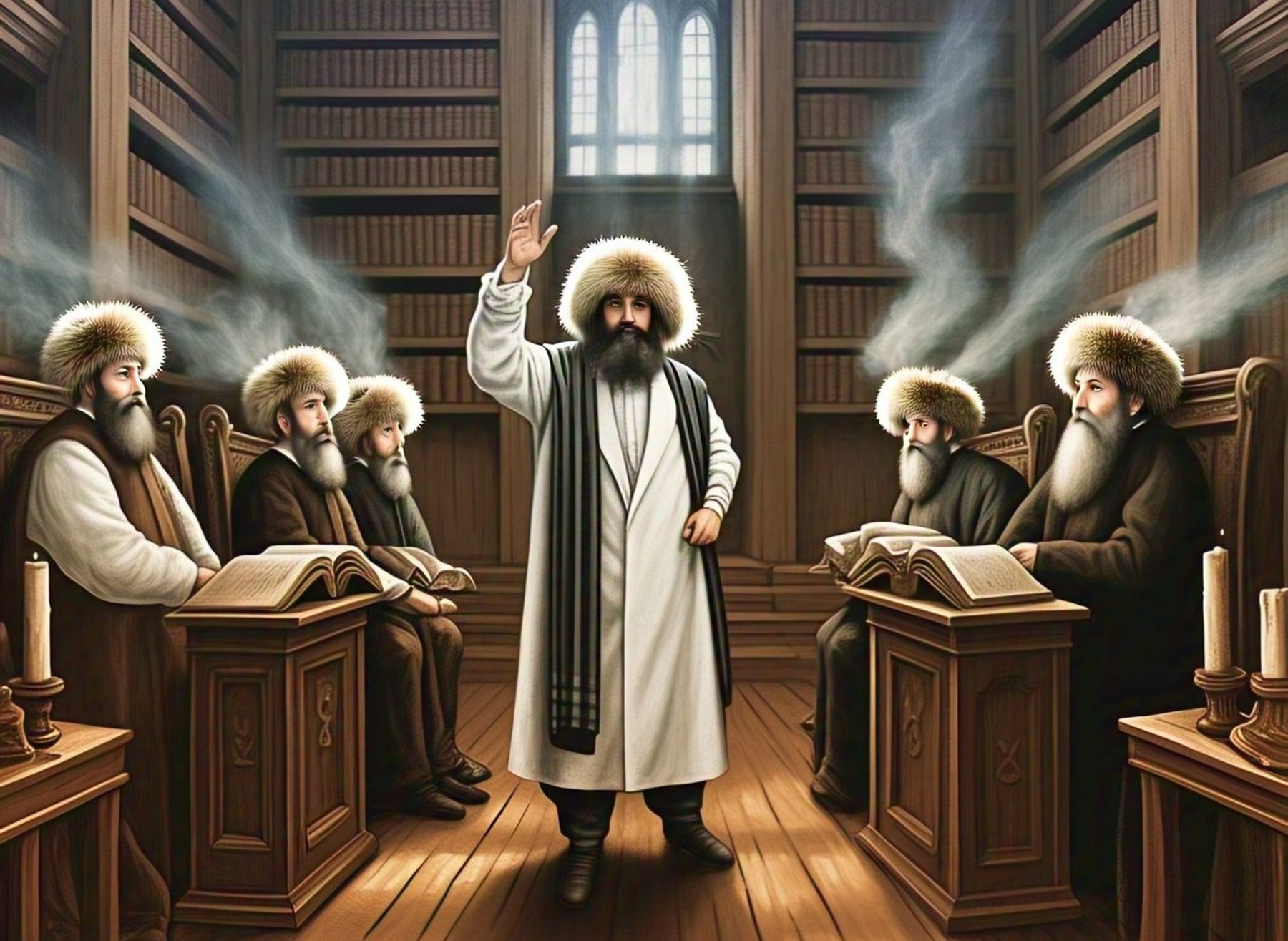
Previously: Reb Baruch Batlan follows R’ Yoel Baal Shem’s Advice and the evil spirits leave the haunted house left by Reb Tuvia the goldsmith and his wife when it becomes a Beis Medrash…
From the TzaddikStory.org collection
However, they’d left behind a terrible smell and a thick, dark smoke, filling the air. One of the men held his nose. “Do you smell that? It’s like… something dead is burning.”
The other nodded, waving a hand to clear the smoke. “It’s the Ruchos. Even now that they’re gone, they won’t let go so easily.”
Without another word, they took their seats, opened the holy sefarim, and began learning, the sound of Torah filling the air.
With each word, each Pasuk, the smoke cleared a little more, and the smell began to go away, as if the darkness itself was being pushed out. The room grew lighter, warmer, until at last, the smoke and smell was gone, and the air was clear.
The place was finally at peace. Success!
* * *
The miracle was the talk of the town; everyone in Posen had heard the story – even the governor and the bishop whispered about it. No one could deny that Reb Yoel Baal Shem’s plan had worked. Yet, there were those who tried.
A group of Yidden who opposed Reb Yoel Baal Shem, seeing his ways as too kabbalistic and “against the true Torah,” wanted nothing to do with him. Even though the miracle was undeniable, they worried this would make Reb Yoel more popular in Posen, and the thought of that bothered them.
“No, this had nothing to do with Reb Yoel Baal Shem!” proclaimed R’ Shloima Moshe loudly one afternoon, waving a hand as he spoke to a group of followers. R’ Shloima Moshe was known as a lamdan, a learned man, and a famous leader in Posen. He’d even lived with R’ Avigdor Tuvya for a time, but left due to the “strange sounds at night.”
“I’m telling you,” he continued, “it was just min ha’shamayim, Hashem’s will! And besides, once they made a Beis Medrash there, the Torah itself would chase out anything tumadik – no need for some famous mekubal to work wonders and miracles. It’s simple, straightforward stuff! I could have told you the same thing myself!”
A murmur went through the crowd, some nodding in agreement, others whispering to each other.
“So you think the Torah alone did this…?” asked one of the younger men, thinking deeply. “No special merits from Reb Yoel? No miracles?”
“Exactly,” R’ Shloima Moshe declared, raising his voice a bit. “No miracles here – just Torah! Reb Yoel is getting credit, even though there’s no proof he was even a part of it.”
But not everyone was convinced. Reb Yaakov, an elderly man known for his wisdom, shook his head thoughtfully. “But tell me, R’ Shloima Moshe,” he said, leaning in, “who brought the Sifrei Torah into that cursed place? Who was brave enough to enter, knowing the danger? That minyan must have been pretty sure they’d be safe…”
R’ Shloima Moshe waved him off. “Nonsense, Reb Yaakov! HaKadosh Baruch Hu protected them, no doubt, but Reb Yoel Baal Shem? Anyone could have done it, and anyone could have given them that advice. He’s not special.”
Reb Yaakov let out a small laugh. “Perhaps, R’ Shloima Moshe. But it seems Hashem’s protection follows those who live with such strong Emuna, don’t you think?”
With this new idea circulating, the town of Posen was buzzing with debate. Was Reb Yoel Baal Shem the true cause of the miracle, or was it just a simple blessing from Hashem in the merit of the new Beis Medrash? The people were torn, some clinging to R’ Shloima Moshe’s words, while others felt that Reb Yoel Baal Shem, a true Tzaddik, had made all the difference.
The question of who was responsible for the miracle became the biggest mystery in Posen.
* * *
It didn’t take long for a new chapter of the story to unfold. Problems had returned to R’ Avigdor Tuvya’s house – the grand mansion, now serving as the Beis Medrash. Six weeks had passed since the Beis Medrash opened, and while everyone thought the Ruchos had left for good, it seemed they had simply found a new place to hide: the dark cellar basement beneath the house, where firewood was stored.
One evening, while everyone was deep in learning, the scary sounds returned – creaks, groans, even whispers – coming up through the floorboards. One of the men looked down, nervously. “Did you hear that…?” he whispered to his friend.
“I thought the Ruchos were gone… but it sounds like they’ve come back.”
The Rosh HaKahal, after reviewing the contract and discovering the cellar wasn’t specifically included, rushed to the old owner. He returned soon after with a signed document in hand, a smile on his face.
“It’s done. We have ownership of the cellar now,” he announced confidently. But as night fell, the noises continued. Each creak seemed louder, each whisper sharper. “What’s going on – why won’t they leave?”
For R’ Shloima Moshe, the ongoing problems were perfect fuel. “See?” he told a group gathered around him. “Reb Yoel’s plan didn’t even work! This is all just nonsense! A miracle? Ha! If this was a miracle, the Ruchos would have stayed away.”
One of the younger men scratched his head. “But if it’s nonsense, what’s causing the noises?”
“Simple!” R’ Shloima Moshe scoffed. “It’s just creaky old floorboards, nothing more. It’s been turned into a bubbeh mayseh, I tell you!”
Meanwhile, Reb Yoel’s followers grew uneasy. “We can’t let them talk about our Rebbe like that,” one of them whispered to Reb Boruch. “That’s not kavod, respectful! We have to bring Reb Yoel here to Posen. Let them see his holiness firsthand!”
Reb Boruch thought, rubbing his beard thoughtfully. “And what if the Misnagdim get upset…?”
“We can’t worry about that,” his friend insisted. “This is about the truth!”
But when R’ Shloima Moshe heard about the plan, he flew into a rage. “What?! A Baal Shem? Coming here, NOW, to Posen?!” he roared, his face red. “Absolutely not! I will not allow this! No. No. No. Yiddishkeit has nothing to do with all this kabbalah nonsense. We are men of Torah, not magicians!” He slammed his fist down, making the table shake.
One of his followers, wide-eyed, leaned in. “But what if… what if the Ruchos are real?” he whispered.
R’ Shloima Moshe waved him off with a snort. “Nonsense! We don’t believe in such things! This is all madness.”
Still, word spread quickly, and tension was in the air. Reb Yoel’s followers were divided, whispering among themselves. “Maybe it’s not the right time. Maybe bringing Reb Yoel to Posen won’t be good for his kavod after all.”
The once-united community was now deeply split, unsure what would happen next or who to believe.
* * *
Now, in addition to being a Lamdan, R’ Shloima Moshe was also a businessman, trading in animal skins and leathers. He stored many of these skins in the cellar beneath the Beis Medrash – it was almost a matter of smug pride, refusing to fear the rumors of the spirits. He thought it was an empty space, like any other. When a merchant came by to pick up a shipment, R’ Shloima Moshe didn’t think twice.
“Menashe,” he called to his son, “take the merchant to the house, down to the cellar, and fetch the furs.”
Menashe nodded, and, with the merchant following, made his way to the empty building. As they reached the cellar door, Menashe pulled out a large iron key and turned it in the lock, the door creaking as it swung open.
“It’s down here,” Menashe said, motioning for the merchant to follow. They stepped inside, the air thick and hard to breathe. But as they walked, a strange shape caught Menashe’s eye.
“What is… that?” he whispered, squinting.
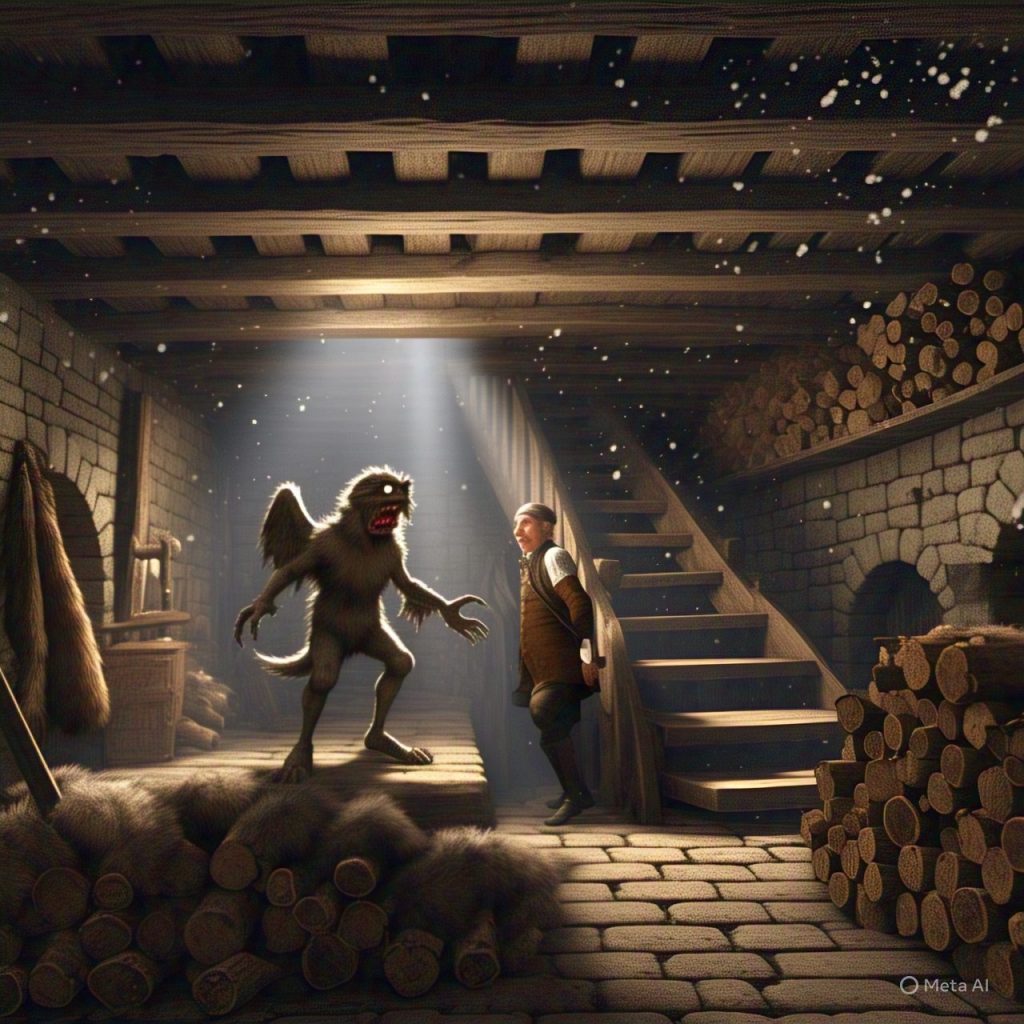
There, hiding in the shadows, was something small. It looked like a child—but it wasn’t. Its feet scraped against the ground in a strange way.
The merchant’s hands shook. “W-what is that?” he whispered.
Before Menashe could answer, the thing moved. It had wings. A kind of a furry tail. It stretched, its body shifting in a way that didn’t look right. Then, a deep sound came from its throat—not a growl, not a scream, but something in between.
It opened its mouth. A long, red tongue rolled out. Sharp teeth flashed. Then, a terrible noise filled the air, like a roar mixed with a laugh. The shadows around them seemed to grow.
And then—it jumped.
Menashe and the merchant screamed at the top of their lungs and scrambled up the steps, tripping and pushing each other to escape.
They burst out of the cellar and into the courtyard, where both collapsed, fainting on the ground. It took a long time and a bucket of water to revive them and hear what happened.
When they finally came to, it was clear they were no longer the same. The merchant stared ahead, his mouth moving, but no words came out. He had lost his ability to speak, his voice stolen by the insanity he’d witnessed. And Menashe – Menashe was far worse. He flicked his eyes around like an animal in a cage, and he was skittish and jumpy and strange.
Days passed, and Menashe’s behavior grew violent. He lashed out, hitting anyone who came near. Eventually, R’ Shloima Moshe had no choice but to have his son’s arms tied to his sides to keep him from hurting others.
The town was shaken. R’ Shloima Moshe, once so confident, had nothing left to say. He sat in silence, the proud look gone from his face.
One of the townspeople, shaking his head, whispered to his friend, “So, he didn’t believe in the Ruchos, did he?”
The friend nodded. “Correct. He didn’t. But he does now.”
Soon, everyone in town went silent about Reb Yoel’s visit. There were no more whispers of bubbeh maysehs. The story of Menashe and the merchant spread quickly, each retelling making the tale more extraordinary.
To be continued
Beis Moshiach #1458 • pp. 56-59
© 2026 Beis Moshiach Magazine. All rights reserved.
This article originally appeared in Beis Moshiach #1458. You are welcome to share it with friends and family by email or in print, provided that you do not change, add to or omit any part of it, you credit the author and Beis Moshiach, and you include a link to archive.bmoshiach.org (written out in full in printed copies).
To republish this article in a newspaper, magazine, book or website, please request permission in advance at [email protected].